CURRICULUM
Curriculum may be considered as blue print of an educational programme. It is
the base of an education on which the teaching learning process is planned
implemented.
The term curriculum is a Latin word “currere” which means run which are taken
to reach goal.
It direct the teaching learning experience of nursing educational programme
DEFINITION
“Curriculum is a tool in the hand of an artist to mould his material, according to
his ideals in his studio.”
Cunningham
CONCEPT OF CURRICULUM
It is dynamic as the changes that occur in the society
In a narrow sense , it is viewed merely as listing of subjects to be taught in
school
In a broad sense , it refers to the total experiences of individuals not only in
schools but in society as well
Systematic group of courses or sequence of subject required for graduation or
certification in a major field of study
A general overall plan of the content or specific material of instruction that the
college should offer the student by way of qualifying him for graduation
A body of prescribed educative experiences under the supervision of an
educational institute , designed to provide an individual with the best possible
training and experience to fit him for society of which he lies as a part or to
quality him for a trade or profession
Nature of curriculum
Curriculum as objectives
Curriculum as subject matter
Curriculum as student experience
Curriculum as opportunity for the student
Dynamic and flexible
Societal orientation
Oriented to life situation
Positive attitude towards the need of learners
Ideal and realistic approach
Depends upon the philosophy and objectives
NATURE OF NURSING CURRICULUM
Health oriented
Flexible to meet the changing health needs of the society
Influenced by the developments in other health care professions
Influenced by transnational trends in nursing education and nursing service
Influenced by the policy decisions based on national health policy
Determinants and Foundation of curriculum planning
The development of curriculum depend on,
1) Philosophy
2) Sociology
3) Psychology
4) Scientific determinants
5) Environmental determinants
6) Historical determinants
Philosophical determinants
It aims at the all round development of the individual
It is based on the philosophy of nation
It reflects the ideals and aspiration of the people
It inculcates the desired ideals of life in youngsters
It helps in develop in personal and national character
It enables the learners to learn the desirable cultural values , intellectual
virtues , social norms , and moral doctrine
Sociological determinants
Core values and needs of society
Changing values of the people
Demands of modernization
Good family life , ways of life
Faith , beliefs , and attitude of the people
Economic efficiency
Cultural , political factors
Knowledge , attitude , belief
Psychological determinants
Knowledge of the learner and learning process and condition facilitate
optimum learning
Intelligent , development capacities
Interest of the learner
Curriculum should be child centred , learning experience should be provided
in accordance with the mental development of learner
Scientific determinants
Environmental determinants
Pollution
Earthquake
Ozone layer depletion
Historical determinants
Country historical background
Culture
Tradition
PURPOSES OF CURRICULUM
Synthesis of subject and life
Harmony between individual and activity
Development of democratic values
Satisfaction of student need
Realization of values
Development of knowledge and enhancement in knowledge
Creation of a conductive environment
PRINCIPLES OF CURRICULUM DEVELOPMENT
Conservative principle (present and past)
Forward looking principle (children of today's are tomorrows citizen)
Creative principle
Principle of totality form (should develop curriculum for entire time)
Activity principle (develop on the basis of experience and activities)
Principle of preparation for life
Principle of connecting to life (provide good life experience)
Child centered curriculum
Principle of integration and correlation (previous year curriculum)
Principle of comprehensiveness and balance (economy ,relationship occupation)
Principle of loyalties (faith towards family , society, institution)
Principle of flexibility and variety
Principle of connecting to community needs (address the community needs)
Principle of connecting with social life (adjust life in the democratic city)
Training of leisure
Principle of character building
Principle of core or common subjects
Principle of all round development of body , mind and spirit
Principle of dignity of labor (positive attitude towards job)
PRINCIPLES RELATED TO DEVELOPMENT OF NURSING CURRICULUM
Nursing curriculum should equip the students with the essential knowledge , skills and
attitude. So that they can full fill their duties and responsibilities during the upcoming
professional life.
The expected result of the curriculum should be made clear to the students as well as the
teacher. Since the modern nurse educator is considered as a facilitator of learning this
principle deserve special attention
Curriculum developments should consider the community needs with special emphasis to
the health needs, life style and cultural background of people, health services available and
changes in the health pattern of the community
As nursing students are living under the influence of media and modern lifestyles , special
measures has to be formulated in the curriculum for inculcating right attitude in them
Posting to the concerned clinical area should be preceded by adequate
coverage of the related theory. Curriculum should offer adequate teaching
learning activities in the classroom , clinical areas and community settings
Curriculum development has to consider the guidelines laid down by the
statutory bodies like nursing council , universities , examination boards
Curriculum development should give due importance to high-tech – high touch
approach in the nursing care. This will helps to maintain the human component of
nursing in the midst of technological advancements in patient care.
Curriculum should allow a participatory approach in the teaching learning
process where students are mainly responsible for their learning and teacher
assumes the role of facilitator of learning
The learning environment should closely resemble the life situation where the
nurses will perform on being qualified from the educational program.
LEVEL OF CURRICULUM PLANING
1) Societal curriculum
2) Institutional Curriculum
3) Instructional curriculum
TYPES OF CURRICULUM
Hidden curriculum (implied by the structure and nature of institution eg:
completion of class )
Null curriculum
Subject centered curriculum (traditional method)
Child centered curriculum( consider student need, interest , intelligence)
Activity centered curriculum
Core curriculum
Legitimate curriculum
Illegitimate curriculum
COMPONENT OF NURSING CURRICULUM
a) The statement of philosophy of educational programme
b) The statement of the objectives of educational programme
c) Total duration of educational programme
d) Detailed course plan
e) Programme of evaluation such as type of examinations, internal assessment
FACTORS INFLUENCING CURRICULUM DEVELOPMENT
Philosophy of nursing education (bring behavioral changes)
Educational Psychology ( teaching learning activities)
Society ( health needs of the society)
Student (meet the needs of the students without neglecting the patient rights)
Knowledge explosion and scientific advancement (possess knowledge from various
discipline , learn recent scientific advancement r/t nsg care )
Technological advancement in patient care ( high tech high touch approach)
Educational technology (Use of educational technology )
Transnational career opportunities (English and geriatric nursing)
 Resources ( teachers , textbook , physical facilities )
STEPS IN CURRICULUM DEVELOPMENT
According to Raph Tyler
1) Formulation of educational objectives
2) Selection of learning experiences
3) Effective and efficient organization of learning experience
4) Evaluation of the curriculum
1) Formulation of educational objectives
“Educational objective is a specific statement of what the learners should
be able to do at the end of the learning period that they could not do before.”
Harper and Harper
Data Required For Formulating Educational Objectives
Philosophical statement of institute
Social and health needs of the society
Resources available in the society
Entry criteria level of the students
Specification of positions to be held by the student on the completion of the
programme like staff nurse, nursing tutor etc
Future trends in nursing
Criteria for the selection and statement of objectives
Objectives should not too detailed
Objectives have to be so worded that each statement contains only a single
objective
Objective should be cooperatively planned and developed by all teachers and
student
Objective should be easily accepted and understood by teachers and as well as
students
Objective selected should be worth while
The objective should be attainable and practicable in the specific teaching learning
situation
The objectives for the subject , lessons, unit should be direct contribution to
attain overall objectives of the curriculum
Step In Formulation of Educational Objectives
1) Identify the needs of the learner
2) Identify the needs of the society
3) Study the suggestions of experts
4) Formulate philosophy
5) State the objectives gathered from various sources in a proper way
6) Formulate the theory of learning
7) Screen the objective through educational philosophy , educational psychology
and select the appropriate one
8) Define the objectives clearly in terms of content
9) State the educational objectives in terms of behavioral outcomes or change
Type Of Objectives
1) General objectives : They are the summarises of the learning outcomes of
teaching learning process and express the generalized behaviour expected to the
student.
2) Specific objectives :Also known as instructional objectives, it tells what the student
will be able to do at the end of a learning period that he would not before head.
3) Central objectives : Also known as institutional objectives. It correspond to the
aim of an particular educational programme. A course objective may be central
objective. It is usually broad , comprehensive and clear
Level of educational objectives
1)At National level : Policy statement of what
education should achieve for nation.
2)At Institutional level : This is intermediate objectives.
They are narrow to achieve local needs like the kind
of certificate to be awarded by the institution.
3) At Instructional level : They are specifically
intended learning outcomes. These should
be expressed in behavioural terms.
Advantages of Educational objectives
Educational objectives fill the communication gap
(teacher and examiner)
Educational objectives enhance a learners
involvement in the learning process (understand
essential topic ,new knowledge, creative thinking,
nursing care)
Educational objective enhances the teaching
ability of nursing educator
Educational objective equip the examine to
measure learning achievements (evaluation)
SPECIFIC OUTCOME OF LEARNING (SOL)
It reflect the changes that have take
place in the individuals knowledge , skill , and
attitude as a result of the learning process.
Specific out comes of learning are ,
Subject based : Knowledge , comprehension,
and ability to apply knowledge in different
situation
Personal outcomes : Interpersonal skills and
interpersonal qualities
Characteristics of SOL/ Qualities Of
Educational Objectives
Feasible (Possible , it is achievable by using
resources)
Observable (evaluate)
Relevant (relevant to educational objectives)
Measurable
Explicit (clear)
BLOOMS TAXONOMY OF EDUCATIONAL
OBJECTIVES
It was initially publish in 1956 under the
leadership of American academic and educational
expert Dr. Benjamin S Bloom .
In this taxonomy Blooms divide educational
objectives into 3 domains . They are,
Cognitive Domain
Affective Domain
Psychomotor domain
1)Cognitive Domain :
The cognitive domain involves those
objective that deal with the development of
intellectual abilities and skills. They have to
do with the mental abilities of the brain.
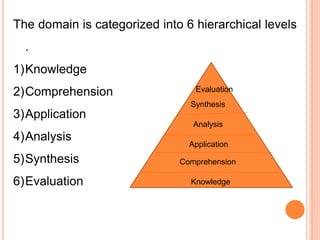
The domain is categorized into 6 hierarchical levels
.
1)Knowledge
2)Comprehension
3)Application
4)Analysis
5)Synthesis
6)Evaluation Knowledge
Comprehension
Application
Analysis
Synthesis
Evaluation
1)Knowledge or Memory:
It is the first and lowest and the foundation for the
development of cognitive skills.
It involve the reorganization or recall of previous
learned information.
Knowledge is remembering or retrieving previously
learned material.
Action verb which used in cognitive domain are ,
Define , state, list, name ,write , recall, select ,
measure , describe, identify.
Example : Define immunity
State the step of curriculum
Describe the healing process
2) Comprehension or Understanding
It is the ability to construct or grasp meaning
from material.
It is on the basis that what is stored in the
brain can be translated interpreted and
extrapolated.
Action verb which used in this domain are ,
Identify , justify , select , indicate , represent ,
illustrate , formulate , explain , classify, translate
Example :
Explain the role of pulse polio in
eradicating poliomyelitis
3) Application
This is the ability to use learned material
such as rules , principle, concept to new and
real situation.
The learning outcome in this area require a
higher level of understanding
Action verb which used in this domain are ,
Select , assess , explain , choose , find ,
show , demonstrate, construct , perform ,
discover , produce , relate
Example : Demonstrate correct use of pulse
oxymeter
ANALYSIS
This refers to the breakdown information into
component parts , which may be elements of
information relationship between elements or
organization and structure of information.
Learning outcome here represent a higher intellectual
level than the comprehension and application.
Action verb which used in this domain are ,
Analyse , identify , conclude , differentiate ,
select , separate , compare , justify , criticise ,
distinguish
Example : Distinguish between marasmus
and kwashiorkor
SYNTHESIS
At this level learner is expected
to combine various part to form a new whole.
Action verb which used in this domain are ,
Restate , summarize , discuss , select ,
conclude , create ,plan , derives
Example : Derives a solution for the hospital
waste problem
Summarize the impact of
consumer protection act
EVALUATION
The level is concerned with the ability to
judge the value of material for a given purpose.
Judgement are based on different criteria.
Action verb which used in this domain are ,
Judge , evaluate , determine , recognise ,
support , compare , justify
Example : Compare and contrast any two
definitions of education
AFFECTIVE DOMAIN
The affective domain consist of 5 level of
objectives. It is mainly related to feelings , emotions ,
attitudes, motivations , beliefs.
In other words it is related to development of
adjustments of students by bringing a changes in
interest , attitude and values.
1) Receiving
2) Responding
3) Valuing
4) Organization
5) Characterization
Receiving : This is the lowest level of learning outcome. It
means attending. It is the learners willingness to attend to a
particular stimulus or his being sensitive to the existence of a
given problem condition or a situation. The learner is
sensitized to the existence of certain phenomena that is he or
she is willing to receive or attend to them.
Action verbs used : Ask , choose , select , replies
Example : Ask right question by honouring the
dignity of the patient during history collection.
Listen others with respect
Responding :
Here the learners respond to the event by
participating.
Attends and react to a particular phenomenon.
Active participation on the part of learners
Action verbs used : answers , assists, discuss
, help , label, practices , presents, reads,
recites, reports , selects, tells , writes
Example: Participate in group discussion
Assists the patient in carrying out
activities of daily living
Valuing
Objectives at this level indicate acceptance and
internalization of the values or attitudes.
The learner acts out these in everyday life in a
consistent way
Action verbs used : initiates , invites , joins ,
justifies
Example : Initiates the building of
interpersonal relationship with the patient
during clinical posting hours
Organization
The learner will encounter the situation in
which more than one values is relevant
This level is concerned with the ability to
organize value and arrange them in
appropriate order
Action verbs used : arrange , combine , modifies
Example : Combines various interactions skills to
nurture interpersonal relationship with patient
Characterization
Highest level and having attained this level
the learner has an internalized value system
which has become their philosophy of life
Action verbs used : display , discriminate , listen
Example : displays confident while caring patient
with MI
PSYCHOMOTOR DOMAIN
It consist of 7 levels,
Perception
Set
Guided response
Mechanism
Complex and response
Adaptation
Origination
1)Perception
Basic level concerned with perception of sensory
cues that guide actions and ranges from
awareness of stimuli to translation into action
Action verb : choose , differentiates,
distinguishes , identifies , detects
Example : Detects the early sign of cancer
2)Set
This is concerned with the cognitive , affective and
psychomotor readiness to act
Action verb :begins , moves , react shows , starts
Example : React promptly to emergency situations
during trauma care settings
3)Guided response
These objects refer to the early stages in skill acquisition
where the skill are performed following demonstration by
the teacher.
Action verbs : carries out, makes , performs, calculates
Example : Perform bed making correctly as demonstrated
by teacher
4) Mechanism
The performance has become habitual, but the movements
are not so complex as the next higher level
Action verb : Same as level 3
Example : Calculate the volume of fluid required in the 1st
day for a patient admitted with 60% burns and weighing 50kg
5)Complex overt response
This level typifies the skilled performance and
involves economy of effort , smoothness of action,
accuracy, and efficiency etc
Action verbs : Same as level 3
Example : Perform endotracheal tube
intubation correctly
Adaptation
Skills are internalized to such an extent that
the students can adapt them to cater for
special circumstances
Action verbs : adapts ,alters , modifies,
Example : Modifies sterilization technique
according to the articles to be sterilized.
Origination
This is the highest level and concerns the
origination of new movement patterns to suit
particular circumstances.
Action verbs :composes, creates, designs,
originates
Example : Design a splint to restrain the
forearm of ac child who is on IV infusion
MODELS OF CURRICULUM
Models of curriculum helps to understand
the nature of curriculum
Behavioural Objective ( Product model)
Stenhouses process model
Lawtons cultural analysis model
Beatties four fold model
Taba model
The Leyton soto model
Oliva model
Wheelers Model
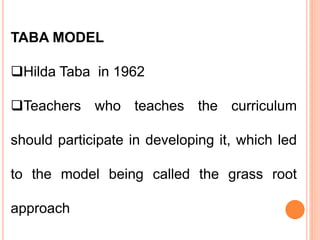
TABA MODEL
Hilda Taba in 1962
Teachers who teaches the curriculum
should participate in developing it, which led
to the model being called the grass root
approach
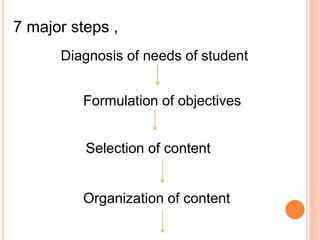
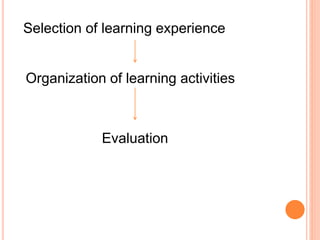
7 major steps ,
Diagnosis of needs of student
Formulation of objectives
Selection of content
Organization of content
Selection of learning experience
Organization of learning activities
Evaluation
The Leyton soto model
It mainly contain 3 factors
1)3 basic elements : Philosophy , psychology
and source
2)3 basic processes : Selection , organization
and evaluation
3) 3 fundamental concept : Objectives ,
activities , and experiences
Oliva model
According to Oliva the curriculum should be
simple , comprehensive and systematic.
It mainly consist of 12 components
1)Philosophical formulation , target , mission and
vision of the institution
2)Analysis of the needs of the community where
the college is located
3 and 4 ) General purpose and special purpose
of curriculum
5) Organizing the design and implement
curriculum
6 and 7) Describe the curriculum in the form
of the form of the formulation of general
objectives and specific learning
8) Define the learning strategy
9) Preliminary studies on possible strategies
or assessment techniques to be used
10) Implement the learning strategy
11and 12) Evaluation of learning experience
and curriculum
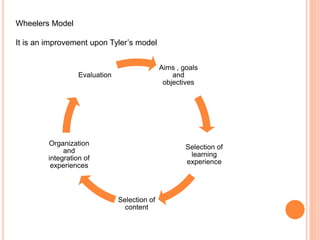
Wheelers Model
It is an improvement upon Tyler’s model
Aims , goals
and
objectives
Selection of
learning
experience
Selection of
content
Organization
and
integration of
experiences
Evaluation
2) Selection of learning experience
Learning experience is defined as deliberately
planned experiences in selected situations
where the students actively participate ,
interact and which result in desirable changes
of behaviour in the students.
Characteristics of Good Learning Experience
Learning experience should allow the students
to learn by doing
Create motivation and interest among students
Should be challenging to students
Should brings multiple outcomes
Help the students to acquire needed
knowledge , skill and attitude
Helpful in gathering information
Helpful attaining the educational objectives
PRINCIPLES
Should be in relation to the selected objectives
Should be in relation to those real life situation
where the students are expected to practice after
being qualified
Selection should be made in a manner that
there is an effective integration between theory
and practice
The same learning experience will result in
several outcomes and several learning
experience may bring out the same outcome
Learning should be selected in a such a way
that learners are constantly motivated
Learning experience should be planned and
organized
Learning is enhanced by utilizing a wide
variety of teaching learning methods
Students will learn effectively , if the
experience are satisfactory to them
Learning experience should consider the
students ability to undergo the desired changes
in behaviour
Learning experience selected should be
according to the need of student and every
students should be given similar learning
experience
Should provide same or equal chances for all
students
Criteria for selection of learning experience
It should be consistent with philosophy of
institution and attain objective
Should be varied and flexible enough
Should be so selected.
Provide sufficient opportunity for self activity of
students
Provide opportunity for the development of
independent thinking and decision making ,
judgement , self discipline
Learning experience are arranged in a
manner that provides continuity, correlation and
integration of theory and practice and clinical
learning experience
Learning experience are planned and
evaluated cooperatively by the teacher and
student
Learning experiences are selected and
arranged to give appropriate emphasis and
weightage according to the importance of
content.
Level of learning experience
1) Direct experience : Immediate sensory contact
with the actual object. The learner have the
opportunity to see, handle, taste , touch, felt and
smelled. It give first hand information
Eg : Lab practice and demonstration
2) Vicarious experience : Create the actual
situation through rearrangement of the reality.
Eg : Model , specimen, film , radio , pictures ,
record , photograph
3) Symbolic experience : They are offered
through verbal symbols( oral / written)
3)ORGANIZATION OF LEARNING EXPERIENCE
According to Tyler the primary aim of organization of
learning experience is to bring and relate various
learning experiences together to produce the
maximum cumulative effect in order to give a unified
view of the whole so that the educational objectives
are achieved.
Continuity , sequence and integration has to
be followed while organizing learning
experiences
Learning experience have to be vertically and
horizontally organized.
Principles
Learning experience has to be so organized
Learning experience should utilize the
allotted time in cost effective manner
Provide sample opportunity for the student to
concentrate and relate the various activities in
different areas of learning. So that the required
ability and skills are easily attained
Organization of learning experience in the
curriculum should be neither too flexible nor too
rigid
Clinical experience and assignment should be
valued on the basis of experience provided to
students
.
Learning experience have to be organized in
such a way that the student is able to practice
professional nursing for next few years.
Elements
1) Grouping of learning experiences
After selecting the learning experiences , we
have to organize them
2)Preparation of master plan for rotation
Overall plan of rotation of all students in a
particular educational programme. Showing the
placement of students belonging to the total
programme including both theory and practical
denoting the study block, clinical block,
examination vacation etc.
Preparation of master plan will guide the
teachers in the placement of subject matter and
clinical experience.
It is prepared well in advance for whole year,
so it gives a complete and clear picture about
student placement either in theory or practical
field during an academic session
For each year it can be prepared separately
and for a total program one can be prepared .
So that every faculty will be aware of students
posting
Teacher should follow the respective
university as a guideline for preparing either
master rotation or clinical rotation
Purposes of master rotation plan
Availability of an advance plan before
implementation of curricular activities during an
academic year for the entire program
All concerned are aware of the placement of
students in clinical field
Coordination are more effective
Helps the students and teachers to prepare
themselves for working in the areas
Assessment of curriculum programme are
more effective
Principles
Plan is accordance with the concerned
curriculum plan/syllabus for the entire
course/programme
Plan in advance for all students in all years of
programme
Plan the activities by following maxims of
teaching
Post the students based on university
syllabus and availability of concerned required
specialities
Select areas that can provide expected
learning experience
Plan to build on previous experience
Provide each clinical experience of same
duration to all the students
Overlapping must be avoided
Master plan explains the following :
Total duration of the program
Explanation of different course of study with
special reference to theory and practical's
Total allotted hours in terms of theory and
practical for each course
Teaching learning method
Scheme of evaluation
Details of student activities like co curricular
activities , health check up , vacation etc
Responsibility of teaching staff
Correlate theory and practice
Participate in teaching , supervision and
evaluation
Prepare the student in theory block before
they enter in clinical block
Maintain adequate and regular attendance at
both the classroom and clinical areas
Report the principal or concerned person for
any changes or modifications
Domain of educational objectives should be
followed
Steps in construction of master rotation plan
Before making master rotation plan list down
theory and practical hours prescribed for each
subject by INC
Week available per year are 52 weeks
1 block = 4 weeks , so divide rotation plan into
13 blocks
Depending on the strength of the student and
clinical areas divide the students into groups.
Example for strength of 60 students , we can
divide into 6 groups. Each group has 10
students. 5 in morning and evening
Align groups vertically and blocks horizontally
On horizontal axis mark 52 weeks and 13
blocks
Enter summer and winter vacation ,
examination as prescribed by INC
Plan how to divide classes and clinical area ,
whether in partial or complete block
1 week = 40 hours ie, Monday – Friday (7*5) and
Saturday 5 hours , so total 40 hours
Accordingly divided into classes and clinical
area , different colour and codes can be used to
depict various area
Make key indicating areas and hours allotted
3) Placement of learning experiences in the
total curriculum
All elements of the curriculum should be related
to one another
Learning experience should be so organized
Follow the principle of sequence , integration
and correlation will help to organize the learning
experience in an effective manner
Eg: OBG nursing should place in the 4th year
4) Preparation of correlation chart
It gives a portrayal of the extent of correlation
achieved in the total curriculum in relation to the
different courses of study and the various
subjects and clinical experience offered in the
programme
5) Organization of clinical experience
It is done on the basis of syllabus and
regulations laid down by the statutory bodies
like INC and universities
Organization of the clinical experience is the
responsibility of the faculty
Clinical experience related to each course
should be planned according to the objectives
Preparing clinical rotation plan will help in
providing clinical experience to the students in
an effective manner
Definition :
It is the statement which explain the order of the
clinical posting of various group of nursing
students belonging to different classes in
relevant clinical areas and community health
settings as per the requirement laid down by the
statutory bodies .
Factors influencing clinical rotation plan
1)Requirement stated by the statutory bodies
2)The objective of the course
3)The number of the students
4)Infrastructure of various clinical area
5)Duration of experience in each area
6)Nurse educator available for supervision
Principles
Clinical rotation plan must be made in
accordance with the master plan of the
curriculum
The rotation plan must be made in advance
with the cooperation of all the faculty members
involved in the clinical teaching
Maxims of teaching should follow while
selecting the areas of experience
Principle of continuity , sequence and
integration should be followed to the maximum
extent possible
Enough teaching staff should be made
available in the clinical areas for giving proper
instructions to the students
Seeking suggestions from nursing staff
working in the clinical area will ensure their
cooperation
First year students should receive maximum
supervision and attention
All students should get enough experience as
per the clinical rotation plan
All assignment related to clinical area should be
finished before the completion of the postings
Overcrowding in the clinical area with the
different group of student is not advisable
6) TEACHING SYSTEM
Complete block or theory block system
Partial block system
Study day system (In between one day
for theory classes)
4) EVALUATION OF CURRICULUM
It involve the assessment of ,
Philosophy of the institution
Programme goals of the institution
Nursing content taught in each course
Course objectives
Teaching learning methods
Course evaluation methods
Principles
It should consist of finding out to what extent
the objectives are being achieved
Objectives for evaluation should be in terms
of behaviour or the reactions to be measured
and also in terms of content which is being
planned through which the behaviour is to
operate
Techniques and methods used in evaluation
should be on the basis of specific behaviours
expected and measured
Evaluation program should include a variety of
evaluation tool or instruments
The decision on whether the student has had
adequate experience in a given area should be
in terms of excellence of performance and nit in
terms of time spent
Record of clinical practice should reflect the
objective of practice and give evidence of the
extent to which the students have achieved the
objectives
In curriculum evaluation 5 M are done
1)Men
2)Money
3)Materials
4)Methods
5)Minutes
CURRICULUM REVISION/CHANGING THE
CURRICULUM
The main approaches in curriculum revision are
addition, deletion and reorganization
Addition : New elements are added to the existing
curriculum
Deletion : Some elements are deleted to modify the
curriculum
Reorganisation : Nothing is added or deleted
only restructuring of the existing curriculum is
done.
STAGES OF CURRICULUM REVISION
COURSE PLAN
Course planning means - planning the course of
instructions in curriculum
Course : A building block of a programme
consisting of time limited component, usually
over one term ( 3 months) , 6 months or 1 year
usually ending with a summative evaluation
Definition
It is defined as a process of planning the
entire content of the programme which has
to be done before the commencement of
course.
PURPOSE
To ensure autonomy
It supports the curriculum process
It secure future progress
It brings about improvements
It promotes utilization of resources
LEVELS OF COURSE PLANNING
University level
Institutional level
Instructional level
PRINCIPLES
State the objectives in behavioural terms
Establish sequence by following maxims of
teaching
Ensure logical and psychological continuity
Principle of integration
The course should give adequate weight age
to the core curriculum content/9nursing
sciences)
Select learning approaches that are
acceptable to all faculty member like problem
solving and problem based learning.
Provide variety in modes of learning
ELEMENTS OF COURSE PLAN
Course description
Behavioural objectives
Placement of the course by specifying the
level of learner
Explain time allotted
In case of courses associated with field
experience like community health nursing ,
details of field experience
Organize the content into unit wise or lesson
plan wise
Details of the resource material and teaching
learning methods to be followed
Details of learning activities for students
References for teachers and students
Details of formative and summative
evaluation , ratio between internal assessment
and university examinations
PROCESS
1) Determine the course content
2) Develop the teaching method and tools
3) Determine how will evaluate the students
learning
4) Select text and other materials
5) Define course policies
6) Develop the course schedule
7)Write the course syllabus
8) Refine the course design (delete
unwanted items)
TEACHERS ROLE IN COURSE PLANNING
The teacher will plan course individually , will
vary from institution to institution
Teacher should select materials and learning
activities according to the level of student
Teacher should formulate the objectives prior
to planning
Teacher should possess the knowledge
adequately
Teacher should be efficient in preparing course
plan
The teacher plan should focus on the general
objective of the course , unit plan and class plan
Teacher should have the skills related to the
area that they are teaching
UNIT PLAN
The planning of the unit is known as unit plan.
DEFINITION
Organizing material for instructional purpose which
utilizes significant subject matter content , involves
pupils in learning activities through active participation
intellectually and physically and modifies the pupils
behaviour to the extent that he is able to cope with
new problem.
UNIT PLAN CONSIST OF ,
Vision
Unit content in detail
Time allocated for the completion of each
stage
Pre and post tests
CHARACTERISTICS
Organize various learning activities or
experience around a central problem or purpose
Units should be suitable to the needs,
capabilities and interests of the students
Provision for a variety of learning experiences
like clinical postings, theory class , field trips
Contribute to the development of students by
providing new experiences
It should deal with a sizable topic , so that the
length of the unit can be kept within limits
It should provide opportunity for creative
experiences
It should emerged out of the students past
experience and should lead to broader interests
It should allow the utilization of various
resources like textbooks , journals
ELEMENTS OF UNIT PLAN
Statement of objectives
Content
Organization of content
Time allotment
Teaching and learning activities
Methods of evaluation
Reference
TYPES OF UNIT PLAN
1)Resource unit
2)Teaching unit
STEPS IN UNIT PLANNING
Content analysis by means of terms, concept,
principles, laws, conclusion etc
Objectives with specification can be realised
through the content analysis
Learning activities : Individual differences and
psychology of the pupil will be considered in
choosing learning activities
Testing procedures : Type of evaluation tools
and techniques
LESSON PLAN
Lesson plan is a plan prepared by a teacher to
teach a lesson in an organized manner
It is a plan of action for understanding the teachers
part about the students , knowledge and expertise
about the topic being taught and her ability to use
effective methods
Definition
Lesson plan is actually a plan of action. It
include the working philosophy of the teacher,
her knowledge of philosophy her information
about and understanding of her pupils , her
comprehension of the objectives of education ,
her knowledge of the material to be taught and
her ability to utilize effective method.
Purposes of lesson planning
It demands adequate consideration of goals
and objectives, the selection of the subject
matter, the selection of the learning methods , the
planning activities, and the planning of evaluation
device
It keeps the teacher on the track, ensure steady
progress and define outcome of teaching and
learning procedures
It helps the teacher in effective teaching
It prevents waste
It provides confidence and self reliance to the
teacher
Principles of lesson planning
The teacher should prepare a careful but
flexible plan
The teacher must have a mastery of and
adequate training in the topic from which the
subject matter has been selected for a certain
lesson
The teacher must know his students thoroughly
and organize the material in a
psychological rather than merely a logical
fashion
The teacher must ensure active student
participation
Since monotony, is a defect different teaching
learning methods have to be employed while
teaching instead of adhering to a single method
Steps in lesson planning
Planning
Preparation or introduction
Presentation
Recapitulation or closing stage
Definition
Course equivalency is the term used in higher
education describing how a course offered by
one college or university
Principles
Courses are regarded as equivalence if they
have the same intended learning outcomes and
consequences the same graduated profile
Equivalence courses should therefore have the
same overall educational aims and assess their
achievement at the same standard
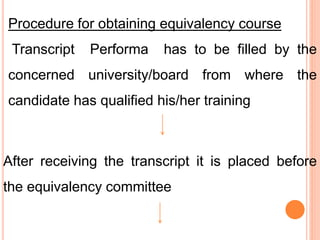
Procedure for obtaining equivalency course
Transcript Performa has to be filled by the
concerned university/board from where the
candidate has qualified his/her training
After receiving the transcript it is placed before
the equivalency committee
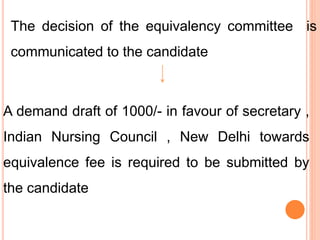
The decision of the equivalency committee is
communicated to the candidate
A demand draft of 1000/- in favour of secretary ,
Indian Nursing Council , New Delhi towards
equivalence fee is required to be submitted by
the candidate
TRANSCRIPT SYSTEM
A transcript is an official copy of a students
academic record. It records all courses
successfully and unsuccessfully completed and
all courses that were withdrawn after the
registration deadline
Characteristics
It is a copy of a students permanent academic
record which usually mean all courses taken , all
grades received , all honors received and
degrees conferred to a student.
It also contain average grade of the class
It is prepared and sent by the issuing school
with an original signature of a school official.
When students are thinking about changing
Schools , the cumulative transcripts usually get
mailed from school to school
Transcript can be cumulative record ,
permanent records , or simply record
Content of an academic record/transcript
Student name and registration number
Date of issue
Previous school name , addresses and phone
numbers
List of courses you took usually by year
Course and unit titles
Year of study and total mark obtained
Qualification and graduation dates
Benefits and uses for the students
Enable students to organize experiences and
document accomplishment
Assists student with targeting specific skill areas
and competencies thereby focusing on goal
setting and attainment
Assists students in communicating their campus
involvement during advising sessions
Assists students with college and university
applications , internship and employment
interview preparation , resume development and
job search strategies
Increase students proactive educational
planning , self awareness and confidence to
support decision making / goal setting
Helps student communicate and effectively
articulate their college experiences to potential
employers , graduate or professionals
Help students to develop personal contacts with
professional staff from student affairs and across
campus who would be of assistance to them in
choosing areas of involvement which meet
personal and career goals
OTHER BENIFITS
To view different aspect of a student ability
Serve as a recruitment and retention tool
Document student competencies for
accreditation and outcome assessments
Provide information that can assist in fostering
students development , decision making , and
retention to graduation
Procedure to request college transcript
A student signature is required each time a transcript is
requested
The request must be in writing and may be sent by a
fax or by mail or requested in person. The request
should include ,
Students name , fathers name , university registration
number , student signature , address where the
transcript is to be mailed
Any transcript issued directly to the students will be
considered as unofficial
Official transcript are marked with official seal of the
university and are mailed directly by the registrars office
to official representatives of universities , to certification
agencies etc
TYPE OF TRANSCRIPTS
1)Official transcripts
2)Unofficial transcript
CREDIT SYSTEM
Credit is a unit by which the course work is
measured. It determines the number of hours of
instructions required per week. One week is
equivalent to
One hour of teaching.
Characteristics of a credit system
It is the achievement or earning
It also indicate the weightage of a course for
calculating grade point average
It measures the volume of content to be
delivered in the course being studied
Advantages of credit system
Promote student
Improves curriculum design
Facilitate student centred education
It allow the students to study in the sequence
Improve the quality of education

1684569036488_curriculum.pptx

  • 1.
  • 2.
    Curriculum may beconsidered as blue print of an educational programme. It is the base of an education on which the teaching learning process is planned implemented. The term curriculum is a Latin word “currere” which means run which are taken to reach goal. It direct the teaching learning experience of nursing educational programme
  • 3.
    DEFINITION “Curriculum is atool in the hand of an artist to mould his material, according to his ideals in his studio.” Cunningham
  • 4.
    CONCEPT OF CURRICULUM Itis dynamic as the changes that occur in the society In a narrow sense , it is viewed merely as listing of subjects to be taught in school In a broad sense , it refers to the total experiences of individuals not only in schools but in society as well Systematic group of courses or sequence of subject required for graduation or certification in a major field of study A general overall plan of the content or specific material of instruction that the college should offer the student by way of qualifying him for graduation
  • 5.
    A body ofprescribed educative experiences under the supervision of an educational institute , designed to provide an individual with the best possible training and experience to fit him for society of which he lies as a part or to quality him for a trade or profession
  • 6.
    Nature of curriculum Curriculumas objectives Curriculum as subject matter Curriculum as student experience Curriculum as opportunity for the student Dynamic and flexible Societal orientation Oriented to life situation Positive attitude towards the need of learners Ideal and realistic approach Depends upon the philosophy and objectives
  • 7.
    NATURE OF NURSINGCURRICULUM Health oriented Flexible to meet the changing health needs of the society Influenced by the developments in other health care professions Influenced by transnational trends in nursing education and nursing service Influenced by the policy decisions based on national health policy
  • 8.
    Determinants and Foundationof curriculum planning The development of curriculum depend on, 1) Philosophy 2) Sociology 3) Psychology 4) Scientific determinants 5) Environmental determinants 6) Historical determinants
  • 9.
    Philosophical determinants It aimsat the all round development of the individual It is based on the philosophy of nation It reflects the ideals and aspiration of the people It inculcates the desired ideals of life in youngsters It helps in develop in personal and national character It enables the learners to learn the desirable cultural values , intellectual virtues , social norms , and moral doctrine
  • 10.
    Sociological determinants Core valuesand needs of society Changing values of the people Demands of modernization Good family life , ways of life Faith , beliefs , and attitude of the people Economic efficiency Cultural , political factors Knowledge , attitude , belief
  • 11.
    Psychological determinants Knowledge ofthe learner and learning process and condition facilitate optimum learning Intelligent , development capacities Interest of the learner Curriculum should be child centred , learning experience should be provided in accordance with the mental development of learner
  • 12.
  • 13.
  • 14.
    Historical determinants Country historicalbackground Culture Tradition
  • 15.
    PURPOSES OF CURRICULUM Synthesisof subject and life Harmony between individual and activity Development of democratic values Satisfaction of student need Realization of values Development of knowledge and enhancement in knowledge Creation of a conductive environment
  • 16.
    PRINCIPLES OF CURRICULUMDEVELOPMENT Conservative principle (present and past) Forward looking principle (children of today's are tomorrows citizen) Creative principle Principle of totality form (should develop curriculum for entire time) Activity principle (develop on the basis of experience and activities) Principle of preparation for life Principle of connecting to life (provide good life experience) Child centered curriculum
  • 17.
    Principle of integrationand correlation (previous year curriculum) Principle of comprehensiveness and balance (economy ,relationship occupation) Principle of loyalties (faith towards family , society, institution) Principle of flexibility and variety Principle of connecting to community needs (address the community needs) Principle of connecting with social life (adjust life in the democratic city) Training of leisure Principle of character building Principle of core or common subjects Principle of all round development of body , mind and spirit
  • 18.
    Principle of dignityof labor (positive attitude towards job)
  • 19.
    PRINCIPLES RELATED TODEVELOPMENT OF NURSING CURRICULUM Nursing curriculum should equip the students with the essential knowledge , skills and attitude. So that they can full fill their duties and responsibilities during the upcoming professional life. The expected result of the curriculum should be made clear to the students as well as the teacher. Since the modern nurse educator is considered as a facilitator of learning this principle deserve special attention Curriculum developments should consider the community needs with special emphasis to the health needs, life style and cultural background of people, health services available and changes in the health pattern of the community As nursing students are living under the influence of media and modern lifestyles , special measures has to be formulated in the curriculum for inculcating right attitude in them
  • 20.
    Posting to theconcerned clinical area should be preceded by adequate coverage of the related theory. Curriculum should offer adequate teaching learning activities in the classroom , clinical areas and community settings Curriculum development has to consider the guidelines laid down by the statutory bodies like nursing council , universities , examination boards Curriculum development should give due importance to high-tech – high touch approach in the nursing care. This will helps to maintain the human component of nursing in the midst of technological advancements in patient care. Curriculum should allow a participatory approach in the teaching learning process where students are mainly responsible for their learning and teacher assumes the role of facilitator of learning
  • 21.
    The learning environmentshould closely resemble the life situation where the nurses will perform on being qualified from the educational program.
  • 22.
    LEVEL OF CURRICULUMPLANING 1) Societal curriculum 2) Institutional Curriculum 3) Instructional curriculum
  • 23.
    TYPES OF CURRICULUM Hiddencurriculum (implied by the structure and nature of institution eg: completion of class ) Null curriculum Subject centered curriculum (traditional method) Child centered curriculum( consider student need, interest , intelligence) Activity centered curriculum Core curriculum Legitimate curriculum Illegitimate curriculum
  • 24.
    COMPONENT OF NURSINGCURRICULUM a) The statement of philosophy of educational programme b) The statement of the objectives of educational programme c) Total duration of educational programme d) Detailed course plan e) Programme of evaluation such as type of examinations, internal assessment
  • 25.
    FACTORS INFLUENCING CURRICULUMDEVELOPMENT Philosophy of nursing education (bring behavioral changes) Educational Psychology ( teaching learning activities) Society ( health needs of the society) Student (meet the needs of the students without neglecting the patient rights) Knowledge explosion and scientific advancement (possess knowledge from various discipline , learn recent scientific advancement r/t nsg care ) Technological advancement in patient care ( high tech high touch approach) Educational technology (Use of educational technology ) Transnational career opportunities (English and geriatric nursing)  Resources ( teachers , textbook , physical facilities )
  • 26.
    STEPS IN CURRICULUMDEVELOPMENT According to Raph Tyler 1) Formulation of educational objectives 2) Selection of learning experiences 3) Effective and efficient organization of learning experience 4) Evaluation of the curriculum
  • 27.
    1) Formulation ofeducational objectives “Educational objective is a specific statement of what the learners should be able to do at the end of the learning period that they could not do before.” Harper and Harper
  • 28.
    Data Required ForFormulating Educational Objectives Philosophical statement of institute Social and health needs of the society Resources available in the society Entry criteria level of the students Specification of positions to be held by the student on the completion of the programme like staff nurse, nursing tutor etc Future trends in nursing
  • 29.
    Criteria for theselection and statement of objectives Objectives should not too detailed Objectives have to be so worded that each statement contains only a single objective Objective should be cooperatively planned and developed by all teachers and student Objective should be easily accepted and understood by teachers and as well as students Objective selected should be worth while The objective should be attainable and practicable in the specific teaching learning situation
  • 30.
    The objectives forthe subject , lessons, unit should be direct contribution to attain overall objectives of the curriculum
  • 31.
    Step In Formulationof Educational Objectives 1) Identify the needs of the learner 2) Identify the needs of the society 3) Study the suggestions of experts 4) Formulate philosophy 5) State the objectives gathered from various sources in a proper way 6) Formulate the theory of learning 7) Screen the objective through educational philosophy , educational psychology and select the appropriate one 8) Define the objectives clearly in terms of content 9) State the educational objectives in terms of behavioral outcomes or change
  • 32.
    Type Of Objectives 1)General objectives : They are the summarises of the learning outcomes of teaching learning process and express the generalized behaviour expected to the student. 2) Specific objectives :Also known as instructional objectives, it tells what the student will be able to do at the end of a learning period that he would not before head. 3) Central objectives : Also known as institutional objectives. It correspond to the aim of an particular educational programme. A course objective may be central objective. It is usually broad , comprehensive and clear
  • 33.
    Level of educationalobjectives 1)At National level : Policy statement of what education should achieve for nation. 2)At Institutional level : This is intermediate objectives. They are narrow to achieve local needs like the kind of certificate to be awarded by the institution.
  • 34.
    3) At Instructionallevel : They are specifically intended learning outcomes. These should be expressed in behavioural terms.
  • 35.
    Advantages of Educationalobjectives Educational objectives fill the communication gap (teacher and examiner) Educational objectives enhance a learners involvement in the learning process (understand essential topic ,new knowledge, creative thinking, nursing care)
  • 36.
    Educational objective enhancesthe teaching ability of nursing educator Educational objective equip the examine to measure learning achievements (evaluation)
  • 37.
    SPECIFIC OUTCOME OFLEARNING (SOL) It reflect the changes that have take place in the individuals knowledge , skill , and attitude as a result of the learning process.
  • 38.
    Specific out comesof learning are , Subject based : Knowledge , comprehension, and ability to apply knowledge in different situation Personal outcomes : Interpersonal skills and interpersonal qualities
  • 39.
    Characteristics of SOL/Qualities Of Educational Objectives Feasible (Possible , it is achievable by using resources) Observable (evaluate) Relevant (relevant to educational objectives) Measurable Explicit (clear)
  • 40.
    BLOOMS TAXONOMY OFEDUCATIONAL OBJECTIVES It was initially publish in 1956 under the leadership of American academic and educational expert Dr. Benjamin S Bloom .
  • 41.
    In this taxonomyBlooms divide educational objectives into 3 domains . They are, Cognitive Domain Affective Domain Psychomotor domain
  • 42.
    1)Cognitive Domain : Thecognitive domain involves those objective that deal with the development of intellectual abilities and skills. They have to do with the mental abilities of the brain.
  • 43.
    The domain iscategorized into 6 hierarchical levels . 1)Knowledge 2)Comprehension 3)Application 4)Analysis 5)Synthesis 6)Evaluation Knowledge Comprehension Application Analysis Synthesis Evaluation
  • 44.
    1)Knowledge or Memory: Itis the first and lowest and the foundation for the development of cognitive skills. It involve the reorganization or recall of previous learned information. Knowledge is remembering or retrieving previously learned material.
  • 45.
    Action verb whichused in cognitive domain are , Define , state, list, name ,write , recall, select , measure , describe, identify. Example : Define immunity State the step of curriculum Describe the healing process
  • 46.
    2) Comprehension orUnderstanding It is the ability to construct or grasp meaning from material. It is on the basis that what is stored in the brain can be translated interpreted and extrapolated.
  • 47.
    Action verb whichused in this domain are , Identify , justify , select , indicate , represent , illustrate , formulate , explain , classify, translate Example : Explain the role of pulse polio in eradicating poliomyelitis
  • 48.
    3) Application This isthe ability to use learned material such as rules , principle, concept to new and real situation. The learning outcome in this area require a higher level of understanding
  • 49.
    Action verb whichused in this domain are , Select , assess , explain , choose , find , show , demonstrate, construct , perform , discover , produce , relate Example : Demonstrate correct use of pulse oxymeter
  • 50.
    ANALYSIS This refers tothe breakdown information into component parts , which may be elements of information relationship between elements or organization and structure of information. Learning outcome here represent a higher intellectual level than the comprehension and application.
  • 51.
    Action verb whichused in this domain are , Analyse , identify , conclude , differentiate , select , separate , compare , justify , criticise , distinguish Example : Distinguish between marasmus and kwashiorkor
  • 52.
    SYNTHESIS At this levellearner is expected to combine various part to form a new whole. Action verb which used in this domain are , Restate , summarize , discuss , select , conclude , create ,plan , derives
  • 53.
    Example : Derivesa solution for the hospital waste problem Summarize the impact of consumer protection act
  • 54.
    EVALUATION The level isconcerned with the ability to judge the value of material for a given purpose. Judgement are based on different criteria.
  • 55.
    Action verb whichused in this domain are , Judge , evaluate , determine , recognise , support , compare , justify Example : Compare and contrast any two definitions of education
  • 56.
    AFFECTIVE DOMAIN The affectivedomain consist of 5 level of objectives. It is mainly related to feelings , emotions , attitudes, motivations , beliefs. In other words it is related to development of adjustments of students by bringing a changes in interest , attitude and values.
  • 57.
    1) Receiving 2) Responding 3)Valuing 4) Organization 5) Characterization
  • 58.
    Receiving : Thisis the lowest level of learning outcome. It means attending. It is the learners willingness to attend to a particular stimulus or his being sensitive to the existence of a given problem condition or a situation. The learner is sensitized to the existence of certain phenomena that is he or she is willing to receive or attend to them.
  • 59.
    Action verbs used: Ask , choose , select , replies Example : Ask right question by honouring the dignity of the patient during history collection. Listen others with respect
  • 60.
    Responding : Here thelearners respond to the event by participating. Attends and react to a particular phenomenon. Active participation on the part of learners
  • 61.
    Action verbs used: answers , assists, discuss , help , label, practices , presents, reads, recites, reports , selects, tells , writes Example: Participate in group discussion Assists the patient in carrying out activities of daily living
  • 62.
    Valuing Objectives at thislevel indicate acceptance and internalization of the values or attitudes. The learner acts out these in everyday life in a consistent way
  • 63.
    Action verbs used: initiates , invites , joins , justifies Example : Initiates the building of interpersonal relationship with the patient during clinical posting hours
  • 64.
    Organization The learner willencounter the situation in which more than one values is relevant This level is concerned with the ability to organize value and arrange them in appropriate order
  • 65.
    Action verbs used: arrange , combine , modifies Example : Combines various interactions skills to nurture interpersonal relationship with patient
  • 66.
    Characterization Highest level andhaving attained this level the learner has an internalized value system which has become their philosophy of life
  • 67.
    Action verbs used: display , discriminate , listen Example : displays confident while caring patient with MI
  • 68.
    PSYCHOMOTOR DOMAIN It consistof 7 levels, Perception Set Guided response Mechanism Complex and response Adaptation Origination
  • 69.
    1)Perception Basic level concernedwith perception of sensory cues that guide actions and ranges from awareness of stimuli to translation into action
  • 70.
    Action verb :choose , differentiates, distinguishes , identifies , detects Example : Detects the early sign of cancer
  • 71.
    2)Set This is concernedwith the cognitive , affective and psychomotor readiness to act Action verb :begins , moves , react shows , starts Example : React promptly to emergency situations during trauma care settings
  • 72.
    3)Guided response These objectsrefer to the early stages in skill acquisition where the skill are performed following demonstration by the teacher. Action verbs : carries out, makes , performs, calculates Example : Perform bed making correctly as demonstrated by teacher
  • 73.
    4) Mechanism The performancehas become habitual, but the movements are not so complex as the next higher level Action verb : Same as level 3 Example : Calculate the volume of fluid required in the 1st day for a patient admitted with 60% burns and weighing 50kg
  • 74.
    5)Complex overt response Thislevel typifies the skilled performance and involves economy of effort , smoothness of action, accuracy, and efficiency etc
  • 75.
    Action verbs :Same as level 3 Example : Perform endotracheal tube intubation correctly
  • 76.
    Adaptation Skills are internalizedto such an extent that the students can adapt them to cater for special circumstances
  • 77.
    Action verbs :adapts ,alters , modifies, Example : Modifies sterilization technique according to the articles to be sterilized.
  • 78.
    Origination This is thehighest level and concerns the origination of new movement patterns to suit particular circumstances.
  • 79.
    Action verbs :composes,creates, designs, originates Example : Design a splint to restrain the forearm of ac child who is on IV infusion
  • 80.
    MODELS OF CURRICULUM Modelsof curriculum helps to understand the nature of curriculum
  • 81.
    Behavioural Objective (Product model) Stenhouses process model Lawtons cultural analysis model Beatties four fold model Taba model The Leyton soto model
  • 82.
  • 83.
    TABA MODEL Hilda Tabain 1962 Teachers who teaches the curriculum should participate in developing it, which led to the model being called the grass root approach
  • 84.
    7 major steps, Diagnosis of needs of student Formulation of objectives Selection of content Organization of content
  • 85.
    Selection of learningexperience Organization of learning activities Evaluation
  • 86.
    The Leyton sotomodel It mainly contain 3 factors 1)3 basic elements : Philosophy , psychology and source 2)3 basic processes : Selection , organization and evaluation
  • 87.
    3) 3 fundamentalconcept : Objectives , activities , and experiences
  • 88.
    Oliva model According toOliva the curriculum should be simple , comprehensive and systematic. It mainly consist of 12 components
  • 89.
    1)Philosophical formulation ,target , mission and vision of the institution 2)Analysis of the needs of the community where the college is located 3 and 4 ) General purpose and special purpose of curriculum
  • 90.
    5) Organizing thedesign and implement curriculum 6 and 7) Describe the curriculum in the form of the form of the formulation of general objectives and specific learning
  • 91.
    8) Define thelearning strategy 9) Preliminary studies on possible strategies or assessment techniques to be used 10) Implement the learning strategy 11and 12) Evaluation of learning experience and curriculum
  • 92.
    Wheelers Model It isan improvement upon Tyler’s model Aims , goals and objectives Selection of learning experience Selection of content Organization and integration of experiences Evaluation
  • 93.
    2) Selection oflearning experience Learning experience is defined as deliberately planned experiences in selected situations where the students actively participate , interact and which result in desirable changes of behaviour in the students.
  • 94.
    Characteristics of GoodLearning Experience Learning experience should allow the students to learn by doing Create motivation and interest among students Should be challenging to students
  • 95.
    Should brings multipleoutcomes Help the students to acquire needed knowledge , skill and attitude Helpful in gathering information Helpful attaining the educational objectives
  • 96.
    PRINCIPLES Should be inrelation to the selected objectives Should be in relation to those real life situation where the students are expected to practice after being qualified
  • 97.
    Selection should bemade in a manner that there is an effective integration between theory and practice The same learning experience will result in several outcomes and several learning experience may bring out the same outcome
  • 98.
    Learning should beselected in a such a way that learners are constantly motivated Learning experience should be planned and organized Learning is enhanced by utilizing a wide variety of teaching learning methods Students will learn effectively , if the experience are satisfactory to them
  • 99.
    Learning experience shouldconsider the students ability to undergo the desired changes in behaviour Learning experience selected should be according to the need of student and every students should be given similar learning experience Should provide same or equal chances for all students
  • 100.
    Criteria for selectionof learning experience It should be consistent with philosophy of institution and attain objective Should be varied and flexible enough Should be so selected. Provide sufficient opportunity for self activity of students
  • 101.
    Provide opportunity forthe development of independent thinking and decision making , judgement , self discipline Learning experience are arranged in a manner that provides continuity, correlation and integration of theory and practice and clinical learning experience
  • 102.
    Learning experience areplanned and evaluated cooperatively by the teacher and student Learning experiences are selected and arranged to give appropriate emphasis and weightage according to the importance of content.
  • 103.
    Level of learningexperience 1) Direct experience : Immediate sensory contact with the actual object. The learner have the opportunity to see, handle, taste , touch, felt and smelled. It give first hand information Eg : Lab practice and demonstration
  • 104.
    2) Vicarious experience: Create the actual situation through rearrangement of the reality. Eg : Model , specimen, film , radio , pictures , record , photograph 3) Symbolic experience : They are offered through verbal symbols( oral / written)
  • 105.
    3)ORGANIZATION OF LEARNINGEXPERIENCE According to Tyler the primary aim of organization of learning experience is to bring and relate various learning experiences together to produce the maximum cumulative effect in order to give a unified view of the whole so that the educational objectives are achieved.
  • 106.
    Continuity , sequenceand integration has to be followed while organizing learning experiences Learning experience have to be vertically and horizontally organized.
  • 107.
    Principles Learning experience hasto be so organized Learning experience should utilize the allotted time in cost effective manner Provide sample opportunity for the student to concentrate and relate the various activities in different areas of learning. So that the required ability and skills are easily attained
  • 108.
    Organization of learningexperience in the curriculum should be neither too flexible nor too rigid Clinical experience and assignment should be valued on the basis of experience provided to students .
  • 109.
    Learning experience haveto be organized in such a way that the student is able to practice professional nursing for next few years.
  • 110.
    Elements 1) Grouping oflearning experiences After selecting the learning experiences , we have to organize them
  • 111.
    2)Preparation of masterplan for rotation Overall plan of rotation of all students in a particular educational programme. Showing the placement of students belonging to the total programme including both theory and practical denoting the study block, clinical block, examination vacation etc.
  • 112.
    Preparation of masterplan will guide the teachers in the placement of subject matter and clinical experience. It is prepared well in advance for whole year, so it gives a complete and clear picture about student placement either in theory or practical field during an academic session
  • 113.
    For each yearit can be prepared separately and for a total program one can be prepared . So that every faculty will be aware of students posting Teacher should follow the respective university as a guideline for preparing either master rotation or clinical rotation
  • 114.
    Purposes of masterrotation plan Availability of an advance plan before implementation of curricular activities during an academic year for the entire program All concerned are aware of the placement of students in clinical field Coordination are more effective Helps the students and teachers to prepare themselves for working in the areas
  • 115.
    Assessment of curriculumprogramme are more effective
  • 116.
    Principles Plan is accordancewith the concerned curriculum plan/syllabus for the entire course/programme Plan in advance for all students in all years of programme Plan the activities by following maxims of teaching
  • 117.
    Post the studentsbased on university syllabus and availability of concerned required specialities Select areas that can provide expected learning experience Plan to build on previous experience Provide each clinical experience of same duration to all the students
  • 118.
  • 119.
    Master plan explainsthe following : Total duration of the program Explanation of different course of study with special reference to theory and practical's Total allotted hours in terms of theory and practical for each course Teaching learning method
  • 120.
    Scheme of evaluation Detailsof student activities like co curricular activities , health check up , vacation etc
  • 121.
    Responsibility of teachingstaff Correlate theory and practice Participate in teaching , supervision and evaluation Prepare the student in theory block before they enter in clinical block Maintain adequate and regular attendance at both the classroom and clinical areas
  • 122.
    Report the principalor concerned person for any changes or modifications Domain of educational objectives should be followed
  • 123.
    Steps in constructionof master rotation plan Before making master rotation plan list down theory and practical hours prescribed for each subject by INC Week available per year are 52 weeks 1 block = 4 weeks , so divide rotation plan into 13 blocks
  • 124.
    Depending on thestrength of the student and clinical areas divide the students into groups. Example for strength of 60 students , we can divide into 6 groups. Each group has 10 students. 5 in morning and evening Align groups vertically and blocks horizontally
  • 125.
    On horizontal axismark 52 weeks and 13 blocks Enter summer and winter vacation , examination as prescribed by INC Plan how to divide classes and clinical area , whether in partial or complete block 1 week = 40 hours ie, Monday – Friday (7*5) and Saturday 5 hours , so total 40 hours
  • 126.
    Accordingly divided intoclasses and clinical area , different colour and codes can be used to depict various area Make key indicating areas and hours allotted
  • 127.
    3) Placement oflearning experiences in the total curriculum All elements of the curriculum should be related to one another Learning experience should be so organized Follow the principle of sequence , integration and correlation will help to organize the learning experience in an effective manner
  • 128.
    Eg: OBG nursingshould place in the 4th year
  • 129.
    4) Preparation ofcorrelation chart It gives a portrayal of the extent of correlation achieved in the total curriculum in relation to the different courses of study and the various subjects and clinical experience offered in the programme
  • 130.
    5) Organization ofclinical experience It is done on the basis of syllabus and regulations laid down by the statutory bodies like INC and universities Organization of the clinical experience is the responsibility of the faculty Clinical experience related to each course should be planned according to the objectives
  • 131.
    Preparing clinical rotationplan will help in providing clinical experience to the students in an effective manner
  • 132.
    Definition : It isthe statement which explain the order of the clinical posting of various group of nursing students belonging to different classes in relevant clinical areas and community health settings as per the requirement laid down by the statutory bodies .
  • 133.
    Factors influencing clinicalrotation plan 1)Requirement stated by the statutory bodies 2)The objective of the course 3)The number of the students 4)Infrastructure of various clinical area 5)Duration of experience in each area 6)Nurse educator available for supervision
  • 134.
    Principles Clinical rotation planmust be made in accordance with the master plan of the curriculum The rotation plan must be made in advance with the cooperation of all the faculty members involved in the clinical teaching Maxims of teaching should follow while selecting the areas of experience
  • 135.
    Principle of continuity, sequence and integration should be followed to the maximum extent possible Enough teaching staff should be made available in the clinical areas for giving proper instructions to the students Seeking suggestions from nursing staff working in the clinical area will ensure their cooperation
  • 136.
    First year studentsshould receive maximum supervision and attention All students should get enough experience as per the clinical rotation plan All assignment related to clinical area should be finished before the completion of the postings Overcrowding in the clinical area with the different group of student is not advisable
  • 137.
    6) TEACHING SYSTEM Completeblock or theory block system Partial block system Study day system (In between one day for theory classes)
  • 138.
    4) EVALUATION OFCURRICULUM It involve the assessment of , Philosophy of the institution Programme goals of the institution Nursing content taught in each course Course objectives Teaching learning methods Course evaluation methods
  • 139.
    Principles It should consistof finding out to what extent the objectives are being achieved Objectives for evaluation should be in terms of behaviour or the reactions to be measured and also in terms of content which is being planned through which the behaviour is to operate
  • 140.
    Techniques and methodsused in evaluation should be on the basis of specific behaviours expected and measured Evaluation program should include a variety of evaluation tool or instruments
  • 141.
    The decision onwhether the student has had adequate experience in a given area should be in terms of excellence of performance and nit in terms of time spent Record of clinical practice should reflect the objective of practice and give evidence of the extent to which the students have achieved the objectives
  • 142.
    In curriculum evaluation5 M are done 1)Men 2)Money 3)Materials 4)Methods 5)Minutes
  • 143.
    CURRICULUM REVISION/CHANGING THE CURRICULUM Themain approaches in curriculum revision are addition, deletion and reorganization Addition : New elements are added to the existing curriculum Deletion : Some elements are deleted to modify the curriculum
  • 144.
    Reorganisation : Nothingis added or deleted only restructuring of the existing curriculum is done.
  • 145.
  • 146.
    COURSE PLAN Course planningmeans - planning the course of instructions in curriculum Course : A building block of a programme consisting of time limited component, usually over one term ( 3 months) , 6 months or 1 year usually ending with a summative evaluation
  • 147.
    Definition It is definedas a process of planning the entire content of the programme which has to be done before the commencement of course.
  • 148.
    PURPOSE To ensure autonomy Itsupports the curriculum process It secure future progress It brings about improvements It promotes utilization of resources
  • 149.
    LEVELS OF COURSEPLANNING University level Institutional level Instructional level
  • 150.
    PRINCIPLES State the objectivesin behavioural terms Establish sequence by following maxims of teaching Ensure logical and psychological continuity
  • 151.
    Principle of integration Thecourse should give adequate weight age to the core curriculum content/9nursing sciences)
  • 152.
    Select learning approachesthat are acceptable to all faculty member like problem solving and problem based learning. Provide variety in modes of learning
  • 153.
    ELEMENTS OF COURSEPLAN Course description Behavioural objectives Placement of the course by specifying the level of learner Explain time allotted
  • 154.
    In case ofcourses associated with field experience like community health nursing , details of field experience Organize the content into unit wise or lesson plan wise
  • 155.
    Details of theresource material and teaching learning methods to be followed Details of learning activities for students
  • 156.
    References for teachersand students Details of formative and summative evaluation , ratio between internal assessment and university examinations
  • 157.
    PROCESS 1) Determine thecourse content 2) Develop the teaching method and tools 3) Determine how will evaluate the students learning 4) Select text and other materials 5) Define course policies
  • 158.
    6) Develop thecourse schedule 7)Write the course syllabus 8) Refine the course design (delete unwanted items)
  • 159.
    TEACHERS ROLE INCOURSE PLANNING The teacher will plan course individually , will vary from institution to institution Teacher should select materials and learning activities according to the level of student Teacher should formulate the objectives prior to planning
  • 160.
    Teacher should possessthe knowledge adequately Teacher should be efficient in preparing course plan The teacher plan should focus on the general objective of the course , unit plan and class plan
  • 161.
    Teacher should havethe skills related to the area that they are teaching
  • 162.
    UNIT PLAN The planningof the unit is known as unit plan.
  • 163.
    DEFINITION Organizing material forinstructional purpose which utilizes significant subject matter content , involves pupils in learning activities through active participation intellectually and physically and modifies the pupils behaviour to the extent that he is able to cope with new problem.
  • 164.
    UNIT PLAN CONSISTOF , Vision Unit content in detail Time allocated for the completion of each stage Pre and post tests
  • 165.
    CHARACTERISTICS Organize various learningactivities or experience around a central problem or purpose Units should be suitable to the needs, capabilities and interests of the students Provision for a variety of learning experiences like clinical postings, theory class , field trips
  • 166.
    Contribute to thedevelopment of students by providing new experiences It should deal with a sizable topic , so that the length of the unit can be kept within limits It should provide opportunity for creative experiences
  • 167.
    It should emergedout of the students past experience and should lead to broader interests It should allow the utilization of various resources like textbooks , journals
  • 168.
    ELEMENTS OF UNITPLAN Statement of objectives Content Organization of content Time allotment Teaching and learning activities
  • 169.
  • 170.
    TYPES OF UNITPLAN 1)Resource unit 2)Teaching unit
  • 171.
    STEPS IN UNITPLANNING Content analysis by means of terms, concept, principles, laws, conclusion etc Objectives with specification can be realised through the content analysis Learning activities : Individual differences and psychology of the pupil will be considered in choosing learning activities
  • 172.
    Testing procedures :Type of evaluation tools and techniques
  • 173.
    LESSON PLAN Lesson planis a plan prepared by a teacher to teach a lesson in an organized manner It is a plan of action for understanding the teachers part about the students , knowledge and expertise about the topic being taught and her ability to use effective methods
  • 174.
    Definition Lesson plan isactually a plan of action. It include the working philosophy of the teacher, her knowledge of philosophy her information about and understanding of her pupils , her comprehension of the objectives of education , her knowledge of the material to be taught and her ability to utilize effective method.
  • 175.
    Purposes of lessonplanning It demands adequate consideration of goals and objectives, the selection of the subject matter, the selection of the learning methods , the planning activities, and the planning of evaluation device It keeps the teacher on the track, ensure steady progress and define outcome of teaching and learning procedures
  • 176.
    It helps theteacher in effective teaching It prevents waste It provides confidence and self reliance to the teacher
  • 177.
    Principles of lessonplanning The teacher should prepare a careful but flexible plan The teacher must have a mastery of and adequate training in the topic from which the subject matter has been selected for a certain lesson The teacher must know his students thoroughly and organize the material in a
  • 178.
    psychological rather thanmerely a logical fashion The teacher must ensure active student participation Since monotony, is a defect different teaching learning methods have to be employed while teaching instead of adhering to a single method
  • 179.
    Steps in lessonplanning Planning Preparation or introduction Presentation Recapitulation or closing stage
  • 180.
    Definition Course equivalency isthe term used in higher education describing how a course offered by one college or university
  • 181.
    Principles Courses are regardedas equivalence if they have the same intended learning outcomes and consequences the same graduated profile Equivalence courses should therefore have the same overall educational aims and assess their achievement at the same standard
  • 182.
    Procedure for obtainingequivalency course Transcript Performa has to be filled by the concerned university/board from where the candidate has qualified his/her training After receiving the transcript it is placed before the equivalency committee
  • 183.
    The decision ofthe equivalency committee is communicated to the candidate A demand draft of 1000/- in favour of secretary , Indian Nursing Council , New Delhi towards equivalence fee is required to be submitted by the candidate
  • 184.
    TRANSCRIPT SYSTEM A transcriptis an official copy of a students academic record. It records all courses successfully and unsuccessfully completed and all courses that were withdrawn after the registration deadline
  • 185.
    Characteristics It is acopy of a students permanent academic record which usually mean all courses taken , all grades received , all honors received and degrees conferred to a student. It also contain average grade of the class It is prepared and sent by the issuing school with an original signature of a school official. When students are thinking about changing
  • 186.
    Schools , thecumulative transcripts usually get mailed from school to school Transcript can be cumulative record , permanent records , or simply record
  • 187.
    Content of anacademic record/transcript Student name and registration number Date of issue Previous school name , addresses and phone numbers List of courses you took usually by year Course and unit titles Year of study and total mark obtained Qualification and graduation dates
  • 188.
    Benefits and usesfor the students Enable students to organize experiences and document accomplishment Assists student with targeting specific skill areas and competencies thereby focusing on goal setting and attainment Assists students in communicating their campus involvement during advising sessions
  • 189.
    Assists students withcollege and university applications , internship and employment interview preparation , resume development and job search strategies Increase students proactive educational planning , self awareness and confidence to support decision making / goal setting
  • 190.
    Helps student communicateand effectively articulate their college experiences to potential employers , graduate or professionals Help students to develop personal contacts with professional staff from student affairs and across campus who would be of assistance to them in choosing areas of involvement which meet personal and career goals
  • 191.
    OTHER BENIFITS To viewdifferent aspect of a student ability Serve as a recruitment and retention tool Document student competencies for accreditation and outcome assessments Provide information that can assist in fostering students development , decision making , and retention to graduation
  • 192.
    Procedure to requestcollege transcript A student signature is required each time a transcript is requested The request must be in writing and may be sent by a fax or by mail or requested in person. The request should include , Students name , fathers name , university registration number , student signature , address where the transcript is to be mailed
  • 193.
    Any transcript issueddirectly to the students will be considered as unofficial Official transcript are marked with official seal of the university and are mailed directly by the registrars office to official representatives of universities , to certification agencies etc
  • 194.
    TYPE OF TRANSCRIPTS 1)Officialtranscripts 2)Unofficial transcript
  • 195.
    CREDIT SYSTEM Credit isa unit by which the course work is measured. It determines the number of hours of instructions required per week. One week is equivalent to One hour of teaching.
  • 196.
    Characteristics of acredit system It is the achievement or earning It also indicate the weightage of a course for calculating grade point average It measures the volume of content to be delivered in the course being studied
  • 197.
    Advantages of creditsystem Promote student Improves curriculum design Facilitate student centred education It allow the students to study in the sequence Improve the quality of education