INTRODUCTION
Curriculum is the crux of the whole educational process
without curriculum, we can’t conceive any educational
endeavour. The curriculum in the literal sense is a
pathway towards goal. Curriculum may be considered
as an educational programme
DEFINITION OF CURRICULUM
• Webster's concisely defines curriculum as, "A
course of study offered by a school”.
• Curriculum is a tool in the hands of artist
(teachers) to mould his material (pupil), according
to his ideals in his studio (school).
Nursing curriculum is the learning opportunities
(subject matter)and the learning activities(clinical
experience and practise)that the faculty plan and
implement in various setting for a particular group of
students, for a specified period of time in order to
attain the objectives
Definition of nursing curriculum
Views on curriculum
For student:- The curriculum is what he
perceives to be intended for him in his courses
and class including assigned reading, home work,
exercises, field trip
For teacher:- the curriculum is what he intends
for the students at one level of insight, a
perceived mean for changing student behaviour.
For teacher and administrators in concert:-The curriculum
is that whole body of courses offered by the institutions or all
planned activities including bedside courses of study,
organized play, athletics, dramatic clubs and other programs
For philosophers , theologists and educational reformers:
The curriculum might be the learning to which group of
students, in his judgement should be exposed
CURRICULUM DEVELOPMENT
The curriculum is what happens, what
actually takes place among teachers and
students, students and students so that
learning occurs. Even though curriculum
cannot be entirely pre-planned and
prescribed, to a great extent a curriculum
that satisfies the needs of the students as
well as the society can be developed.
RESPONSIBILITY OF
CURRICULUM
DEVELOPMENT
The construction of nursing curriculum is the responsibility
of the faculty of the nursing institute, but the minimum
requirements which are prescribed by statutory bodies like
nursing council or university in the name of syllabus has to
be followed by all institutes. Since the needs of students as
well as the needs of the society vary from place to place,
individual nursing institute can adopt as much as is
required from the minimum prescribed syllabus in order to
achieve the educational objectives. Knowledge regarding
the changing health needs of the society, developments in
the field of general education, scientific and technological
advancements, changes in the health care delivery system,
advancements in the medicine and allied fields will assist
the faculty in the process of curriculum development.
PURPOSES OF CURRICULUM DEVELOPMENT
It establishes a clear philosophy and set of overarching goals
that guides the entire program and decisions that affect each
aspect of the program.
It outlines a basic framework for what to do, how to do it,
when to do it, & how to know if it has been achieved?
It allows for flexibility and encourages experimentation and
innovation within an overall structure.
It promote interdisciplinary approaches and the integration
of curricula when appropriate.
It suggests method of assessing the achievement of
program’s goal and objectives
It provide a means for its own ongoing revision and
improvement
PROCESS OF CURRICULUM
DEVELOPMENT
According to Ralph Taylor, there are four main steps
or tasks in curriculum development. They are —
• Formulation of educational objectives
• Selection of learning experiences
• Effective and efficient organisation of learning
experiences
• Evaluation of the curriculum
I. formulation of educational objectives
• Educational objectives are the statements of those desired
changes in behaviour as a result of specific teaching
learning activity or specific teacher learner activity
• Steps in formulation of educational objectives:
Identify the needs of the learner
Identify the needs of the society
Study of suggestion of the expert
Formulate the philosophy
II. Selection of learning experiences
 Learning experience is defined as the deliberately planned
experiences in selected situations where students actively
participate, interact and which result in desirable changes
behaviour in students
 Principles:
 All learning needs should be in relation to the selected
objectives
 Learning objectives should be in relation to those real life
situations where the students are expected to practice after
being qualified
 Selection should be in a manner that there is an effective
integration between theory and practice
Characteristics:
• Learning experiences should allow the student to
learning by doing
• Learning experience should create motivation and
interest among students
• Learning experience should be challenging to
students
• Learning experience should satisfy the needs of
the time and multiple outcomes in the students
III. Organisation of learning experiences
• Organisation of learning experience has to be done
carefully, systematically and sequentially.
• Continuity, sequence and integration have to be followed
while organising the learning experiences. Continuity is
achieved through building each experience one after
other. Sequence refers to building of learning experience
one over the other more deeply and broadly. Integration
is relating the learning experiences in such a way that the
learner gets view of whole learning.
IV Evaluation of the Curriculum:
• Evaluation of nursing curriculum has become
major concern of nurse educators in recent
years. Curriculum evaluation involves the
assessment of philosophy of institution,
programme goals of the institution, nursing
content taught in each course, course objectives,
teaching learning methods, course evaluation
methods, and relations of non nursing courses to
overall plan of the study.
Principles of Curriculum Development
• According to Agarwal the following principles
can used for developing a fruitful curriculum—
• The conservative principle
• The forward looking principle
• The creative principle
• The principle of totality form
• The activity principle
• Principle of preparation for life
• Principle of connecting to life
• Child centred curriculum
• Principle of integration and correlation
• Principle of comprehensiveness and balance
• Principle of loyalties
• Principle of variety and flexibility
• Principle of connecting to community needs
• Principle of connecting with social life
• Training for leisure
• Principle of core or common subjects
• Principle of all round development of body, mind and
spirit
• Principle of democracy, secularism and socialism
• Principle of dignity of labour
• Principle of character building
Objective model:- this model contains content that is
based on specific objectives. There objectives
should specifies expected learning outcomes in
terms of specific measurable behaviors.
This model comprises four main step:-
1.Curriculam idea
4. evaluation 2.objectives
3.Content
material
methodology
Product model:-
The key elements of a product model of the
curriculum are objectives, knowledge, experience and
evaluation.
evaluation
objectives
experience
knowledge
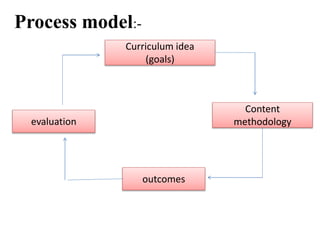
Process model:-
Curriculum idea
(goals)
evaluation
Content
methodology
outcomes
Process approaches to the curriculum as being more
open-ended than the product approach.
Continuous development is emphasized and the
outcome is perceived in terms of the development of
certain desirable processess and potentialities.
It will be evident that the element which comprise the
nursing process are used.
Various components of process model are curriculum
idea, content, methodology, outcome and evaluation.
(iv) The tyler model:-
The Leyton soto model
Leyton soto observed the linear nature of the Leyton model
and the separation of the three sources of objectives. He
eliminated some of the objectives to the Tyler model and
added some of his refinements and clarifications he charted
(a) Three basic element:-philosophy, psychology and source
(b) Three basic process:-selection, organization, and
evaluation
(c) Three fundamental concept:-objectives, activities,
experiences.
OLIVA MODEL
1.Philosophy of nursing education:-Education is the
deliberate and systematic influence exerted by the
mature person upon the immature through instruction ,
discipline and the harmonious development of all
power of the human being.
2.Educational psychology:- It provides as with data
on problems of learning through experimentation, it
provides us with data from which the principles of
learning are developed thereby it forms the basis for
development of principles and methode of teaching,
educational aim and objectives are the educational
ends , they are the results to be achieved through
learning.
3.Society :- To educate ,nursing students who will
possess sound judgement, are intellectually and
morally enlightened and professionally equipped so
that they are capable of caring for the sick and
functioning efficiently in health programmes and
thereby contributing to the health and the welfare of
society.
4.Health needs:- The nurse educator need to know the
society’s health needs and recourses. The changing
social pattern of family life, a study of the social
changes and their influence on the family provides
data which are essential to the development of a
curriculum.
5. The student:- Meeting the nursing students needs
requires the inclusion of certain activities in the
curriculum. If the student nurse is young and
inexperienced is living away from home and
unprepared to meet the environmental challenges of
his new life he may develop emotional tensions and
anxieties that will disturb his scholastic achievements
and his relationship with others.
Conclusion
It is important that the teacher is always involved
at all stages of any curriculum development and
review. This will ensure that quality assurance
happens at all stages of development.

Curriculum development

  • 2.
  • 3.
    Curriculum is thecrux of the whole educational process without curriculum, we can’t conceive any educational endeavour. The curriculum in the literal sense is a pathway towards goal. Curriculum may be considered as an educational programme
  • 4.
  • 5.
    • Webster's conciselydefines curriculum as, "A course of study offered by a school”. • Curriculum is a tool in the hands of artist (teachers) to mould his material (pupil), according to his ideals in his studio (school).
  • 6.
    Nursing curriculum isthe learning opportunities (subject matter)and the learning activities(clinical experience and practise)that the faculty plan and implement in various setting for a particular group of students, for a specified period of time in order to attain the objectives Definition of nursing curriculum
  • 9.
  • 10.
    For student:- Thecurriculum is what he perceives to be intended for him in his courses and class including assigned reading, home work, exercises, field trip For teacher:- the curriculum is what he intends for the students at one level of insight, a perceived mean for changing student behaviour.
  • 11.
    For teacher andadministrators in concert:-The curriculum is that whole body of courses offered by the institutions or all planned activities including bedside courses of study, organized play, athletics, dramatic clubs and other programs For philosophers , theologists and educational reformers: The curriculum might be the learning to which group of students, in his judgement should be exposed
  • 12.
  • 13.
    The curriculum iswhat happens, what actually takes place among teachers and students, students and students so that learning occurs. Even though curriculum cannot be entirely pre-planned and prescribed, to a great extent a curriculum that satisfies the needs of the students as well as the society can be developed.
  • 14.
  • 15.
    The construction ofnursing curriculum is the responsibility of the faculty of the nursing institute, but the minimum requirements which are prescribed by statutory bodies like nursing council or university in the name of syllabus has to be followed by all institutes. Since the needs of students as well as the needs of the society vary from place to place, individual nursing institute can adopt as much as is required from the minimum prescribed syllabus in order to achieve the educational objectives. Knowledge regarding the changing health needs of the society, developments in the field of general education, scientific and technological advancements, changes in the health care delivery system, advancements in the medicine and allied fields will assist the faculty in the process of curriculum development.
  • 16.
  • 17.
    It establishes aclear philosophy and set of overarching goals that guides the entire program and decisions that affect each aspect of the program. It outlines a basic framework for what to do, how to do it, when to do it, & how to know if it has been achieved? It allows for flexibility and encourages experimentation and innovation within an overall structure. It promote interdisciplinary approaches and the integration of curricula when appropriate. It suggests method of assessing the achievement of program’s goal and objectives It provide a means for its own ongoing revision and improvement
  • 18.
  • 19.
    According to RalphTaylor, there are four main steps or tasks in curriculum development. They are — • Formulation of educational objectives • Selection of learning experiences • Effective and efficient organisation of learning experiences • Evaluation of the curriculum
  • 20.
    I. formulation ofeducational objectives • Educational objectives are the statements of those desired changes in behaviour as a result of specific teaching learning activity or specific teacher learner activity • Steps in formulation of educational objectives: Identify the needs of the learner Identify the needs of the society Study of suggestion of the expert Formulate the philosophy
  • 21.
    II. Selection oflearning experiences  Learning experience is defined as the deliberately planned experiences in selected situations where students actively participate, interact and which result in desirable changes behaviour in students  Principles:  All learning needs should be in relation to the selected objectives  Learning objectives should be in relation to those real life situations where the students are expected to practice after being qualified  Selection should be in a manner that there is an effective integration between theory and practice
  • 22.
    Characteristics: • Learning experiencesshould allow the student to learning by doing • Learning experience should create motivation and interest among students • Learning experience should be challenging to students • Learning experience should satisfy the needs of the time and multiple outcomes in the students
  • 23.
    III. Organisation oflearning experiences • Organisation of learning experience has to be done carefully, systematically and sequentially. • Continuity, sequence and integration have to be followed while organising the learning experiences. Continuity is achieved through building each experience one after other. Sequence refers to building of learning experience one over the other more deeply and broadly. Integration is relating the learning experiences in such a way that the learner gets view of whole learning.
  • 24.
    IV Evaluation ofthe Curriculum: • Evaluation of nursing curriculum has become major concern of nurse educators in recent years. Curriculum evaluation involves the assessment of philosophy of institution, programme goals of the institution, nursing content taught in each course, course objectives, teaching learning methods, course evaluation methods, and relations of non nursing courses to overall plan of the study.
  • 25.
  • 26.
    • According toAgarwal the following principles can used for developing a fruitful curriculum— • The conservative principle • The forward looking principle • The creative principle • The principle of totality form • The activity principle • Principle of preparation for life • Principle of connecting to life • Child centred curriculum
  • 27.
    • Principle ofintegration and correlation • Principle of comprehensiveness and balance • Principle of loyalties • Principle of variety and flexibility • Principle of connecting to community needs • Principle of connecting with social life • Training for leisure • Principle of core or common subjects • Principle of all round development of body, mind and spirit • Principle of democracy, secularism and socialism • Principle of dignity of labour • Principle of character building
  • 29.
    Objective model:- thismodel contains content that is based on specific objectives. There objectives should specifies expected learning outcomes in terms of specific measurable behaviors. This model comprises four main step:- 1.Curriculam idea 4. evaluation 2.objectives 3.Content material methodology
  • 30.
    Product model:- The keyelements of a product model of the curriculum are objectives, knowledge, experience and evaluation. evaluation objectives experience knowledge
  • 31.
  • 32.
    Process approaches tothe curriculum as being more open-ended than the product approach. Continuous development is emphasized and the outcome is perceived in terms of the development of certain desirable processess and potentialities. It will be evident that the element which comprise the nursing process are used. Various components of process model are curriculum idea, content, methodology, outcome and evaluation.
  • 33.
  • 34.
  • 35.
    Leyton soto observedthe linear nature of the Leyton model and the separation of the three sources of objectives. He eliminated some of the objectives to the Tyler model and added some of his refinements and clarifications he charted (a) Three basic element:-philosophy, psychology and source (b) Three basic process:-selection, organization, and evaluation (c) Three fundamental concept:-objectives, activities, experiences.
  • 37.
  • 40.
    1.Philosophy of nursingeducation:-Education is the deliberate and systematic influence exerted by the mature person upon the immature through instruction , discipline and the harmonious development of all power of the human being. 2.Educational psychology:- It provides as with data on problems of learning through experimentation, it provides us with data from which the principles of learning are developed thereby it forms the basis for development of principles and methode of teaching, educational aim and objectives are the educational ends , they are the results to be achieved through learning.
  • 41.
    3.Society :- Toeducate ,nursing students who will possess sound judgement, are intellectually and morally enlightened and professionally equipped so that they are capable of caring for the sick and functioning efficiently in health programmes and thereby contributing to the health and the welfare of society. 4.Health needs:- The nurse educator need to know the society’s health needs and recourses. The changing social pattern of family life, a study of the social changes and their influence on the family provides data which are essential to the development of a curriculum.
  • 42.
    5. The student:-Meeting the nursing students needs requires the inclusion of certain activities in the curriculum. If the student nurse is young and inexperienced is living away from home and unprepared to meet the environmental challenges of his new life he may develop emotional tensions and anxieties that will disturb his scholastic achievements and his relationship with others.
  • 43.
    Conclusion It is importantthat the teacher is always involved at all stages of any curriculum development and review. This will ensure that quality assurance happens at all stages of development.