CURRICULUM PROCESS
Prepared by
WAHIDNO
INTRODUCTION
Curriculum is composite of entire
range of experiences the learner
undergoes of school or college. It is a
systematic arrangement of the sum
total of selected experiences planned
by a school or college or defined
group of student to attain the aims of
particular educational program.
INTRODUCTION
A curriculum directed to the education of the
nurses is designed within three frameworks
1. The Legally established limits for the nursing
activities of the nurses within the individual
state or union and union territorial.
2. The natural role of nurse in the profession of
nursing.
3. The type of nursing situations or areas where
specifically qualified persons are able to learn
for nursing.
PHASES OF CURRICULUM
PROCESS
I. Formulating the statement of philosophy
of the school or college or university
II. Establishment of purposes and
objectives of the school or college or
university
III. Selection of learning experience to
achieve the purpose and objective
IV. Effecting organization of selected
learning experience
V. Evaluation of the total program.
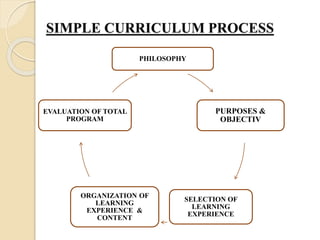
SIMPLE CURRICULUM PROCESS
PHILOSOPHY
PURPOSES &
OBJECTIV
SELECTION OF
LEARNING
EXPERIENCE
ORGANIZATION OF
LEARNING
EXPERIENCE &
CONTENT
EVALUATION OF TOTAL
PROGRAM
I. FORMULATING THE STATEMENT
OF THE PHILOSOPHY
Philosophies are the beliefs and
standards of the persons who starts a
program.
The philosophy serves as a framework
within which an organization, school or
college or educational program can
function with an objective and purpose.
The philosophy is expressed in different
ways as the quality of education,
selection, of teachers and students.
GUIDELINES FOR DEVELOPMENT
OF PHILOSOPHY
An educational philosophy states the
values which are believed to be right,
true and good by the persons
responsibilities for the school or college.
An educational philosophy will be unique
to the particular society and individual
whom it serves.
All teaching staff should participate in
the formulation of the school philosophy
or college philosophy.
College or school philosophy is used
as a screen.
College or school philosophy should
not conflict with the philosophy of the
institution of which it is a part.
College or school philosophy should
be re – examined periodically to
determine its suitability in the light of
the changing conditions.
II. AIMS GOALS AND OBJECTIVES
The term ‘Purposes’ refers to describe
the overall goals of the total education
program and the term ‘objective’ refers
to the breakdown of purposes into the
specific goals which can be used to
pinpoint the content.
The objective is developed to indicate
what changes in behavior it is hoped to
bring about in the student as a result of
the courses being offered.
FACTORS TO BE CONSIDERED
Statement of philosophy.
Social and health needs of the people.
Kind of students to be expected in the
education program.
Level of professional competence to be
attained.
Role of nurse (after qualifying) in society.
Statutory minimum requirements.
Teaching, physical and clinical resources
availability.
III. SELECTION OF A LEARNING
EXPERIENCES
A learning experience is something in
which the student actively participate
and which results in a change of
behavior.
The teacher should select only
experiences which will result in a
change in behavior outlined in the
objectives of the program.
CLASSIFICATION OF LEARNING
EXPERIENCES
 Direct Learning Experiences
◦ These are first hand experiences with various
objects or symbols.
Examples for direct learning experiences are as
follows
Observing samples or specimens
Experimenting with physical and chemical
materials
Setting up apparatus for experiment
Operating machines
Constructing models, charts, plans
Dramatizing historical events
Summarizing a lengthy description
Collecting, analyzing and interpreting the
data and generalizing.
Listing important facts and points
Presenting ideas orally or in writing
Conducting physical examination of
clients
Performing nursing procedures
Handling different types of medical
equipments and articles.
Indirect Learning experiences
Those experiences which are not the first
hand information.
Reading accounts or descriptions or
discussion in books, journals, magazines
and newspaper.
Observing pictures photos maps and models
Listening to oral descriptions and lecture
talks
IV. ORGANIZATION & INTEGRATION
OF EXPERIENCIES & CONTENT
The major task to be attempted in
phase IV is the combining of
information about experiences,
including developmental sequences &
stage discovered in phase II.
With information derived from the
taxonomic analyses of phase III in
order to setup educational
experiences designed to achieve the
goals of phase I
Phase IV is concerned with
educational sequences, this is with
sequences of selected experiences
with content planned to produce
certain behavior within the general
areas of understandings, sensitivities,
feelings, attitudes, values and skill.
ORGANIZATION OF LEARNING
EXPERIENCE
After the content knowledge &
learning experiences have been
selected carefully in relation to be
desired objectives, they must
organized in the curriculum.
The element of the curriculum should
be relative to one another vertical &
horizontally, so that systematic body of
ideas and activities will be expanded
continuously into larger and more
meaningful patterns.
CRITERIA FOR ORGANIZING
LEARNING EXPERIENCE
1. Continuity
2. Sequence
3. Integration
Guidelines for the selection,
organization of learning
experiences
1) A learning experience is defined as
an interaction between the student
and condition in the environment to
which he/she can react.
2) The faculty should develop a
systematic approach to the selection
of learning experience through
which student are provided with
opportunity to meet the objective
3) Effective learning depends upon
planned organization of the
experiences included in the
curriculum
4) The teaching method used should
depend upon the purposes to be
serve the learner, the teacher and
the available resources.
5) The selection, organization and
guidance of student’s learning
experiences should be submitted to
continuous appraisal by the faculty.
V. EVALUATION
The final phase in the curriculum
process is the coming to the
conclusions about the success or
failure, of the educational enterprise by
means of some measurement or
assessment of change in behaviour.
Criteria for evaluation of curriculum
1) Child centered
2) Concentrate on the experience of
human race as a whole
3) Best on the twin principle of unity &
reality
4) Broad-bases, flexible &
changing/dynamic and should not be
rigid & static
5) Possess continuity, articulation &
integration
6) Provide for individual differences
among children/student
7) Social significance
8) Consist of purposeful activities &
meaningful experience
9) Provide direct instruction
10)Provide democratic value
11)Achieve the rounded growth of the
child or student
Guidelines for curriculum
evaluation
Curriculum evaluation – A continuous
process
An organized plan for student
evaluation
Evaluation of results as the basis for
curriculum revision & improvement.
Bibliography
 Nursing Education, BT
Basavanthappa, 2003 Jaypee
Brothers
 Curriculum Development and
Evaluation in Nursing, Sarah B. Keating.
Third Edition
 http://www.moe.gov.tt/curriculum_process.h
tml

Curriculum process

  • 1.
  • 2.
    INTRODUCTION Curriculum is compositeof entire range of experiences the learner undergoes of school or college. It is a systematic arrangement of the sum total of selected experiences planned by a school or college or defined group of student to attain the aims of particular educational program.
  • 3.
    INTRODUCTION A curriculum directedto the education of the nurses is designed within three frameworks 1. The Legally established limits for the nursing activities of the nurses within the individual state or union and union territorial. 2. The natural role of nurse in the profession of nursing. 3. The type of nursing situations or areas where specifically qualified persons are able to learn for nursing.
  • 4.
    PHASES OF CURRICULUM PROCESS I.Formulating the statement of philosophy of the school or college or university II. Establishment of purposes and objectives of the school or college or university III. Selection of learning experience to achieve the purpose and objective IV. Effecting organization of selected learning experience V. Evaluation of the total program.
  • 5.
    SIMPLE CURRICULUM PROCESS PHILOSOPHY PURPOSES& OBJECTIV SELECTION OF LEARNING EXPERIENCE ORGANIZATION OF LEARNING EXPERIENCE & CONTENT EVALUATION OF TOTAL PROGRAM
  • 6.
    I. FORMULATING THESTATEMENT OF THE PHILOSOPHY Philosophies are the beliefs and standards of the persons who starts a program. The philosophy serves as a framework within which an organization, school or college or educational program can function with an objective and purpose. The philosophy is expressed in different ways as the quality of education, selection, of teachers and students.
  • 7.
    GUIDELINES FOR DEVELOPMENT OFPHILOSOPHY An educational philosophy states the values which are believed to be right, true and good by the persons responsibilities for the school or college. An educational philosophy will be unique to the particular society and individual whom it serves. All teaching staff should participate in the formulation of the school philosophy or college philosophy.
  • 8.
    College or schoolphilosophy is used as a screen. College or school philosophy should not conflict with the philosophy of the institution of which it is a part. College or school philosophy should be re – examined periodically to determine its suitability in the light of the changing conditions.
  • 9.
    II. AIMS GOALSAND OBJECTIVES The term ‘Purposes’ refers to describe the overall goals of the total education program and the term ‘objective’ refers to the breakdown of purposes into the specific goals which can be used to pinpoint the content. The objective is developed to indicate what changes in behavior it is hoped to bring about in the student as a result of the courses being offered.
  • 10.
    FACTORS TO BECONSIDERED Statement of philosophy. Social and health needs of the people. Kind of students to be expected in the education program. Level of professional competence to be attained. Role of nurse (after qualifying) in society. Statutory minimum requirements. Teaching, physical and clinical resources availability.
  • 11.
    III. SELECTION OFA LEARNING EXPERIENCES A learning experience is something in which the student actively participate and which results in a change of behavior. The teacher should select only experiences which will result in a change in behavior outlined in the objectives of the program.
  • 12.
    CLASSIFICATION OF LEARNING EXPERIENCES Direct Learning Experiences ◦ These are first hand experiences with various objects or symbols. Examples for direct learning experiences are as follows Observing samples or specimens Experimenting with physical and chemical materials Setting up apparatus for experiment Operating machines Constructing models, charts, plans
  • 13.
    Dramatizing historical events Summarizinga lengthy description Collecting, analyzing and interpreting the data and generalizing. Listing important facts and points Presenting ideas orally or in writing Conducting physical examination of clients Performing nursing procedures Handling different types of medical equipments and articles.
  • 14.
    Indirect Learning experiences Thoseexperiences which are not the first hand information. Reading accounts or descriptions or discussion in books, journals, magazines and newspaper. Observing pictures photos maps and models Listening to oral descriptions and lecture talks
  • 15.
    IV. ORGANIZATION &INTEGRATION OF EXPERIENCIES & CONTENT The major task to be attempted in phase IV is the combining of information about experiences, including developmental sequences & stage discovered in phase II. With information derived from the taxonomic analyses of phase III in order to setup educational experiences designed to achieve the goals of phase I
  • 16.
    Phase IV isconcerned with educational sequences, this is with sequences of selected experiences with content planned to produce certain behavior within the general areas of understandings, sensitivities, feelings, attitudes, values and skill.
  • 17.
    ORGANIZATION OF LEARNING EXPERIENCE Afterthe content knowledge & learning experiences have been selected carefully in relation to be desired objectives, they must organized in the curriculum. The element of the curriculum should be relative to one another vertical & horizontally, so that systematic body of ideas and activities will be expanded continuously into larger and more meaningful patterns.
  • 18.
    CRITERIA FOR ORGANIZING LEARNINGEXPERIENCE 1. Continuity 2. Sequence 3. Integration
  • 19.
    Guidelines for theselection, organization of learning experiences 1) A learning experience is defined as an interaction between the student and condition in the environment to which he/she can react. 2) The faculty should develop a systematic approach to the selection of learning experience through which student are provided with opportunity to meet the objective
  • 20.
    3) Effective learningdepends upon planned organization of the experiences included in the curriculum 4) The teaching method used should depend upon the purposes to be serve the learner, the teacher and the available resources. 5) The selection, organization and guidance of student’s learning experiences should be submitted to continuous appraisal by the faculty.
  • 21.
    V. EVALUATION The finalphase in the curriculum process is the coming to the conclusions about the success or failure, of the educational enterprise by means of some measurement or assessment of change in behaviour.
  • 22.
    Criteria for evaluationof curriculum 1) Child centered 2) Concentrate on the experience of human race as a whole 3) Best on the twin principle of unity & reality 4) Broad-bases, flexible & changing/dynamic and should not be rigid & static 5) Possess continuity, articulation & integration
  • 23.
    6) Provide forindividual differences among children/student 7) Social significance 8) Consist of purposeful activities & meaningful experience 9) Provide direct instruction 10)Provide democratic value 11)Achieve the rounded growth of the child or student
  • 24.
    Guidelines for curriculum evaluation Curriculumevaluation – A continuous process An organized plan for student evaluation Evaluation of results as the basis for curriculum revision & improvement.
  • 25.
    Bibliography  Nursing Education,BT Basavanthappa, 2003 Jaypee Brothers  Curriculum Development and Evaluation in Nursing, Sarah B. Keating. Third Edition  http://www.moe.gov.tt/curriculum_process.h tml