Curriculum
Development
ANANDGOWDA.S
ASSISTANT PROFESSOR
COMMUNITY HEALTH NURSING
YENEPOYA NURSING COLLEGE
YENEPOYA UNIVERSITY ,
MANGALURU
Introduction
In today’s world of rapidly
shifting resources, institutions of
higher education are facing the
need to make numerous changes to
successfully meet the challenges of
the future. Creative, innovative
methods of curriculum delivery are
being exposed in an effort to
provide cost effective, quality
programming to an increasingly
diverse population of students.
The term “curriculum” was first used
in Scotland as early as 1820 and became
part of education.
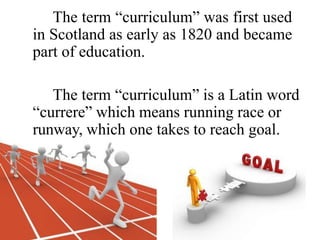
The term “curriculum” is a Latin word
“currere” which means running race or
runway, which one takes to reach goal.
Definition
“Curriculum is defined as the formal and
informal content and process by which learners gain
knowledge and understanding, develop, skills, and
alter attitudes, appreciations and values under the
auspices of that school.”
- Ronald.c.Doll,1996
“Curriculum is a tool in the hands of the artist (teacher)
to mould his material (pupils) according to his ideals (aim
and objectives) in his studio (school)”.
- Cunningbam
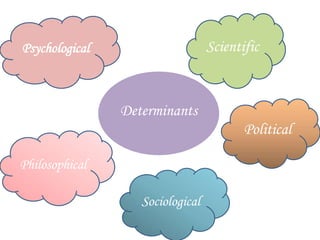
Psychological Scientific
Determinants
Political
Philosophical
Sociological
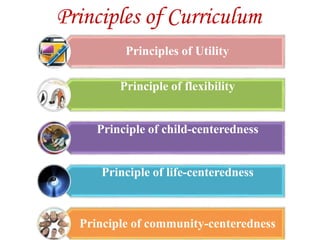
Principles of Curriculum
Principles of Utility
Principle of flexibility
Principle of child-centeredness
Principle of life-centeredness
Principle of community-centeredness
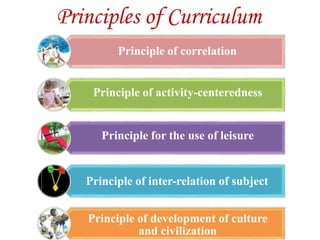
Principles of Curriculum
Principle of correlation
Principle of activity-centeredness
Principle for the use of leisure
Principle of inter-relation of subject
Principle of development of culture
and civilization
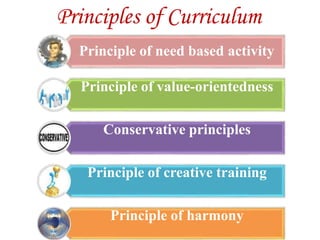
Principles of Curriculum
Principle of need based activity
Principle of value-orientedness
Conservative principles
Principle of creative training
Principle of harmony
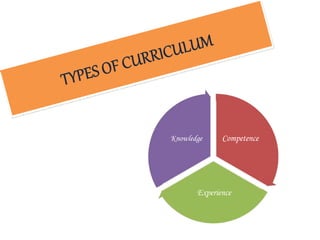
Competence
Experience
Knowledge
Knowledge centered curriculum
(subject centered)
Knowledge centered curriculum is
that curriculum in which knowledge is
divided in terms of isolated subjects, the
sequence followed is the logical sequence
pertaining to the particular discipline and the
logic is determined by the subject specialist.
Competence based curriculum
(Task oriented or activity based curriculum)
“ what should a learner be able to do and
what she should learn during the course?” is
the basic question that drives the making of
such a curriculum plan.
The focus is on the tasks that a successful
graduate Nurse need to do later as a competent
professional.
The tasks could be of
Cognitive problem solving skills,
Definitive communication skills or
Mixed type encompassing more than one
domain.
Nursing curricula need to adopt this
approach more widely.
Experience based curriculum
In this type of curriculum learner is
placed in the natural setting of the
community
Perhaps community oriented nursing
education is an ideal method of educating
learners.
STEPS IN CURRICULUM
DEVELOPMENT
Curriculum Development
Curriculum development is a deliberate process,
not a event, that takes concentrated time, effort and
faculty commitment.
The process consists of a series of systematic,
logical, dynamic spiraled and progressive stages that
can be time consuming and labor intensive.
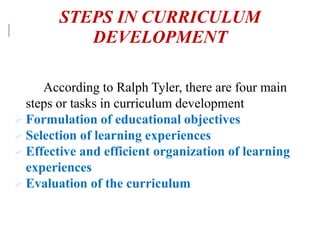
According to Ralph Tyler, there are four main
steps or tasks in curriculum development
 Formulation of educational objectives
 Selection of learning experiences
 Effective and efficient organization of learning
experiences
 Evaluation of the curriculum
STEPS IN CURRICULUM
DEVELOPMENT
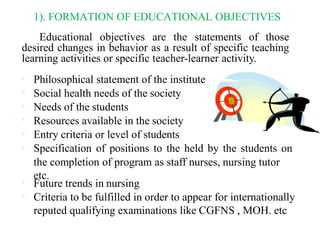
1). FORMATION OF EDUCATIONAL OBJECTIVES
Educational objectives are the statements of those
desired changes in behavior as a result of specific teaching
learning activities or specific teacher-learner activity.
• Philosophical statement of the institute
• Social health needs of the society
• Needs of the students
• Resources available in the society
• Entry criteria or level of students
• Specification of positions to the held by the students on
the completion of program as staff nurses, nursing tutor
etc.
• Future trends in nursing
• Criteria to be fulfilled in order to appear for internationally
reputed qualifying examinations like CGFNS , MOH. etc
Steps in the formulation of educational
objectives
According to Ralph Tyler there are nine
essential tasks or steps in the formulation of
education objectives
Identify the needs of the learner
Identity the needs of the society
Study the suggestions of experts
Formulate the philosophy
State the objectives gathered from sourcesfrom
Formulate a theory of learning
Screen the objectives through educational
philosophy and educational psychology helps to
determine the methods of teaching, principles of
teaching, methods of learning etc.
Define the objectives clearly n terms of content
State the educational objectives in terms
of behavioral outcomes or changes.
2. SELECTION OF LEARNINGEXPERIENCES
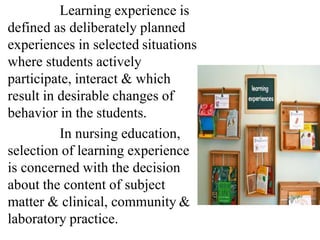
Learning experience is
defined as deliberately planned
experiences in selected situations
where students actively
participate, interact & which
result in desirable changes of
behavior in the students.
In nursing education,
selection of learning experience
is concerned with the decision
about the content of subject
matter & clinical, community &
laboratory practice.
Characteristics of good learning experiences
Learning experiences should allow the student learning
by doing
Learning experience should create motivation and
interest among students
Learning experiences should be challenging to the
students
Should satisfy the needs of the time
Should bring out multiple outcomes in students
Should help students to acquire needed knowledge skill
and attitude
Should be helpful in hunting or gathering information
Should be helpful to the students in attaining the
educational objectives
Criteria for the selection of Learning
Experiences
Learning experience should be:
Consistent with the philosophy
Varied & flexible enough
Give the students an opportunity to practice
Provide chance for the development of
independent thinking
Adapted to the needs of the student
Provide continuity, correlation & integration
Planned & evaluated co-operatively by the
teacher & the student
Selected & arranged to give appropriate emphasis
& weight age according to the relative importance
of the various L.Es & contents.
Should allow the student to learn by doing
Should create motivation & interest
among students
Selected should bring out multiple
outcomes in students
All learning experiences which are
planned & selected should be helpful to
the student in attaining the educational
objectives.
3) ORGANIZATION OF LEARNING
EXPERIENCES
• It has to be done carefully, systematically &
sequentially
• Acc to Tyler, primary aim of organization of
learning experiences in the curriculum is to bring
& relate various learning experiences together to
produce the maximum.
• Continuity, sequence & integration has to be
followed
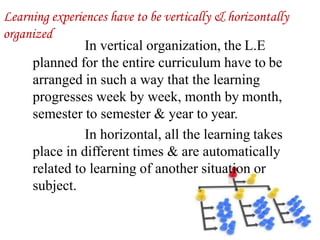
Learning experiences have to be vertically & horizontally
organized
In vertical organization, the L.E
planned for the entire curriculum have to be
arranged in such a way that the learning
progresses week by week, month by month,
semester to semester & year to year.
In horizontal, all the learning takes
place in different times & are automatically
related to learning of another situation or
subject.
Elements of Organizing the Learning
ExperiencesGrouping learning under subject headings
Humanities sciences
Behavioral sciences
Nursing sciences
Medical sciences etc
Preparation of master plan for curriculum
Total duration of programmes
Explanation of different courses of study
Total allotted hours
Teaching –learning methods
Details of student activities-
Placement of learning experiences in the total
curriculum-
Following the principle of sequence, integration and
correlation
Preparation of the correlation chart
Helps identify the extent of correlation
achieved in the total curriculum ---different
courses of study and various subjects and
clinical experiences
Organization of clinical experience
Vital element in the curriculum
Students clinical expertise--Determined
by the volume and quality of clinical
experience they receive
Types of teaching system have to be followed
Complete block or teaching block system
Partial block system
Study day system
4). EVALUATION OFTHECURRICULUM
of the
Curriculum evaluation involves :-
 Anassessment of the philosophy institution
Program goals of the institution
Nursing content taught in each course
Course objectives
Teaching learning methods
Course evaluation methods and
The relationship of non-nursing courses to
the overall plan study.
Evaluation of a curriculum should be efficient
& effective.
Five M’s of curriculum evaluation
Men & other personnel involved
Money
Materials
Methods
Minutes
 Men whether curriculum has been organized and
implemented properly by the faculty members and
other personnel involved
 Money whether money meant for curriculum
development is utilized properly
 Materials evaluation of text books, literature and the
like used for the development and implementation of
curriculum
 Methods whether teaching learning methods which
are planned in curriculum are appropriate
 Minutes whether adequate time is given for theory
and practical in each course like community health
nursing, medical surgical nursing, mental health
nursing etc.
Curriculum models or conceptual models
provide faculty with a means of conceptualizing
and organizing the knowledge, skills, values &
beliefs critical to the delivery of a coherent
curriculum that facilitates the achievement of
the desired curriculum outcomes.
Curriculum models
Purpose of models.
Provide a blueprint for determining the scope
of knowledge.
Highlight the purpose they serve, their goals
and objectives, content & methods of
instruction & evaluation they promote.
These are the educational road maps.
Linear Development
• Linear nursing education models are objectives-
driven, emphasizing desired student-nurse
outcomes.
• Objectives or specific behaviors are established
and a step-by-step program is developed to teach
students and achieve desired outcomes.
• As an educational blueprint, linear models can be
assessed to determine if the stated objectives have
been reached.
Cyclic Models
Cyclic models portray nursing curriculum
development as a coherent and logical
procedure involving five specific mechanisms
including
Situational analysis,
Choice of objectives,
Content selection and arrangement,
Methods selection and arrangement and
Learning assessment.
This model assumes that what is being
taught is circular with no specific starting or
ending point.
Dynamic Models
Complex, flexible, interactive and
dynamic, this model encourages curriculum
development participants to debate, argue and
discuss the curriculum approach until arriving at
an agreed-upon result.
The model urges nursing educators, nurses,
doctors, students and health care community
leaders to have involvement and input in the
curriculum design and development.
The Tyler Model
In 1949, Ralph Tyler, a consultant
with the University of Washington School of
Nursing, introduced "Syllabus for Education
360," which was then revised in 1950 to
"Basic Principles of Curriculum and
Instruction." Tyler's model was based on
objectives or "goal-attainment,"
This is considered the Classic Curriculum
Model, one of the earliest ideas in education
that leads to the measurement of outcomes.
The Tyler Model remains the foundation for a
performance-based nursing curriculum.
Tyler identified four principles for teaching:
1. Defining appropriate learning objectives.
2. Establishing useful learning experiences.
3. Organizing learning experiences to have a
maximum cumulative effect.
4. Evaluating the curriculum and revising those
aspects that did not prove to be effective.
Curriculum Revision / Changing
the Curriculum
Curriculum Revision means making the
curriculum different in some way to give it a new
position or direction
This often means alteration to its philosophy
by way of its aims & objectives, reviewing the
content included, revising its methods & re
thinking its evaluatory procedures.
Approaches to Curriculum Revision:
Addition
Deletion
Reorganization
Stages of Curriculum Revision
Fred greaves describes the 7 stages in revising
a nursing curriculum
Stage I: Formation of Curriculum development &
evaluation committee
Stage II: Appraise the existing nursing&
educational practices
Stage III: make a detailed study of the existing
curriculum content
Stage IV: establish criteria for decisions
Stage V: Design & writing of the new
curriculum changes
Stage VI: within this stage the actual
implementation of changes put into action
Stage VII: evaluate the effects of those
changes & it is with evaluation that this final
stage is concerned.
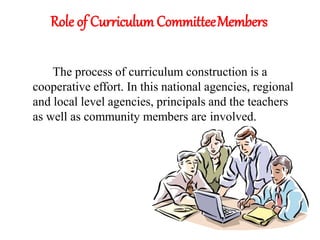
Role of Curriculum CommitteeMembers
The process of curriculum construction is a
cooperative effort. In this national agencies, regional
and local level agencies, principals and the teachers
as well as community members are involved.
National agency
In Indian situation for the planning of secondary level
curriculum the agency involved at the central level is National
Council Of Educational Research And Training (NCERT).
It frames the curriculum and circulates it for adoption to state
departments of education, boards of examination etc.
It frames the curriculum in consultation with experts, subject
teachers, and heads of institutions.
Its task is to frame the curriculum in keeping with the national
policy on education.
The curriculum framework prepared by it is only suggestive
and it is for the state governments and boards of Examination
to accept it, modify it or reject it.
State Government
As mention above the NCERT prepares the
curriculum which is suggestive in nature and it is the
state government who decides to select, modify or
rejected.
Every state government appoints a board of
examination for secondary and higher secondary
examination. This board prescribes the curriculum
which has to be followed in all the institution which
are to be recognized for sending their students for
public examination conducted by the board.
Each board has a subject committee which prescribes
the content of the courses in that subject.
Indian Nursing Council
Indian Nursing Council plays a major role in
the development & revision of the nursing
curriculum
Nursing Educational Committee , part of INC
will prepare the curriculum for the prescribed
courses.
Members of the committee only will have an
opportunity to participate in curriculum
development & revision.
The Role of Teachers
Only those teachers who are the part of committee have
the opportunity to participate in this process.
The teachers working in aided and recognized schools
have no freedom to plan their own curriculum. But , the
teachers working in experimental innovative schools may
have the opportunity to do so.
But for the most of teachers it is not possible to do so.
They may only have some freedom in the transacting the
curriculum in prescribed framework.
The need for research in nursing
Nursing research is a needed in nursing practice,
education, administration, management.
Nursing research needed to discover, verify,
structure and restructure the professional knowledge
through systematic way.
Research is the only way to:
– Build a body of nursing knowledge
– Validate improvements in nursing
– Make health care efficient as well as cost
effective
Contd..
Nursing are expected to deliver the
highest quality care.
To get high quality need to update new
knowledge through nursing research.
It is needed to implement the research
into a scientific approach of facts finding.
Importance of Research in Nursing
Curriculum
To improve the quality of care.
To update the knowledge.
Research allows nurses to question their
practice, find answers and thus implement into
their area.
Evidence based practice.
Conclusion
Curriculum is considered as the blueprint of an
educational program.
We need to consider how to design the curriculum that
would work in the globalized world and for globalization,
how to design the curriculum that accommodates diversity
and differences, how to design the curriculum that is
meaningful to the students, and how to design the
curriculum that reflects to the concepts of the profession.
Nursing curriculum is the learning opportunities and
the learning activities that the faculty plans and implement
in various settings for a particular group of students, for a
specified period of time in order to attain the objectives.
Curriculum development-Nursing education 1st year M.Sc Nursing

Curriculum development-Nursing education 1st year M.Sc Nursing

  • 1.
    Curriculum Development ANANDGOWDA.S ASSISTANT PROFESSOR COMMUNITY HEALTHNURSING YENEPOYA NURSING COLLEGE YENEPOYA UNIVERSITY , MANGALURU
  • 2.
    Introduction In today’s worldof rapidly shifting resources, institutions of higher education are facing the need to make numerous changes to successfully meet the challenges of the future. Creative, innovative methods of curriculum delivery are being exposed in an effort to provide cost effective, quality programming to an increasingly diverse population of students.
  • 3.
    The term “curriculum”was first used in Scotland as early as 1820 and became part of education. The term “curriculum” is a Latin word “currere” which means running race or runway, which one takes to reach goal.
  • 4.
    Definition “Curriculum is definedas the formal and informal content and process by which learners gain knowledge and understanding, develop, skills, and alter attitudes, appreciations and values under the auspices of that school.” - Ronald.c.Doll,1996 “Curriculum is a tool in the hands of the artist (teacher) to mould his material (pupils) according to his ideals (aim and objectives) in his studio (school)”. - Cunningbam
  • 5.
  • 6.
    Principles of Curriculum Principlesof Utility Principle of flexibility Principle of child-centeredness Principle of life-centeredness Principle of community-centeredness
  • 7.
    Principles of Curriculum Principleof correlation Principle of activity-centeredness Principle for the use of leisure Principle of inter-relation of subject Principle of development of culture and civilization
  • 8.
    Principles of Curriculum Principleof need based activity Principle of value-orientedness Conservative principles Principle of creative training Principle of harmony
  • 9.
  • 10.
    Knowledge centered curriculum (subjectcentered) Knowledge centered curriculum is that curriculum in which knowledge is divided in terms of isolated subjects, the sequence followed is the logical sequence pertaining to the particular discipline and the logic is determined by the subject specialist.
  • 11.
    Competence based curriculum (Taskoriented or activity based curriculum) “ what should a learner be able to do and what she should learn during the course?” is the basic question that drives the making of such a curriculum plan. The focus is on the tasks that a successful graduate Nurse need to do later as a competent professional.
  • 12.
    The tasks couldbe of Cognitive problem solving skills, Definitive communication skills or Mixed type encompassing more than one domain. Nursing curricula need to adopt this approach more widely.
  • 13.
    Experience based curriculum Inthis type of curriculum learner is placed in the natural setting of the community Perhaps community oriented nursing education is an ideal method of educating learners.
  • 14.
  • 15.
    Curriculum Development Curriculum developmentis a deliberate process, not a event, that takes concentrated time, effort and faculty commitment. The process consists of a series of systematic, logical, dynamic spiraled and progressive stages that can be time consuming and labor intensive.
  • 16.
    According to RalphTyler, there are four main steps or tasks in curriculum development  Formulation of educational objectives  Selection of learning experiences  Effective and efficient organization of learning experiences  Evaluation of the curriculum STEPS IN CURRICULUM DEVELOPMENT
  • 17.
    1). FORMATION OFEDUCATIONAL OBJECTIVES Educational objectives are the statements of those desired changes in behavior as a result of specific teaching learning activities or specific teacher-learner activity. • Philosophical statement of the institute • Social health needs of the society • Needs of the students • Resources available in the society • Entry criteria or level of students • Specification of positions to the held by the students on the completion of program as staff nurses, nursing tutor etc. • Future trends in nursing • Criteria to be fulfilled in order to appear for internationally reputed qualifying examinations like CGFNS , MOH. etc
  • 18.
    Steps in theformulation of educational objectives According to Ralph Tyler there are nine essential tasks or steps in the formulation of education objectives Identify the needs of the learner Identity the needs of the society Study the suggestions of experts Formulate the philosophy State the objectives gathered from sourcesfrom
  • 19.
    Formulate a theoryof learning Screen the objectives through educational philosophy and educational psychology helps to determine the methods of teaching, principles of teaching, methods of learning etc. Define the objectives clearly n terms of content State the educational objectives in terms of behavioral outcomes or changes.
  • 20.
    2. SELECTION OFLEARNINGEXPERIENCES
  • 21.
    Learning experience is definedas deliberately planned experiences in selected situations where students actively participate, interact & which result in desirable changes of behavior in the students. In nursing education, selection of learning experience is concerned with the decision about the content of subject matter & clinical, community & laboratory practice.
  • 22.
    Characteristics of goodlearning experiences Learning experiences should allow the student learning by doing Learning experience should create motivation and interest among students Learning experiences should be challenging to the students Should satisfy the needs of the time Should bring out multiple outcomes in students Should help students to acquire needed knowledge skill and attitude Should be helpful in hunting or gathering information Should be helpful to the students in attaining the educational objectives
  • 23.
    Criteria for theselection of Learning Experiences Learning experience should be: Consistent with the philosophy Varied & flexible enough Give the students an opportunity to practice Provide chance for the development of independent thinking Adapted to the needs of the student Provide continuity, correlation & integration
  • 24.
    Planned & evaluatedco-operatively by the teacher & the student Selected & arranged to give appropriate emphasis & weight age according to the relative importance of the various L.Es & contents. Should allow the student to learn by doing Should create motivation & interest among students Selected should bring out multiple outcomes in students All learning experiences which are planned & selected should be helpful to the student in attaining the educational objectives.
  • 25.
    3) ORGANIZATION OFLEARNING EXPERIENCES • It has to be done carefully, systematically & sequentially • Acc to Tyler, primary aim of organization of learning experiences in the curriculum is to bring & relate various learning experiences together to produce the maximum. • Continuity, sequence & integration has to be followed
  • 26.
    Learning experiences haveto be vertically & horizontally organized In vertical organization, the L.E planned for the entire curriculum have to be arranged in such a way that the learning progresses week by week, month by month, semester to semester & year to year. In horizontal, all the learning takes place in different times & are automatically related to learning of another situation or subject.
  • 27.
    Elements of Organizingthe Learning ExperiencesGrouping learning under subject headings Humanities sciences Behavioral sciences Nursing sciences Medical sciences etc Preparation of master plan for curriculum Total duration of programmes Explanation of different courses of study Total allotted hours Teaching –learning methods Details of student activities-
  • 28.
    Placement of learningexperiences in the total curriculum- Following the principle of sequence, integration and correlation Preparation of the correlation chart Helps identify the extent of correlation achieved in the total curriculum ---different courses of study and various subjects and clinical experiences
  • 29.
    Organization of clinicalexperience Vital element in the curriculum Students clinical expertise--Determined by the volume and quality of clinical experience they receive Types of teaching system have to be followed Complete block or teaching block system Partial block system Study day system
  • 30.
    4). EVALUATION OFTHECURRICULUM ofthe Curriculum evaluation involves :-  Anassessment of the philosophy institution Program goals of the institution Nursing content taught in each course Course objectives Teaching learning methods Course evaluation methods and The relationship of non-nursing courses to the overall plan study. Evaluation of a curriculum should be efficient & effective.
  • 31.
    Five M’s ofcurriculum evaluation Men & other personnel involved Money Materials Methods Minutes
  • 32.
     Men whethercurriculum has been organized and implemented properly by the faculty members and other personnel involved  Money whether money meant for curriculum development is utilized properly  Materials evaluation of text books, literature and the like used for the development and implementation of curriculum  Methods whether teaching learning methods which are planned in curriculum are appropriate  Minutes whether adequate time is given for theory and practical in each course like community health nursing, medical surgical nursing, mental health nursing etc.
  • 33.
    Curriculum models orconceptual models provide faculty with a means of conceptualizing and organizing the knowledge, skills, values & beliefs critical to the delivery of a coherent curriculum that facilitates the achievement of the desired curriculum outcomes. Curriculum models
  • 34.
    Purpose of models. Providea blueprint for determining the scope of knowledge. Highlight the purpose they serve, their goals and objectives, content & methods of instruction & evaluation they promote. These are the educational road maps.
  • 35.
    Linear Development • Linearnursing education models are objectives- driven, emphasizing desired student-nurse outcomes. • Objectives or specific behaviors are established and a step-by-step program is developed to teach students and achieve desired outcomes. • As an educational blueprint, linear models can be assessed to determine if the stated objectives have been reached.
  • 36.
    Cyclic Models Cyclic modelsportray nursing curriculum development as a coherent and logical procedure involving five specific mechanisms including Situational analysis, Choice of objectives, Content selection and arrangement, Methods selection and arrangement and Learning assessment. This model assumes that what is being taught is circular with no specific starting or ending point.
  • 37.
    Dynamic Models Complex, flexible,interactive and dynamic, this model encourages curriculum development participants to debate, argue and discuss the curriculum approach until arriving at an agreed-upon result. The model urges nursing educators, nurses, doctors, students and health care community leaders to have involvement and input in the curriculum design and development.
  • 38.
    The Tyler Model In1949, Ralph Tyler, a consultant with the University of Washington School of Nursing, introduced "Syllabus for Education 360," which was then revised in 1950 to "Basic Principles of Curriculum and Instruction." Tyler's model was based on objectives or "goal-attainment,"
  • 39.
    This is consideredthe Classic Curriculum Model, one of the earliest ideas in education that leads to the measurement of outcomes. The Tyler Model remains the foundation for a performance-based nursing curriculum.
  • 40.
    Tyler identified fourprinciples for teaching: 1. Defining appropriate learning objectives. 2. Establishing useful learning experiences. 3. Organizing learning experiences to have a maximum cumulative effect. 4. Evaluating the curriculum and revising those aspects that did not prove to be effective.
  • 41.
    Curriculum Revision /Changing the Curriculum
  • 42.
    Curriculum Revision meansmaking the curriculum different in some way to give it a new position or direction This often means alteration to its philosophy by way of its aims & objectives, reviewing the content included, revising its methods & re thinking its evaluatory procedures.
  • 43.
    Approaches to CurriculumRevision: Addition Deletion Reorganization
  • 44.
    Stages of CurriculumRevision Fred greaves describes the 7 stages in revising a nursing curriculum Stage I: Formation of Curriculum development & evaluation committee Stage II: Appraise the existing nursing& educational practices Stage III: make a detailed study of the existing curriculum content Stage IV: establish criteria for decisions
  • 45.
    Stage V: Design& writing of the new curriculum changes Stage VI: within this stage the actual implementation of changes put into action Stage VII: evaluate the effects of those changes & it is with evaluation that this final stage is concerned.
  • 46.
    Role of CurriculumCommitteeMembers The process of curriculum construction is a cooperative effort. In this national agencies, regional and local level agencies, principals and the teachers as well as community members are involved.
  • 47.
    National agency In Indiansituation for the planning of secondary level curriculum the agency involved at the central level is National Council Of Educational Research And Training (NCERT). It frames the curriculum and circulates it for adoption to state departments of education, boards of examination etc. It frames the curriculum in consultation with experts, subject teachers, and heads of institutions. Its task is to frame the curriculum in keeping with the national policy on education. The curriculum framework prepared by it is only suggestive and it is for the state governments and boards of Examination to accept it, modify it or reject it.
  • 48.
    State Government As mentionabove the NCERT prepares the curriculum which is suggestive in nature and it is the state government who decides to select, modify or rejected. Every state government appoints a board of examination for secondary and higher secondary examination. This board prescribes the curriculum which has to be followed in all the institution which are to be recognized for sending their students for public examination conducted by the board. Each board has a subject committee which prescribes the content of the courses in that subject.
  • 49.
    Indian Nursing Council IndianNursing Council plays a major role in the development & revision of the nursing curriculum Nursing Educational Committee , part of INC will prepare the curriculum for the prescribed courses. Members of the committee only will have an opportunity to participate in curriculum development & revision.
  • 50.
    The Role ofTeachers Only those teachers who are the part of committee have the opportunity to participate in this process. The teachers working in aided and recognized schools have no freedom to plan their own curriculum. But , the teachers working in experimental innovative schools may have the opportunity to do so. But for the most of teachers it is not possible to do so. They may only have some freedom in the transacting the curriculum in prescribed framework.
  • 51.
    The need forresearch in nursing Nursing research is a needed in nursing practice, education, administration, management. Nursing research needed to discover, verify, structure and restructure the professional knowledge through systematic way. Research is the only way to: – Build a body of nursing knowledge – Validate improvements in nursing – Make health care efficient as well as cost effective
  • 52.
    Contd.. Nursing are expectedto deliver the highest quality care. To get high quality need to update new knowledge through nursing research. It is needed to implement the research into a scientific approach of facts finding.
  • 53.
    Importance of Researchin Nursing Curriculum To improve the quality of care. To update the knowledge. Research allows nurses to question their practice, find answers and thus implement into their area. Evidence based practice.
  • 54.
    Conclusion Curriculum is consideredas the blueprint of an educational program. We need to consider how to design the curriculum that would work in the globalized world and for globalization, how to design the curriculum that accommodates diversity and differences, how to design the curriculum that is meaningful to the students, and how to design the curriculum that reflects to the concepts of the profession. Nursing curriculum is the learning opportunities and the learning activities that the faculty plans and implement in various settings for a particular group of students, for a specified period of time in order to attain the objectives.