PROCEDURE ON
ORAL HYGIENE
ANAMIKA RAMAWAT
M.Sc. Nursing
Batch 2017-18
GCON, Jodhpur
INTRODUCTION
■ Certain patients are prone to oral
problems because of lack of knowledge.
■ Good oral hygiene includes daily
stimulation of the gums and brushing of
the teeth.
DEFINITION
“Oral hygiene cleaning the teeth and
the oral cavity of the patient. It
includes the measures to prevent the
spread of disease from mouth and
increase the comfort of the patient.”
PURPOSES
To maintain the healthy state of mouth, gums, teeth and lips.
To remove food particles from and between the teeth.
To stimulate appetite.
To provide a sense of well-being.
To remove dental plaque.
To prevent sores and infection of the oral tissues.
To relieve discomfort resulting from halitosis and taste.
To prevent gum inflammation and infection.
To prevent the mucous membrane from becoming dry.
To prevent sordes, which results in ulceration.
To maintain the intactness and health of the lips and oral cavity.
To prevent oral infections.
To clean and moisten the membranes of the mouth and lips.
INDICATIONS
Seriously ill
patient.
Patients with
fever.
Postoperative
patients.
Unconscious
patients.
Patients
breathing
through mouth.
Paralyzed
patients.
Patients with
infections and
disease of
mouth.
Patients under
anesthesia.
ARTICLES-
 Articles needed for conscious patients- A tray containing the
following articles-
o Face towel.
o Mackintosh with draw sheet or towel.
o Disposable gloves(clean).
o Toothbrush.
o Toothpaste.
o Log of tepid water.
o Emollients (liquid paraffins, coconut oil, boroglycerine Vaseline.
o Cotton applicator.
 Articles needed for unconscious patients-
o Face towel.
o Mackintosh with draw sheet.
o Disposable gloves(clean)
o Artery forceps
o Dissecting forceps.
o Tongue depressor
o Mouth gag
o Potassium permanganate(1gm:5000ml)
o Gauze piece
o Emollients (liquid paraffins, coconut oil, boro glycerine Vaseline
o Cotton applicator
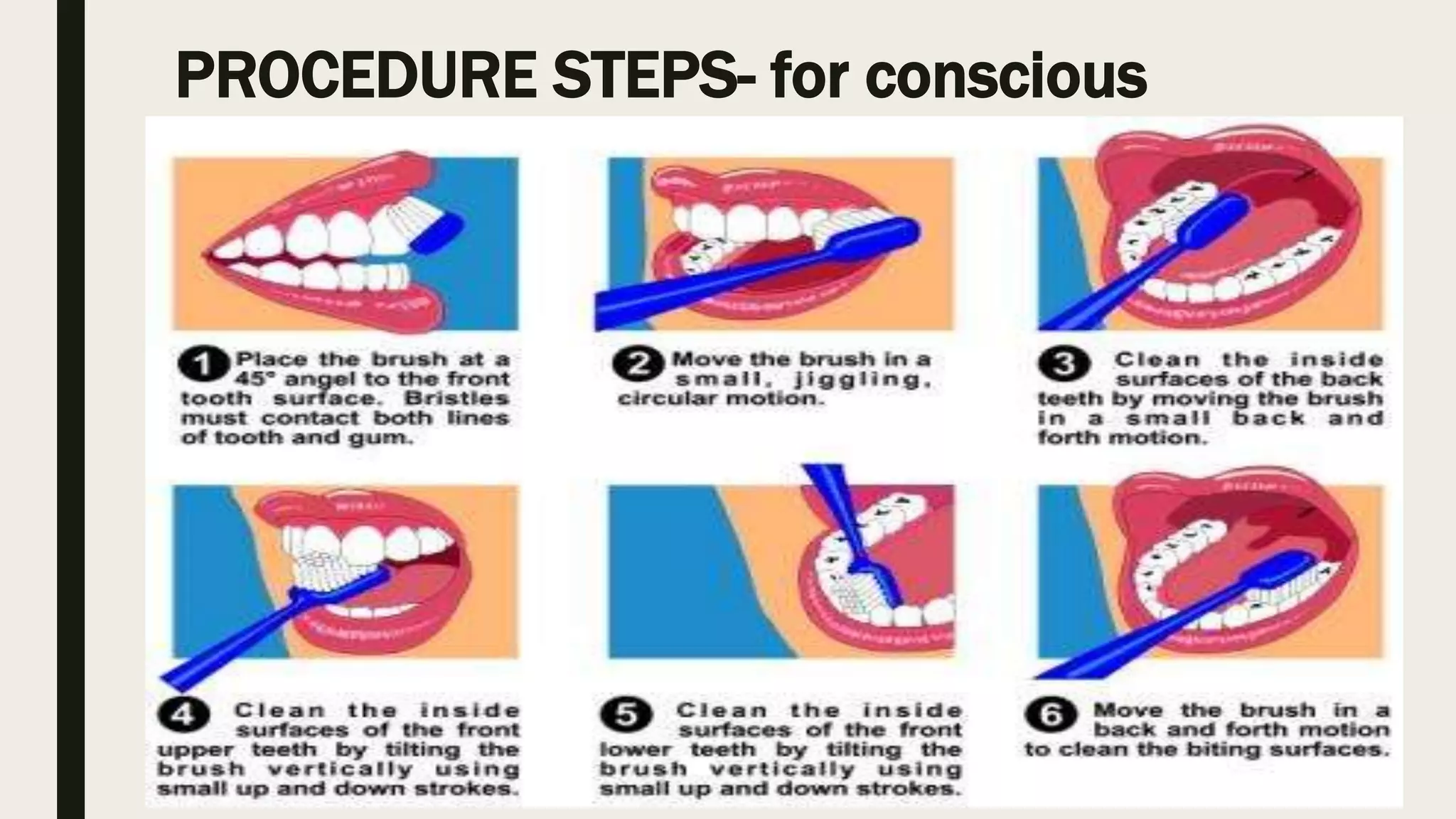
PROCEDURE STEPS- for conscious
For unconscious
Post procedural/ After procedural
Steps■ Apply emollient over the lips.
■ Remove and dispose off equipment appropriately.
■ Remove and discard the gloves.
■ Remove kidney tray, mackintosh and towel.
■ Make the patient comfortable.
■ Tidy up the unit.
■ In unconscious patient, if there is collection of secretions in mouth, apply suction.
■ Take all the articles to treatment room. Discard the waste as per protocol of
biomedical waste management and clean the articles with soap and water.
■ Wash hands.
■ Record the time and nature of treatment and condition of the mouth on nurse
record. Document assessment of the teeth, tongue, gums, and oral cavity.
COMPLICATIONS OF
NEGLECTED MOUTH
CARE
LOCAL Complications GENERAL Complications
Halitosis
Stomatitis
Pyorrhea
Root abscess
Tonsillitis
Sinusitis
Parotitis
Glossitis
Sordes and crust
Adenitis
Otitis media
 Inhalation pneumonia
 Nephritis
 Joint disease
 Rheumatic heart disease
 Loss of appetite
SUMMARY…
THANK YOU
&
KEEP SMILING!

Procedure on oral hygiene

  • 1.
    PROCEDURE ON ORAL HYGIENE ANAMIKARAMAWAT M.Sc. Nursing Batch 2017-18 GCON, Jodhpur
  • 2.
    INTRODUCTION ■ Certain patientsare prone to oral problems because of lack of knowledge. ■ Good oral hygiene includes daily stimulation of the gums and brushing of the teeth.
  • 3.
    DEFINITION “Oral hygiene cleaningthe teeth and the oral cavity of the patient. It includes the measures to prevent the spread of disease from mouth and increase the comfort of the patient.”
  • 4.
    PURPOSES To maintain thehealthy state of mouth, gums, teeth and lips. To remove food particles from and between the teeth. To stimulate appetite. To provide a sense of well-being. To remove dental plaque. To prevent sores and infection of the oral tissues.
  • 5.
    To relieve discomfortresulting from halitosis and taste. To prevent gum inflammation and infection. To prevent the mucous membrane from becoming dry. To prevent sordes, which results in ulceration. To maintain the intactness and health of the lips and oral cavity. To prevent oral infections. To clean and moisten the membranes of the mouth and lips.
  • 6.
  • 7.
    Seriously ill patient. Patients with fever. Postoperative patients. Unconscious patients. Patients breathing throughmouth. Paralyzed patients. Patients with infections and disease of mouth. Patients under anesthesia.
  • 8.
    ARTICLES-  Articles neededfor conscious patients- A tray containing the following articles- o Face towel. o Mackintosh with draw sheet or towel. o Disposable gloves(clean). o Toothbrush. o Toothpaste. o Log of tepid water. o Emollients (liquid paraffins, coconut oil, boroglycerine Vaseline. o Cotton applicator.
  • 10.
     Articles neededfor unconscious patients- o Face towel. o Mackintosh with draw sheet. o Disposable gloves(clean) o Artery forceps o Dissecting forceps. o Tongue depressor o Mouth gag o Potassium permanganate(1gm:5000ml) o Gauze piece o Emollients (liquid paraffins, coconut oil, boro glycerine Vaseline o Cotton applicator
  • 12.
  • 13.
  • 14.
    Post procedural/ Afterprocedural Steps■ Apply emollient over the lips. ■ Remove and dispose off equipment appropriately. ■ Remove and discard the gloves. ■ Remove kidney tray, mackintosh and towel. ■ Make the patient comfortable. ■ Tidy up the unit. ■ In unconscious patient, if there is collection of secretions in mouth, apply suction. ■ Take all the articles to treatment room. Discard the waste as per protocol of biomedical waste management and clean the articles with soap and water. ■ Wash hands. ■ Record the time and nature of treatment and condition of the mouth on nurse record. Document assessment of the teeth, tongue, gums, and oral cavity.
  • 15.
  • 16.
    LOCAL Complications GENERALComplications Halitosis Stomatitis Pyorrhea Root abscess Tonsillitis Sinusitis Parotitis Glossitis Sordes and crust Adenitis Otitis media  Inhalation pneumonia  Nephritis  Joint disease  Rheumatic heart disease  Loss of appetite
  • 17.
  • 18.