CURRICULUM DEVELOPMENT
MRS.MAMTA TOPPO
MS. PUSHPA M. MICHEAL
Presentation Objectives
By the end of this presentation the
participant should be able to:
• define the terms curriculum and
nursing curriculum;
• explain the components of a
nursing curriculum ;
• describe the process of curriculum
development.
Definition
• Latin word , Currere = run
• Blue print of an educational programme
• Curriculum is a tool in the hands of an
artist to mould his material, according
to his ideals in his studio.
-Cunningham
• Artist= teacher
• Material= student
• Ideals= objectives
• Studio= educational institute
• Curriculum is a systematic
arrangement of the sum total of
selected experiences planned by a
school for a defined group of students
to attain the aim of a particular
educational programme.
(Florence nightingale)
What a curriculum is not
• A list of subjects to be transmitted
and learned
that is a syllabus
• details of methods and times
that is a timetable
Nursing Curriculum
• Nursing Curriculum is the learning
opportunities and the learning
activities that the faculty plans and
implement in various settings for a
particular group of students for a
specified period of time in order to
attain the objectives
Components of nursing curriculum
• Statement of Philosophy
• Statement of the objectives
• Total duration of the educational program
• Detailed Course Plans: Subject Matter,
allotted time in terms of theory and
practical hours
• Programme of evaluation
CURRICULUM DEVELOPMENT
• Curriculum development is defined
as the process of selecting,
organizing, executing and evaluating
the learning experiences on the basis
of the needs, abilities, and interest of
learners, and on the basis of the
nature of the society or community.
IMPORTANCE OF CURRICULUM DEVELOPMENT
• To provide learning experience according to
educational objective
• To maintain continuity and sequence of
learning experience.
• To provide supervised clinical nursing
practice
• To co-relate theory with practice
• To provide environment related to life
situation
• For continuous evaluation
CRITERIA FOR CURRICULUM DEVELOPMENT
• Student is central factor in curriculum.
• It should be flexible and adjustable to
need of the student.
• It should be dynamic and possible of
revision.
• The experience presented should be as a
whole so that activities of teacher and
student are integrated.
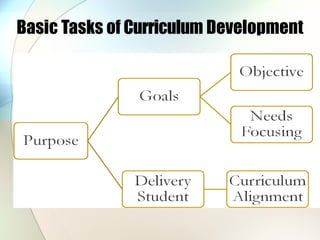
Basic Tasks of Curriculum Development
Major Factors Which Influence Curriculum
Development in Nursing Education
 Philosophy of nursing education
 Educational psychology
 Society
 Student
 Knowledge explosion and scientific
advancements
 Technological advancements in patient care
 Educational technology
 Transnational career opportunities
 Resources
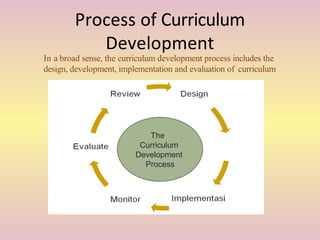
Process of Curriculum
Development
In a broad sense, the curriculum development process includes the
design, development, implementation and evaluation of curriculum
The
Curriculum
Development
Process
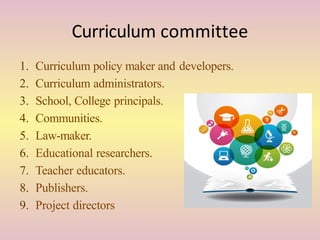
Curriculum committee
1. Curriculum policy maker and developers.
2. Curriculum administrators.
3. School, College principals.
4. Communities.
5. Law-maker.
6. Educational researchers.
7. Teacher educators.
8. Publishers.
9. Project directors
STEPS IN CURRICULUM
DEVELOPMENT
According to Ralph Tyler
1. Formulation of Educational Objectives
2. Selection of Learning Experiences
3. Organization of Learning Experiences
4. Evaluation of the curriculum
1. Formulation of Educational Objectives
Data required for formulating educational objectives
―Philosophy
―Needs of the society
―Needs of the student
―Resources available in the society
―Level of the students
―Specifications of positions to be held by the student
on the completion of the programme
―Minimum facilities required
―Future trends
Steps in the Formulation of Educational Objectives
1. Identify the needs of the learner
2. Identify the needs of the society
3. Study the suggestions of the experts
4. Formulate the philosophy
5. State the objectives gathered from various sources in
a proper way
6. Formulate a theory of learning
7. Screen the objectives through educational philosophy
and educational psychology and select the
appropriate ones
8. Define the objectives clearly
9. State in terms of behavioural outcomes
2. Selection of Learning Experiences
• Learning Experience: deliberately planned
experiences in selected situations where
students actively participate, interact and
which result in desirable changes in the
behaviour of the students
3. Organization of Learning Experiences
• Principles of continuity, sequence and
integration
Continuity: building each experiences one
after another
Sequence: building one over the other more
deeply
Integration: relating the experiences to get a
whole view
• Vertical (continuity and sequence)and
horizontal organization(integration)
Elements of Organization of Learning
Experiences
1. Grouping learning experiences under subject
headings
2. Preparation of master plan
3. Placement of learning experience in the total
curriculum
4. Preparation of correlation chart
5. Organization of clinical experience
6. Teaching system to be followed: complete
block/ teaching block, partial block and study
day system
EVALUATION OF CURRICULUM
• CURRICULUM EVALUATION involves an
assessment of the philosophy of the
institution, goals of the institution, nursing
content taught in each course, course
objectives, teaching- learning methods,
course evaluation methods and the
relationship of non nursing courses to the
overall plan of study.
CURRICULUM EVALUATION
5 M’s
●
Man
●
Money
●
Materials
●
Methods
●
Minutes
NEED FOR CURRICULUM
EVALUATION
• It determines the value of the curriculum.
• To find out the cause for defective curriculum.
• It clarify objectives and also to know the extent
of objectives achieved. it leads to the
improvement of institution, teaching-learning
process.
• To diagnose difficulties in curriculum process.
• To gather information for administrative
purpose.
• To provide quality control in education.
CURRICULUM REVISION
• Means changing or altering the existing
curriculum and making the curriculum
different in some way.
• To improve the existing curriculum
• Alteration can be in any area where there is a
deficit
• The philosophy, objectives, courses, teaching
– learning methods or evaluatory procedures
• Approaches: Addition , deletion or
reorganization
NEED FOR CURRICULUM CHANGE
• To restructure the curriculum according to the
needs of learner’s society.
• To eliminate unnecessary units, teaching
methods and contents.
• To introduce latest and updated methods of
teaching and content, new knowledge and
practices.
“Learning is like rowing upstream:
not to advance is to drop back.”

Curriculum development

  • 1.
  • 3.
    Presentation Objectives By theend of this presentation the participant should be able to: • define the terms curriculum and nursing curriculum; • explain the components of a nursing curriculum ; • describe the process of curriculum development.
  • 4.
    Definition • Latin word, Currere = run • Blue print of an educational programme • Curriculum is a tool in the hands of an artist to mould his material, according to his ideals in his studio. -Cunningham • Artist= teacher • Material= student • Ideals= objectives • Studio= educational institute
  • 5.
    • Curriculum isa systematic arrangement of the sum total of selected experiences planned by a school for a defined group of students to attain the aim of a particular educational programme. (Florence nightingale)
  • 6.
    What a curriculumis not • A list of subjects to be transmitted and learned that is a syllabus • details of methods and times that is a timetable
  • 7.
    Nursing Curriculum • NursingCurriculum is the learning opportunities and the learning activities that the faculty plans and implement in various settings for a particular group of students for a specified period of time in order to attain the objectives
  • 8.
    Components of nursingcurriculum • Statement of Philosophy • Statement of the objectives • Total duration of the educational program • Detailed Course Plans: Subject Matter, allotted time in terms of theory and practical hours • Programme of evaluation
  • 9.
  • 10.
    CURRICULUM DEVELOPMENT • Curriculumdevelopment is defined as the process of selecting, organizing, executing and evaluating the learning experiences on the basis of the needs, abilities, and interest of learners, and on the basis of the nature of the society or community.
  • 11.
    IMPORTANCE OF CURRICULUMDEVELOPMENT • To provide learning experience according to educational objective • To maintain continuity and sequence of learning experience. • To provide supervised clinical nursing practice • To co-relate theory with practice • To provide environment related to life situation • For continuous evaluation
  • 12.
    CRITERIA FOR CURRICULUMDEVELOPMENT • Student is central factor in curriculum. • It should be flexible and adjustable to need of the student. • It should be dynamic and possible of revision. • The experience presented should be as a whole so that activities of teacher and student are integrated.
  • 13.
    Basic Tasks ofCurriculum Development
  • 14.
    Major Factors WhichInfluence Curriculum Development in Nursing Education  Philosophy of nursing education  Educational psychology  Society  Student  Knowledge explosion and scientific advancements  Technological advancements in patient care  Educational technology  Transnational career opportunities  Resources
  • 15.
    Process of Curriculum Development Ina broad sense, the curriculum development process includes the design, development, implementation and evaluation of curriculum The Curriculum Development Process
  • 16.
    Curriculum committee 1. Curriculumpolicy maker and developers. 2. Curriculum administrators. 3. School, College principals. 4. Communities. 5. Law-maker. 6. Educational researchers. 7. Teacher educators. 8. Publishers. 9. Project directors
  • 17.
    STEPS IN CURRICULUM DEVELOPMENT Accordingto Ralph Tyler 1. Formulation of Educational Objectives 2. Selection of Learning Experiences 3. Organization of Learning Experiences 4. Evaluation of the curriculum
  • 18.
    1. Formulation ofEducational Objectives Data required for formulating educational objectives ―Philosophy ―Needs of the society ―Needs of the student ―Resources available in the society ―Level of the students ―Specifications of positions to be held by the student on the completion of the programme ―Minimum facilities required ―Future trends
  • 19.
    Steps in theFormulation of Educational Objectives 1. Identify the needs of the learner 2. Identify the needs of the society 3. Study the suggestions of the experts 4. Formulate the philosophy 5. State the objectives gathered from various sources in a proper way 6. Formulate a theory of learning 7. Screen the objectives through educational philosophy and educational psychology and select the appropriate ones 8. Define the objectives clearly 9. State in terms of behavioural outcomes
  • 20.
    2. Selection ofLearning Experiences • Learning Experience: deliberately planned experiences in selected situations where students actively participate, interact and which result in desirable changes in the behaviour of the students
  • 21.
    3. Organization ofLearning Experiences • Principles of continuity, sequence and integration Continuity: building each experiences one after another Sequence: building one over the other more deeply Integration: relating the experiences to get a whole view • Vertical (continuity and sequence)and horizontal organization(integration)
  • 23.
    Elements of Organizationof Learning Experiences 1. Grouping learning experiences under subject headings 2. Preparation of master plan 3. Placement of learning experience in the total curriculum 4. Preparation of correlation chart 5. Organization of clinical experience 6. Teaching system to be followed: complete block/ teaching block, partial block and study day system
  • 25.
    EVALUATION OF CURRICULUM •CURRICULUM EVALUATION involves an assessment of the philosophy of the institution, goals of the institution, nursing content taught in each course, course objectives, teaching- learning methods, course evaluation methods and the relationship of non nursing courses to the overall plan of study.
  • 26.
  • 27.
    NEED FOR CURRICULUM EVALUATION •It determines the value of the curriculum. • To find out the cause for defective curriculum. • It clarify objectives and also to know the extent of objectives achieved. it leads to the improvement of institution, teaching-learning process. • To diagnose difficulties in curriculum process. • To gather information for administrative purpose. • To provide quality control in education.
  • 28.
    CURRICULUM REVISION • Meanschanging or altering the existing curriculum and making the curriculum different in some way. • To improve the existing curriculum • Alteration can be in any area where there is a deficit • The philosophy, objectives, courses, teaching – learning methods or evaluatory procedures • Approaches: Addition , deletion or reorganization
  • 29.
    NEED FOR CURRICULUMCHANGE • To restructure the curriculum according to the needs of learner’s society. • To eliminate unnecessary units, teaching methods and contents. • To introduce latest and updated methods of teaching and content, new knowledge and practices.
  • 30.
    “Learning is likerowing upstream: not to advance is to drop back.”