

๏‚ž โ€œ A systematic arrangement of the sum total of
selected experiences planned by a school or a
defined group of students to attain the aims of a
particular educational programme.โ€
Florence nightingale international foundation
๏‚ž โ€œ Curriculum is the primary aid in the process of
adjusting the child to the environment in which he
function from day-to-day and in the environment in
which he will have to organize his activities later.โ€
K G Sayyidan
๏‚ž โ€œ It is a complex of more or less planned and
controlled conditions under which students learn to
behave in their ways. In it, new behaviour may be
acquired, present behaviour maintained or eliminated
and desirable behaviour may become both persistent
and viableโ€
Kerney & Cook
๏‚ž โ€œNursing curriculum is defined as the totality
of the philosophical approaches, curriculum
outcome statements, overall
design, courses, teaching-learning
strategies, delivery
methods, interactions, learning
climate, evaluation methods, curriculum
policies and resources.โ€
Iwasiw
๏‚ž It includes all the learning experience which
child has.
๏‚ž It is the systematic arrangement of certain
courses designed with certain objectives.
๏‚ž The courses offered within a certain field in
the school.
๏‚ž The courses studied by an individual child.
๏‚ž It includes the total learning experience
of the child within or outside the
classroom
๏‚ž according to his age and ability.
๏‚ž directs the teaching-learning
experiences.
๏‚ž provides formal and informal contacts.
๏‚ž the blue print plan.
๏‚ž reflects the patterns of life.
๏‚ž tool in the hands of the teacher to give
training.
๏‚ž inculcate the standards of moral action.
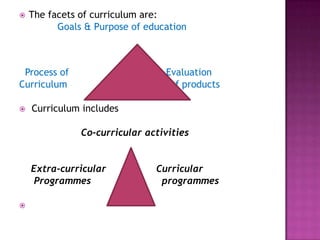
๏‚ž The facets of curriculum are:
Goals & Purpose of education
Process of Evaluation
Curriculum of products
๏‚ž Curriculum includes
Co-curricular activities
Extra-curricular Curricular
Programmes programmes
๏‚ž
๏‚ž Philosophy.
๏‚ž Objectives.
๏‚ž Duration of learning.
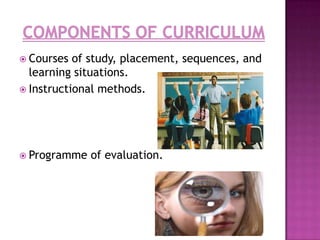
๏‚ž Courses of study, placement, sequences, and
learning situations.
๏‚ž Instructional methods.
๏‚ž Programme of evaluation.
AREAS OF STUDY FROM WHERE THE
COMPONENTS OF NURSING CURRICULUM ARE TO
BE DRAWN
โ€ข The natural sciences like biology,
microbiology, biophysics, chemistry, pharmacology
etc gives the information about facts, principles.
โ€ข The humanities, behavioural and social sciences like
psychology, sociology, fine arts etc. provide the
insight and background for the development of the
art of nursing.
โ€ข Professional nursing areas where by the student
nurse is responsible to learn and practice
nursing, the subjects like fundamentals of
nursing, midwifery, community health
nursing, paediatric nursing and different branches of
nursing
๏‚ž The behavioural model
๏‚ข Objectives.
๏‚ข Content.
๏‚ข Method.
๏‚ข Evaluation.
๏‚ž Stenhouseโ€™s proess model:
๏‚ข Similarly teaching methods and learning
experiences can be selected in terms of
worthwhileness as learning activities.
๏‚ข the teacherโ€Ÿs commitment to professional
development is vital.
๏‚ž Lawtonโ€™s cultural analysis model
๏‚ข . Culture is defined as the whole way of life
of society and the purpose of education is to
make available to the next generation what
we regard as the most important aspects of
culture.
๏‚ž Beattieโ€™s four fold model
๏‚ก The curriculum as a map of key subjects
๏‚ก The curriculum as the schedule of basic skills
๏‚ก The curriculum as a portfolio of meaningful
personal experiences
๏‚ก The curriculum as the agenda of important
cultural issues
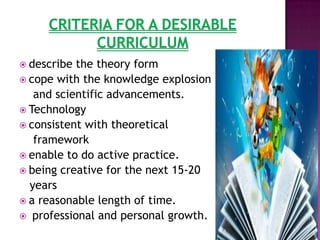
๏‚ž describe the theory form
๏‚ž cope with the knowledge explosion
and scientific advancements.
๏‚ž Technology
๏‚ž consistent with theoretical
framework
๏‚ž enable to do active practice.
๏‚ž being creative for the next 15-20
years
๏‚ž a reasonable length of time.
๏‚ž professional and personal growth.
๏‚ž Legitimate curriculum:
๏‚ง agreed by the faculty either
implicitly or explicitly.
๏‚ง โ€žreal curriculumโ€Ÿ.
๏‚ž The illegitimate curriculum:
๏‚ง is the curriculum of insights,
patterns, creativity, strategies,
inquiry and understanding.
๏‚ž Hidden curriculum:
This is the curriculum of subtle socialization
of teaching how to think and feel nurses. It is
the curriculum that covertly communicates
priorities, relationships and values.
๏‚ž The null curriculum:
This is the curriculum that exists
only in the hearts and mind of
educators but seldom exists in
reality.
๏‚žโ€œ It is the process of
gathering, sorting, selecting, bala
ncing and synthesizing relevant
information for many sources in
order to design those experiences
that will assist learners in
attaining
the goals of curriculum.โ€
Societal curriculum:
Institutional curriculum:
The instructional curriculum:
๏‚ž Philosophy of nursing education:
the goal is to prepare the student so that he can
attain the end for which he was created.
๏‚ž Educational psychology:
provides information and principles which serve
to help in selection, organization and the
evaluation of learning experiences in the
curriculum.
๏‚ž Society:
nursing is one of the social institution concerned
with health, a fundamental need of all people and
consequently canโ€Ÿt be conceived of today apart
from the society in which it functions
๏‚ž Health needs:
๏‚ก Prepare the number and the kind of nurses
essential to fulfil the nursing needs of the
society.
๏‚ž The student:
๏‚ก to assist the student to help them to
overcome the difficulties and in adjusting
them.
๏‚ž Life activities:
๏‚ก Helps in the growth of student in individual
capacities and in social participation.
๏‚ž Knowledge:
๏‚ก consists of Subject matter courses
๏‚ž Technological advancements:
๏‚ก the high-tech-high-touch approach
in nursing.
๏‚ž Transnational career oppurtunities:
๏‚ก abroad career oppurtunities.
๏‚ž Resources:
๏‚ก depends upon the availability of tangible and
intangible resources.
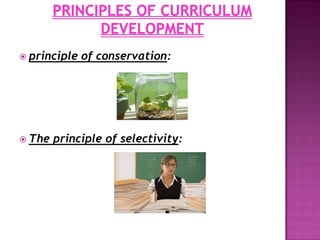
๏‚ž principle of conservation:
๏‚ž The principle of selectivity:
๏‚ž The forward looking principle:
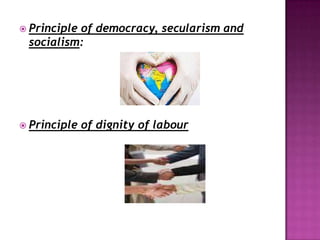
๏‚ž The activity and experience principle:
๏‚ž Principle of all round development of
body, mind and spirit:
๏‚ž Principle of democracy, secularism and
socialism:
๏‚ž Principle of dignity of labour
๏‚ž Principle of character building
๏‚ž Principle of comprehensiveness and
balance
๏‚ž Principle of loyalties
๏‚ž Principle of connecting to community
needs:
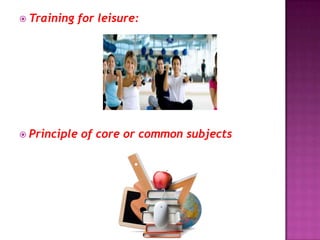
๏‚ž Training for leisure:
๏‚ž Principle of core or common subjects
๏‚ž principle of preparation of life
๏‚ž Principle of connecting to life
๏‚ž Child centred curriculum
๏‚ž The creative principle
๏‚ž Principle of integration and co-relation
๏‚ž Principle of maturity
๏‚ž Principle of individual difference
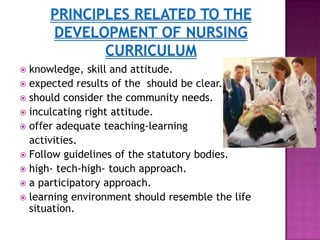
๏‚ž knowledge, skill and attitude.
๏‚ž expected results of the should be clear.
๏‚ž should consider the community needs.
๏‚ž inculcating right attitude.
๏‚ž offer adequate teaching-learning
activities.
๏‚ž Follow guidelines of the statutory bodies.
๏‚ž high- tech-high- touch approach.
๏‚ž a participatory approach.
๏‚ž learning environment should resemble the life
situation.
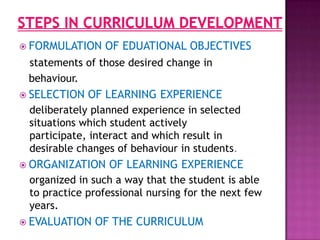
๏‚ž FORMULATION OF EDUATIONAL OBJECTIVES
statements of those desired change in
behaviour.
๏‚ž SELECTION OF LEARNING EXPERIENCE
deliberately planned experience in selected
situations which student actively
participate, interact and which result in
desirable changes of behaviour in students.
๏‚ž ORGANIZATION OF LEARNING EXPERIENCE
organized in such a way that the student is able
to practice professional nursing for the next few
years.
๏‚ž EVALUATION OF THE CURRICULUM
Concepts and steps in curriculum

Concepts and steps in curriculum

  • 2.
    ๏‚ž โ€œ Asystematic arrangement of the sum total of selected experiences planned by a school or a defined group of students to attain the aims of a particular educational programme.โ€ Florence nightingale international foundation
  • 3.
    ๏‚ž โ€œ Curriculumis the primary aid in the process of adjusting the child to the environment in which he function from day-to-day and in the environment in which he will have to organize his activities later.โ€ K G Sayyidan ๏‚ž โ€œ It is a complex of more or less planned and controlled conditions under which students learn to behave in their ways. In it, new behaviour may be acquired, present behaviour maintained or eliminated and desirable behaviour may become both persistent and viableโ€ Kerney & Cook
  • 4.
    ๏‚ž โ€œNursing curriculumis defined as the totality of the philosophical approaches, curriculum outcome statements, overall design, courses, teaching-learning strategies, delivery methods, interactions, learning climate, evaluation methods, curriculum policies and resources.โ€ Iwasiw
  • 5.
    ๏‚ž It includesall the learning experience which child has. ๏‚ž It is the systematic arrangement of certain courses designed with certain objectives. ๏‚ž The courses offered within a certain field in the school. ๏‚ž The courses studied by an individual child. ๏‚ž It includes the total learning experience of the child within or outside the classroom
  • 6.
    ๏‚ž according tohis age and ability. ๏‚ž directs the teaching-learning experiences. ๏‚ž provides formal and informal contacts. ๏‚ž the blue print plan. ๏‚ž reflects the patterns of life. ๏‚ž tool in the hands of the teacher to give training. ๏‚ž inculcate the standards of moral action.
  • 7.
    ๏‚ž The facetsof curriculum are: Goals & Purpose of education Process of Evaluation Curriculum of products ๏‚ž Curriculum includes Co-curricular activities Extra-curricular Curricular Programmes programmes ๏‚ž
  • 8.
  • 9.
    ๏‚ž Courses ofstudy, placement, sequences, and learning situations. ๏‚ž Instructional methods. ๏‚ž Programme of evaluation.
  • 10.
    AREAS OF STUDYFROM WHERE THE COMPONENTS OF NURSING CURRICULUM ARE TO BE DRAWN โ€ข The natural sciences like biology, microbiology, biophysics, chemistry, pharmacology etc gives the information about facts, principles. โ€ข The humanities, behavioural and social sciences like psychology, sociology, fine arts etc. provide the insight and background for the development of the art of nursing. โ€ข Professional nursing areas where by the student nurse is responsible to learn and practice nursing, the subjects like fundamentals of nursing, midwifery, community health nursing, paediatric nursing and different branches of nursing
  • 11.
    ๏‚ž The behaviouralmodel ๏‚ข Objectives. ๏‚ข Content. ๏‚ข Method. ๏‚ข Evaluation. ๏‚ž Stenhouseโ€™s proess model: ๏‚ข Similarly teaching methods and learning experiences can be selected in terms of worthwhileness as learning activities. ๏‚ข the teacherโ€Ÿs commitment to professional development is vital.
  • 12.
    ๏‚ž Lawtonโ€™s culturalanalysis model ๏‚ข . Culture is defined as the whole way of life of society and the purpose of education is to make available to the next generation what we regard as the most important aspects of culture. ๏‚ž Beattieโ€™s four fold model ๏‚ก The curriculum as a map of key subjects ๏‚ก The curriculum as the schedule of basic skills ๏‚ก The curriculum as a portfolio of meaningful personal experiences ๏‚ก The curriculum as the agenda of important cultural issues
  • 13.
    ๏‚ž describe thetheory form ๏‚ž cope with the knowledge explosion and scientific advancements. ๏‚ž Technology ๏‚ž consistent with theoretical framework ๏‚ž enable to do active practice. ๏‚ž being creative for the next 15-20 years ๏‚ž a reasonable length of time. ๏‚ž professional and personal growth.
  • 14.
    ๏‚ž Legitimate curriculum: ๏‚งagreed by the faculty either implicitly or explicitly. ๏‚ง โ€žreal curriculumโ€Ÿ. ๏‚ž The illegitimate curriculum: ๏‚ง is the curriculum of insights, patterns, creativity, strategies, inquiry and understanding.
  • 15.
    ๏‚ž Hidden curriculum: Thisis the curriculum of subtle socialization of teaching how to think and feel nurses. It is the curriculum that covertly communicates priorities, relationships and values. ๏‚ž The null curriculum: This is the curriculum that exists only in the hearts and mind of educators but seldom exists in reality.
  • 16.
    ๏‚žโ€œ It isthe process of gathering, sorting, selecting, bala ncing and synthesizing relevant information for many sources in order to design those experiences that will assist learners in attaining the goals of curriculum.โ€
  • 17.
  • 18.
    ๏‚ž Philosophy ofnursing education: the goal is to prepare the student so that he can attain the end for which he was created. ๏‚ž Educational psychology: provides information and principles which serve to help in selection, organization and the evaluation of learning experiences in the curriculum. ๏‚ž Society: nursing is one of the social institution concerned with health, a fundamental need of all people and consequently canโ€Ÿt be conceived of today apart from the society in which it functions
  • 19.
    ๏‚ž Health needs: ๏‚กPrepare the number and the kind of nurses essential to fulfil the nursing needs of the society. ๏‚ž The student: ๏‚ก to assist the student to help them to overcome the difficulties and in adjusting them. ๏‚ž Life activities: ๏‚ก Helps in the growth of student in individual capacities and in social participation.
  • 20.
    ๏‚ž Knowledge: ๏‚ก consistsof Subject matter courses ๏‚ž Technological advancements: ๏‚ก the high-tech-high-touch approach in nursing. ๏‚ž Transnational career oppurtunities: ๏‚ก abroad career oppurtunities. ๏‚ž Resources: ๏‚ก depends upon the availability of tangible and intangible resources.
  • 21.
    ๏‚ž principle ofconservation: ๏‚ž The principle of selectivity:
  • 22.
    ๏‚ž The forwardlooking principle: ๏‚ž The activity and experience principle: ๏‚ž Principle of all round development of body, mind and spirit:
  • 23.
    ๏‚ž Principle ofdemocracy, secularism and socialism: ๏‚ž Principle of dignity of labour
  • 24.
    ๏‚ž Principle ofcharacter building ๏‚ž Principle of comprehensiveness and balance ๏‚ž Principle of loyalties ๏‚ž Principle of connecting to community needs:
  • 25.
    ๏‚ž Training forleisure: ๏‚ž Principle of core or common subjects
  • 26.
    ๏‚ž principle ofpreparation of life ๏‚ž Principle of connecting to life ๏‚ž Child centred curriculum ๏‚ž The creative principle
  • 27.
    ๏‚ž Principle ofintegration and co-relation ๏‚ž Principle of maturity ๏‚ž Principle of individual difference
  • 28.
    ๏‚ž knowledge, skilland attitude. ๏‚ž expected results of the should be clear. ๏‚ž should consider the community needs. ๏‚ž inculcating right attitude. ๏‚ž offer adequate teaching-learning activities. ๏‚ž Follow guidelines of the statutory bodies. ๏‚ž high- tech-high- touch approach. ๏‚ž a participatory approach. ๏‚ž learning environment should resemble the life situation.
  • 29.
    ๏‚ž FORMULATION OFEDUATIONAL OBJECTIVES statements of those desired change in behaviour. ๏‚ž SELECTION OF LEARNING EXPERIENCE deliberately planned experience in selected situations which student actively participate, interact and which result in desirable changes of behaviour in students. ๏‚ž ORGANIZATION OF LEARNING EXPERIENCE organized in such a way that the student is able to practice professional nursing for the next few years. ๏‚ž EVALUATION OF THE CURRICULUM