



MRS.B.KAVITHA M.SC (N),
PROFESSOR
ASWINI COLLEGE OF NURSING,
THRISSUR
INTRODUCTION
Education aims the behavior modification of learners.
Behavior modification is achieved through a series of
activities curriculum is concerned with guiding the teachers
and students in the educative process. Therefore curriculum
for the preparation of a teacher, nurse and student who can
carry out these professional functions humanely and
competently must be developed.
MEANING AND DEFINITION OF CURRICULUM
 The term curriculum is derived from the Latin word
“currere” which means, “run”. Thus, curriculum is a
runway of attaining the goal of education. Curriculum may
be considered as a blueprint of an educational program.
 According to Cunningham, “curriculum” is the tool in the
hands of an artist to mould his material, according to his
ideals in his studio”. In this definition, artist is the teacher,
material is the student ideals are objectives and studio is
the educational institute.
 According to Florence nightingale-”curriculum is
systematic arrangement of the sum total of selected
experiences planned by a school for a defined group of
students to attain the aims of a particular educational
program.
 Nursing curriculum is the learning opportunities (subject
matter) and the learning activities (clinical experiences
and practices) that the faculty plans and implement in
various settings for a particular group of students, for a
specified period of time in order to attain the objectives
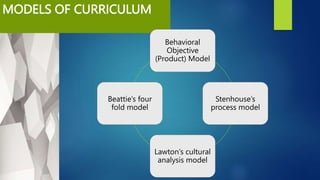
MODELS OF CURRICULUM
Behavioral
Objective
(Product) Model
Stenhouse’s
process model
Lawton’s cultural
analysis model
Beattie’s four
fold model
PURPOSES OF CURRICULUM
 To equip the learners through bringing the desirable
changes in them
 To cope with and handle life situations realistically,
rationally without sacrifying the humane principles.
 To establish values through intimate acquaintance with
the humanities, arts, natural sciences, social sciences
and religion
PURPOSES OF CURRICULUM
 To develop the character of students, i.e. integrity,
honesty, judgement, cooperation's, friendliness and
goodwill.
 To meet the needs of students with a wide range of
ability, aptitudes and interests
FUNCTIONS OF CURICULUM
PRIMARY FUNCTIONS:
To relate the various learning experiences which
together comprise the curriculum so as to
produce the maximum cumulative effect in
attaining the objectives of the school.
SECONDARY FUNCTIONS:
The effect it has on its student motivation.
Learning experiences should be organized
so as to maximize the total effect of the
various learning experiences by
Student’s personality development
Within the subject matter
COMPONENTS OF NURSING CURRICULUM
Curriculum invariably contains
 The statement of philosophy of the educational program
 The statement of the objectives of educational program
 Total duration of educational programme
 Detailed course plan for each course.
 Program of evaluation such as type of examinations,
various grades according to results, percentage meant for
internal assessment in university examinations etc.
NATURE OF CURRICULUM
 Curriculum as objectives
 Curriculum as subject matter
 Curriculum as student experience
 Curriculum as opportunities for
students
NATURE
OF
NURSIN
G
CURRIC
ULUM
In addition with above mentioned features,
nursing curriculum is
Health oriented
Flexible to meet the changing needs of the
society
Influenced by the developments in other health
care professions
Influenced by transnational trends in nursing
educatin and nursing service
Influenced by policy decisions based on
national health policy
CRITERIA FOR A DESIRABLE CURRICULUM
 The curriculum should describe the theory form,
i.e subject in the real form of community needs
 Curriculum should cope with the knowledge
explosion and scientific advancement
 Curriculum should use all the teaching personnel in
the most efficient and economic way
 Curriculum should use the logical, precise and
effective technology which are currently available in
the same as well in the allied discipline
 The curriculum should be consistent with the
theoretical framework of all the subjects included in
it
 The curriculum should enable the student to do active
practice
 The curriculum should provide facilities for testing the
ground behaviour in reality for the student
 The curriculum should be as such to produce graduates
who was capable of being creative for the next 15 to 20
years at least
 A curriculum which is plant should spend reasonable
length of time in order to complete the goals
 The curriculum should be enriched with the activities
for professional and personal growth of the learners
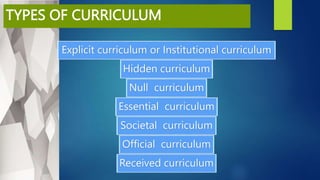
TYPES OF CURRICULUM
Explicit curriculum or Institutional curriculum
Hidden curriculum
Null curriculum
Essential curriculum
Societal curriculum
Official curriculum
Received curriculum
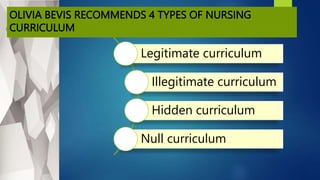
OLIVIA BEVIS RECOMMENDS 4 TYPES OF NURSING
CURRICULUM
Legitimate curriculum
Illegitimate curriculum
Hidden curriculum
Null curriculum
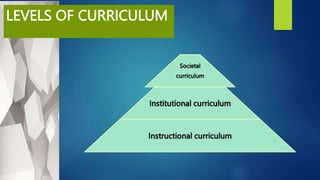
LEVELS OF CURRICULUM
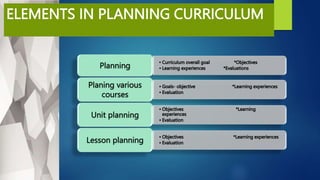
ELEMENTS IN PLANNING CURRICULUM
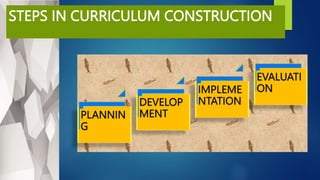
STEPS IN CURRICULUM CONSTRUCTION
ORGANIZATION OF CURRICULUM
 An ideal curriculum should be neither too flexible nor
too rigid- an appreciable amount of flexibility has to be
maintained
 Curriculum should be planned and organized in an
integrated form to maintain wholeness
 Curriculum should consider those needs, especially
the psychological needs of the students
 Curriculum should be organized on the basis of
desirable attitudes, abilities and skills including social,
moral, intellectual and aesthetical values of life
 Curriculum has to be organised effectively, efficiently,
logically, and should allow the precise use of
educational technology
 Curriculum should take into the knowledge explosion
and scientific advancement
 Curriculum should be organized in such a way that it
should provide appropriate learning experience and
also attending mastery in relevant areas of knowledge
 Democratic approach and leadership styles have to be
followed while organizing the curriculum
 Opinions of experts from other discipline should be
given due consideration while organizing the
curriculum
CURRICULUM PLANNING AND
DEVELOPMENT
 A process in which participants at many levels make decisions about the
purposes of leaning and teaching situation.
 It is the process of gathering, starting, selecting ,balancing and
synthesizing relevant information from many resources in order to design
those experiences that will assist learners in attaining the goals of
curriculum.
 It is the orderly study and improvement of schooling in light of stated
objectives.
CHARACTERISTICS
It is a continuous process
It takes place at many levels
It involves many groups, decisions about a variety
of planning and issues.
It is ultimately concerned with the experiences of
learner
BASIC PRINCIPLES OF CURRICULUM
CONSTRUCTION
• Principle of conservation
• Principle of selectivity
• Principle of forward-looking
• The creative principle
• Activity and experience curriculum
• Principle of preparation for life
• Principle of linking with life
• Child-centered curriculum
• Principle of maturity
• Principle of individual difference
• Vertical and horizontal articulation
• Principle of comprehensiveness and balance
• Principle of loyalties
• Principle of flexibility and need baseness
• Principle of common subjects/core subjects
• Principle of leisure
• Principle of sensitivity
CURRICULUM COMMITTEE
It is a committee consisting of members who actively participate in the
development or construction of curriculum for their school/college.
Curriculum administrator
Principal
School boards Communities
Law makers
Educational researchers
Teacher educators
Publishers.
State department of education
Parents
Students
Non school educators
Project directors
 Authors
 Testers
 Accreditors
 Polisters
 Lobbyists
 Philanthropists
ROLE OF CURRICULUM COMMITTEE
MEMBERS
 The process of curriculum construction is a cooperative effort.
 In this national agency, regional and local level agencies,
principals and the teachers as well as community members are
involved.
NATIONALAGENCY
 In Indian situation for the planning of secondary level curriculum the agency
involved at the central level are National Council of Educational Research and
Training (NCERT).
 It frames the curriculum and circulates it for adoption to state departments of
education, boards of examination etc.
 It frames the curriculum in consultation with experts, subject teachers, and heads of
institutions. I
 ts task is to frame the curriculum in keeping with the national policy on education.
 The curriculum framework prepared by it is only suggestive and it is for the state
governments and boards of Examination to accept it, modify it or reject it.
STATE GOVERNMENT
 As mention above the NCERT prepares the curriculum which is suggestive in
nature and it is the state government who decides to select, modify or rejected.
 Every state government appoints a board of examination for secondary and
higher secondary examination. This board prescribes the curriculum which has
to be followed in all the institution which are to be recognized for sending their
students for public examination conducted by the board.
 Each board has a subject committee which prescribes the content of the courses
in that subject.
INDIAN NURSING COUNCIL
 Indian Nursing Council plays a major role in the
development & revision of the nursing curriculum
 Nursing Educational Committee, part of INC will prepare
the curriculum for the prescribed courses.
 Members of the committee only will have an opportunity
to participate in curriculum development & revision.
THE ROLE OF TEACHERS
 Only those teachers who are the part of committee have the opportunity to
participate in this process.
 The teachers working in aided and recognized schools have no freedom to plan
their own curriculum.
 But , the teachers working in experimental innovative schools may have the
opportunity to do so. But for the most of teachers it is not possible to do so.
They may only have some freedom in the transacting the curriculum in
prescribed framework.
THE NEED FOR RESEARCH IN
NURSING
 Nursing research is a needed in nursing practice, education, administration, management.
 Nursing research needed to discover, verify, structure and restructure the professional knowledge
through systematic way.
 Research is the only way to:
 Build a body of nursing knowledge
 Validate improvements in nursing
 Make health care efficient as well as cost effective
 Nursing are expected to deliver the highest quality care.
 To get high quality need to update new knowledge through nursing research.
 It is needed to implement the research into a scientific approach of facts finding.
IMPORTANCE OF RESEARCH IN NURSING
CURRICULUM
 To improve the quality of care.
 To update the knowledge.
 Research allows nurses to question their practice,
find answers and thus implement into their area.
 Evidence based practice.
PATTERNS OF CURRICULUM ORGANIZATION
1. Student centered curriculum
 Co-operation, common interests, working together are under lying elements
brings about growth in life related skills.
 Learners are active partners in the curriculum pupil’s interest individual’s needs
are essential ingredients of curriculum
 Flexibility should be brought in the content, areas of learning & use of
instructional materials.
 Suitable resources have to be collected reference books, newspapers, journals,
excursions, libraries, films, audiotapes and TV etc.
2. Correlated curriculum
 Two or more subjects often exist in a school side by side with no apparent connection.
In some cases, these points are ‘natural’. For example, mathematical formulate needed for
solving problems in physics or chemistry.
3. Integrated or fused curriculum
 It means ‘blended together’.
 A bouring together of subjects and students might provide a stronger base for learning
for example; post basic B.sc (N) program, all the subjects which basic students learned
in four years, will be studied with in tow years as they had preliminary training in
diploma course and post basic B.se (N) will become base for learning
4. Core curriculum
 According to John Dewey’s “philosophy of experimentalism gave concepts
of core curriculum
 Focus of learning upon fundamental human activities
 Learning viewed of continuous reconstruction of experience
 Problem solving Basic democratic values and dynamic changes in political
and social ideas, cultural factors.
 Acceptance of cognitive theories of learning.
 It is a dynamic, organic process
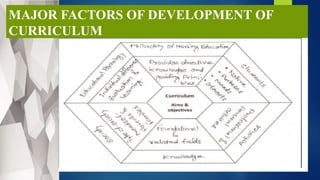
MAJOR FACTORS OF DEVELOPMENT OF
CURRICULUM
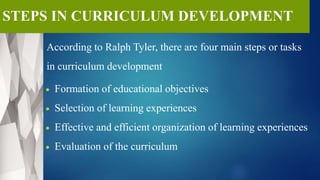
According to Ralph Tyler, there are four main steps or tasks
in curriculum development
 Formation of educational objectives
 Selection of learning experiences
 Effective and efficient organization of learning experiences
 Evaluation of the curriculum

Nursing curriculum is the learning opportunity

  • 1.
    MRS.B.KAVITHA M.SC (N), PROFESSOR ASWINICOLLEGE OF NURSING, THRISSUR
  • 2.
    INTRODUCTION Education aims thebehavior modification of learners. Behavior modification is achieved through a series of activities curriculum is concerned with guiding the teachers and students in the educative process. Therefore curriculum for the preparation of a teacher, nurse and student who can carry out these professional functions humanely and competently must be developed.
  • 3.
    MEANING AND DEFINITIONOF CURRICULUM  The term curriculum is derived from the Latin word “currere” which means, “run”. Thus, curriculum is a runway of attaining the goal of education. Curriculum may be considered as a blueprint of an educational program.  According to Cunningham, “curriculum” is the tool in the hands of an artist to mould his material, according to his ideals in his studio”. In this definition, artist is the teacher, material is the student ideals are objectives and studio is the educational institute.
  • 4.
     According toFlorence nightingale-”curriculum is systematic arrangement of the sum total of selected experiences planned by a school for a defined group of students to attain the aims of a particular educational program.  Nursing curriculum is the learning opportunities (subject matter) and the learning activities (clinical experiences and practices) that the faculty plans and implement in various settings for a particular group of students, for a specified period of time in order to attain the objectives
  • 5.
    MODELS OF CURRICULUM Behavioral Objective (Product)Model Stenhouse’s process model Lawton’s cultural analysis model Beattie’s four fold model
  • 6.
    PURPOSES OF CURRICULUM To equip the learners through bringing the desirable changes in them  To cope with and handle life situations realistically, rationally without sacrifying the humane principles.  To establish values through intimate acquaintance with the humanities, arts, natural sciences, social sciences and religion
  • 7.
    PURPOSES OF CURRICULUM To develop the character of students, i.e. integrity, honesty, judgement, cooperation's, friendliness and goodwill.  To meet the needs of students with a wide range of ability, aptitudes and interests
  • 8.
    FUNCTIONS OF CURICULUM PRIMARYFUNCTIONS: To relate the various learning experiences which together comprise the curriculum so as to produce the maximum cumulative effect in attaining the objectives of the school.
  • 9.
    SECONDARY FUNCTIONS: The effectit has on its student motivation. Learning experiences should be organized so as to maximize the total effect of the various learning experiences by Student’s personality development Within the subject matter
  • 10.
    COMPONENTS OF NURSINGCURRICULUM Curriculum invariably contains  The statement of philosophy of the educational program  The statement of the objectives of educational program  Total duration of educational programme  Detailed course plan for each course.  Program of evaluation such as type of examinations, various grades according to results, percentage meant for internal assessment in university examinations etc.
  • 11.
    NATURE OF CURRICULUM Curriculum as objectives  Curriculum as subject matter  Curriculum as student experience  Curriculum as opportunities for students
  • 12.
    NATURE OF NURSIN G CURRIC ULUM In addition withabove mentioned features, nursing curriculum is Health oriented Flexible to meet the changing needs of the society Influenced by the developments in other health care professions Influenced by transnational trends in nursing educatin and nursing service Influenced by policy decisions based on national health policy
  • 13.
    CRITERIA FOR ADESIRABLE CURRICULUM  The curriculum should describe the theory form, i.e subject in the real form of community needs  Curriculum should cope with the knowledge explosion and scientific advancement  Curriculum should use all the teaching personnel in the most efficient and economic way
  • 14.
     Curriculum shoulduse the logical, precise and effective technology which are currently available in the same as well in the allied discipline  The curriculum should be consistent with the theoretical framework of all the subjects included in it  The curriculum should enable the student to do active practice
  • 15.
     The curriculumshould provide facilities for testing the ground behaviour in reality for the student  The curriculum should be as such to produce graduates who was capable of being creative for the next 15 to 20 years at least  A curriculum which is plant should spend reasonable length of time in order to complete the goals  The curriculum should be enriched with the activities for professional and personal growth of the learners
  • 16.
    TYPES OF CURRICULUM Explicitcurriculum or Institutional curriculum Hidden curriculum Null curriculum Essential curriculum Societal curriculum Official curriculum Received curriculum
  • 17.
    OLIVIA BEVIS RECOMMENDS4 TYPES OF NURSING CURRICULUM Legitimate curriculum Illegitimate curriculum Hidden curriculum Null curriculum
  • 18.
  • 19.
  • 20.
    STEPS IN CURRICULUMCONSTRUCTION
  • 21.
    ORGANIZATION OF CURRICULUM An ideal curriculum should be neither too flexible nor too rigid- an appreciable amount of flexibility has to be maintained  Curriculum should be planned and organized in an integrated form to maintain wholeness  Curriculum should consider those needs, especially the psychological needs of the students
  • 22.
     Curriculum shouldbe organized on the basis of desirable attitudes, abilities and skills including social, moral, intellectual and aesthetical values of life  Curriculum has to be organised effectively, efficiently, logically, and should allow the precise use of educational technology  Curriculum should take into the knowledge explosion and scientific advancement
  • 23.
     Curriculum shouldbe organized in such a way that it should provide appropriate learning experience and also attending mastery in relevant areas of knowledge  Democratic approach and leadership styles have to be followed while organizing the curriculum  Opinions of experts from other discipline should be given due consideration while organizing the curriculum
  • 24.
    CURRICULUM PLANNING AND DEVELOPMENT A process in which participants at many levels make decisions about the purposes of leaning and teaching situation.  It is the process of gathering, starting, selecting ,balancing and synthesizing relevant information from many resources in order to design those experiences that will assist learners in attaining the goals of curriculum.  It is the orderly study and improvement of schooling in light of stated objectives.
  • 25.
    CHARACTERISTICS It is acontinuous process It takes place at many levels It involves many groups, decisions about a variety of planning and issues. It is ultimately concerned with the experiences of learner
  • 26.
    BASIC PRINCIPLES OFCURRICULUM CONSTRUCTION • Principle of conservation • Principle of selectivity • Principle of forward-looking • The creative principle • Activity and experience curriculum • Principle of preparation for life • Principle of linking with life • Child-centered curriculum • Principle of maturity • Principle of individual difference • Vertical and horizontal articulation • Principle of comprehensiveness and balance • Principle of loyalties • Principle of flexibility and need baseness • Principle of common subjects/core subjects • Principle of leisure • Principle of sensitivity
  • 27.
    CURRICULUM COMMITTEE It isa committee consisting of members who actively participate in the development or construction of curriculum for their school/college. Curriculum administrator Principal School boards Communities Law makers Educational researchers Teacher educators Publishers. State department of education Parents Students Non school educators Project directors  Authors  Testers  Accreditors  Polisters  Lobbyists  Philanthropists
  • 28.
    ROLE OF CURRICULUMCOMMITTEE MEMBERS  The process of curriculum construction is a cooperative effort.  In this national agency, regional and local level agencies, principals and the teachers as well as community members are involved.
  • 29.
    NATIONALAGENCY  In Indiansituation for the planning of secondary level curriculum the agency involved at the central level are National Council of Educational Research and Training (NCERT).  It frames the curriculum and circulates it for adoption to state departments of education, boards of examination etc.  It frames the curriculum in consultation with experts, subject teachers, and heads of institutions. I  ts task is to frame the curriculum in keeping with the national policy on education.  The curriculum framework prepared by it is only suggestive and it is for the state governments and boards of Examination to accept it, modify it or reject it.
  • 30.
    STATE GOVERNMENT  Asmention above the NCERT prepares the curriculum which is suggestive in nature and it is the state government who decides to select, modify or rejected.  Every state government appoints a board of examination for secondary and higher secondary examination. This board prescribes the curriculum which has to be followed in all the institution which are to be recognized for sending their students for public examination conducted by the board.  Each board has a subject committee which prescribes the content of the courses in that subject.
  • 31.
    INDIAN NURSING COUNCIL Indian Nursing Council plays a major role in the development & revision of the nursing curriculum  Nursing Educational Committee, part of INC will prepare the curriculum for the prescribed courses.  Members of the committee only will have an opportunity to participate in curriculum development & revision.
  • 32.
    THE ROLE OFTEACHERS  Only those teachers who are the part of committee have the opportunity to participate in this process.  The teachers working in aided and recognized schools have no freedom to plan their own curriculum.  But , the teachers working in experimental innovative schools may have the opportunity to do so. But for the most of teachers it is not possible to do so. They may only have some freedom in the transacting the curriculum in prescribed framework.
  • 33.
    THE NEED FORRESEARCH IN NURSING  Nursing research is a needed in nursing practice, education, administration, management.  Nursing research needed to discover, verify, structure and restructure the professional knowledge through systematic way.  Research is the only way to:  Build a body of nursing knowledge  Validate improvements in nursing  Make health care efficient as well as cost effective  Nursing are expected to deliver the highest quality care.  To get high quality need to update new knowledge through nursing research.  It is needed to implement the research into a scientific approach of facts finding.
  • 34.
    IMPORTANCE OF RESEARCHIN NURSING CURRICULUM  To improve the quality of care.  To update the knowledge.  Research allows nurses to question their practice, find answers and thus implement into their area.  Evidence based practice.
  • 35.
    PATTERNS OF CURRICULUMORGANIZATION 1. Student centered curriculum  Co-operation, common interests, working together are under lying elements brings about growth in life related skills.  Learners are active partners in the curriculum pupil’s interest individual’s needs are essential ingredients of curriculum  Flexibility should be brought in the content, areas of learning & use of instructional materials.  Suitable resources have to be collected reference books, newspapers, journals, excursions, libraries, films, audiotapes and TV etc.
  • 36.
    2. Correlated curriculum Two or more subjects often exist in a school side by side with no apparent connection. In some cases, these points are ‘natural’. For example, mathematical formulate needed for solving problems in physics or chemistry. 3. Integrated or fused curriculum  It means ‘blended together’.  A bouring together of subjects and students might provide a stronger base for learning for example; post basic B.sc (N) program, all the subjects which basic students learned in four years, will be studied with in tow years as they had preliminary training in diploma course and post basic B.se (N) will become base for learning
  • 37.
    4. Core curriculum According to John Dewey’s “philosophy of experimentalism gave concepts of core curriculum  Focus of learning upon fundamental human activities  Learning viewed of continuous reconstruction of experience  Problem solving Basic democratic values and dynamic changes in political and social ideas, cultural factors.  Acceptance of cognitive theories of learning.  It is a dynamic, organic process
  • 38.
    MAJOR FACTORS OFDEVELOPMENT OF CURRICULUM
  • 39.
    According to RalphTyler, there are four main steps or tasks in curriculum development  Formation of educational objectives  Selection of learning experiences  Effective and efficient organization of learning experiences  Evaluation of the curriculum