HEALTH PROBLEMS IN INDIA
ANAMIKA RAMAWAT
M.SC. NURSING PREV.
BATCH 2017-18
GCON, JODHPUR
Introduction
 India is an incredibly diverse and
culturally rich country. Despite
gigantic and beautiful
monuments, delicious food, a
booming business sector, and
Bollywood, it still has some major
health issues that many other
countries have minimized far
more successfully. These health
issues affect absolutely everyone,
from the poorest people to the
richest ones and from those who
live there to tourists who only
come for a short stay.
Health Problem
It is a state in which we are unable to
function normally (state of ill health,
unhealthiness).
HEALTH
PROBLEMS IN
INDIA
There are many health problems those are an obstacle in
the development of the country.
Communicable
disease problems
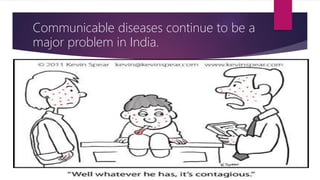
Communicable diseases continue to be a
major problem in India.
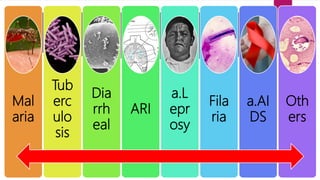
Mal
aria
Tub
erc
ulo
sis
Dia
rrh
eal
ARI
a.L
epr
osy
Fila
ria
a.AI
DS
Oth
ers
Malaria
 Malaria continues to be a health problem in India. Although total
malaria cases have declined compared to previous years, the
proportion of P. falciparum has increased.
 Malaria cases have increased in North-East states, Madhya
Pradesh, Chhattisgarh, Jharkhand, Orissa, Andhra Pradesh,
Maharashtra etc.
 During 2013 there were 0.8 million cases of malaria (which
included 0.44 million cases of Pf malaria) and 379 deaths
Tuberculosis
 Tuberculosis remains a public health problem, with India
accounting for one-fifth of the world incidence.
 Every year about 2.6 million persons develop tuberculosis of which
about 0.62 million are new smear positive highly infectious cases
and about 0.24 million people die of TB every year.
 The emergence of HIV-TB co-infection and multidrug resistant TB
has increased the severity and magnitude of the disease.
 In March 2006 RNTCP has achieved nation-wide coverage.
Diarrhoeal diseases
 Diarrhoeal diseases constitute one of the major causes of
morbidity and mortality, especially in children below 5 years of
age.
 They are responsible for about 10.76 million cases of
diarrhoea each year.
 Outbreaks of diarrhoeal diseases (including cholera) continue
to occur in India due to poor environmental conditions.
ARI
 Acute respiratory diseases are one of the major censes of
mortality and morbidity in children below 5 years of age.
 During 2013, 31.7 million episodes Of ARI were reported
with 3,278 deaths.
Leprosy
 Leprosy is another important public health problem in India.
 During the year 2013—2014, total of 1.27 lakh new cases were detected,
out of which child cases were 9.49% and deformity grade II and above
was 4.14% percent of cases are estimated to be multibacillary.
 All the States and Union Territories report cases of leprosy.
 However, there are considerable variations not only between one State
and another, but also between one district and another.
 With the prevalence rate of about 0.68 per 10,000 population, India has
achieved the goal of leprosy elimination at national level.
Filaria
 The problem of filaria remains endemic in about 250 districts in 20
States and UTs.
 The population at risk is over 600 million. To achieve elimination of
LF, the Govt. of India has launched nationwide Annual Drug
Administration (MDA) with annual single recommended dose of
diethylcarbamazine citrate tablets in addition to scaling up home
based foot care and hydrocele operations.
 In 2012, 250 endemic districts implemented MDA targeting a
population of about 554 million with a coverage rate of 87 per
cent.
AIDS
 The problem of AIDS is stable. It is estimated
that by the end of year 2012 there were about
2.08 million HIV positive cases in the country
Others
 Kala-azar
 Meningitis
 viral hepatitis
 Japanese encephalitis
 dengue fever
 enteric fever
 helminthic infestations - are among the other important
communicable disease problems in India
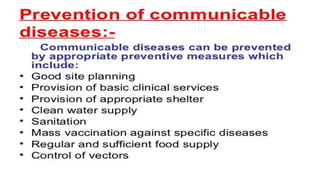
The tragedy is that most of these diseases can be
either easily prevented or treated with minimum
input of resources.
In fact, most of the developed countries of the
world have overcome many of these problems by
such measures as manipulation of environment,
practice of preventive medicine and,
improvement of standards of living.
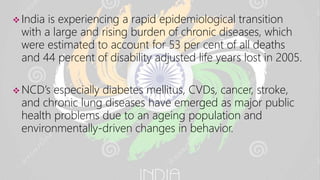
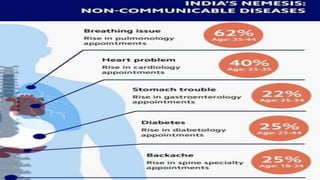
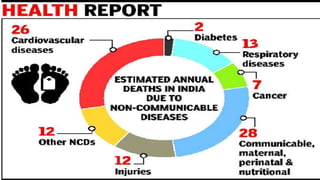
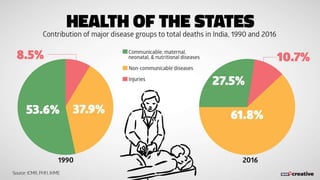
 India is experiencing a rapid epidemiological transition
with a large and rising burden of chronic diseases, which
were estimated to account for 53 per cent of all deaths
and 44 percent of disability adjusted life years lost in 2005.
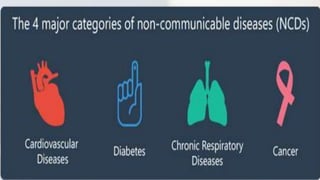
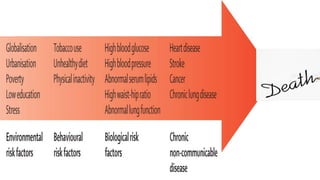
 NCD’s especially diabetes mellitus, CVDs, cancer, stroke,
and chronic lung diseases have emerged as major public
health problems due to an ageing population and
environmentally-driven changes in behavior.
 Cancer has become an important public health problem in India
with an estimated 7 to 9 lakh cases occurring every year.
 At any point of time, it is estimated that there are nearly 25 lakh
cases in the country.
 In India, tobacco related cancers account for about half the total
cancers among men and 20% among women. About one million
tobacco related deaths occur each year, making tobacco related
health issues a major public health concern.
 In India, more than 12 million people are blind.
 Cataract (62.6 per cent) is the main cause of blindness
followed by Refractive Error (19.70 per cent).
 There has been a significant increase in proportion of
cataract surgeries with Intra Ocular Lens (IOL)
implantation from <5 per cent in 1994 to 95 per cent in
2011—12.
 Oral Health Care has not been given sufficient importance
in our country.
 Most of the district hospitals have a post of dental surgeon
but they lack equipment, machinery, and material.
 Even where the equipment exists, the maintenance is
poor, hence service delivery is affected.
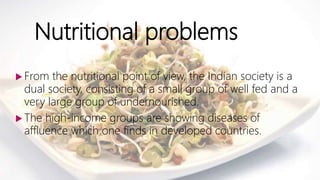
Nutritional problems
 From the nutritional point of view, the Indian society is a
dual society, consisting of a small group of well fed and a
very large group of undernourished.
 The high-income groups are showing diseases of
affluence which one finds in developed countries.
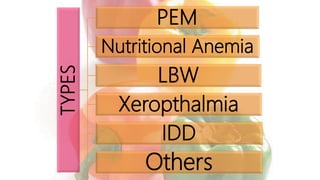
TYPES
PEM
Nutritional Anemia
LBW
Xeropthalmia
IDD
Others
Protein-energy malnutrition
 Insufficiency of food — the so-called "food gap"—
appears to be the chief cause of PEM, which is a
major health problem particularly in the first years of
life.
 The great majority of cases of PEM, nearly 80 per
cent are mild and moderate cases.
 The incidence of severe cases is 1 to 2 per cent in
preschool age children.
 The problem exists in all the States and the
nutritional marasmus is more frequent than
kwashiorkor
Nutritional anemia
 India has probably the highest prevalence of nutritional anemia in women
and children.
 About one-half of non-pregnant women and young children are estimated
to suffer from anemia i.e., 60 to 80 per cent of pregnant women are anemic,
19 per cent of maternal deaths are attributed to anemia.
 According to NFHS-3, about 57.9 per cent women are anemic of which 54.6
per cent are in urban areas and 59 per cent in rural areas.
 The survey also shows that the incidence of anemia in children aged 6-35
months is 79.2 per cent with 72.7 per cent in urban areas and 81.2 per cent
in rural areas. By far the most frequent cause of anemia is iron deficiency,
and less frequently folate and vitamin B12 deficiency
Low birth weight
 This is a major public health problem in many
developing countries.
 About 28 percent of babies born are of low birth
weight (less than 2.5 kg), as compared to about 4
percent in some developed countries.
 Maternal malnutrition and remain are mainly
responsible for this condition.
Xerophthalmia (nutritional
blindness)
 About 0.04 per cent of total blindness in India is attributed
to nutritional deficiency of vitamin A.
 Keratomalacia has been the major cause of nutritional
blindness in children usually between 1—3 years of age.
 Subclinical deficiency of vitamin A is also widespread and is
associated with increased morbidity and mortality from
respiratory and gastro-intestinal infections
Iodine deficiency disorders
 Goiter and other iodine deficiency disorders(IDD) have been
known to be highly endemic in sub-Himalayan regions.
 Reassessment of the magnitude of the problem by the Indian
Council of Medical Research showed that the problem I not
restricted to the “goiter belt” as was thought earlier but is
extremely prevalent in other parts of India as well.
 It has been found that out of 324 districts surveyed in 29 states
and all Uts, 263 districts are endemic i.e. where the prevalence of
IDD is more than 10 per cent.
 It is also estimated that more than 71 million people are suffering
from goiter and other IDD.
OTHERS
 Other nutritional problems of importance are lathyrism
and endemic fluorosis in certain parts of the country.
 To these must be added the widespread adulteration
of foodstuffs.
Environmental Sanitation
Problem
 The most difficult problem to tackle in
this country is perhaps the
environmental sanitation problem,
which is multifaceted and
multifactorial.
 The twin problems of environmental
sanitation are lack of safe water in
many areas of the country and
primitive methods of excreta disposal.
 Besides these, there has been a growing concern about the
impact of "new" problems resulting from population explosion,
urbanization and industrialization leading to hazards to human
health in the air, in water and in the food chain.
 At the United Nations Water Conference in Argentina, in 1977, it
was recommended that the priority should be given to the
provision of safe water supply and sanitation services for all.
 As of year, 2012 safe water is available to 96 per cent of the urban
and 87 per cent of the rural population; and adequate facilities for
waste disposal to 64 percent of the urban and 21 percent of the
rural population. The problem is gigantic.
MEDICAL CARE PROBLEMS
 The financial resources are considered inadequate to
furnish the costs of running such a service.
 The existing hospital-based, disease-oriented health
care model has provided health benefits mainly to the
urban elite.
 Approximately 80 per cent of health facilities are
concentrated in urban areas.
 Even in urban areas, there is an uneven distribution of
doctors.
 With large migrations occurring from rural to urban areas,
urban health problems have been aggravated and include
overcrowding in hospitals, inadequate staffing and scarcity
of certain essential drugs and medicines.
 The rural areas where nearly 72 per cent of the population live, do
not enjoy the benefits of the modern curative and preventive
health services.
 Many villages rely on indigenous systems of medicine. Thus, the
major medical care problem in India is in equable distribution of
available health resources between urban and rural areas, and lack
of penetration of health services to the social periphery.
 The HFA/2000 movement and the primary health care approach
which lays stress on equity, intersectoral coordination and
community participation seek to redress these imbalances.
Population Problem
 The population problem is one of the biggest problems facing the country,
with its inevitable consequences on all aspects of development, especially
employment, education, housing, health care, sanitation and environment.
 The country's population has already reached one billion marks by the turn
of the century.
 The Government has set a goal of 1 per cent population growth rate by the
year 2000 (which was not attained); currently, the country-s growth rate is
1.8 per cent. This calls for the "two child family norm".
 The population size and structure represent the most important single
factor in health and manpower planning in India today where the law of
diminishing returns, among other factors, plays an important role in the
economic development of the country
SUMMARY…
Health problems in India

Health problems in India

  • 1.
    HEALTH PROBLEMS ININDIA ANAMIKA RAMAWAT M.SC. NURSING PREV. BATCH 2017-18 GCON, JODHPUR
  • 2.
    Introduction  India isan incredibly diverse and culturally rich country. Despite gigantic and beautiful monuments, delicious food, a booming business sector, and Bollywood, it still has some major health issues that many other countries have minimized far more successfully. These health issues affect absolutely everyone, from the poorest people to the richest ones and from those who live there to tourists who only come for a short stay.
  • 6.
    Health Problem It isa state in which we are unable to function normally (state of ill health, unhealthiness).
  • 7.
    HEALTH PROBLEMS IN INDIA There aremany health problems those are an obstacle in the development of the country.
  • 9.
  • 10.
    Communicable diseases continueto be a major problem in India.
  • 12.
  • 13.
    Malaria  Malaria continuesto be a health problem in India. Although total malaria cases have declined compared to previous years, the proportion of P. falciparum has increased.  Malaria cases have increased in North-East states, Madhya Pradesh, Chhattisgarh, Jharkhand, Orissa, Andhra Pradesh, Maharashtra etc.  During 2013 there were 0.8 million cases of malaria (which included 0.44 million cases of Pf malaria) and 379 deaths
  • 14.
    Tuberculosis  Tuberculosis remainsa public health problem, with India accounting for one-fifth of the world incidence.  Every year about 2.6 million persons develop tuberculosis of which about 0.62 million are new smear positive highly infectious cases and about 0.24 million people die of TB every year.  The emergence of HIV-TB co-infection and multidrug resistant TB has increased the severity and magnitude of the disease.  In March 2006 RNTCP has achieved nation-wide coverage.
  • 15.
    Diarrhoeal diseases  Diarrhoealdiseases constitute one of the major causes of morbidity and mortality, especially in children below 5 years of age.  They are responsible for about 10.76 million cases of diarrhoea each year.  Outbreaks of diarrhoeal diseases (including cholera) continue to occur in India due to poor environmental conditions.
  • 16.
    ARI  Acute respiratorydiseases are one of the major censes of mortality and morbidity in children below 5 years of age.  During 2013, 31.7 million episodes Of ARI were reported with 3,278 deaths.
  • 17.
    Leprosy  Leprosy isanother important public health problem in India.  During the year 2013—2014, total of 1.27 lakh new cases were detected, out of which child cases were 9.49% and deformity grade II and above was 4.14% percent of cases are estimated to be multibacillary.  All the States and Union Territories report cases of leprosy.  However, there are considerable variations not only between one State and another, but also between one district and another.  With the prevalence rate of about 0.68 per 10,000 population, India has achieved the goal of leprosy elimination at national level.
  • 18.
    Filaria  The problemof filaria remains endemic in about 250 districts in 20 States and UTs.  The population at risk is over 600 million. To achieve elimination of LF, the Govt. of India has launched nationwide Annual Drug Administration (MDA) with annual single recommended dose of diethylcarbamazine citrate tablets in addition to scaling up home based foot care and hydrocele operations.  In 2012, 250 endemic districts implemented MDA targeting a population of about 554 million with a coverage rate of 87 per cent.
  • 19.
    AIDS  The problemof AIDS is stable. It is estimated that by the end of year 2012 there were about 2.08 million HIV positive cases in the country
  • 20.
    Others  Kala-azar  Meningitis viral hepatitis  Japanese encephalitis  dengue fever  enteric fever  helminthic infestations - are among the other important communicable disease problems in India
  • 21.
    The tragedy isthat most of these diseases can be either easily prevented or treated with minimum input of resources. In fact, most of the developed countries of the world have overcome many of these problems by such measures as manipulation of environment, practice of preventive medicine and, improvement of standards of living.
  • 24.
     India isexperiencing a rapid epidemiological transition with a large and rising burden of chronic diseases, which were estimated to account for 53 per cent of all deaths and 44 percent of disability adjusted life years lost in 2005.  NCD’s especially diabetes mellitus, CVDs, cancer, stroke, and chronic lung diseases have emerged as major public health problems due to an ageing population and environmentally-driven changes in behavior.
  • 27.
     Cancer hasbecome an important public health problem in India with an estimated 7 to 9 lakh cases occurring every year.  At any point of time, it is estimated that there are nearly 25 lakh cases in the country.  In India, tobacco related cancers account for about half the total cancers among men and 20% among women. About one million tobacco related deaths occur each year, making tobacco related health issues a major public health concern.
  • 28.
     In India,more than 12 million people are blind.  Cataract (62.6 per cent) is the main cause of blindness followed by Refractive Error (19.70 per cent).  There has been a significant increase in proportion of cataract surgeries with Intra Ocular Lens (IOL) implantation from <5 per cent in 1994 to 95 per cent in 2011—12.
  • 29.
     Oral HealthCare has not been given sufficient importance in our country.  Most of the district hospitals have a post of dental surgeon but they lack equipment, machinery, and material.  Even where the equipment exists, the maintenance is poor, hence service delivery is affected.
  • 35.
    Nutritional problems  Fromthe nutritional point of view, the Indian society is a dual society, consisting of a small group of well fed and a very large group of undernourished.  The high-income groups are showing diseases of affluence which one finds in developed countries.
  • 37.
  • 38.
    Protein-energy malnutrition  Insufficiencyof food — the so-called "food gap"— appears to be the chief cause of PEM, which is a major health problem particularly in the first years of life.  The great majority of cases of PEM, nearly 80 per cent are mild and moderate cases.  The incidence of severe cases is 1 to 2 per cent in preschool age children.  The problem exists in all the States and the nutritional marasmus is more frequent than kwashiorkor
  • 39.
    Nutritional anemia  Indiahas probably the highest prevalence of nutritional anemia in women and children.  About one-half of non-pregnant women and young children are estimated to suffer from anemia i.e., 60 to 80 per cent of pregnant women are anemic, 19 per cent of maternal deaths are attributed to anemia.  According to NFHS-3, about 57.9 per cent women are anemic of which 54.6 per cent are in urban areas and 59 per cent in rural areas.  The survey also shows that the incidence of anemia in children aged 6-35 months is 79.2 per cent with 72.7 per cent in urban areas and 81.2 per cent in rural areas. By far the most frequent cause of anemia is iron deficiency, and less frequently folate and vitamin B12 deficiency
  • 40.
    Low birth weight This is a major public health problem in many developing countries.  About 28 percent of babies born are of low birth weight (less than 2.5 kg), as compared to about 4 percent in some developed countries.  Maternal malnutrition and remain are mainly responsible for this condition.
  • 41.
    Xerophthalmia (nutritional blindness)  About0.04 per cent of total blindness in India is attributed to nutritional deficiency of vitamin A.  Keratomalacia has been the major cause of nutritional blindness in children usually between 1—3 years of age.  Subclinical deficiency of vitamin A is also widespread and is associated with increased morbidity and mortality from respiratory and gastro-intestinal infections
  • 42.
    Iodine deficiency disorders Goiter and other iodine deficiency disorders(IDD) have been known to be highly endemic in sub-Himalayan regions.  Reassessment of the magnitude of the problem by the Indian Council of Medical Research showed that the problem I not restricted to the “goiter belt” as was thought earlier but is extremely prevalent in other parts of India as well.  It has been found that out of 324 districts surveyed in 29 states and all Uts, 263 districts are endemic i.e. where the prevalence of IDD is more than 10 per cent.  It is also estimated that more than 71 million people are suffering from goiter and other IDD.
  • 43.
    OTHERS  Other nutritionalproblems of importance are lathyrism and endemic fluorosis in certain parts of the country.  To these must be added the widespread adulteration of foodstuffs.
  • 44.
    Environmental Sanitation Problem  Themost difficult problem to tackle in this country is perhaps the environmental sanitation problem, which is multifaceted and multifactorial.  The twin problems of environmental sanitation are lack of safe water in many areas of the country and primitive methods of excreta disposal.
  • 45.
     Besides these,there has been a growing concern about the impact of "new" problems resulting from population explosion, urbanization and industrialization leading to hazards to human health in the air, in water and in the food chain.  At the United Nations Water Conference in Argentina, in 1977, it was recommended that the priority should be given to the provision of safe water supply and sanitation services for all.  As of year, 2012 safe water is available to 96 per cent of the urban and 87 per cent of the rural population; and adequate facilities for waste disposal to 64 percent of the urban and 21 percent of the rural population. The problem is gigantic.
  • 46.
    MEDICAL CARE PROBLEMS The financial resources are considered inadequate to furnish the costs of running such a service.  The existing hospital-based, disease-oriented health care model has provided health benefits mainly to the urban elite.
  • 47.
     Approximately 80per cent of health facilities are concentrated in urban areas.  Even in urban areas, there is an uneven distribution of doctors.  With large migrations occurring from rural to urban areas, urban health problems have been aggravated and include overcrowding in hospitals, inadequate staffing and scarcity of certain essential drugs and medicines.
  • 48.
     The ruralareas where nearly 72 per cent of the population live, do not enjoy the benefits of the modern curative and preventive health services.  Many villages rely on indigenous systems of medicine. Thus, the major medical care problem in India is in equable distribution of available health resources between urban and rural areas, and lack of penetration of health services to the social periphery.  The HFA/2000 movement and the primary health care approach which lays stress on equity, intersectoral coordination and community participation seek to redress these imbalances.
  • 49.
    Population Problem  Thepopulation problem is one of the biggest problems facing the country, with its inevitable consequences on all aspects of development, especially employment, education, housing, health care, sanitation and environment.  The country's population has already reached one billion marks by the turn of the century.  The Government has set a goal of 1 per cent population growth rate by the year 2000 (which was not attained); currently, the country-s growth rate is 1.8 per cent. This calls for the "two child family norm".  The population size and structure represent the most important single factor in health and manpower planning in India today where the law of diminishing returns, among other factors, plays an important role in the economic development of the country
  • 50.