Curriculum development
• It is a set of practices aimed at introducing
planned changes in search of better
achievements
• Curriculum development is a process that
continuously strives to find newer better and
more efficient means to accomplish the task of
educating the next generation
Purposes of curriculum development
• It establishes a clear philosophy and set of goals
that guides the entire program
• It outlines a basic framework for what to do,
how to do it, when to do it, and how to know if it
has been achieved?
• It allows for flexibility and encourages
experimentation and innovation within an over
all structure
• It promote interdisciplinary approaches and the
integration of curricula
• It suggests method of assessing the
achievement of program’s goals and objective
• It provides a means for it’s own going revision
and improvement
• It provides direction for procurement of
human, material and fiscal resources to
implement the program
Process
The process progress from evaluating the
existing program, to design an improved
program, to implementing a new program and
back to evaluating the revised program
Steps
1. Formulating the statement of philosophy
2. Establishing the purposes and objectives
3. Selection of learning experiences
4. Effective organization of the selected learning
experiences
5. Evaluation of the total program
1. Formulating the statement of the philosophy
of the school or college or university
- Philosophy originates from the board of trustees
and it’s members
- It serves as a framework within the organization
- It states the values which are to be believed right,
true and good by the persons responsible for the
college
- Statement of philosophy will be foundation on
which the objectives of the program will be
determined
2. Establishing the purposes and objectives
Purposes:- describe the overall goals of the total
education program
Objective:- breakdown of purposes into specific
goals which can be used to pinpoint the
content
- Objective is formulating to indicate what
changes in behavior it is hoped to bring about
in the students
Factors should be considered while determining the
purposes and objectives
 Statement of philosophy
 Social and health needs of the people
 Kind of student to be expected in the education
program
 Level of professional competence to be attained
 Role of nurse in society
 Statutory minimum requirements
 Teaching, physical and clinical resources
availability
- Objective of the institution become objective of the
curriculum of educational program
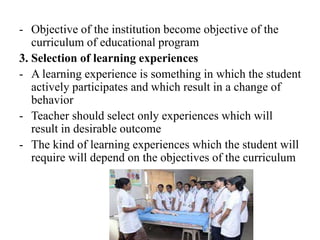
3. Selection of learning experiences
- A learning experience is something in which the student
actively participates and which result in a change of
behavior
- Teacher should select only experiences which will
result in desirable outcome
- The kind of learning experiences which the student will
require will depend on the objectives of the curriculum
4. Organization and integration of experiences
and content
- After selecting the learning experiences it
should be organized in the curriculum
- Criteria for organizing the learning
experiences
Continuity
Sequence
Integration
Continuity:- relationship existing between
different levels of the same subjects or skills
Sequence:- it is related to continuity
- Each successive experience goes more deeply
and broadly into the subjects
- Each new experience reinforces and extends
the previous one
Integration:- relationship among learning
experiences which bring about a unified view
and behavior
5. Evaluation of the curriculum
Final step is the coming to conclusions about
the success or failure of the educational
enterprise
Curriculum development steps in Nursing
Education in India
1. Regulatory bodies, governing bodies
2. Need identification for curriculum development
3. Selection of experts from various nursing and
medical departments
4. Defining goals, philosophy, mission statement of
curriculum
5. Selection of various technical working groups
(TWG) from experts for division of work
7. Selection of group leader, who will represent
each TWG at national level
8. Distribution of subjects/content matter to
various working TWG
9. Sub division of work in each group under the
guidance of group leader
10. Submission of content matter
11. Revisions, modification within TWG
12.Try out through workshop
13.Final submission to group leader of each
TWG
14.Meeting of leaders to all TWGs
15.Discussion, modifications by national core
committee
16.Formulation of final draft
17.Implementation of developed curriculum- try out
18.Revision after try out and final implementation
at national level
19.At institutional level, implementation of course
plan/ syllabus as formed by core committee
20.At institutional level, development of unit plan,
master rotation plan and clinical rotation plan
21.Evaluation
Types of curriculum
1. Traditional curriculum
- It is one which has been in vogue for a
sufficiently long time and is concerned in terms
of subjects
- It is nothing but a statement of subjects of study
with indications of their extent and time limit.
- Each subject is separate entity and its nature and
score is clearly defined
- Stress on intellectual attainment
2. Activity curriculum
• In activity curriculum subject matter is
translated in terms of activities and knowledge
is gained as an outgrowth and product of those
activities
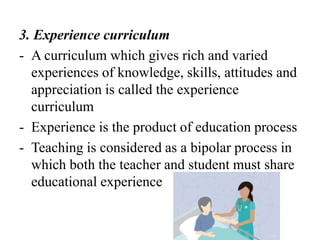
3. Experience curriculum
- A curriculum which gives rich and varied
experiences of knowledge, skills, attitudes and
appreciation is called the experience
curriculum
- Experience is the product of education process
- Teaching is considered as a bipolar process in
which both the teacher and student must share
educational experience
4. Undifferentiated curriculum
• Curriculum which does not aim at specialized
study of various subjects
• It lays on stress on the formation of habits,
skills and virtues
5. Basic curriculum
• To bring about an all round development of
child the curriculum of basic education has
been constructed around three integrally
related centers: physical environment, social
environment, craft
6. Life centered or balanced curriculum
• It will include all the aspect of human activity
and human development and will thus cater the
need of both the individual and society
7. Overt, explicit or written curriculum
- Is that which is written as part of formal
instruction of schooling experiences
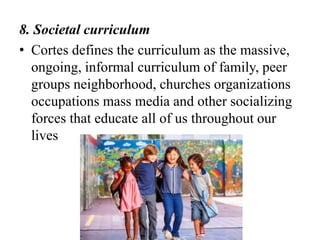
8. Societal curriculum
• Cortes defines the curriculum as the massive,
ongoing, informal curriculum of family, peer
groups neighborhood, churches organizations
occupations mass media and other socializing
forces that educate all of us throughout our
lives
9. Hidden or covert curriculum
• Kind of all learning children derive from very
nature and organizational design of the public
school as well as from the behaviors and
attitudes of teachers and administrators
10. Null curriculum
• According to Eisner, the Null curriculum is
that which we do not teach, thus giving
students the message that these elements are
not important in their educational experiences
or in our society
• It is simply which is not taught in educational
institutions
11. Phantom curriculum
• It consists of the messages prevalent in and
through exposure to any type of media
• These components and messages play a major
part in the acculturation of students of students
into the predominant meta-culture
• Acculturation is the process of adopting the
cultural traits or social patterns of another
group
12.Concomitant curriculum
• What is taught or emphasized at home, or
those experiences or related experiences
sanctioned by the family
13. Rhetorical curriculum
Rhetorical- relating to
• It focused on teaching students how to
construct and express arguments through
deeper exposure to and practice with the
subjects taught
14. Formal curriculum
Comprises those things in textbooks, and content
concepts in the district curriculum guides
The curriculum-in-use is the actual curriculum
that is delivered and presented by each teacher
15. Received curriculum
- Those things that students actually take out of
classroom
- Those concepts and content that are truly
learned and remembered
16. The internal curriculum
- Processes, content, knowledge combined with
the experiences and realities of the learner to
create new knowledge.
16. Electronic curriculum
- Through searching the internet for information
or through using e-forms of communication
17. Competency curriculum
- It consists of competencies
- Assessment and certification of achievement
of the competencies is sequentially integrated
into each year of the curriculum culminating
with a competency transcript upon graduation
18. Medical curriculum
There are nine competencies of medical curriculum
a) Effective communication
b) Basic clinical skills
c) Using science to guide diagnosis, management,
therapeutics and prevention
d) Lifelong learning
e) Self-awareness, self care and personal growth
f) Social and community contexts of health care
g) Moral reasoning and Judgment
h) Problem solving
i) Professionalism and role recognition
19. Core curriculum
- It is concept born out of necessity to tame the
knowledge explosion and show the teachers
and the learners what are the essential
knowledge and skills that the learners should
acquire during the course
- It develops integration, serves the needs of the
students and promotes active learning and
relates to life and learning

Curriculum development in nursing ed.pptx

  • 1.
  • 2.
    • It isa set of practices aimed at introducing planned changes in search of better achievements • Curriculum development is a process that continuously strives to find newer better and more efficient means to accomplish the task of educating the next generation
  • 3.
    Purposes of curriculumdevelopment • It establishes a clear philosophy and set of goals that guides the entire program • It outlines a basic framework for what to do, how to do it, when to do it, and how to know if it has been achieved? • It allows for flexibility and encourages experimentation and innovation within an over all structure • It promote interdisciplinary approaches and the integration of curricula
  • 4.
    • It suggestsmethod of assessing the achievement of program’s goals and objective • It provides a means for it’s own going revision and improvement • It provides direction for procurement of human, material and fiscal resources to implement the program
  • 5.
    Process The process progressfrom evaluating the existing program, to design an improved program, to implementing a new program and back to evaluating the revised program
  • 6.
    Steps 1. Formulating thestatement of philosophy 2. Establishing the purposes and objectives 3. Selection of learning experiences 4. Effective organization of the selected learning experiences 5. Evaluation of the total program
  • 7.
    1. Formulating thestatement of the philosophy of the school or college or university - Philosophy originates from the board of trustees and it’s members - It serves as a framework within the organization - It states the values which are to be believed right, true and good by the persons responsible for the college - Statement of philosophy will be foundation on which the objectives of the program will be determined
  • 8.
    2. Establishing thepurposes and objectives Purposes:- describe the overall goals of the total education program Objective:- breakdown of purposes into specific goals which can be used to pinpoint the content - Objective is formulating to indicate what changes in behavior it is hoped to bring about in the students
  • 9.
    Factors should beconsidered while determining the purposes and objectives  Statement of philosophy  Social and health needs of the people  Kind of student to be expected in the education program  Level of professional competence to be attained  Role of nurse in society  Statutory minimum requirements  Teaching, physical and clinical resources availability
  • 10.
    - Objective ofthe institution become objective of the curriculum of educational program 3. Selection of learning experiences - A learning experience is something in which the student actively participates and which result in a change of behavior - Teacher should select only experiences which will result in desirable outcome - The kind of learning experiences which the student will require will depend on the objectives of the curriculum
  • 11.
    4. Organization andintegration of experiences and content - After selecting the learning experiences it should be organized in the curriculum - Criteria for organizing the learning experiences Continuity Sequence Integration
  • 12.
    Continuity:- relationship existingbetween different levels of the same subjects or skills Sequence:- it is related to continuity - Each successive experience goes more deeply and broadly into the subjects - Each new experience reinforces and extends the previous one Integration:- relationship among learning experiences which bring about a unified view and behavior
  • 13.
    5. Evaluation ofthe curriculum Final step is the coming to conclusions about the success or failure of the educational enterprise
  • 14.
    Curriculum development stepsin Nursing Education in India 1. Regulatory bodies, governing bodies 2. Need identification for curriculum development 3. Selection of experts from various nursing and medical departments 4. Defining goals, philosophy, mission statement of curriculum 5. Selection of various technical working groups (TWG) from experts for division of work
  • 15.
    7. Selection ofgroup leader, who will represent each TWG at national level 8. Distribution of subjects/content matter to various working TWG 9. Sub division of work in each group under the guidance of group leader 10. Submission of content matter 11. Revisions, modification within TWG 12.Try out through workshop 13.Final submission to group leader of each TWG
  • 16.
    14.Meeting of leadersto all TWGs 15.Discussion, modifications by national core committee 16.Formulation of final draft 17.Implementation of developed curriculum- try out 18.Revision after try out and final implementation at national level 19.At institutional level, implementation of course plan/ syllabus as formed by core committee 20.At institutional level, development of unit plan, master rotation plan and clinical rotation plan 21.Evaluation
  • 17.
    Types of curriculum 1.Traditional curriculum - It is one which has been in vogue for a sufficiently long time and is concerned in terms of subjects - It is nothing but a statement of subjects of study with indications of their extent and time limit. - Each subject is separate entity and its nature and score is clearly defined - Stress on intellectual attainment
  • 18.
    2. Activity curriculum •In activity curriculum subject matter is translated in terms of activities and knowledge is gained as an outgrowth and product of those activities
  • 19.
    3. Experience curriculum -A curriculum which gives rich and varied experiences of knowledge, skills, attitudes and appreciation is called the experience curriculum - Experience is the product of education process - Teaching is considered as a bipolar process in which both the teacher and student must share educational experience
  • 20.
    4. Undifferentiated curriculum •Curriculum which does not aim at specialized study of various subjects • It lays on stress on the formation of habits, skills and virtues
  • 21.
    5. Basic curriculum •To bring about an all round development of child the curriculum of basic education has been constructed around three integrally related centers: physical environment, social environment, craft
  • 22.
    6. Life centeredor balanced curriculum • It will include all the aspect of human activity and human development and will thus cater the need of both the individual and society 7. Overt, explicit or written curriculum - Is that which is written as part of formal instruction of schooling experiences
  • 23.
    8. Societal curriculum •Cortes defines the curriculum as the massive, ongoing, informal curriculum of family, peer groups neighborhood, churches organizations occupations mass media and other socializing forces that educate all of us throughout our lives
  • 24.
    9. Hidden orcovert curriculum • Kind of all learning children derive from very nature and organizational design of the public school as well as from the behaviors and attitudes of teachers and administrators
  • 25.
    10. Null curriculum •According to Eisner, the Null curriculum is that which we do not teach, thus giving students the message that these elements are not important in their educational experiences or in our society • It is simply which is not taught in educational institutions
  • 26.
    11. Phantom curriculum •It consists of the messages prevalent in and through exposure to any type of media • These components and messages play a major part in the acculturation of students of students into the predominant meta-culture • Acculturation is the process of adopting the cultural traits or social patterns of another group
  • 27.
    12.Concomitant curriculum • Whatis taught or emphasized at home, or those experiences or related experiences sanctioned by the family 13. Rhetorical curriculum Rhetorical- relating to • It focused on teaching students how to construct and express arguments through deeper exposure to and practice with the subjects taught
  • 28.
    14. Formal curriculum Comprisesthose things in textbooks, and content concepts in the district curriculum guides The curriculum-in-use is the actual curriculum that is delivered and presented by each teacher
  • 29.
    15. Received curriculum -Those things that students actually take out of classroom - Those concepts and content that are truly learned and remembered 16. The internal curriculum - Processes, content, knowledge combined with the experiences and realities of the learner to create new knowledge.
  • 30.
    16. Electronic curriculum -Through searching the internet for information or through using e-forms of communication 17. Competency curriculum - It consists of competencies - Assessment and certification of achievement of the competencies is sequentially integrated into each year of the curriculum culminating with a competency transcript upon graduation
  • 31.
    18. Medical curriculum Thereare nine competencies of medical curriculum a) Effective communication b) Basic clinical skills c) Using science to guide diagnosis, management, therapeutics and prevention d) Lifelong learning e) Self-awareness, self care and personal growth f) Social and community contexts of health care g) Moral reasoning and Judgment h) Problem solving i) Professionalism and role recognition
  • 32.
    19. Core curriculum -It is concept born out of necessity to tame the knowledge explosion and show the teachers and the learners what are the essential knowledge and skills that the learners should acquire during the course - It develops integration, serves the needs of the students and promotes active learning and relates to life and learning