Ohms Law
Today’s Focus
• Background Information of Ohms
law
• Formula and triangle method
relationship
• Examples
VOLTAGE, CURRENT, AND RESISTANCE
1.VOLTAGE- THE AMOUNT OF ENERGY PER CHANGE MOVE ELECTRONS IN ONE POINT TO
ANOTHER IN A CIRCUIT. IT IS MEASURE IN VOLTS(V)
2. CURRENT- THE RATE OF CHARGE FLOW AND IT IS MEASURED IN AMPERES (A).
3. RESISTANCE- THE OPPOSITION OF CURRENT AND IT IS MEASURED IN OHMS (Ω)
DC CIRCUIT
• THE CURRENT FROM A BATTERY AND IS ALWAYS IN THE SAME DIRECTION
• ONE END OF THE BATTERY IS POSITIVE AND THE OTHER END IS NEGATIVE
• THE DIRECTION OF CURRENT FLOWS FROM POSITIVE TO NEGATIVE
AC CIRCUIT
• IF VOLTAGE ALTERNATES, SO DOES THE CURRENT
• WHEN THE VOLTAGE IS POSITIVE, THE CURRENT IN THE CIRCUIT IS CLOCKWISE
• WHEN THE VOLTAGE IS NEGATIVE THE CURRENT IS THE OPPOSITE DIRECTION
BACKTRACKING
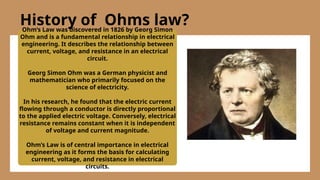
Ohm’s Law was discovered in 1826 by Georg Simon
Ohm and is a fundamental relationship in electrical
engineering. It describes the relationship between
current, voltage, and resistance in an electrical
circuit.
Georg Simon Ohm was a German physicist and
mathematician who primarily focused on the
science of electricity.
In his research, he found that the electric current
flowing through a conductor is directly proportional
to the applied electric voltage. Conversely, electrical
resistance remains constant when it is independent
of voltage and current magnitude.
Ohm’s Law is of central importance in electrical
engineering as it forms the basis for calculating
current, voltage, and resistance in electrical
circuits.
History of Ohms law?
The amount of steady current through a large number of materials is directly
proportional to the potential difference, or Voltage, across the materials. Thus, if the
voltage V (in units of volts) between two ends of a wire made from one of these
materials is tripled, the Current I (amperes) also triples; and the quotient V/I remains
constant. The quotient V/I for a given piece of material is called its resistance, R,
measured in units named ohms. The resistance of materials for which Ohm’s law is
valid does not change over enormous ranges of voltage and current.
Further explanation
REPRESENTATION
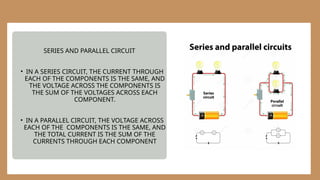
SERIES AND PARALLEL CIRCUIT
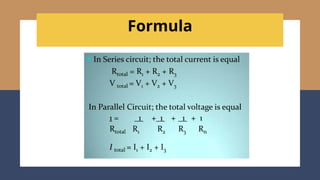
• IN A SERIES CIRCUIT, THE CURRENT THROUGH
EACH OF THE COMPONENTS IS THE SAME, AND
THE VOLTAGE ACROSS THE COMPONENTS IS
THE SUM OF THE VOLTAGES ACROSS EACH
COMPONENT.
• IN A PARALLEL CIRCUIT, THE VOLTAGE ACROSS
EACH OF THE COMPONENTS IS THE SAME, AND
THE TOTAL CURRENT IS THE SUM OF THE
CURRENTS THROUGH EACH COMPONENT
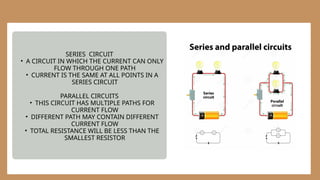
SERIES CIRCUIT
• A CIRCUIT IN WHICH THE CURRENT CAN ONLY
FLOW THROUGH ONE PATH
• CURRENT IS THE SAME AT ALL POINTS IN A
SERIES CIRCUIT
PARALLEL CIRCUITS
• THIS CIRCUIT HAS MULTIPLE PATHS FOR
CURRENT FLOW
• DIFFERENT PATH MAY CONTAIN DIFFERENT
CURRENT FLOW
• TOTAL RESISTANCE WILL BE LESS THAN THE
SMALLEST RESISTOR
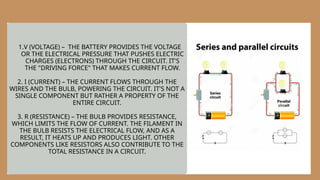
1.V (VOLTAGE) – THE BATTERY PROVIDES THE VOLTAGE
OR THE ELECTRICAL PRESSURE THAT PUSHES ELECTRIC
CHARGES (ELECTRONS) THROUGH THE CIRCUIT. IT'S
THE "DRIVING FORCE" THAT MAKES CURRENT FLOW.
2. I (CURRENT) – THE CURRENT FLOWS THROUGH THE
WIRES AND THE BULB, POWERING THE CIRCUIT. IT'S NOT A
SINGLE COMPONENT BUT RATHER A PROPERTY OF THE
ENTIRE CIRCUIT.
3. R (RESISTANCE) – THE BULB PROVIDES RESISTANCE,
WHICH LIMITS THE FLOW OF CURRENT. THE FILAMENT IN
THE BULB RESISTS THE ELECTRICAL FLOW, AND AS A
RESULT, IT HEATS UP AND PRODUCES LIGHT. OTHER
COMPONENTS LIKE RESISTORS ALSO CONTRIBUTE TO THE
TOTAL RESISTANCE IN A CIRCUIT.
Formula
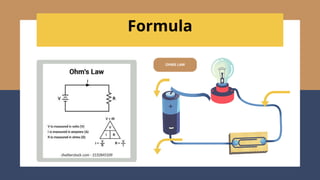
OHMS LAW
Formula
Triangle Method
The Ohm's Law triangle is a simple
visual tool to help remember the
relationship between voltage (V),
current (I), and resistance (R). It
allows you to easily rearrange the
formula depending on which value
you need to calculate.
EXAMPLES
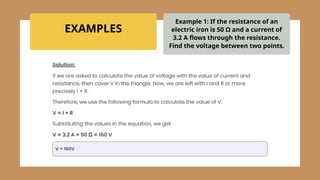
Example 1: If the resistance of an
electric iron is 50 Ω and a current of
3.2 A flows through the resistance.
Find the voltage between two points.
EXAMPLES
Example 2: You are using a phone
charger that provides a voltage of 5
volts to charge your smartphone. The
internal resistance of your phone's
battery is 2 ohms. Using Ohm's Law,
calculate the current flowing into the
battery.
EXAMPLES
Example 3: An EMF source of 8.0 V is
connected to a purely resistive
electrical appliance (a light bulb). An
electric current of 2.0 A flows through
it. Consider the conducting wires to
be resistance-free. Calculate the
resistance offered by the electrical
appliance.
EXAMPLES
Example 3: An EMF source of 8.0 V is
connected to a purely resistive
electrical appliance (a light bulb). An
electric current of 2.0 A flows through
it. Consider the conducting wires to
be resistance-free. Calculate the
resistance offered by the electrical
appliance.
EXAMPLES
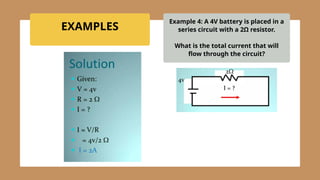
Example 4: A 4V battery is placed in a
series circuit with a 2Ω resistor.
What is the total current that will
flow through the circuit?
EXAMPLES
Example 5: A 110V supplies a load
with a resistance of 3Ω, 5Ω, and 7Ω
respectively, find the current in the
circuit?
EXAMPLES
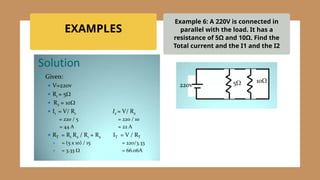
Example 6: A 220V is connected in
parallel with the load. It has a
resistance of 5Ω and 10Ω. Find the
Total current and the I1 and the I2
EXAMPLES
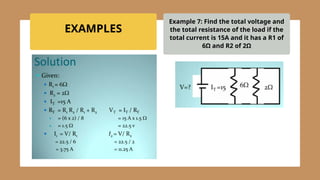
Example 7: Find the total voltage and
the total resistance of the load if the
total current is 15A and it has a R1 of
6Ω and R2 of 2Ω
You are given a circuit that consists of
a battery providing 2 voltages of 4
volts, and three resistors: R1=2 Ω, R2=4
Ω, and R3=6 Ω. Resistor R1​is connected
in series with two resistors, R2​and R3
which are connected in parallel.
1: Calculate the total resistance of the
circuit.
2: Calculate the total voltage of the
circuit.
3: Using Ohm's Law, determine the
current flowing through the circuit.
Additional
Example
Solve The
Problem
THANK YOU!!
Prepared by: Group 7
Aniñon, Krhysr Marie C.
Tamayo, Daniela S.

OHMS-LAW FOR THIRD BASIC UNDERSTANDING AND CONCEPT

  • 1.
  • 2.
    Today’s Focus • BackgroundInformation of Ohms law • Formula and triangle method relationship • Examples
  • 3.
    VOLTAGE, CURRENT, ANDRESISTANCE 1.VOLTAGE- THE AMOUNT OF ENERGY PER CHANGE MOVE ELECTRONS IN ONE POINT TO ANOTHER IN A CIRCUIT. IT IS MEASURE IN VOLTS(V) 2. CURRENT- THE RATE OF CHARGE FLOW AND IT IS MEASURED IN AMPERES (A). 3. RESISTANCE- THE OPPOSITION OF CURRENT AND IT IS MEASURED IN OHMS (Ω) DC CIRCUIT • THE CURRENT FROM A BATTERY AND IS ALWAYS IN THE SAME DIRECTION • ONE END OF THE BATTERY IS POSITIVE AND THE OTHER END IS NEGATIVE • THE DIRECTION OF CURRENT FLOWS FROM POSITIVE TO NEGATIVE AC CIRCUIT • IF VOLTAGE ALTERNATES, SO DOES THE CURRENT • WHEN THE VOLTAGE IS POSITIVE, THE CURRENT IN THE CIRCUIT IS CLOCKWISE • WHEN THE VOLTAGE IS NEGATIVE THE CURRENT IS THE OPPOSITE DIRECTION BACKTRACKING
  • 4.
    Ohm’s Law wasdiscovered in 1826 by Georg Simon Ohm and is a fundamental relationship in electrical engineering. It describes the relationship between current, voltage, and resistance in an electrical circuit. Georg Simon Ohm was a German physicist and mathematician who primarily focused on the science of electricity. In his research, he found that the electric current flowing through a conductor is directly proportional to the applied electric voltage. Conversely, electrical resistance remains constant when it is independent of voltage and current magnitude. Ohm’s Law is of central importance in electrical engineering as it forms the basis for calculating current, voltage, and resistance in electrical circuits. History of Ohms law?
  • 5.
    The amount ofsteady current through a large number of materials is directly proportional to the potential difference, or Voltage, across the materials. Thus, if the voltage V (in units of volts) between two ends of a wire made from one of these materials is tripled, the Current I (amperes) also triples; and the quotient V/I remains constant. The quotient V/I for a given piece of material is called its resistance, R, measured in units named ohms. The resistance of materials for which Ohm’s law is valid does not change over enormous ranges of voltage and current. Further explanation
  • 6.
  • 7.
    SERIES AND PARALLELCIRCUIT • IN A SERIES CIRCUIT, THE CURRENT THROUGH EACH OF THE COMPONENTS IS THE SAME, AND THE VOLTAGE ACROSS THE COMPONENTS IS THE SUM OF THE VOLTAGES ACROSS EACH COMPONENT. • IN A PARALLEL CIRCUIT, THE VOLTAGE ACROSS EACH OF THE COMPONENTS IS THE SAME, AND THE TOTAL CURRENT IS THE SUM OF THE CURRENTS THROUGH EACH COMPONENT
  • 8.
    SERIES CIRCUIT • ACIRCUIT IN WHICH THE CURRENT CAN ONLY FLOW THROUGH ONE PATH • CURRENT IS THE SAME AT ALL POINTS IN A SERIES CIRCUIT PARALLEL CIRCUITS • THIS CIRCUIT HAS MULTIPLE PATHS FOR CURRENT FLOW • DIFFERENT PATH MAY CONTAIN DIFFERENT CURRENT FLOW • TOTAL RESISTANCE WILL BE LESS THAN THE SMALLEST RESISTOR
  • 10.
    1.V (VOLTAGE) –THE BATTERY PROVIDES THE VOLTAGE OR THE ELECTRICAL PRESSURE THAT PUSHES ELECTRIC CHARGES (ELECTRONS) THROUGH THE CIRCUIT. IT'S THE "DRIVING FORCE" THAT MAKES CURRENT FLOW. 2. I (CURRENT) – THE CURRENT FLOWS THROUGH THE WIRES AND THE BULB, POWERING THE CIRCUIT. IT'S NOT A SINGLE COMPONENT BUT RATHER A PROPERTY OF THE ENTIRE CIRCUIT. 3. R (RESISTANCE) – THE BULB PROVIDES RESISTANCE, WHICH LIMITS THE FLOW OF CURRENT. THE FILAMENT IN THE BULB RESISTS THE ELECTRICAL FLOW, AND AS A RESULT, IT HEATS UP AND PRODUCES LIGHT. OTHER COMPONENTS LIKE RESISTORS ALSO CONTRIBUTE TO THE TOTAL RESISTANCE IN A CIRCUIT.
  • 11.
  • 12.
  • 13.
    Triangle Method The Ohm'sLaw triangle is a simple visual tool to help remember the relationship between voltage (V), current (I), and resistance (R). It allows you to easily rearrange the formula depending on which value you need to calculate.
  • 14.
    EXAMPLES Example 1: Ifthe resistance of an electric iron is 50 Ω and a current of 3.2 A flows through the resistance. Find the voltage between two points.
  • 15.
    EXAMPLES Example 2: Youare using a phone charger that provides a voltage of 5 volts to charge your smartphone. The internal resistance of your phone's battery is 2 ohms. Using Ohm's Law, calculate the current flowing into the battery.
  • 16.
    EXAMPLES Example 3: AnEMF source of 8.0 V is connected to a purely resistive electrical appliance (a light bulb). An electric current of 2.0 A flows through it. Consider the conducting wires to be resistance-free. Calculate the resistance offered by the electrical appliance.
  • 17.
    EXAMPLES Example 3: AnEMF source of 8.0 V is connected to a purely resistive electrical appliance (a light bulb). An electric current of 2.0 A flows through it. Consider the conducting wires to be resistance-free. Calculate the resistance offered by the electrical appliance.
  • 18.
    EXAMPLES Example 4: A4V battery is placed in a series circuit with a 2Ω resistor. What is the total current that will flow through the circuit?
  • 19.
    EXAMPLES Example 5: A110V supplies a load with a resistance of 3Ω, 5Ω, and 7Ω respectively, find the current in the circuit?
  • 20.
    EXAMPLES Example 6: A220V is connected in parallel with the load. It has a resistance of 5Ω and 10Ω. Find the Total current and the I1 and the I2
  • 21.
    EXAMPLES Example 7: Findthe total voltage and the total resistance of the load if the total current is 15A and it has a R1 of 6Ω and R2 of 2Ω
  • 22.
    You are givena circuit that consists of a battery providing 2 voltages of 4 volts, and three resistors: R1=2 Ω, R2=4 Ω, and R3=6 Ω. Resistor R1​is connected in series with two resistors, R2​and R3 which are connected in parallel. 1: Calculate the total resistance of the circuit. 2: Calculate the total voltage of the circuit. 3: Using Ohm's Law, determine the current flowing through the circuit. Additional Example
  • 23.
  • 24.
    THANK YOU!! Prepared by:Group 7 Aniñon, Krhysr Marie C. Tamayo, Daniela S.