CURRENT ELECTRICITY
This chapter covers the following important aspects:
CURRENT ELECTRICITY
CURRENT ELECTRICITY
CURRENT ELECTRICITY
• Current
• Potential
• E.M.F. of a cell
• Internal resistance of a cell
• Resistance of a conductor
• Ohm’s law
• Ohmic and Non-ohmic conductors
• Resistivity or Specific Resistance
• Unit of resistivity
• Conductivity
• Variation of Resistance and resistivity
Combination of resistors
CURRENT ELECTRICITY
Current:
Current is defined as the amount of charge flowing per second. If a charge Q flows
through a cross section of a conductor in time t,
then current I = Q/t
The current is measured in ampere (A). The current is 1A, if the rate of flow of charge is
1 coulomb per second.
In metals, the moving charges are the electrons while in the electrolytes and ionised
gases, electrons and positively charged ions are the moving charges which constitute
current.
If we say 1A current flows through a conductor it implies that 6.25 * 1018 electrons
pass in 1 second across the cross section of the conductor.
The direction of current is conventionally taken opposite to the direction of motion of
electrons.
If n electrons pass through a cross section of a conductor in time t, then total charge
passed Q = n * e and current in conductor
I = Q/t = ne/t
Potential :
Potential is the electrical condition of the conductor, which determines the direction of
flow of charges when the two conductors are kept in contact or they are connected by a
metallic wire.
Potential at a point is defined as the amount of work done in bringing a unit positive
charge from infinity to that point.
The unit of potential is volt (symbol V).
If W joule of work need to be done to give Q coulomb of charge to a body then its
potential
V = W/Q
The potential difference between two points is equal to the work done in moving a unit
positive charge from one point to the other.
CURRENT ELECTRICITY
CURRENT ELECTRICITY
E.M.F. of a cell :
When no current is drawn from a cell i.e., the cell is in open circuit, the potential
difference between the terminals of a cell is called its electro motive force or (e.m.f.).
The e.m.f. of a cell depends on the following two factors;
(i) the material of electrodes, and
(ii) the electrolyte used in the cell.
Terminal voltage of a cell: When current is drawn from a cell i.e., the cell is in closed
circuit, the potential difference between the electrodes of the cell is called the terminal
voltage.
CURRENT ELECTRICITY
Internal resistance of a cell:
The resistance offered by the electrolyte, inside the cell, to the flow of current is called the
internal resistance of the cell. It is denoted by the symbol r.
Its unit is ohm (symbol )
The internal resistance of a cell depends on the following four factors:
• The surface area of the electrodes - larger the surface area, less is the
internal resistance.
• The distance between the electrodes - more the distance, greater is the
internal resistance.
• The nature, and concentration of the electrolyte, greater is the internal resistance
• The temperature of the electrolyte - higher the temperature of the electrolyte, less is
the internal resistance.
For circuit analysis, the internal resistance of a cell can be considered to be connected in series with the cell.
CURRENT ELECTRICITY
Resistance of a conductor :
The obstruction offered in the flow of current by the wire is called its resistance.
The resistance of a wire depends on the following four factors:
1. The material of the wire - Good conductors of electricity (such as silver, copper) offer
less resistance.
2. The length of the wire - A longer wire offers more resistance.
3. The area of cross section of the wire - A thicker wire offers less resistance.
4. The temperature of the wire - The resistance of the metallic wire increases with the
increase in temperature
Conductance: The reciprocal of resistance is called conductance. It’s unit is (ohm -1)
ohm or siemen.
CURRENT ELECTRICITY
Ohm’s law:
According to Ohm’s law, at a constant temperature, the current flowing in a conductor is
directly proportional to the potential difference across its ends.
If a current I flows in a conductor when the potential difference across its ends is V,
then according to Ohm’s law
V  I
or V = IR
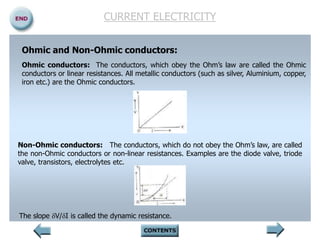
Ohmic and Non-Ohmic conductors:
Ohmic conductors: The conductors, which obey the Ohm’s law are called the Ohmic
conductors or linear resistances. All metallic conductors (such as silver, Aluminium, copper,
iron etc.) are the Ohmic conductors.
Non-Ohmic conductors: The conductors, which do not obey the Ohm’s law, are called
the non-Ohmic conductors or non-linear resistances. Examples are the diode valve, triode
valve, transistors, electrolytes etc.
The slope V/I is called the dynamic resistance.
CURRENT ELECTRICITY
CURRENT ELECTRICITY
Resistivity or Specific Resistance :
Resistance of a wire is directly proportional to its length.
i.e. R  L
Resistance of a wire varies inversely as the area of cross section of the wire.
i.e. R  1 /a
where R is the radius of the wire.
R  L/a
or R=  L/ Лr2
Here  is a constant, which is called the Resistivity or specific resistance of the
material of the wire.
The Resistivity of a material is the resistance of a wire of that material of unit length
and unit area of cross section.
CURRENT ELECTRICITY
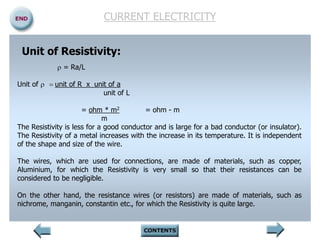
Unit of Resistivity:
 = Ra/L
Unit of  = unit of R x unit of a
unit of L
= ohm * m2 = ohm - m
m
The Resistivity is less for a good conductor and is large for a bad conductor (or insulator).
The Resistivity of a metal increases with the increase in its temperature. It is independent
of the shape and size of the wire.
The wires, which are used for connections, are made of materials, such as copper,
Aluminium, for which the Resistivity is very small so that their resistances can be
considered to be negligible.
On the other hand, the resistance wires (or resistors) are made of materials, such as
nichrome, manganin, constantin etc., for which the Resistivity is quite large.
CURRENT ELECTRICITY
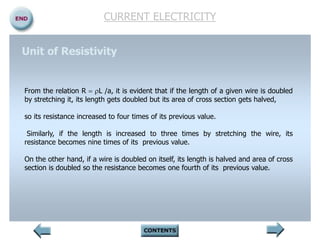
From the relation R = L /a, it is evident that if the length of a given wire is doubled
by stretching it, its length gets doubled but its area of cross section gets halved,
so its resistance increased to four times of its previous value.
Similarly, if the length is increased to three times by stretching the wire, its
resistance becomes nine times of its previous value.
On the other hand, if a wire is doubled on itself, its length is halved and area of cross
section is doubled so the resistance becomes one fourth of its previous value.
Unit of Resistivity
CURRENT ELECTRICITY
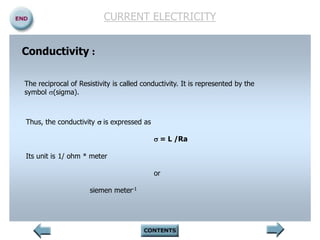
Conductivity :
The reciprocal of Resistivity is called conductivity. It is represented by the
symbol (sigma).
Thus, the conductivity  is expressed as
 = L /Ra
Its unit is 1/ ohm * meter
or
siemen meter-1
CURRENT ELECTRICITY
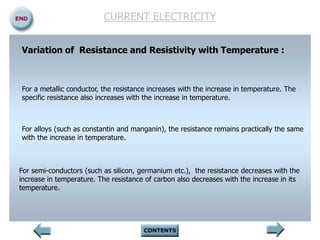
Variation of Resistance and Resistivity with Temperature :
For a metallic conductor, the resistance increases with the increase in temperature. The
specific resistance also increases with the increase in temperature.
For alloys (such as constantin and manganin), the resistance remains practically the same
with the increase in temperature.
For semi-conductors (such as silicon, germanium etc.), the resistance decreases with the
increase in temperature. The resistance of carbon also decreases with the increase in its
temperature.
CURRENT ELECTRICITY
Combination of Resistors :
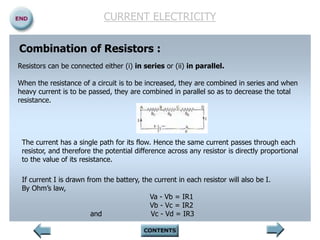
Resistors can be connected either (i) in series or (ii) in parallel.
When the resistance of a circuit is to be increased, they are combined in series and when
heavy current is to be passed, they are combined in parallel so as to decrease the total
resistance.
The current has a single path for its flow. Hence the same current passes through each
resistor, and therefore the potential difference across any resistor is directly proportional
to the value of its resistance.
If current I is drawn from the battery, the current in each resistor will also be I.
By Ohm’s law,
Va - Vb = IR1
Vb - Vc = IR2
and Vc - Vd = IR3
CURRENT ELECTRICITY
Combination of Resistors in parallel :
Adding these,
Va - Vd = I (R1+ R2 + R3 )
or R = R1+ R2 + R3
In general, if resistors R1 , R2 , R3 ,…. are combined in series, the equivalent resistance R
is given by the relation
R = R1+ R2 + R3 +……..
Resistors in parallel
Thus, in series combination, the equivalent resistance is equal to the sum of the individual
resistances.
CURRENT ELECTRICITY
Combination of Resistors :
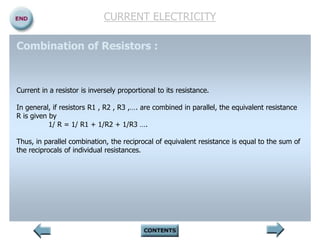
Current in a resistor is inversely proportional to its resistance.
In general, if resistors R1 , R2 , R3 ,…. are combined in parallel, the equivalent resistance
R is given by
1/ R = 1/ R1 + 1/R2 + 1/R3 ….
Thus, in parallel combination, the reciprocal of equivalent resistance is equal to the sum of
the reciprocals of individual resistances.

Current electricity Series Parallel.ppt

  • 1.
    CURRENT ELECTRICITY This chaptercovers the following important aspects: CURRENT ELECTRICITY CURRENT ELECTRICITY CURRENT ELECTRICITY • Current • Potential • E.M.F. of a cell • Internal resistance of a cell • Resistance of a conductor • Ohm’s law • Ohmic and Non-ohmic conductors • Resistivity or Specific Resistance • Unit of resistivity • Conductivity • Variation of Resistance and resistivity Combination of resistors
  • 2.
    CURRENT ELECTRICITY Current: Current isdefined as the amount of charge flowing per second. If a charge Q flows through a cross section of a conductor in time t, then current I = Q/t The current is measured in ampere (A). The current is 1A, if the rate of flow of charge is 1 coulomb per second. In metals, the moving charges are the electrons while in the electrolytes and ionised gases, electrons and positively charged ions are the moving charges which constitute current. If we say 1A current flows through a conductor it implies that 6.25 * 1018 electrons pass in 1 second across the cross section of the conductor. The direction of current is conventionally taken opposite to the direction of motion of electrons. If n electrons pass through a cross section of a conductor in time t, then total charge passed Q = n * e and current in conductor I = Q/t = ne/t
  • 3.
    Potential : Potential isthe electrical condition of the conductor, which determines the direction of flow of charges when the two conductors are kept in contact or they are connected by a metallic wire. Potential at a point is defined as the amount of work done in bringing a unit positive charge from infinity to that point. The unit of potential is volt (symbol V). If W joule of work need to be done to give Q coulomb of charge to a body then its potential V = W/Q The potential difference between two points is equal to the work done in moving a unit positive charge from one point to the other. CURRENT ELECTRICITY
  • 4.
    CURRENT ELECTRICITY E.M.F. ofa cell : When no current is drawn from a cell i.e., the cell is in open circuit, the potential difference between the terminals of a cell is called its electro motive force or (e.m.f.). The e.m.f. of a cell depends on the following two factors; (i) the material of electrodes, and (ii) the electrolyte used in the cell. Terminal voltage of a cell: When current is drawn from a cell i.e., the cell is in closed circuit, the potential difference between the electrodes of the cell is called the terminal voltage.
  • 5.
    CURRENT ELECTRICITY Internal resistanceof a cell: The resistance offered by the electrolyte, inside the cell, to the flow of current is called the internal resistance of the cell. It is denoted by the symbol r. Its unit is ohm (symbol ) The internal resistance of a cell depends on the following four factors: • The surface area of the electrodes - larger the surface area, less is the internal resistance. • The distance between the electrodes - more the distance, greater is the internal resistance. • The nature, and concentration of the electrolyte, greater is the internal resistance • The temperature of the electrolyte - higher the temperature of the electrolyte, less is the internal resistance. For circuit analysis, the internal resistance of a cell can be considered to be connected in series with the cell.
  • 6.
    CURRENT ELECTRICITY Resistance ofa conductor : The obstruction offered in the flow of current by the wire is called its resistance. The resistance of a wire depends on the following four factors: 1. The material of the wire - Good conductors of electricity (such as silver, copper) offer less resistance. 2. The length of the wire - A longer wire offers more resistance. 3. The area of cross section of the wire - A thicker wire offers less resistance. 4. The temperature of the wire - The resistance of the metallic wire increases with the increase in temperature Conductance: The reciprocal of resistance is called conductance. It’s unit is (ohm -1) ohm or siemen.
  • 7.
    CURRENT ELECTRICITY Ohm’s law: Accordingto Ohm’s law, at a constant temperature, the current flowing in a conductor is directly proportional to the potential difference across its ends. If a current I flows in a conductor when the potential difference across its ends is V, then according to Ohm’s law V  I or V = IR
  • 8.
    Ohmic and Non-Ohmicconductors: Ohmic conductors: The conductors, which obey the Ohm’s law are called the Ohmic conductors or linear resistances. All metallic conductors (such as silver, Aluminium, copper, iron etc.) are the Ohmic conductors. Non-Ohmic conductors: The conductors, which do not obey the Ohm’s law, are called the non-Ohmic conductors or non-linear resistances. Examples are the diode valve, triode valve, transistors, electrolytes etc. The slope V/I is called the dynamic resistance. CURRENT ELECTRICITY
  • 9.
    CURRENT ELECTRICITY Resistivity orSpecific Resistance : Resistance of a wire is directly proportional to its length. i.e. R  L Resistance of a wire varies inversely as the area of cross section of the wire. i.e. R  1 /a where R is the radius of the wire. R  L/a or R=  L/ Лr2 Here  is a constant, which is called the Resistivity or specific resistance of the material of the wire. The Resistivity of a material is the resistance of a wire of that material of unit length and unit area of cross section.
  • 10.
    CURRENT ELECTRICITY Unit ofResistivity:  = Ra/L Unit of  = unit of R x unit of a unit of L = ohm * m2 = ohm - m m The Resistivity is less for a good conductor and is large for a bad conductor (or insulator). The Resistivity of a metal increases with the increase in its temperature. It is independent of the shape and size of the wire. The wires, which are used for connections, are made of materials, such as copper, Aluminium, for which the Resistivity is very small so that their resistances can be considered to be negligible. On the other hand, the resistance wires (or resistors) are made of materials, such as nichrome, manganin, constantin etc., for which the Resistivity is quite large.
  • 11.
    CURRENT ELECTRICITY From therelation R = L /a, it is evident that if the length of a given wire is doubled by stretching it, its length gets doubled but its area of cross section gets halved, so its resistance increased to four times of its previous value. Similarly, if the length is increased to three times by stretching the wire, its resistance becomes nine times of its previous value. On the other hand, if a wire is doubled on itself, its length is halved and area of cross section is doubled so the resistance becomes one fourth of its previous value. Unit of Resistivity
  • 12.
    CURRENT ELECTRICITY Conductivity : Thereciprocal of Resistivity is called conductivity. It is represented by the symbol (sigma). Thus, the conductivity  is expressed as  = L /Ra Its unit is 1/ ohm * meter or siemen meter-1
  • 13.
    CURRENT ELECTRICITY Variation ofResistance and Resistivity with Temperature : For a metallic conductor, the resistance increases with the increase in temperature. The specific resistance also increases with the increase in temperature. For alloys (such as constantin and manganin), the resistance remains practically the same with the increase in temperature. For semi-conductors (such as silicon, germanium etc.), the resistance decreases with the increase in temperature. The resistance of carbon also decreases with the increase in its temperature.
  • 14.
    CURRENT ELECTRICITY Combination ofResistors : Resistors can be connected either (i) in series or (ii) in parallel. When the resistance of a circuit is to be increased, they are combined in series and when heavy current is to be passed, they are combined in parallel so as to decrease the total resistance. The current has a single path for its flow. Hence the same current passes through each resistor, and therefore the potential difference across any resistor is directly proportional to the value of its resistance. If current I is drawn from the battery, the current in each resistor will also be I. By Ohm’s law, Va - Vb = IR1 Vb - Vc = IR2 and Vc - Vd = IR3
  • 15.
    CURRENT ELECTRICITY Combination ofResistors in parallel : Adding these, Va - Vd = I (R1+ R2 + R3 ) or R = R1+ R2 + R3 In general, if resistors R1 , R2 , R3 ,…. are combined in series, the equivalent resistance R is given by the relation R = R1+ R2 + R3 +…….. Resistors in parallel Thus, in series combination, the equivalent resistance is equal to the sum of the individual resistances.
  • 16.
    CURRENT ELECTRICITY Combination ofResistors : Current in a resistor is inversely proportional to its resistance. In general, if resistors R1 , R2 , R3 ,…. are combined in parallel, the equivalent resistance R is given by 1/ R = 1/ R1 + 1/R2 + 1/R3 …. Thus, in parallel combination, the reciprocal of equivalent resistance is equal to the sum of the reciprocals of individual resistances.