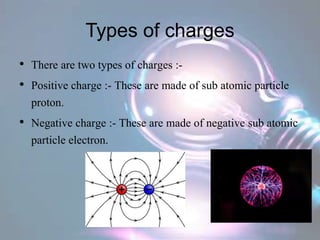
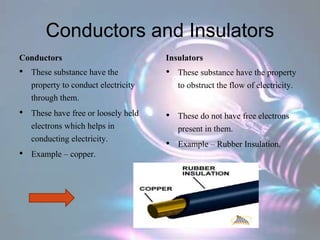
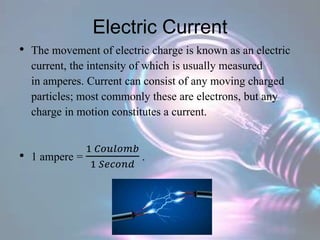
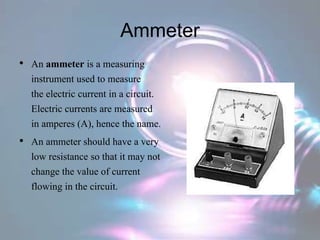
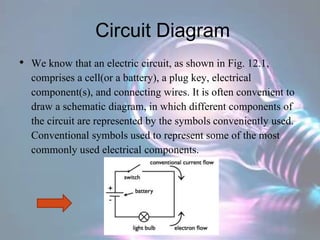
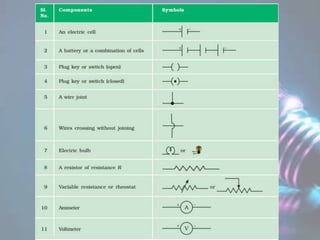
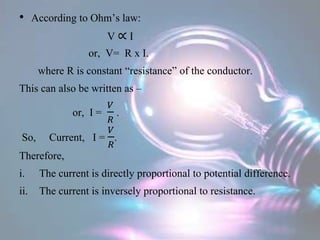
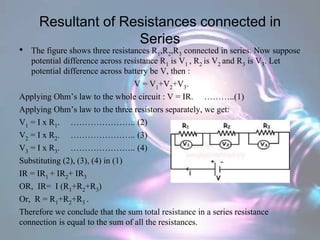
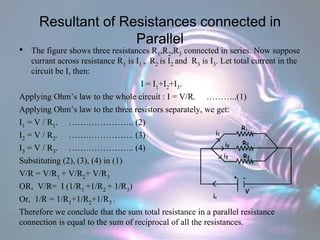
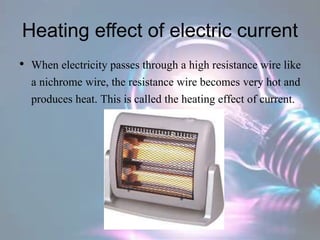
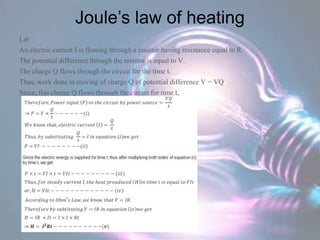
There are two types of charges: positive charges consist of protons, and negative charges consist of electrons. The standard unit of charge is the coulomb. Conductors contain free or loosely bound electrons that allow them to conduct electricity, while insulators do not have free electrons and obstruct electricity flow. Ohm's law defines the relationship between voltage, current, and resistance in a circuit. Joule's law states that the heat produced is directly proportional to the square of the current, the resistance, and the time of current flow. Electric power is defined as voltage multiplied by current and measured in watts.