CRYOCAR 
 PRESENTED BY UNDER GUIDENCE OF 
 KIRAN KUMAR PROF. RITESH MULGE 
 USN-3AE10ME012
ABSTRACT 
 Cryogens are effective thermal storage medium which 
can be used for automotive propulsion, that boils at a 
temperature below about 110k 
 An automotive propulsion concept is present with 
open rankine cycle which utilise liquid nitrogen as 
work fluid. 
 Pressurised liquid nitrogen(LN2) can be vapourised by 
only heat input to engine which is supplied by ambient 
heat exchanger , resulting in easy propulsion of 
automobile. 
 Refill of LN2 requires only few minutes .
CONTENTS 
 INTRODUCTION 
 THEORY BEHIND CRYOCAR 
 WHAT IS CRYOCAR 
 COMPONENTS OF CRYOCAR 
 WORKING OF CRYOCAR 
 ADVANTAGES AND DISADVANTAGES
INTRODUCTION 
 Various factors that influence choice of car include 
performance , fuel ,pollution etc. 
 As price of fuels are increasing and availability is 
decreasing we have to go for alternate choice. 
 At this point of view we have “ CRYOCARS “ as an 
alternate choice.
THEORY BEHIND CRYOCAR 
 Research at the university of Washington are 
developing a new Zero Emission automobile 
propulsion concept that uses LN2 as fuel . 
 Principle of operation is like that of steam engine , 
except there is no combustion involved. 
 Instead LN2 is pressurised and then vapourised in a 
heat exchanger by ambient temperature of 
surrounding air.
WHAT IS CRYOCAR? 
 It is a liquid nitrogen powered vehicle. 
 Propulsion systems are cryogenic heat engines in 
which a cryogenic substance is used as a heat sink.
Cryogenic Heat Engine 
 It is a engine which uses very cold substances to 
produce useful energy. 
 There is always some heat input to the working fluid 
during the expansion process.
Liquid Nitrogen(LN2) 
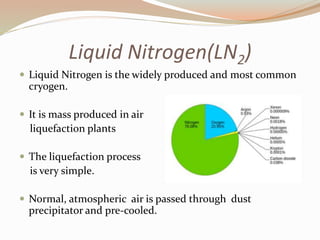
 Liquid Nitrogen is the widely produced and most common 
cryogen. 
 It is mass produced in air 
liquefaction plants 
 The liquefaction process 
is very simple. 
 Normal, atmospheric air is passed through dust 
precipitator and pre-cooled.
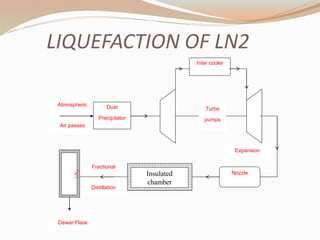
LIQUEFACTION OF LN2 
Atmospheric 
Air passes 
Dust 
Precipitator 
Fractional 
Distillation 
Inter cooler 
Nozzle 
LN2 
Insulated 
chamber 
Expansion 
Turbo 
pumps 
Dewar Flask
Main Components of the Engine: 
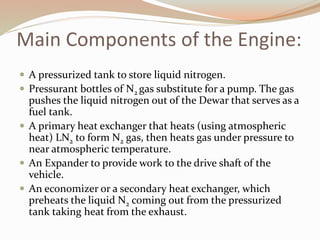
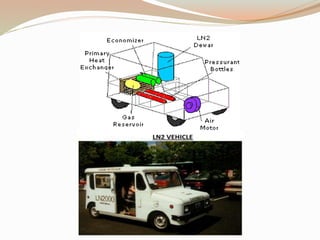
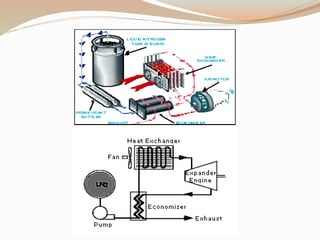
 A pressurized tank to store liquid nitrogen. 
 Pressurant bottles of N2 gas substitute for a pump. The gas 
pushes the liquid nitrogen out of the Dewar that serves as a 
fuel tank. 
 A primary heat exchanger that heats (using atmospheric 
heat) LN2 to form N2 gas, then heats gas under pressure to 
near atmospheric temperature. 
 An Expander to provide work to the drive shaft of the 
vehicle. 
 An economizer or a secondary heat exchanger, which 
preheats the liquid N2 coming out from the pressurized 
tank taking heat from the exhaust.
Principle of Operation: 
 LN2 at –320oF (-196oC) is pressurized and then 
vaporized in a heat exchanger by ambient temperature 
of the surrounding air. 
 This heat exchanger is like the radiator of a car but 
instead of using air to cool water, it uses air to heat and 
boil liquid nitrogen. 
 Liquid N2 passing through the primary heat exchanger 
quickly reaches its boiling point. 
 The N2 expands to a gas with a pressure of 150 psi.
•The pressurised N2 gas drives the motor. 
•The only exhaust is nitrogen, which is major constituent of our 
atmosphere. 
•Energy+N2(l)-->N2(g) 
Hence, there is no pollution produced by running this car.
Advantages over electric cars: 
 A liquid nitrogen car is much lighter and refilling its 
tank takes only about 10-15 minutes. 
 The exhaust produced by the car is environmental 
friendly. 
 A cryogenic car could have three times the range of an 
electric car of the same weight and no battery disposal 
concerns .
Drawbacks: 
 The N2 passing through the tubes of the heat exchanger is 
so cold that the moisture in the surrounding air would 
condense on the outside of the tubes, obstructing the air 
flow. 
 If nitrogen car is kept in a poorly ventilated space and, if 
there is a nitrogen leaks off, it could prove fatal. 
 Turning N2 gas into a liquid requires a lot of energy. So 
while cryogenic cars have zero emissions, they rely on 
energy produced at emission generating power plants.
Probable Solutions: 
 A tube within a tube design. 
 N2 passes back and forth inside a set of three nested 
tubes. 
 By the time it reaches the outermost tubes, the N2 is 
warm enough that the exterior wall of the tube 
remains above the freezing point of water. 
 Route the exhaust from the fossil fuel power plants 
through cryogenic plants, so that the pollutants and 
the greenhouse gases could be condensed for later 
disposal
Efficiency: 
 The LN2 car can travel 15 miles on a full (48 gallon) 
tank of liquid nitrogen going 20 MPH. 
 Its maximum speed is over 35 MPH.
Why not commercialized? 
Even though the technology is 10 to 12 years old, still it 
has not come to the market for two reasons. 
 Safety issues have not been sorted out as yet. 
 Lack of funds for research.
Conclusion: 
 In a real sense, the more such vehicles are used, the 
cleaner the air will become. 
 In addition to the environmental impact of these 
vehicles, refueling using current technology can take 
only a few minutes, which is very similar to current gas 
refueling times.
REFERENCE 
[1] “LN2000”, University of Washington Research Team, Sept. 18, 2007 
<http://www.aa.washington.edu/AERP/CRYOCAR/CryoCar.htm>." 
[2] “Liquid Nitrogen”, Wikipedia Online Encyclopedia, Sept. 13, 2007 
<http://en.wikipedia.org/wiki/Liquid nitrogen>. 
[3] “Cryogenic Chilling and Freezing”, BOC Gases, Sept. 18, 2007 <http://www.boc-gases. 
com/products and services/by process/cryogenic_chilling_and_freezing.asp>. 
[4] “Cryogenic Paint Removal”, Sig Attilio Bernasconi, Sept. 18, 2007 
<http://www.p2pays org/ref/10/09444.htm
THANK YOU

Cryocar(1)

  • 1.
    CRYOCAR  PRESENTEDBY UNDER GUIDENCE OF  KIRAN KUMAR PROF. RITESH MULGE  USN-3AE10ME012
  • 2.
    ABSTRACT  Cryogensare effective thermal storage medium which can be used for automotive propulsion, that boils at a temperature below about 110k  An automotive propulsion concept is present with open rankine cycle which utilise liquid nitrogen as work fluid.  Pressurised liquid nitrogen(LN2) can be vapourised by only heat input to engine which is supplied by ambient heat exchanger , resulting in easy propulsion of automobile.  Refill of LN2 requires only few minutes .
  • 3.
    CONTENTS  INTRODUCTION  THEORY BEHIND CRYOCAR  WHAT IS CRYOCAR  COMPONENTS OF CRYOCAR  WORKING OF CRYOCAR  ADVANTAGES AND DISADVANTAGES
  • 4.
    INTRODUCTION  Variousfactors that influence choice of car include performance , fuel ,pollution etc.  As price of fuels are increasing and availability is decreasing we have to go for alternate choice.  At this point of view we have “ CRYOCARS “ as an alternate choice.
  • 5.
    THEORY BEHIND CRYOCAR  Research at the university of Washington are developing a new Zero Emission automobile propulsion concept that uses LN2 as fuel .  Principle of operation is like that of steam engine , except there is no combustion involved.  Instead LN2 is pressurised and then vapourised in a heat exchanger by ambient temperature of surrounding air.
  • 6.
    WHAT IS CRYOCAR?  It is a liquid nitrogen powered vehicle.  Propulsion systems are cryogenic heat engines in which a cryogenic substance is used as a heat sink.
  • 7.
    Cryogenic Heat Engine  It is a engine which uses very cold substances to produce useful energy.  There is always some heat input to the working fluid during the expansion process.
  • 8.
    Liquid Nitrogen(LN2) Liquid Nitrogen is the widely produced and most common cryogen.  It is mass produced in air liquefaction plants  The liquefaction process is very simple.  Normal, atmospheric air is passed through dust precipitator and pre-cooled.
  • 9.
    LIQUEFACTION OF LN2 Atmospheric Air passes Dust Precipitator Fractional Distillation Inter cooler Nozzle LN2 Insulated chamber Expansion Turbo pumps Dewar Flask
  • 10.
    Main Components ofthe Engine:  A pressurized tank to store liquid nitrogen.  Pressurant bottles of N2 gas substitute for a pump. The gas pushes the liquid nitrogen out of the Dewar that serves as a fuel tank.  A primary heat exchanger that heats (using atmospheric heat) LN2 to form N2 gas, then heats gas under pressure to near atmospheric temperature.  An Expander to provide work to the drive shaft of the vehicle.  An economizer or a secondary heat exchanger, which preheats the liquid N2 coming out from the pressurized tank taking heat from the exhaust.
  • 12.
    Principle of Operation:  LN2 at –320oF (-196oC) is pressurized and then vaporized in a heat exchanger by ambient temperature of the surrounding air.  This heat exchanger is like the radiator of a car but instead of using air to cool water, it uses air to heat and boil liquid nitrogen.  Liquid N2 passing through the primary heat exchanger quickly reaches its boiling point.  The N2 expands to a gas with a pressure of 150 psi.
  • 13.
    •The pressurised N2gas drives the motor. •The only exhaust is nitrogen, which is major constituent of our atmosphere. •Energy+N2(l)-->N2(g) Hence, there is no pollution produced by running this car.
  • 15.
    Advantages over electriccars:  A liquid nitrogen car is much lighter and refilling its tank takes only about 10-15 minutes.  The exhaust produced by the car is environmental friendly.  A cryogenic car could have three times the range of an electric car of the same weight and no battery disposal concerns .
  • 16.
    Drawbacks:  TheN2 passing through the tubes of the heat exchanger is so cold that the moisture in the surrounding air would condense on the outside of the tubes, obstructing the air flow.  If nitrogen car is kept in a poorly ventilated space and, if there is a nitrogen leaks off, it could prove fatal.  Turning N2 gas into a liquid requires a lot of energy. So while cryogenic cars have zero emissions, they rely on energy produced at emission generating power plants.
  • 17.
    Probable Solutions: A tube within a tube design.  N2 passes back and forth inside a set of three nested tubes.  By the time it reaches the outermost tubes, the N2 is warm enough that the exterior wall of the tube remains above the freezing point of water.  Route the exhaust from the fossil fuel power plants through cryogenic plants, so that the pollutants and the greenhouse gases could be condensed for later disposal
  • 18.
    Efficiency:  TheLN2 car can travel 15 miles on a full (48 gallon) tank of liquid nitrogen going 20 MPH.  Its maximum speed is over 35 MPH.
  • 19.
    Why not commercialized? Even though the technology is 10 to 12 years old, still it has not come to the market for two reasons.  Safety issues have not been sorted out as yet.  Lack of funds for research.
  • 20.
    Conclusion:  Ina real sense, the more such vehicles are used, the cleaner the air will become.  In addition to the environmental impact of these vehicles, refueling using current technology can take only a few minutes, which is very similar to current gas refueling times.
  • 21.
    REFERENCE [1] “LN2000”,University of Washington Research Team, Sept. 18, 2007 <http://www.aa.washington.edu/AERP/CRYOCAR/CryoCar.htm>." [2] “Liquid Nitrogen”, Wikipedia Online Encyclopedia, Sept. 13, 2007 <http://en.wikipedia.org/wiki/Liquid nitrogen>. [3] “Cryogenic Chilling and Freezing”, BOC Gases, Sept. 18, 2007 <http://www.boc-gases. com/products and services/by process/cryogenic_chilling_and_freezing.asp>. [4] “Cryogenic Paint Removal”, Sig Attilio Bernasconi, Sept. 18, 2007 <http://www.p2pays org/ref/10/09444.htm
  • 22.