Presentation By:
Under Guidance Of:
Smt. Kamala and Sri. Venkappa M. Agadi College of
Engineering and Technology, Laxmeshwar
Department of Mechanical Engineering
• Introduction
• Brief Introduction About Cryogenic
• Liquid Nitrogen
• Main Components of Cryogenic Heat Engine
• Schematic Dig. of Liquid Nitrogen Car LN2000
• Principle of Operation
• Advantages
• Disadvantages
• Efficiency
• Conclusion
• References
Introduction
 The soul of each and every engine is the FUEL that we are using.
 Usage of fossil fuels from olden days.
 Majority of pollution in the world is contributed by automobiles.
 Also the price of the fuels are increasing and availability is decreasing. So, we have to go for
alternate choice
 Scientists are searching for renewable resource as a fuel for engine and moreover pollution free.
 Liquid Nitrogen is the cheapest, widely produced and most common cryogenic liquid.
 It is mass produced in Air Liquefaction Plants.
 Invention of Cryogenic Heat Engine.
 In 1997, the University of North Texas (UNT) and University of Washington (UW)
independently developed liquid nitrogen powered vehicles
It is a process of production of icy cold. Or It is a low temperature technique involving the
temperature of -150˚C.
 Cryogenic Engineering:
It is mainly concerned with temperatures found in range of –150oC to absolute zero (-273.15oC).
 Various Cryogenic Fluids:
1. Liquid Helium 4. Liquid Neon
2. Liquid Oxygen 5. Liquid Xenon
3. Liquid Nitrogen 6. Liquid Argon
 Cryogenic Heat Engine:
It is a engine which uses very cold substances to produce useful energy.
 What is Cryogenic?
Liquid Nitrogen (LN2)
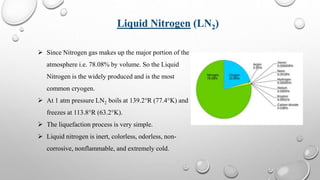
 Since Nitrogen gas makes up the major portion of the
atmosphere i.e. 78.08% by volume. So the Liquid
Nitrogen is the widely produced and is the most
common cryogen.
 At 1 atm pressure LN2 boils at 139.2°R (77.4°K) and
freezes at 113.8°R (63.2°K).
 The liquefaction process is very simple.
 Liquid nitrogen is inert, colorless, odorless, non-
corrosive, nonflammable, and extremely cold.
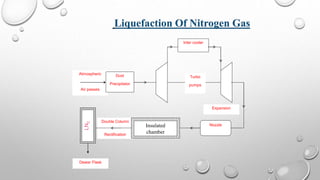
Atmospheric
Air passes
Double Column
Rectification
Dust
Precipitator
Inter cooler
Nozzle
LN2
Insulated
chamber
Expansion
Turbo
pumps
Dewar Flask
Liquefaction Of Nitrogen Gas
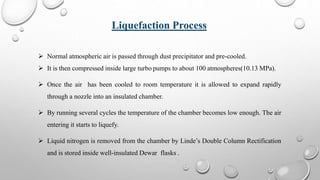
 Normal atmospheric air is passed through dust precipitator and pre-cooled.
 It is then compressed inside large turbo pumps to about 100 atmospheres(10.13 MPa).
 Once the air has been cooled to room temperature it is allowed to expand rapidly
through a nozzle into an insulated chamber.
 By running several cycles the temperature of the chamber becomes low enough. The air
entering it starts to liquefy.
 Liquid nitrogen is removed from the chamber by Linde’s Double Column Rectification
and is stored inside well-insulated Dewar flasks .
Liquefaction Process
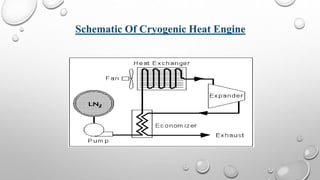
Schematic Of Cryogenic Heat Engine
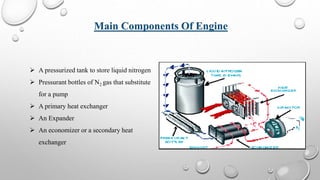
 A pressurized tank to store liquid nitrogen
 Pressurant bottles of N2 gas that substitute
for a pump
 A primary heat exchanger
 An Expander
 An economizer or a secondary heat
exchanger
Main Components Of Engine
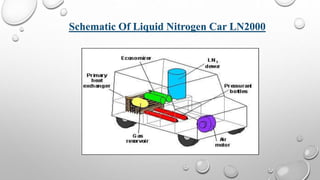
Schematic Of Liquid Nitrogen Car LN2000
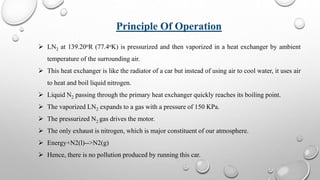
 LN2 at 139.20oR (77.4oK) is pressurized and then vaporized in a heat exchanger by ambient
temperature of the surrounding air.
 This heat exchanger is like the radiator of a car but instead of using air to cool water, it uses air
to heat and boil liquid nitrogen.
 Liquid N2 passing through the primary heat exchanger quickly reaches its boiling point.
 The vaporized LN2 expands to a gas with a pressure of 150 KPa.
 The pressurized N2 gas drives the motor.
 The only exhaust is nitrogen, which is major constituent of our atmosphere.
 Energy+N2(l)-->N2(g)
 Hence, there is no pollution produced by running this car.
Principle Of Operation
 Liquid nitrogen is not a combustible, corrosive or toxic. It is just a cold.
 LN2 powered vehicles have significant performance and environmental
advantages over electric vehicles.
 A liquid nitrogen car is much lighter and refilling its tank will take only 10-15
minutes.
 The exhaust produced by the car is environmental friendly.
Advantages
 Liquid nitrogen is not available in public refueling stations.
 Turning N2 gas into a liquid requires a lot of energy. So while cryogenic cars
have zero emissions, they rely on energy produced at emission generating power
plants.
Disadvantages
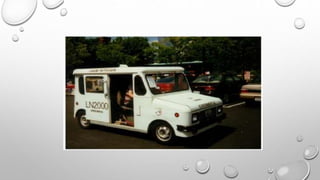
 The LN2000 car has a 7hp engine.
 Its maximum speed is over 40 kmph.
 It could travel 79 miles(127.58 km) on a full 24 gallon(90 liter) tank of liquid
nitrogen running at the speed of 32 kmph.
LN2000 Car Characteristics
Conclusion
The Liquid Nitrogen powered vehicles keeps the air much cleaner if the
liquefaction process is driven by non-polluting energy sources. And refueling process
is time and cost efficient.
References
[1] “Liquid Nitrogen as a Non-Polluting Vehicle Fuel”, Mitty c. Plummer, Carlos A.
Ordonez and Richard F. Reidy, University of North Texas.
[2] “Liquid Nitrogen”, Wikipedia Online Encyclopedia, Sept. 13, 2007
<http://en.wikipedia.org/wiki/Liquid nitrogen>.
[3] “LN2000”, University of Washington Research Team, Sept. 18, 2007
<http://www.aa.washington.edu/AERP/CRYOCAR/CryoCar.htm>.
[4] “Liquid Nitrogen Car”, University of Washington, May 2, 2011
< https://www.youtube.com/watch?v=uV5YsAdA9Lg >
Liquid Nitrogen- An Alternative Fuel

Liquid Nitrogen- An Alternative Fuel

  • 1.
    Presentation By: Under GuidanceOf: Smt. Kamala and Sri. Venkappa M. Agadi College of Engineering and Technology, Laxmeshwar Department of Mechanical Engineering
  • 2.
    • Introduction • BriefIntroduction About Cryogenic • Liquid Nitrogen • Main Components of Cryogenic Heat Engine • Schematic Dig. of Liquid Nitrogen Car LN2000 • Principle of Operation • Advantages • Disadvantages • Efficiency • Conclusion • References
  • 3.
    Introduction  The soulof each and every engine is the FUEL that we are using.  Usage of fossil fuels from olden days.  Majority of pollution in the world is contributed by automobiles.  Also the price of the fuels are increasing and availability is decreasing. So, we have to go for alternate choice  Scientists are searching for renewable resource as a fuel for engine and moreover pollution free.  Liquid Nitrogen is the cheapest, widely produced and most common cryogenic liquid.  It is mass produced in Air Liquefaction Plants.  Invention of Cryogenic Heat Engine.  In 1997, the University of North Texas (UNT) and University of Washington (UW) independently developed liquid nitrogen powered vehicles
  • 4.
    It is aprocess of production of icy cold. Or It is a low temperature technique involving the temperature of -150˚C.  Cryogenic Engineering: It is mainly concerned with temperatures found in range of –150oC to absolute zero (-273.15oC).  Various Cryogenic Fluids: 1. Liquid Helium 4. Liquid Neon 2. Liquid Oxygen 5. Liquid Xenon 3. Liquid Nitrogen 6. Liquid Argon  Cryogenic Heat Engine: It is a engine which uses very cold substances to produce useful energy.  What is Cryogenic?
  • 5.
    Liquid Nitrogen (LN2) Since Nitrogen gas makes up the major portion of the atmosphere i.e. 78.08% by volume. So the Liquid Nitrogen is the widely produced and is the most common cryogen.  At 1 atm pressure LN2 boils at 139.2°R (77.4°K) and freezes at 113.8°R (63.2°K).  The liquefaction process is very simple.  Liquid nitrogen is inert, colorless, odorless, non- corrosive, nonflammable, and extremely cold.
  • 6.
    Atmospheric Air passes Double Column Rectification Dust Precipitator Intercooler Nozzle LN2 Insulated chamber Expansion Turbo pumps Dewar Flask Liquefaction Of Nitrogen Gas
  • 7.
     Normal atmosphericair is passed through dust precipitator and pre-cooled.  It is then compressed inside large turbo pumps to about 100 atmospheres(10.13 MPa).  Once the air has been cooled to room temperature it is allowed to expand rapidly through a nozzle into an insulated chamber.  By running several cycles the temperature of the chamber becomes low enough. The air entering it starts to liquefy.  Liquid nitrogen is removed from the chamber by Linde’s Double Column Rectification and is stored inside well-insulated Dewar flasks . Liquefaction Process
  • 8.
  • 9.
     A pressurizedtank to store liquid nitrogen  Pressurant bottles of N2 gas that substitute for a pump  A primary heat exchanger  An Expander  An economizer or a secondary heat exchanger Main Components Of Engine
  • 10.
    Schematic Of LiquidNitrogen Car LN2000
  • 12.
     LN2 at139.20oR (77.4oK) is pressurized and then vaporized in a heat exchanger by ambient temperature of the surrounding air.  This heat exchanger is like the radiator of a car but instead of using air to cool water, it uses air to heat and boil liquid nitrogen.  Liquid N2 passing through the primary heat exchanger quickly reaches its boiling point.  The vaporized LN2 expands to a gas with a pressure of 150 KPa.  The pressurized N2 gas drives the motor.  The only exhaust is nitrogen, which is major constituent of our atmosphere.  Energy+N2(l)-->N2(g)  Hence, there is no pollution produced by running this car. Principle Of Operation
  • 13.
     Liquid nitrogenis not a combustible, corrosive or toxic. It is just a cold.  LN2 powered vehicles have significant performance and environmental advantages over electric vehicles.  A liquid nitrogen car is much lighter and refilling its tank will take only 10-15 minutes.  The exhaust produced by the car is environmental friendly. Advantages
  • 14.
     Liquid nitrogenis not available in public refueling stations.  Turning N2 gas into a liquid requires a lot of energy. So while cryogenic cars have zero emissions, they rely on energy produced at emission generating power plants. Disadvantages
  • 15.
     The LN2000car has a 7hp engine.  Its maximum speed is over 40 kmph.  It could travel 79 miles(127.58 km) on a full 24 gallon(90 liter) tank of liquid nitrogen running at the speed of 32 kmph. LN2000 Car Characteristics
  • 16.
    Conclusion The Liquid Nitrogenpowered vehicles keeps the air much cleaner if the liquefaction process is driven by non-polluting energy sources. And refueling process is time and cost efficient.
  • 17.
    References [1] “Liquid Nitrogenas a Non-Polluting Vehicle Fuel”, Mitty c. Plummer, Carlos A. Ordonez and Richard F. Reidy, University of North Texas. [2] “Liquid Nitrogen”, Wikipedia Online Encyclopedia, Sept. 13, 2007 <http://en.wikipedia.org/wiki/Liquid nitrogen>. [3] “LN2000”, University of Washington Research Team, Sept. 18, 2007 <http://www.aa.washington.edu/AERP/CRYOCAR/CryoCar.htm>. [4] “Liquid Nitrogen Car”, University of Washington, May 2, 2011 < https://www.youtube.com/watch?v=uV5YsAdA9Lg >