By-
DAV UNIVERSITY
Department of Mechanical Engineering
Seminar on-
CRYOCAR
CONTENTS
1. INTRODUCTION
2. LIQUID NITROGEN VEHICLE
3. MANUFACTURE OF LIQUID NITROGEN
4. LIQUID NITROGEN PROPULISION CYCLE
5. PARTS OF LNPC
6. PRINCIPLE OF OPERATION
7. EFFICIENCY
8. ADVANTAGES
9. TECHNICAL ISSUES
10. CONCLUSION
11. REFERENCES
INDRODUCTION
CRYOCAR
uses
Cryogenic
fuel
like
Liquid
Nitrogen
LIQUID NITROGEN VEHICLE
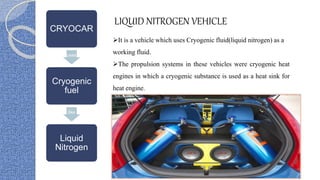
It is a vehicle which uses Cryogenic fluid(liquid nitrogen) as a
working fluid.
The propulsion systems in these vehicles were cryogenic heat
engines in which a cryogenic substance is used as a heat sink for
heat engine.
LIQUID NITROGEN VEHICLE….
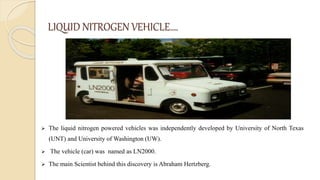
 The liquid nitrogen powered vehicles was independently developed by University of North Texas
(UNT) and University of Washington (UW).
 The vehicle (car) was named as LN2000.
 The main Scientist behind this discovery is Abraham Hertzberg.
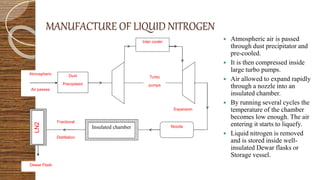
MANUFACTURE OF LIQUID NITROGEN
 Atmospheric air is passed
through dust precipitator and
pre-cooled.
 It is then compressed inside
large turbo pumps.
 Air allowed to expand rapidly
through a nozzle into an
insulated chamber.
 By running several cycles the
temperature of the chamber
becomes low enough. The air
entering it starts to liquefy.
 Liquid nitrogen is removed
and is stored inside well-
insulated Dewar flasks or
Storage vessel.
Atmospheric
Air passes
Fractional
Distillation
Dust
Precipitator
Inter cooler
Nozzle
LN2
Insulated chamber
Expansion
Turbo
pumps
Dewar Flask
LIQUID NITROGEN PROPULISION CYCLE
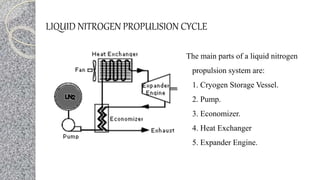
The main parts of a liquid nitrogen
propulsion system are:
1. Cryogen Storage Vessel.
2. Pump.
3. Economizer.
4. Heat Exchanger
5. Expander Engine.
PARTS OF LNPC
Cryogen
Storage
Vessel
A pressurized tank to store liquid nitrogen.
Resistance to deceleration forces in the horizontal plane in the event of
traffic accident, Low boil-off rate , minimum size and mass and
reasonable cost.
Pump
The pump is used to pump the liquid nitrogen into the engine. The
pump which are used for this purpose have an operating pressure
ranging between 500 – 600 Psi. As the pump, pumps liquid instead
of gas, it is noticed that the efficiency is high.
Economizer
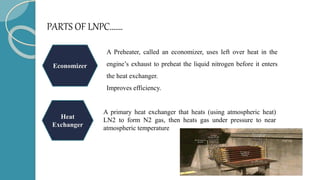
A Preheater, called an economizer, uses left over heat in the
engine’s exhaust to preheat the liquid nitrogen before it enters
the heat exchanger.
Improves efficiency.
PARTS OF LNPC…….
Heat
Exchanger
A primary heat exchanger that heats (using atmospheric heat)
LN2 to form N2 gas, then heats gas under pressure to near
atmospheric temperature
PARTS OF LNPC…….
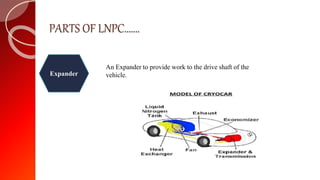
Expander
An Expander to provide work to the drive shaft of the
vehicle.
Principle of operation
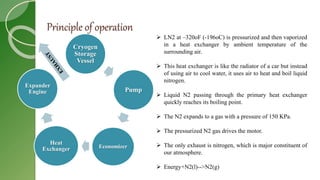
Cryogen
Storage
Vessel
Pump
Economizer
Heat
Exchanger
Expander
Engine
 LN2 at –320oF (-196oC) is pressurized and then vaporized
in a heat exchanger by ambient temperature of the
surrounding air.
 This heat exchanger is like the radiator of a car but instead
of using air to cool water, it uses air to heat and boil liquid
nitrogen.
 Liquid N2 passing through the primary heat exchanger
quickly reaches its boiling point.
 The N2 expands to a gas with a pressure of 150 KPa.
 The pressurized N2 gas drives the motor.
 The only exhaust is nitrogen, which is major constituent of
our atmosphere.
 Energy+N2(l)-->N2(g)
EFFICIENCY
The first LN2 car could travel 79 miles (127.58 km) on a full 24 gallon (90 liter)
tank of liquid nitrogen going 32 Kmph.
Its maximum speed was over 56 Kmph.
After further Researches, the Efficiency has improved as follows:
Power : 78KW or 104.5bhp @ 97Kmph
 400 Liters (106 gallon) gives a mileage of 560Km and weighs 280Kg
 Operating Cost is around 2.4cents per Km( Re 1 per Km)
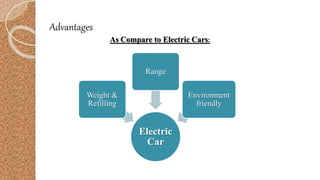
Advantages
Electric
Car
Weight &
Refilling
Range
Environment
friendly
As Compare to Electric Cars:
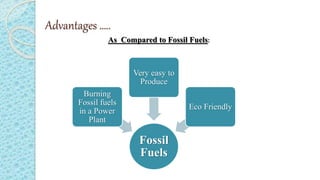
Advantages …..
Fossil
Fuels
Burning
Fossil fuels
in a Power
Plant
Very easy to
Produce
Eco Friendly
As Compared to Fossil Fuels:
TECHNICAL ISSUES
 The N2 passing through the tubes of the heat exchanger is so cold that the
moisture in the surrounding air would condense on the outside of the tubes,
obstructing the air flow.
 There's the safety issue. Should a nitrogen car be kept in a poorly ventilated
space and, if the Nitrogen leaks off, it could prove fatal.
 Turning N2 gas into a liquid requires a lot of energy. So while cryogenic cars
have zero emissions, they rely on energy produced at emission generating power
plants.
Why not commercialized?
Even though the technology is 10 to 12 years old,
still it has not come to the market for two
reasons.
 Safety issues have not been sorted out as yet.
 Lack of funds for research.
 Technology has certain limitations such speed,
leakage hazard, generating liquid nitrogen etc.
CONCLUSION
 In a real sense, the more such vehicles are used, the cleaner the air will become
 Time to recharge, infrastructure investment and environmental impact are among the
issues to consider , in addition to range and performance , when comparing the relative
merits of different ZEV technologies.
 Manufacturing LN2 from ambient air inherently removes small quantities of
atmospheric pollutants and the installation of large-scale liquefaction equipment at
existing fossil-fuel power stations could make flue gas condensation processes
economical.
 Extra research work is needed to utilize the most of the available energy
REFERENCES
 Research paper on “Liquid Nitrogen as a Non-Polluting Vehicle Fuel” by
Mitty c. Plummer, Carlos A. Ordonez and Richard F. Reidy, University of
North Texas.
 “LN2000”, University of Washington Research Team, Sept. 18, 2007
 “Liquid Nitrogen”, Wikipedia Online Encyclopedia.
 Book of Popular Science, 1998.
 “Cryogenic Chilling and Freezing”, BOC Gases.
-by

Cryocar 2

  • 1.
    By- DAV UNIVERSITY Department ofMechanical Engineering Seminar on- CRYOCAR
  • 2.
    CONTENTS 1. INTRODUCTION 2. LIQUIDNITROGEN VEHICLE 3. MANUFACTURE OF LIQUID NITROGEN 4. LIQUID NITROGEN PROPULISION CYCLE 5. PARTS OF LNPC 6. PRINCIPLE OF OPERATION 7. EFFICIENCY 8. ADVANTAGES 9. TECHNICAL ISSUES 10. CONCLUSION 11. REFERENCES
  • 3.
  • 4.
    CRYOCAR uses Cryogenic fuel like Liquid Nitrogen LIQUID NITROGEN VEHICLE Itis a vehicle which uses Cryogenic fluid(liquid nitrogen) as a working fluid. The propulsion systems in these vehicles were cryogenic heat engines in which a cryogenic substance is used as a heat sink for heat engine.
  • 5.
    LIQUID NITROGEN VEHICLE…. The liquid nitrogen powered vehicles was independently developed by University of North Texas (UNT) and University of Washington (UW).  The vehicle (car) was named as LN2000.  The main Scientist behind this discovery is Abraham Hertzberg.
  • 6.
    MANUFACTURE OF LIQUIDNITROGEN  Atmospheric air is passed through dust precipitator and pre-cooled.  It is then compressed inside large turbo pumps.  Air allowed to expand rapidly through a nozzle into an insulated chamber.  By running several cycles the temperature of the chamber becomes low enough. The air entering it starts to liquefy.  Liquid nitrogen is removed and is stored inside well- insulated Dewar flasks or Storage vessel. Atmospheric Air passes Fractional Distillation Dust Precipitator Inter cooler Nozzle LN2 Insulated chamber Expansion Turbo pumps Dewar Flask
  • 7.
    LIQUID NITROGEN PROPULISIONCYCLE The main parts of a liquid nitrogen propulsion system are: 1. Cryogen Storage Vessel. 2. Pump. 3. Economizer. 4. Heat Exchanger 5. Expander Engine.
  • 8.
    PARTS OF LNPC Cryogen Storage Vessel Apressurized tank to store liquid nitrogen. Resistance to deceleration forces in the horizontal plane in the event of traffic accident, Low boil-off rate , minimum size and mass and reasonable cost. Pump The pump is used to pump the liquid nitrogen into the engine. The pump which are used for this purpose have an operating pressure ranging between 500 – 600 Psi. As the pump, pumps liquid instead of gas, it is noticed that the efficiency is high.
  • 9.
    Economizer A Preheater, calledan economizer, uses left over heat in the engine’s exhaust to preheat the liquid nitrogen before it enters the heat exchanger. Improves efficiency. PARTS OF LNPC……. Heat Exchanger A primary heat exchanger that heats (using atmospheric heat) LN2 to form N2 gas, then heats gas under pressure to near atmospheric temperature
  • 10.
    PARTS OF LNPC……. Expander AnExpander to provide work to the drive shaft of the vehicle.
  • 11.
    Principle of operation Cryogen Storage Vessel Pump Economizer Heat Exchanger Expander Engine LN2 at –320oF (-196oC) is pressurized and then vaporized in a heat exchanger by ambient temperature of the surrounding air.  This heat exchanger is like the radiator of a car but instead of using air to cool water, it uses air to heat and boil liquid nitrogen.  Liquid N2 passing through the primary heat exchanger quickly reaches its boiling point.  The N2 expands to a gas with a pressure of 150 KPa.  The pressurized N2 gas drives the motor.  The only exhaust is nitrogen, which is major constituent of our atmosphere.  Energy+N2(l)-->N2(g)
  • 12.
    EFFICIENCY The first LN2car could travel 79 miles (127.58 km) on a full 24 gallon (90 liter) tank of liquid nitrogen going 32 Kmph. Its maximum speed was over 56 Kmph. After further Researches, the Efficiency has improved as follows: Power : 78KW or 104.5bhp @ 97Kmph  400 Liters (106 gallon) gives a mileage of 560Km and weighs 280Kg  Operating Cost is around 2.4cents per Km( Re 1 per Km)
  • 13.
  • 14.
    Advantages ….. Fossil Fuels Burning Fossil fuels ina Power Plant Very easy to Produce Eco Friendly As Compared to Fossil Fuels:
  • 15.
    TECHNICAL ISSUES  TheN2 passing through the tubes of the heat exchanger is so cold that the moisture in the surrounding air would condense on the outside of the tubes, obstructing the air flow.  There's the safety issue. Should a nitrogen car be kept in a poorly ventilated space and, if the Nitrogen leaks off, it could prove fatal.  Turning N2 gas into a liquid requires a lot of energy. So while cryogenic cars have zero emissions, they rely on energy produced at emission generating power plants.
  • 16.
    Why not commercialized? Eventhough the technology is 10 to 12 years old, still it has not come to the market for two reasons.  Safety issues have not been sorted out as yet.  Lack of funds for research.  Technology has certain limitations such speed, leakage hazard, generating liquid nitrogen etc.
  • 17.
    CONCLUSION  In areal sense, the more such vehicles are used, the cleaner the air will become  Time to recharge, infrastructure investment and environmental impact are among the issues to consider , in addition to range and performance , when comparing the relative merits of different ZEV technologies.  Manufacturing LN2 from ambient air inherently removes small quantities of atmospheric pollutants and the installation of large-scale liquefaction equipment at existing fossil-fuel power stations could make flue gas condensation processes economical.  Extra research work is needed to utilize the most of the available energy
  • 18.
    REFERENCES  Research paperon “Liquid Nitrogen as a Non-Polluting Vehicle Fuel” by Mitty c. Plummer, Carlos A. Ordonez and Richard F. Reidy, University of North Texas.  “LN2000”, University of Washington Research Team, Sept. 18, 2007  “Liquid Nitrogen”, Wikipedia Online Encyclopedia.  Book of Popular Science, 1998.  “Cryogenic Chilling and Freezing”, BOC Gases.
  • 19.