CRYOCAR 
PRESENTED BY 
SIDDHARTHA BHATTACHARJEE 
DEPARTMENT OF MECHANICAL 
ENGG.
INTRODUCTION 
Cryogens are effective thermal storage media which, when 
used for automotive purposes, offer significant advantages over 
current and proposed electrochemical battery technologies, both in 
performance and economy. An automotive propulsion concept is 
presented which utilizes liquid nitrogen as the working fluid for 
an open Rankine cycle. The principle of operation is like that of a 
steam engine, except there is no combustion involved. 
The usage of cryogenic fuels has significant advantage over 
other fuel. Also, factors such as production and storage of 
nitrogen and pollutants in the exhaust give advantage for the 
cryogenic fuels.
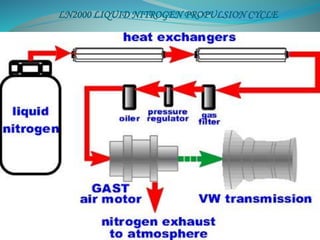
LN2000 LIQUID NITROGEN PROPULSION CYCLE
HEAT EXCHANGER 
The heat exchanger is like the radiator of a car but 
instead of using air to cool water, it uses air to heat 
and boil liquid nitrogen. The resulting high-pressure 
nitrogen gas is fed to an engine that operates like a 
reciprocating steam engine, converting pressure to 
mechanical power. The only exhaust is nitrogen, which 
is the major constituent of our atmosphere.
POWER CYCLE 
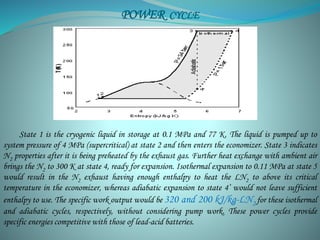
State 1 is the cryogenic liquid in storage at 0.1 MPa and 77 K. The liquid is pumped up to 
system pressure of 4 MPa (supercritical) at state 2 and then enters the economizer. State 3 indicates 
N2 properties after it is being preheated by the exhaust gas. Further heat exchange with ambient air 
brings the N2 to 300 K at state 4, ready for expansion. Isothermal expansion to 0.11 MPa at state 5 
would result in the N2 exhaust having enough enthalpy to heat the LN2 to above its critical 
temperature in the economizer, whereas adiabatic expansion to state 4’ would not leave sufficient 
enthalpy to use. The specific work output would be 320 and 200 kJ/kg-LN2 for these isothermal 
and adiabatic cycles, respectively, without considering pump work. These power cycles provide 
specific energies competitive with those of lead-acid batteries.
PERFORMANCE OF A 
MODIFIED HONDA 
CRX(RANKINE CYCLE) 
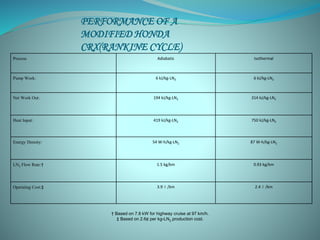
Process Adiabatic Isothermal 
Pump Work: 6 kJ/kg-LN2 6 kJ/kg-LN2 
Net Work Out: 194 kJ/kg-LN2 314 kJ/kg-LN2 
Heat Input: 419 kJ/kg-LN2 750 kJ/kg-LN2 
Energy Density: 54 W-h/kg-LN2 87 W-h/kg-LN2 
LN2 Flow Rate:† 1.5 kg/km 0.93 kg/km 
Operating Cost:‡ 3.9 ¢ /km 2.4 ¢ /km 
† Based on 7.8 kW for highway cruise at 97 km/h. 
‡ Based on 2.6¢ per kg-LN2 production cost.
COMPARED TO 
FOSSIL FUELS
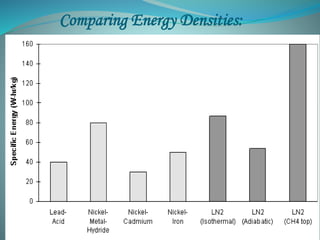
Comparing Energy Densities:
TECHNICAL ISSUES 
Range Extension and Power Boosting: 
Range extension and performance enhancement can be 
realized by heating the LN2 to above ambient temperatures 
with the combustion of a relatively low pollution fuel such 
as ethanol or natural gas. By increasing the gaseous N2 
temperature to 500 K, the specific work at 4 MPa for the 
adiabatic engine is increased by 60% to make it nearly the 
same as the work from an isothermal expansion engine 
operating at 300 K. In this particular propulsive cycle an 
extra superheat of 200°C results in only a 30% increase in 
specific power. Thus the advantage of operating above 
ambient temperature depends, on how isothermal the 
expansion process can be made to be.
CONCLUSION 
The potential for utilizing the available energy of liquid nitrogen 
for automotive propulsion looks very promising. Time to recharge 
(refuel), infrastructure investment, and environmental impact are 
among the issues to consider, in addition to range and performance, 
when comparing the relative merits of different technologies. The 
convenience of pumping a fluid into the storage tank is very attractive 
when compared with the typical recharge times associated with lead-acid 
batteries. Manufacturing LN2 from ambient air inherently removes 
small quantities of atmospheric pollutants and the installation of large-scale 
liquefaction equipment at existing fossil-fuel power stations could 
make flue gas condensation processes economical and even eliminate the 
emissions of CO2.
WHY??? 
HOW???? 
WHEN????? 
WHERE??????? 
????????????????? 
???????????????????????????????????? 
QUESTIONSSSSS…!!!!!?????

CRYOCAR

  • 1.
    CRYOCAR PRESENTED BY SIDDHARTHA BHATTACHARJEE DEPARTMENT OF MECHANICAL ENGG.
  • 2.
    INTRODUCTION Cryogens areeffective thermal storage media which, when used for automotive purposes, offer significant advantages over current and proposed electrochemical battery technologies, both in performance and economy. An automotive propulsion concept is presented which utilizes liquid nitrogen as the working fluid for an open Rankine cycle. The principle of operation is like that of a steam engine, except there is no combustion involved. The usage of cryogenic fuels has significant advantage over other fuel. Also, factors such as production and storage of nitrogen and pollutants in the exhaust give advantage for the cryogenic fuels.
  • 3.
    LN2000 LIQUID NITROGENPROPULSION CYCLE
  • 4.
    HEAT EXCHANGER Theheat exchanger is like the radiator of a car but instead of using air to cool water, it uses air to heat and boil liquid nitrogen. The resulting high-pressure nitrogen gas is fed to an engine that operates like a reciprocating steam engine, converting pressure to mechanical power. The only exhaust is nitrogen, which is the major constituent of our atmosphere.
  • 5.
    POWER CYCLE State1 is the cryogenic liquid in storage at 0.1 MPa and 77 K. The liquid is pumped up to system pressure of 4 MPa (supercritical) at state 2 and then enters the economizer. State 3 indicates N2 properties after it is being preheated by the exhaust gas. Further heat exchange with ambient air brings the N2 to 300 K at state 4, ready for expansion. Isothermal expansion to 0.11 MPa at state 5 would result in the N2 exhaust having enough enthalpy to heat the LN2 to above its critical temperature in the economizer, whereas adiabatic expansion to state 4’ would not leave sufficient enthalpy to use. The specific work output would be 320 and 200 kJ/kg-LN2 for these isothermal and adiabatic cycles, respectively, without considering pump work. These power cycles provide specific energies competitive with those of lead-acid batteries.
  • 6.
    PERFORMANCE OF A MODIFIED HONDA CRX(RANKINE CYCLE) Process Adiabatic Isothermal Pump Work: 6 kJ/kg-LN2 6 kJ/kg-LN2 Net Work Out: 194 kJ/kg-LN2 314 kJ/kg-LN2 Heat Input: 419 kJ/kg-LN2 750 kJ/kg-LN2 Energy Density: 54 W-h/kg-LN2 87 W-h/kg-LN2 LN2 Flow Rate:† 1.5 kg/km 0.93 kg/km Operating Cost:‡ 3.9 ¢ /km 2.4 ¢ /km † Based on 7.8 kW for highway cruise at 97 km/h. ‡ Based on 2.6¢ per kg-LN2 production cost.
  • 7.
  • 8.
  • 9.
    TECHNICAL ISSUES RangeExtension and Power Boosting: Range extension and performance enhancement can be realized by heating the LN2 to above ambient temperatures with the combustion of a relatively low pollution fuel such as ethanol or natural gas. By increasing the gaseous N2 temperature to 500 K, the specific work at 4 MPa for the adiabatic engine is increased by 60% to make it nearly the same as the work from an isothermal expansion engine operating at 300 K. In this particular propulsive cycle an extra superheat of 200°C results in only a 30% increase in specific power. Thus the advantage of operating above ambient temperature depends, on how isothermal the expansion process can be made to be.
  • 10.
    CONCLUSION The potentialfor utilizing the available energy of liquid nitrogen for automotive propulsion looks very promising. Time to recharge (refuel), infrastructure investment, and environmental impact are among the issues to consider, in addition to range and performance, when comparing the relative merits of different technologies. The convenience of pumping a fluid into the storage tank is very attractive when compared with the typical recharge times associated with lead-acid batteries. Manufacturing LN2 from ambient air inherently removes small quantities of atmospheric pollutants and the installation of large-scale liquefaction equipment at existing fossil-fuel power stations could make flue gas condensation processes economical and even eliminate the emissions of CO2.
  • 11.
    WHY??? HOW???? WHEN????? WHERE??????? ????????????????? ???????????????????????????????????? QUESTIONSSSSS…!!!!!?????