CHAMELI DEVI GROUP OF INSTITUTIONS 
Department of mechanical engineering 
Seminar on- 
CRYOCAR 
AMAN 
KAPOOR 
By-
Topic of interest- 
1) Introduction 
2) What is liquid nitrogen vehicle? 
3) Why nitrogen as a vehicle fuel? 
4) Parts of a LNPC 
5) Principle of operation 
6) Liquid nitrogen propulsion cycle 
7) Advantages over electric cars 
8) Efficiency 
9) Drawbacks 
10)Why not commercialized? 
11)Conclusion
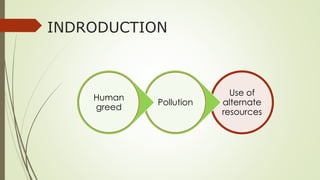
INDRODUCTION 
Use of 
alternate 
resources 
Pollution 
Human 
greed
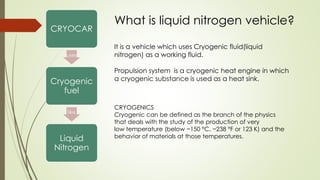
CRYOCAR 
uses 
Cryogenic 
fuel 
like 
Liquid 
Nitrogen 
What is liquid nitrogen vehicle? 
It is a vehicle which uses Cryogenic fluid(liquid 
nitrogen) as a working fluid. 
Propulsion system is a cryogenic heat engine in which 
a cryogenic substance is used as a heat sink. 
CRYOGENICS 
Cryogenic can be defined as the branch of the physics 
that deals with the study of the production of very 
low temperature (below −150 °C, −238 °F or 123 K) and the 
behavior of materials at those temperatures.
Why nitrogen as a vehicle fuel? 
High cost and limited availability of fossil fuels like petrol and diesel. 
Due to high level of pollution associated with the combustion of fossil fuels the 
need of ZEV(Zero Emission Vehicle) has been generated. (presently the 
battery powered electric vehicle is the only commercially available ZEV but 
not successful due to high initial cost, slow recharge and limited range). 
And the most important is the huge availability of Nitrogen gas(78% of air is 
nitrogen). 
Note: According to Petroleum Conservation and Research Association 
petroleum production will be at its peak in 2012 and is likely to 
decrease after that.
Parts of a LNPC 
1) 
Cryogen 
storage 
vessel 
A pressurized tank(24 gallon) to store liquid nitrogen. 
Low boil-off rate , minimum size and mass and reasonable cost. 
2) 
Pump 
The pump is used to pump the liquid nitrogen into the engine. 
Operating pressure between 500-600psi
Parts of LNPC……. 
3) 
Economizer 
A preheater , called an economizer , uses left over heat in 
the engine’s exhaust to preheat the liquid nitrogen before 
it enters the heat exchanger. 
Improves efficiency. 
4) 
Heat 
exchanger 
A primary heat exchanger that heats (using 
atmospheric heat) LN2 to form N2 gas, then heats gas 
under pressure to near atmospheric temperature
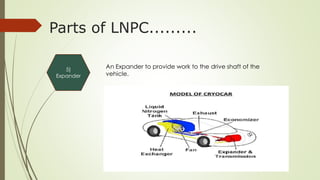
Parts of LNPC......... 
5) 
Expander 
An Expander to provide work to the drive shaft of the 
vehicle.
Principle of operation 
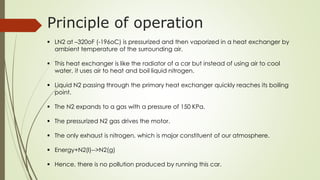
 LN2 at –320oF (-196oC) is pressurized and then vaporized in a heat exchanger by 
ambient temperature of the surrounding air. 
 This heat exchanger is like the radiator of a car but instead of using air to cool 
water, it uses air to heat and boil liquid nitrogen. 
 Liquid N2 passing through the primary heat exchanger quickly reaches its boiling 
point. 
 The N2 expands to a gas with a pressure of 150 KPa. 
 The pressurized N2 gas drives the motor. 
 The only exhaust is nitrogen, which is major constituent of our atmosphere. 
 Energy+N2(l)-->N2(g) 
 Hence, there is no pollution produced by running this car.
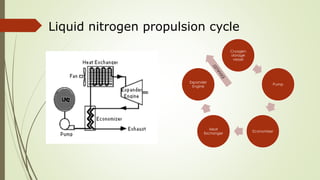
Liquid nitrogen propulsion cycle 
Cryogen 
storage 
vessel 
Pump 
Economizer 
Heat 
Expander 
Engine 
Exchanger
Advantages over electric cars 
 A liquid nitrogen car is much lighter and refilling its tank takes only about 10- 
15 minutes. 
 The exhaust produced by the car is environmental friendly. 
 A cryogenic car could have three times the range of an electric car of the 
same weight and no battery disposal concerns 
ZEV
Efficiency- 
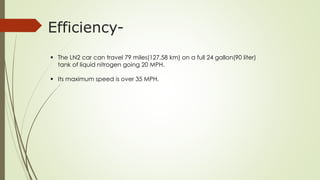
 The LN2 car can travel 79 miles(127.58 km) on a full 24 gallon(90 liter) 
tank of liquid nitrogen going 20 MPH. 
 Its maximum speed is over 35 MPH.
Drawbacks: 
 The N2 passing through the tubes of the heat exchanger is so cold that 
the moisture in the surrounding air would condense on the outside of the 
tubes, obstructing the air flow. 
 Then there's the safety issue. Should a nitrogen car be kept in a poorly 
ventilated space and, if the Nitrogen leaks off, it could prove fatal.
Why not commercialized? 
Even though the technology is 10 to 12 years old, still it has not come to the 
market for two reasons. 
 Safety issues have not been sorted out as yet. 
 Lack of funds for research. 
SAD
Conclusion 
 In a real sense, the more such vehicles are used, the cleaner the air will 
become 
 Time to recharge , infrastructure investment , and environmental impact 
are among the issues to consider , in addition to range and performance 
, when comparing the relative merits of different ZEV technologies. 
 Extra research work is needed to utilize the most of the available energy

Cryocar

  • 1.
    CHAMELI DEVI GROUPOF INSTITUTIONS Department of mechanical engineering Seminar on- CRYOCAR AMAN KAPOOR By-
  • 2.
    Topic of interest- 1) Introduction 2) What is liquid nitrogen vehicle? 3) Why nitrogen as a vehicle fuel? 4) Parts of a LNPC 5) Principle of operation 6) Liquid nitrogen propulsion cycle 7) Advantages over electric cars 8) Efficiency 9) Drawbacks 10)Why not commercialized? 11)Conclusion
  • 3.
    INDRODUCTION Use of alternate resources Pollution Human greed
  • 4.
    CRYOCAR uses Cryogenic fuel like Liquid Nitrogen What is liquid nitrogen vehicle? It is a vehicle which uses Cryogenic fluid(liquid nitrogen) as a working fluid. Propulsion system is a cryogenic heat engine in which a cryogenic substance is used as a heat sink. CRYOGENICS Cryogenic can be defined as the branch of the physics that deals with the study of the production of very low temperature (below −150 °C, −238 °F or 123 K) and the behavior of materials at those temperatures.
  • 5.
    Why nitrogen asa vehicle fuel? High cost and limited availability of fossil fuels like petrol and diesel. Due to high level of pollution associated with the combustion of fossil fuels the need of ZEV(Zero Emission Vehicle) has been generated. (presently the battery powered electric vehicle is the only commercially available ZEV but not successful due to high initial cost, slow recharge and limited range). And the most important is the huge availability of Nitrogen gas(78% of air is nitrogen). Note: According to Petroleum Conservation and Research Association petroleum production will be at its peak in 2012 and is likely to decrease after that.
  • 6.
    Parts of aLNPC 1) Cryogen storage vessel A pressurized tank(24 gallon) to store liquid nitrogen. Low boil-off rate , minimum size and mass and reasonable cost. 2) Pump The pump is used to pump the liquid nitrogen into the engine. Operating pressure between 500-600psi
  • 7.
    Parts of LNPC……. 3) Economizer A preheater , called an economizer , uses left over heat in the engine’s exhaust to preheat the liquid nitrogen before it enters the heat exchanger. Improves efficiency. 4) Heat exchanger A primary heat exchanger that heats (using atmospheric heat) LN2 to form N2 gas, then heats gas under pressure to near atmospheric temperature
  • 8.
    Parts of LNPC......... 5) Expander An Expander to provide work to the drive shaft of the vehicle.
  • 9.
    Principle of operation  LN2 at –320oF (-196oC) is pressurized and then vaporized in a heat exchanger by ambient temperature of the surrounding air.  This heat exchanger is like the radiator of a car but instead of using air to cool water, it uses air to heat and boil liquid nitrogen.  Liquid N2 passing through the primary heat exchanger quickly reaches its boiling point.  The N2 expands to a gas with a pressure of 150 KPa.  The pressurized N2 gas drives the motor.  The only exhaust is nitrogen, which is major constituent of our atmosphere.  Energy+N2(l)-->N2(g)  Hence, there is no pollution produced by running this car.
  • 10.
    Liquid nitrogen propulsioncycle Cryogen storage vessel Pump Economizer Heat Expander Engine Exchanger
  • 11.
    Advantages over electriccars  A liquid nitrogen car is much lighter and refilling its tank takes only about 10- 15 minutes.  The exhaust produced by the car is environmental friendly.  A cryogenic car could have three times the range of an electric car of the same weight and no battery disposal concerns ZEV
  • 12.
    Efficiency-  TheLN2 car can travel 79 miles(127.58 km) on a full 24 gallon(90 liter) tank of liquid nitrogen going 20 MPH.  Its maximum speed is over 35 MPH.
  • 13.
    Drawbacks:  TheN2 passing through the tubes of the heat exchanger is so cold that the moisture in the surrounding air would condense on the outside of the tubes, obstructing the air flow.  Then there's the safety issue. Should a nitrogen car be kept in a poorly ventilated space and, if the Nitrogen leaks off, it could prove fatal.
  • 14.
    Why not commercialized? Even though the technology is 10 to 12 years old, still it has not come to the market for two reasons.  Safety issues have not been sorted out as yet.  Lack of funds for research. SAD
  • 15.
    Conclusion  Ina real sense, the more such vehicles are used, the cleaner the air will become  Time to recharge , infrastructure investment , and environmental impact are among the issues to consider , in addition to range and performance , when comparing the relative merits of different ZEV technologies.  Extra research work is needed to utilize the most of the available energy