
Smart Materials For Vibration Reduction
A seminar Report
Submitted by
DIANA ALKEFLAWI
IN
MECHANICAL ENGINEERING
AT
ERCIYES UNIVERSITY
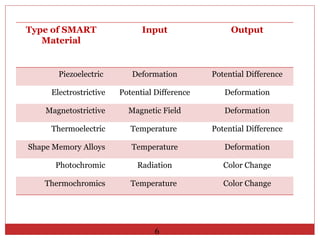
MECHANICAL ENGINEERING DEPARTMENT
KAYSERI
17/12/2015
Abstract
For active noise and vibration reduction tasks in smart-structures
technology piezoelectric ceramics are first choice. They generate
large forces, have fast response time, are commercially available as
fibres, patches and stacks and allow integration into structural
components.
-i-
The purpose of this research is compare the vibration test results for
a plate with and without smart damping. Also discusses the
benefits of smart materials when added to existing damping
materials in terms of vibration.
TABLE OF CONTENTS
-ii-
Page
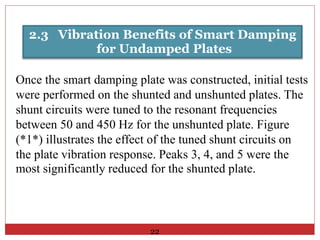
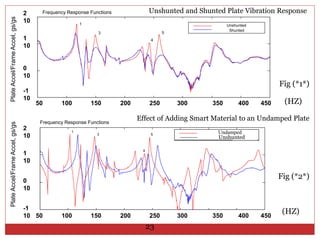
CHAPTER 1 : 1 . INTRODUCTION …………….……..…………….……….. …1
1.1 What is Smart Materials ?..............................................................................1
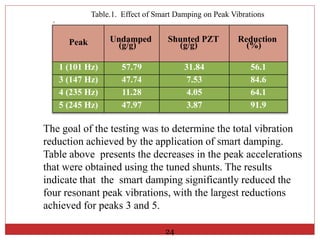
1.2 Traditional vs. Smart structure…………………..…………………………2
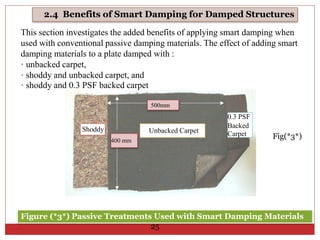
1.3 Classification of Smart Materials…………..…………………………… ..3
1.4 Smart Composites…………………………………………….…………….7
1.5 Smart Structures………………………………………………………….…8
1.6 Importance For Smart Structures…………………………..……………….10
1.7 Smart System For Engineering Applications……………….....…..………..11
1.8 Smart Structure Applications …..……………………………………..……12
CHAPTER 2 :
2.1 What is vibration?........................................................................................17
2.2 Terms Definitions…………………………………………….. ……..18
2.2.1 Shunt Circuit Design……………...………………………….....…18
2.2.2 Shunt Tuning…………….……………………………………...…19
2.2.3 Damped vs. Undamped Vibration…………………………………20
2.3 Vibration Benefits Of Smart Damping For Undamed Plates…………..…22
2.4 Benefits Of Smart Damping For Damped Structures………….……..…..25
2.5 Summary ………………………………………………………..……….34
REFERENCES……………………… .………………………………………………35
CHAPTER ONE
1.1 WHAT IS SMART MATERIALS ?
-1-
-Smart or intelligent materials are materials that have the
intrinsic and extrinsic capabilities, first, to respond to stimuli
and environmental changes, second, to activate their functions
according to these changes.
*Stimulus —stress, strain, light, electric field, temperature ,
pressure,moisture, magnatic field.
*Response —motion or change in optical properties,modulus,
surface tension, piezoelectricity etc.
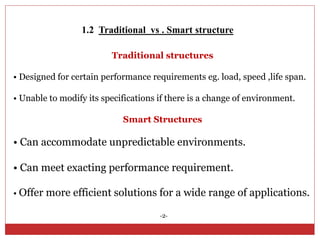
1.2 Traditional vs . Smart structure
Traditional structures
• Designed for certain performance requirements eg. load, speed ,life span.
• Unable to modify its specifications if there is a change of environment.
Smart Structures
• Can accommodate unpredictable environments.
• Can meet exacting performance requirement.
• Offer more efficient solutions for a wide range of applications.
-2-
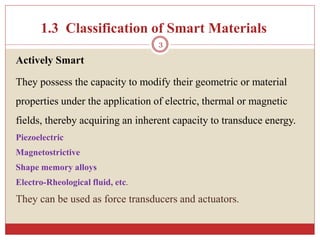
1.3 Classification of Smart Materials
Actively Smart
They possess the capacity to modify their geometric or material
properties under the application of electric, thermal or magnetic
fields, thereby acquiring an inherent capacity to transduce energy.
Piezoelectric
Magnetostrictive
Shape memory alloys
Electro-Rheological fluid, etc.
They can be used as force transducers and actuators.
3
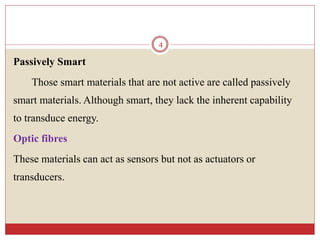
Passively Smart
Those smart materials that are not active are called passively
smart materials. Although smart, they lack the inherent capability
to transduce energy.
Optic fibres
These materials can act as sensors but not as actuators or
transducers.
4
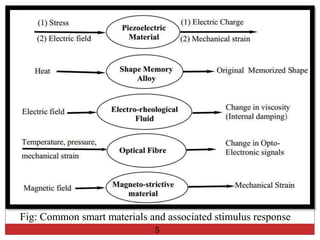
Fig: Common smart materials and associated stimulus response
5
Type of SMART
Material
Input Output
Piezoelectric Deformation Potential Difference
Electrostrictive Potential Difference Deformation
Magnetostrictive Magnetic Field Deformation
Thermoelectric Temperature Potential Difference
Shape Memory Alloys Temperature Deformation
Photochromic Radiation Color Change
Thermochromics Temperature Color Change
6
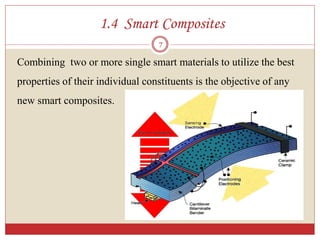
1.4 Smart Composites
Combining two or more single smart materials to utilize the best
properties of their individual constituents is the objective of any
new smart composites.
7
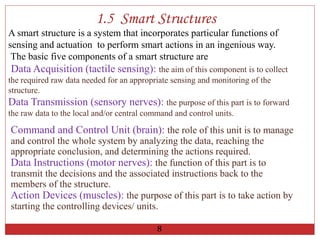
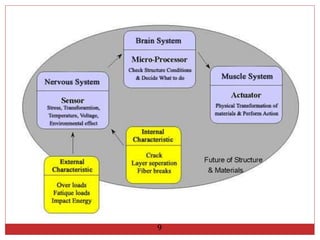
A smart structure is a system that incorporates particular functions of
sensing and actuation to perform smart actions in an ingenious way.
The basic five components of a smart structure are
Data Acquisition (tactile sensing): the aim of this component is to collect
the required raw data needed for an appropriate sensing and monitoring of the
structure.
Data Transmission (sensory nerves): the purpose of this part is to forward
the raw data to the local and/or central command and control units.
1.5 Smart Structures
Command and Control Unit (brain): the role of this unit is to manage
and control the whole system by analyzing the data, reaching the
appropriate conclusion, and determining the actions required.
Data Instructions (motor nerves): the function of this part is to
transmit the decisions and the associated instructions back to the
members of the structure.
Action Devices (muscles): the purpose of this part is to take action by
starting the controlling devices/ units.
8
9
1.6 Importance for Smart Structures
- Light weight
- Warnings on problems that can encounter
- Preventative maintenance
- Performance optimization
- Improved life cycle
10
General Requirements and Expectations
1. High degree of reliability, efficiency and sustainability not only of the structure
but also of the whole system.
2. High security of the infrastructures particularly when subjected to extreme and
unconventional conditions.
3. Full integration of all the functions of the system.
4. Continuous health and integrity monitoring.
5. Damage detection and self-recovery.
6. Intelligent operational management system.
Smart Technologies Prospects
1. New sensing materials and devices.
2. New actuation materials and devices.
3. New control devices and techniques.
4. Self-detection, self-diagnostic, self-corrective and self-controlled functions of
smart materials/systems.
1.7 SMART SYSTEM FOR ENGINEERING APPLICATIONS
11
The scope of application of smart material includes solving engineering problems
for creation of new products with unfeasible efficiency and provides an opportunity
that generate revenue .
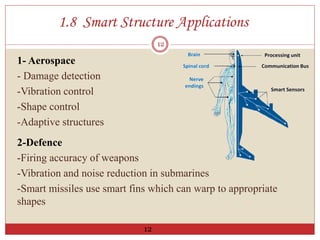
1.8 Smart Structure Applications
1- Aerospace
- Damage detection
-Vibration control
-Shape control
-Adaptive structures
2-Defence
-Firing accuracy of weapons
-Vibration and noise reduction in submarines
-Smart missiles use smart fins which can warp to appropriate
shapes
12
12
3-Automotive
-Passenger comfort (noise control in cabin)
-Vibration control (active engine mounts)
-Health monitoring (smart sensors)
4-Industrial
-Manufacturing (machine tool chatter
control)
-Air conditioning and ventilation (noise
control)
-Mining machinery (vibration control)
5-Medical
 Smart sensors
 Micro robotics
 Surgical tools
6-Civil
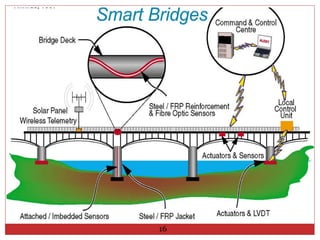
 Bridges
 Earthquake protection
13
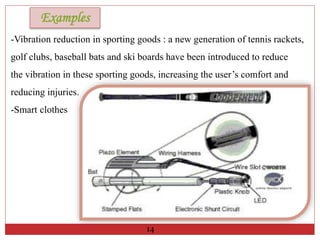
-Vibration reduction in sporting goods : a new generation of tennis rackets,
golf clubs, baseball bats and ski boards have been introduced to reduce
the vibration in these sporting goods, increasing the user’s comfort and
reducing injuries.
-Smart clothes
14
Examples
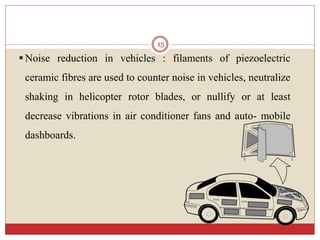
Noise reduction in vehicles : filaments of piezoelectric
ceramic fibres are used to counter noise in vehicles, neutralize
shaking in helicopter rotor blades, or nullify or at least
decrease vibrations in air conditioner fans and auto- mobile
dashboards.
15
16
CHAPTER TWO
17
2.1 WHAT IS VIBRATION ?
Scientific Definition
Any motion that repeats itself after an internal of
time.
Engineering Definition
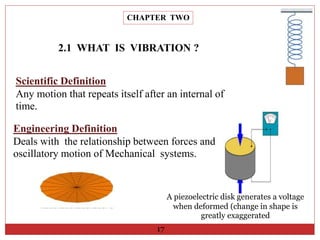
Deals with the relationship between forces and
oscillatory motion of Mechanical systems.
A piezoelectric disk generates a voltage
when deformed (change in shape is
greatly exaggerated
Shunt Circuit Design
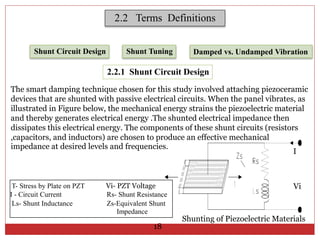
The smart damping technique chosen for this study involved attaching piezoceramic
devices that are shunted with passive electrical circuits. When the panel vibrates, as
illustrated in Figure below, the mechanical energy strains the piezoelectric material
and thereby generates electrical energy .The shunted electrical impedance then
dissipates this electrical energy. The components of these shunt circuits (resistors
,capacitors, and inductors) are chosen to produce an effective mechanical
impedance at desired levels and frequencies.
2.2 Terms Definitions
Shunt Tuning Damped vs. Undamped Vibration
2.2.1 Shunt Circuit Design
18
T- Stress by Plate on PZT Vi- PZT Voltage
I - Circuit Current Rs- Shunt Resistance
Ls- Shunt Inductance Zs-Equivalent Shunt
Impedance
I
Vi
Shunting of Piezoelectric Materials
2.2.2 Shunt Tuning
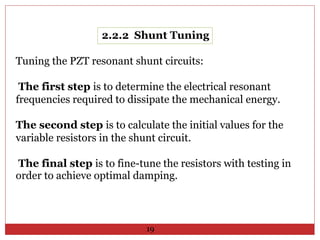
Tuning the PZT resonant shunt circuits:
The first step is to determine the electrical resonant
frequencies required to dissipate the mechanical energy.
The second step is to calculate the initial values for the
variable resistors in the shunt circuit.
The final step is to fine-tune the resistors with testing in
order to achieve optimal damping.
19
Damped and undamped vibration refer to two different
types of vibrations. The main difference between them
is that undamped vibration refer to vibrations where
energy of the vibrating object does not get dissipated to
surroundings over time, whereas damped vibration refers
to vibrations where the vibrating object loses its energy to
the surroundings.
2.2.3 Damped vs. Undamped Vibration
20
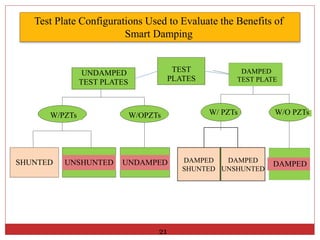
UNSHUNTED UNDAMPED
W/PZTs W/OPZTs
UNDAMPED
TEST PLATES
SHUNTED DAMPED
SHUNTED
DAMPED
UNSHUNTED
W/ PZTs W/O PZTs
DAMPED
TEST
PLATES
DAMPED
TEST PLATE
Test Plate Configurations Used to Evaluate the Benefits of
Smart Damping
21
2.3 Vibration Benefits of Smart Damping
for Undamped Plates
Once the smart damping plate was constructed, initial tests
were performed on the shunted and unshunted plates. The
shunt circuits were tuned to the resonant frequencies
between 50 and 450 Hz for the unshunted plate. Figure
(*1*) illustrates the effect of the tuned shunt circuits on
the plate vibration response. Peaks 3, 4, and 5 were the
most significantly reduced for the shunted plate.
22
Frequency Response Functions
1
3 5
4
Unshunted
Shunted
PlateAccel/FrameAccel,gs/gs
Fig (*1*)
50 100 150 200 250 300 350 400 450
-1
10
0
10
1
10
2
10
23
(HZ)
Unshunted and Shunted Plate Vibration Response
1
3 5
4
PlateAccel/FrameAccel,gs/gs
Fig (*2*)
(HZ)-1
10
0
10
1
10
2
10
50 100 150 200 250 300 350 400 450
Effect of Adding Smart Material to an Undamped PlateFrequency Response Functions
Unshunted
Undamped
Peak Undamped
(g/g)
Shunted PZT
(g/g)
Reduction
(%)
1 (101 Hz) 57.79 31.84 56.1
3 (147 Hz) 47.74 7.53 84.6
4 (235 Hz) 11.28 4.05 64.1
5 (245 Hz) 47.97 3.87 91.9
2
The goal of the testing was to determine the total vibration
reduction achieved by the application of smart damping.
Table above presents the decreases in the peak accelerations
that were obtained using the tuned shunts. The results
indicate that the smart damping significantly reduced the
four resonant peak vibrations, with the largest reductions
achieved for peaks 3 and 5.
Table.1. Effect of Smart Damping on Peak Vibrations
24
2.4 Benefits of Smart Damping for Damped Structures
This section investigates the added benefits of applying smart damping when
used with conventional passive damping materials. The effect of adding smart
damping materials to a plate damped with :
· unbacked carpet,
· shoddy and unbacked carpet, and
· shoddy and 0.3 PSF backed carpet
25
Figure (*3*) Passive Treatments Used with Smart Damping Materials
500mm
Shoddy Unbacked Carpet
0.3 PSF
Backed
Carpet
400 mm
Fig(*3*)
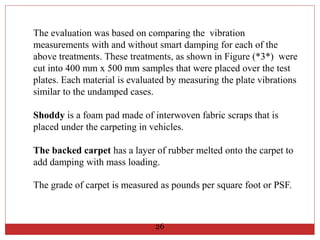
The evaluation was based on comparing the vibration
measurements with and without smart damping for each of the
above treatments. These treatments, as shown in Figure (*3*) were
cut into 400 mm x 500 mm samples that were placed over the test
plates. Each material is evaluated by measuring the plate vibrations
similar to the undamped cases.
Shoddy is a foam pad made of interwoven fabric scraps that is
placed under the carpeting in vehicles.
The backed carpet has a layer of rubber melted onto the carpet to
add damping with mass loading.
The grade of carpet is measured as pounds per square foot or PSF.
26
As was expected, the damping treatments altered the frequency
response of the plate which required the shunts to be retuned
for each damping case. Once the shunt circuits were optimized,
the three different treatments were tested for both the shunted
plate and the undamped plate.
The augmenting vibration benefits of PZTs are presented
first followed by the acoustic benefits.
27
Vibration Benefits of Adding Smart Damping to
Damped Structures
28
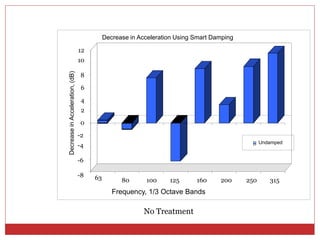
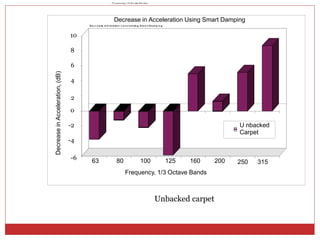
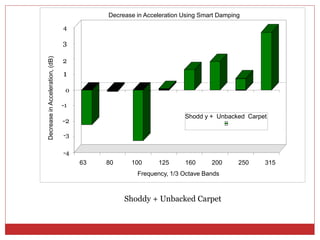
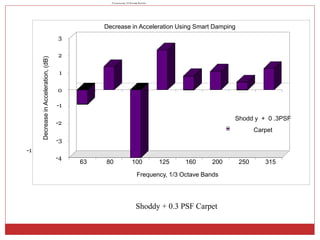
It is evident in Figures below that the smart damping has the most
effect on accelerations above 125 Hz. It is also noted that the
PZTs add less additional damping as the amount of treatment
increases and the vibrations decrease.
Another convenient method to assess the benefits of smart
damping materials is to evaluate their broadband performance
using a third-octave band analysis. For the vibration data, 1/3-
octave values were determined for each center frequency.
Undamped
Decrease in Acceleration Using Smart Damping
Frequency, 1/3 Octave Bands
DecreaseinAcceleration,(dB)
-8
-6
-4
-2
0
2
4
6
8
10
12
63 80 100 125 200 250 315
No Treatment
160
U nbacked
Carpet
Decrease in Acceleration Using Smart Damping
63 80 100 125 160 200 250 315
Frequency, 1/3 Octave Bands
-6
-4
-2
0
2
4
6
8
10
DecreaseinAcceleration,(dB)
D e c r e a se in V i b ra tio n L e v e l s U sin g S m a r t D a m p i n g
F r e q u e n cy, ( 1 /3 O c t ave B a n d s )
Unbacked carpet
Shodd y + Unbacked Carpet
Decrease in Acceleration Using Smart Damping
Frequency, 1/3 Octave Bands
DecreaseinAcceleration,(dB)
Shoddy + Unbacked Carpet
-4
-2
0
2
4
63 80 100 125 160 200 250 315
-3
-1
1
3
Shodd y + 0 .3PSF
Carpet
Decrease in Acceleration Using Smart Damping
63 80 100 125 160 200 250 315
Frequency, 1/3 Octave Bands
DecreaseinAcceleration,(dB)
-3
-1
-4
-2
0
2
F r e q u e n cy, 1 /3 O c t ave B a n d s
Shoddy + 0.3 PSF Carpet
-1
3
1
63 80 100 125 160 200 250 315
UNDAMPED
PLATE
0.5 -1 8 -6 10 3 10 12
UNBACKED
PLATE
-4 -1 -2 -6 5 1.8 5 8
SHODDY+
UNBACKED
PLATE
-2 -0.1 -3 0.1 1.2 1.6 1 4
SHODDY +
0.3 PSF
PLATE
-1 1.5 -4 2 0.9 1 0.5 1
TYPES OF
PLATES
Hz
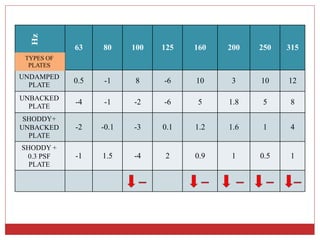
The benefits of smart damping materials, specifically
piezoceramics with shunt circuits, in reducing vibrations
were addressed. Tests were conducted on a test plate with
shunted PZTs. A comparison of the results with an
undamped plate showed that the smart damping materials
can significantly lower both the plate vibration for both
narrowband and broadband frequencies.
2.5 Summary
34
 Akhras, G., “Advanced Composites for Smart Structures”, Proceedings, ICCM-12, 12th
International Conference on Composite Materials, Paris5-9.
INTRODUCTION, CLASSIFICATION AND APPLICATIONS OF SMART MATERIALS: AN
OVERVIEW American Journal of Applied Sciences 10 (8): 876-880, 2013 Susmita Kamila
 An Experimental Evaluation of the Application of Smart Damping Materials for Reducing
Structural Noise and Vibrations Kristina M. Jeric
 International Journal of Mechanical and Industrial Engineering (IJMIE) ISSN No.
2231-6477, Vol-3, Iss-1, 2013
 Ref. H.W. Hagood, and A von Flotow, “ Damping of Structural Vibrations with Piezoelectric
Materials and Passive Electrical Networks,” Journal of Sound and Vibration
35
 Smart materials for active noise and vibration reduction
H. P. Monner German Aerospace Center (DLR), Institute of Composite Structures and
Adaptive Systems Lilienthalplatz 7, D-38108 Brunswick, Germany
 Overview of Smart Materials Bishakh Bhattacharya & Nachiketa Tiwari
Department of Mechanical Engineering Indian Institute of Technology, Kanpur
SMART MATERIALS AND SMART SYSTEMS FOR THE FUTURE by Georges
Akhras Canadian Military Journal Autumn 2000
IF THERE IS ANY
QUESTION
YOU WELCOME
THANK YOU FOR YOUR
LISTENING
36

Seminar

  • 1.
    Smart Materials ForVibration Reduction A seminar Report Submitted by DIANA ALKEFLAWI IN MECHANICAL ENGINEERING AT ERCIYES UNIVERSITY MECHANICAL ENGINEERING DEPARTMENT KAYSERI 17/12/2015
  • 2.
    Abstract For active noiseand vibration reduction tasks in smart-structures technology piezoelectric ceramics are first choice. They generate large forces, have fast response time, are commercially available as fibres, patches and stacks and allow integration into structural components. -i- The purpose of this research is compare the vibration test results for a plate with and without smart damping. Also discusses the benefits of smart materials when added to existing damping materials in terms of vibration.
  • 3.
    TABLE OF CONTENTS -ii- Page CHAPTER1 : 1 . INTRODUCTION …………….……..…………….……….. …1 1.1 What is Smart Materials ?..............................................................................1 1.2 Traditional vs. Smart structure…………………..…………………………2 1.3 Classification of Smart Materials…………..…………………………… ..3 1.4 Smart Composites…………………………………………….…………….7 1.5 Smart Structures………………………………………………………….…8 1.6 Importance For Smart Structures…………………………..……………….10 1.7 Smart System For Engineering Applications……………….....…..………..11 1.8 Smart Structure Applications …..……………………………………..……12 CHAPTER 2 : 2.1 What is vibration?........................................................................................17 2.2 Terms Definitions…………………………………………….. ……..18 2.2.1 Shunt Circuit Design……………...………………………….....…18 2.2.2 Shunt Tuning…………….……………………………………...…19 2.2.3 Damped vs. Undamped Vibration…………………………………20 2.3 Vibration Benefits Of Smart Damping For Undamed Plates…………..…22 2.4 Benefits Of Smart Damping For Damped Structures………….……..…..25 2.5 Summary ………………………………………………………..……….34 REFERENCES……………………… .………………………………………………35
  • 4.
    CHAPTER ONE 1.1 WHATIS SMART MATERIALS ? -1- -Smart or intelligent materials are materials that have the intrinsic and extrinsic capabilities, first, to respond to stimuli and environmental changes, second, to activate their functions according to these changes. *Stimulus —stress, strain, light, electric field, temperature , pressure,moisture, magnatic field. *Response —motion or change in optical properties,modulus, surface tension, piezoelectricity etc.
  • 5.
    1.2 Traditional vs. Smart structure Traditional structures • Designed for certain performance requirements eg. load, speed ,life span. • Unable to modify its specifications if there is a change of environment. Smart Structures • Can accommodate unpredictable environments. • Can meet exacting performance requirement. • Offer more efficient solutions for a wide range of applications. -2-
  • 6.
    1.3 Classification ofSmart Materials Actively Smart They possess the capacity to modify their geometric or material properties under the application of electric, thermal or magnetic fields, thereby acquiring an inherent capacity to transduce energy. Piezoelectric Magnetostrictive Shape memory alloys Electro-Rheological fluid, etc. They can be used as force transducers and actuators. 3
  • 7.
    Passively Smart Those smartmaterials that are not active are called passively smart materials. Although smart, they lack the inherent capability to transduce energy. Optic fibres These materials can act as sensors but not as actuators or transducers. 4
  • 8.
    Fig: Common smartmaterials and associated stimulus response 5
  • 9.
    Type of SMART Material InputOutput Piezoelectric Deformation Potential Difference Electrostrictive Potential Difference Deformation Magnetostrictive Magnetic Field Deformation Thermoelectric Temperature Potential Difference Shape Memory Alloys Temperature Deformation Photochromic Radiation Color Change Thermochromics Temperature Color Change 6
  • 10.
    1.4 Smart Composites Combiningtwo or more single smart materials to utilize the best properties of their individual constituents is the objective of any new smart composites. 7
  • 11.
    A smart structureis a system that incorporates particular functions of sensing and actuation to perform smart actions in an ingenious way. The basic five components of a smart structure are Data Acquisition (tactile sensing): the aim of this component is to collect the required raw data needed for an appropriate sensing and monitoring of the structure. Data Transmission (sensory nerves): the purpose of this part is to forward the raw data to the local and/or central command and control units. 1.5 Smart Structures Command and Control Unit (brain): the role of this unit is to manage and control the whole system by analyzing the data, reaching the appropriate conclusion, and determining the actions required. Data Instructions (motor nerves): the function of this part is to transmit the decisions and the associated instructions back to the members of the structure. Action Devices (muscles): the purpose of this part is to take action by starting the controlling devices/ units. 8
  • 12.
  • 13.
    1.6 Importance forSmart Structures - Light weight - Warnings on problems that can encounter - Preventative maintenance - Performance optimization - Improved life cycle 10
  • 14.
    General Requirements andExpectations 1. High degree of reliability, efficiency and sustainability not only of the structure but also of the whole system. 2. High security of the infrastructures particularly when subjected to extreme and unconventional conditions. 3. Full integration of all the functions of the system. 4. Continuous health and integrity monitoring. 5. Damage detection and self-recovery. 6. Intelligent operational management system. Smart Technologies Prospects 1. New sensing materials and devices. 2. New actuation materials and devices. 3. New control devices and techniques. 4. Self-detection, self-diagnostic, self-corrective and self-controlled functions of smart materials/systems. 1.7 SMART SYSTEM FOR ENGINEERING APPLICATIONS 11 The scope of application of smart material includes solving engineering problems for creation of new products with unfeasible efficiency and provides an opportunity that generate revenue .
  • 15.
    1.8 Smart StructureApplications 1- Aerospace - Damage detection -Vibration control -Shape control -Adaptive structures 2-Defence -Firing accuracy of weapons -Vibration and noise reduction in submarines -Smart missiles use smart fins which can warp to appropriate shapes 12 12
  • 16.
    3-Automotive -Passenger comfort (noisecontrol in cabin) -Vibration control (active engine mounts) -Health monitoring (smart sensors) 4-Industrial -Manufacturing (machine tool chatter control) -Air conditioning and ventilation (noise control) -Mining machinery (vibration control) 5-Medical  Smart sensors  Micro robotics  Surgical tools 6-Civil  Bridges  Earthquake protection 13
  • 17.
    -Vibration reduction insporting goods : a new generation of tennis rackets, golf clubs, baseball bats and ski boards have been introduced to reduce the vibration in these sporting goods, increasing the user’s comfort and reducing injuries. -Smart clothes 14 Examples
  • 18.
    Noise reduction invehicles : filaments of piezoelectric ceramic fibres are used to counter noise in vehicles, neutralize shaking in helicopter rotor blades, or nullify or at least decrease vibrations in air conditioner fans and auto- mobile dashboards. 15
  • 19.
  • 20.
    CHAPTER TWO 17 2.1 WHATIS VIBRATION ? Scientific Definition Any motion that repeats itself after an internal of time. Engineering Definition Deals with the relationship between forces and oscillatory motion of Mechanical systems. A piezoelectric disk generates a voltage when deformed (change in shape is greatly exaggerated
  • 21.
    Shunt Circuit Design Thesmart damping technique chosen for this study involved attaching piezoceramic devices that are shunted with passive electrical circuits. When the panel vibrates, as illustrated in Figure below, the mechanical energy strains the piezoelectric material and thereby generates electrical energy .The shunted electrical impedance then dissipates this electrical energy. The components of these shunt circuits (resistors ,capacitors, and inductors) are chosen to produce an effective mechanical impedance at desired levels and frequencies. 2.2 Terms Definitions Shunt Tuning Damped vs. Undamped Vibration 2.2.1 Shunt Circuit Design 18 T- Stress by Plate on PZT Vi- PZT Voltage I - Circuit Current Rs- Shunt Resistance Ls- Shunt Inductance Zs-Equivalent Shunt Impedance I Vi Shunting of Piezoelectric Materials
  • 22.
    2.2.2 Shunt Tuning Tuningthe PZT resonant shunt circuits: The first step is to determine the electrical resonant frequencies required to dissipate the mechanical energy. The second step is to calculate the initial values for the variable resistors in the shunt circuit. The final step is to fine-tune the resistors with testing in order to achieve optimal damping. 19
  • 23.
    Damped and undampedvibration refer to two different types of vibrations. The main difference between them is that undamped vibration refer to vibrations where energy of the vibrating object does not get dissipated to surroundings over time, whereas damped vibration refers to vibrations where the vibrating object loses its energy to the surroundings. 2.2.3 Damped vs. Undamped Vibration 20
  • 24.
    UNSHUNTED UNDAMPED W/PZTs W/OPZTs UNDAMPED TESTPLATES SHUNTED DAMPED SHUNTED DAMPED UNSHUNTED W/ PZTs W/O PZTs DAMPED TEST PLATES DAMPED TEST PLATE Test Plate Configurations Used to Evaluate the Benefits of Smart Damping 21
  • 25.
    2.3 Vibration Benefitsof Smart Damping for Undamped Plates Once the smart damping plate was constructed, initial tests were performed on the shunted and unshunted plates. The shunt circuits were tuned to the resonant frequencies between 50 and 450 Hz for the unshunted plate. Figure (*1*) illustrates the effect of the tuned shunt circuits on the plate vibration response. Peaks 3, 4, and 5 were the most significantly reduced for the shunted plate. 22
  • 26.
    Frequency Response Functions 1 35 4 Unshunted Shunted PlateAccel/FrameAccel,gs/gs Fig (*1*) 50 100 150 200 250 300 350 400 450 -1 10 0 10 1 10 2 10 23 (HZ) Unshunted and Shunted Plate Vibration Response 1 3 5 4 PlateAccel/FrameAccel,gs/gs Fig (*2*) (HZ)-1 10 0 10 1 10 2 10 50 100 150 200 250 300 350 400 450 Effect of Adding Smart Material to an Undamped PlateFrequency Response Functions Unshunted Undamped
  • 27.
    Peak Undamped (g/g) Shunted PZT (g/g) Reduction (%) 1(101 Hz) 57.79 31.84 56.1 3 (147 Hz) 47.74 7.53 84.6 4 (235 Hz) 11.28 4.05 64.1 5 (245 Hz) 47.97 3.87 91.9 2 The goal of the testing was to determine the total vibration reduction achieved by the application of smart damping. Table above presents the decreases in the peak accelerations that were obtained using the tuned shunts. The results indicate that the smart damping significantly reduced the four resonant peak vibrations, with the largest reductions achieved for peaks 3 and 5. Table.1. Effect of Smart Damping on Peak Vibrations 24
  • 28.
    2.4 Benefits ofSmart Damping for Damped Structures This section investigates the added benefits of applying smart damping when used with conventional passive damping materials. The effect of adding smart damping materials to a plate damped with : · unbacked carpet, · shoddy and unbacked carpet, and · shoddy and 0.3 PSF backed carpet 25 Figure (*3*) Passive Treatments Used with Smart Damping Materials 500mm Shoddy Unbacked Carpet 0.3 PSF Backed Carpet 400 mm Fig(*3*)
  • 29.
    The evaluation wasbased on comparing the vibration measurements with and without smart damping for each of the above treatments. These treatments, as shown in Figure (*3*) were cut into 400 mm x 500 mm samples that were placed over the test plates. Each material is evaluated by measuring the plate vibrations similar to the undamped cases. Shoddy is a foam pad made of interwoven fabric scraps that is placed under the carpeting in vehicles. The backed carpet has a layer of rubber melted onto the carpet to add damping with mass loading. The grade of carpet is measured as pounds per square foot or PSF. 26
  • 30.
    As was expected,the damping treatments altered the frequency response of the plate which required the shunts to be retuned for each damping case. Once the shunt circuits were optimized, the three different treatments were tested for both the shunted plate and the undamped plate. The augmenting vibration benefits of PZTs are presented first followed by the acoustic benefits. 27
  • 31.
    Vibration Benefits ofAdding Smart Damping to Damped Structures 28 It is evident in Figures below that the smart damping has the most effect on accelerations above 125 Hz. It is also noted that the PZTs add less additional damping as the amount of treatment increases and the vibrations decrease. Another convenient method to assess the benefits of smart damping materials is to evaluate their broadband performance using a third-octave band analysis. For the vibration data, 1/3- octave values were determined for each center frequency.
  • 32.
    Undamped Decrease in AccelerationUsing Smart Damping Frequency, 1/3 Octave Bands DecreaseinAcceleration,(dB) -8 -6 -4 -2 0 2 4 6 8 10 12 63 80 100 125 200 250 315 No Treatment 160
  • 33.
    U nbacked Carpet Decrease inAcceleration Using Smart Damping 63 80 100 125 160 200 250 315 Frequency, 1/3 Octave Bands -6 -4 -2 0 2 4 6 8 10 DecreaseinAcceleration,(dB) D e c r e a se in V i b ra tio n L e v e l s U sin g S m a r t D a m p i n g F r e q u e n cy, ( 1 /3 O c t ave B a n d s ) Unbacked carpet
  • 34.
    Shodd y +Unbacked Carpet Decrease in Acceleration Using Smart Damping Frequency, 1/3 Octave Bands DecreaseinAcceleration,(dB) Shoddy + Unbacked Carpet -4 -2 0 2 4 63 80 100 125 160 200 250 315 -3 -1 1 3
  • 35.
    Shodd y +0 .3PSF Carpet Decrease in Acceleration Using Smart Damping 63 80 100 125 160 200 250 315 Frequency, 1/3 Octave Bands DecreaseinAcceleration,(dB) -3 -1 -4 -2 0 2 F r e q u e n cy, 1 /3 O c t ave B a n d s Shoddy + 0.3 PSF Carpet -1 3 1
  • 36.
    63 80 100125 160 200 250 315 UNDAMPED PLATE 0.5 -1 8 -6 10 3 10 12 UNBACKED PLATE -4 -1 -2 -6 5 1.8 5 8 SHODDY+ UNBACKED PLATE -2 -0.1 -3 0.1 1.2 1.6 1 4 SHODDY + 0.3 PSF PLATE -1 1.5 -4 2 0.9 1 0.5 1 TYPES OF PLATES Hz
  • 37.
    The benefits ofsmart damping materials, specifically piezoceramics with shunt circuits, in reducing vibrations were addressed. Tests were conducted on a test plate with shunted PZTs. A comparison of the results with an undamped plate showed that the smart damping materials can significantly lower both the plate vibration for both narrowband and broadband frequencies. 2.5 Summary 34
  • 38.
     Akhras, G.,“Advanced Composites for Smart Structures”, Proceedings, ICCM-12, 12th International Conference on Composite Materials, Paris5-9. INTRODUCTION, CLASSIFICATION AND APPLICATIONS OF SMART MATERIALS: AN OVERVIEW American Journal of Applied Sciences 10 (8): 876-880, 2013 Susmita Kamila  An Experimental Evaluation of the Application of Smart Damping Materials for Reducing Structural Noise and Vibrations Kristina M. Jeric  International Journal of Mechanical and Industrial Engineering (IJMIE) ISSN No. 2231-6477, Vol-3, Iss-1, 2013  Ref. H.W. Hagood, and A von Flotow, “ Damping of Structural Vibrations with Piezoelectric Materials and Passive Electrical Networks,” Journal of Sound and Vibration 35  Smart materials for active noise and vibration reduction H. P. Monner German Aerospace Center (DLR), Institute of Composite Structures and Adaptive Systems Lilienthalplatz 7, D-38108 Brunswick, Germany  Overview of Smart Materials Bishakh Bhattacharya & Nachiketa Tiwari Department of Mechanical Engineering Indian Institute of Technology, Kanpur SMART MATERIALS AND SMART SYSTEMS FOR THE FUTURE by Georges Akhras Canadian Military Journal Autumn 2000
  • 39.
    IF THERE ISANY QUESTION YOU WELCOME THANK YOU FOR YOUR LISTENING 36

Editor's Notes

  • #7 Classification based on their ability to transduce energy.
  • #11 A completely tailored man-made composite material. The purpose of this material is to improve or add strength or stiffness. An amalgamation of single/composite materials with Fibre Reinforced Polymers (FRPs).If the FRP is combined with fibre optic sensors, the resulting product will be an attractive and particularly cost effective smart composite