Sanjeev Kumar Tomar
        B-Tech (M.E)
             8th Sem
      Roll No. 804152
Topics of Interest
 Introduction to the liquid nitrogen vehicle
 History
 Justifying the use of liquid nitrogen vehicle
 Cryogenic heat engines
 Production of liquid nitrogen
 Main components
 Principle of operation
 Open Rankine cycle
Topics of Interest
 Advantages
 Drawbacks
 Solutions to drawbacks
 Efficiency
 Reason for not being commercialized
 Conclusion
What is Liquid Nitrogen Vehicle?
 It is a vehicle which uses Cryogenic fluid(liquid
  nitrogen) as a working fluid.
 Propulsion system is a cryogenic heat engine in
  which a cryogenic substance is used as a heat sink.


CRYOGENICS
Cryogenic can be defined as the branch of the physics that deals with the study
of the production of very low temperature (below −150 °C, −238 °F or 123 K)
and the behavior of materials at those temperatures.
History
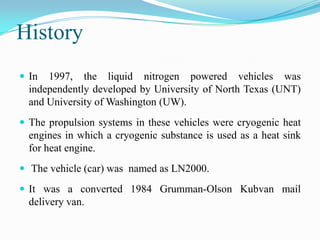
 In  1997, the liquid nitrogen powered vehicles was
  independently developed by University of North Texas (UNT)
  and University of Washington (UW).
 The propulsion systems in these vehicles were cryogenic heat
  engines in which a cryogenic substance is used as a heat sink
  for heat engine.
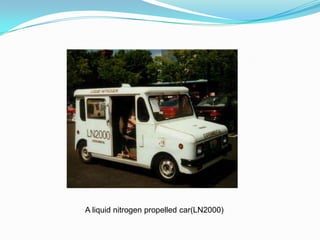
 The vehicle (car) was named as LN2000.

 It was a converted 1984 Grumman-Olson Kubvan mail
  delivery van.
A liquid nitrogen propelled car(LN2000)
Why Nitrogen as a Vehicle Fuel?
 High cost and limited availability of fossil fuels like petrol and
  diesel.
 Due to high level of pollution associated with the combustion
  of fossil fuels the need of ZEV(Zero Emission Vehicle) has
  been generated. (presently the battery powered electric vehicle
  is the only commercially available ZEV but not successful due
  to high initial cost, slow recharge and limited range).
 And the most important is the huge availability of Nitrogen
  gas(78% of air is nitrogen).

Note: According to Petroleum Conservation and Research Association
      petroleum production will be at its peak in 2012 and is likely to
      decrease after that.
Cryogenic Heat Engine
 It is a engine which uses very cold substances to produce
  useful energy.
 There is always some heat input to the working fluid during the
  expansion process.
Liquid Nitrogen(LN2)
 Liquid Nitrogen is the cheapest, widely produced and most
  common cryogen.
 It is mass produced in air liquefaction plants

 The liquefaction process is very simple.

 Normal, atmospheric air is passed through dust precipitator
  and pre-cooled.
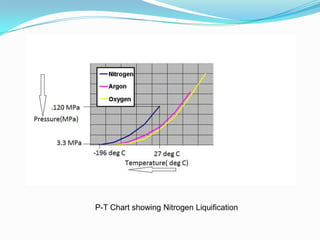
P-T Chart showing Nitrogen Liquification
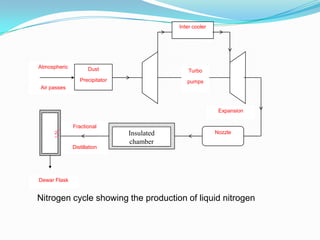
Inter cooler


Atmospheric          Dust                       Turbo
                 Precipitator                  pumps
Air passes


                                                            Expansion

              Fractional
      LN2


                                Insulated                  Nozzle
                                chamber
              Distillation


Dewar Flask


Nitrogen cycle showing the production of liquid nitrogen
 It is then compressed inside large turbo pumps to about 100
  atmospheres(10.13 MPa).
 Once the air has been cooled to room temperature it is allowed
  to expand rapidly through a nozzle into an insulated chamber.
 By running several cycles the temperature of the chamber
  becomes low enough. The air entering it starts to liquefy.
 Liquid nitrogen is removed from the chamber by fractional
  distillation and is stored inside well-insulated Dewar flasks .
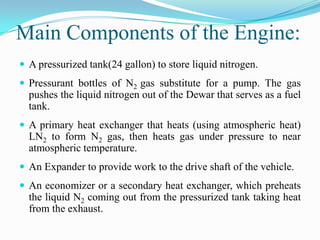
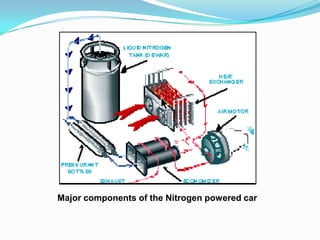
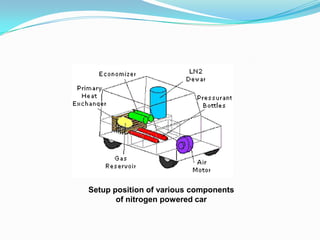
Main Components of the Engine:
 A pressurized tank(24 gallon) to store liquid nitrogen.
 Pressurant bottles of N2 gas substitute for a pump. The gas
  pushes the liquid nitrogen out of the Dewar that serves as a fuel
  tank.
 A primary heat exchanger that heats (using atmospheric heat)
  LN2 to form N2 gas, then heats gas under pressure to near
  atmospheric temperature.
 An Expander to provide work to the drive shaft of the vehicle.
 An economizer or a secondary heat exchanger, which preheats
  the liquid N2 coming out from the pressurized tank taking heat
  from the exhaust.
Major components of the Nitrogen powered car
Setup position of various components
       of nitrogen powered car
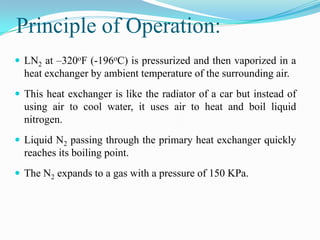
Principle of Operation:
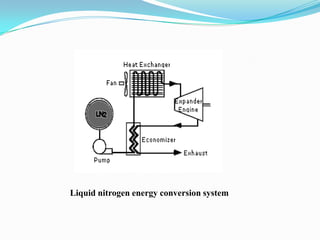
 LN2 at –320oF (-196oC) is pressurized and then vaporized in a
  heat exchanger by ambient temperature of the surrounding air.
 This heat exchanger is like the radiator of a car but instead of
  using air to cool water, it uses air to heat and boil liquid
  nitrogen.
 Liquid N2 passing through the primary heat exchanger quickly
  reaches its boiling point.
 The N2 expands to a gas with a pressure of 150 KPa.
Liquid nitrogen energy conversion system
 The pressurized N2 gas drives the motor.
 The only exhaust is nitrogen, which is major constituent of our
  atmosphere.
 Energy+N2(l)-->N2(g)

Hence, there is no pollution produced by running this car.
Advantages over electric cars:
 A liquid nitrogen car is much lighter and refilling its tank takes
  only about 10-15 minutes.
 The exhaust produced by the car is environmental friendly.

 A cryogenic car could have three times the range of an electric
  car of the same weight and no battery disposal concerns .
Drawbacks:
 The N2 passing through the tubes of the heat exchanger is so
  cold that the moisture in the surrounding air would condense
  on the outside of the tubes, obstructing the air flow.
 Then there's the safety issue. Should a nitrogen car be kept in a
  poorly ventilated space and, if the Nitrogen leaks off, it could
  prove fatal.
 Turning N2 gas into a liquid requires a lot of energy. So while
  cryogenic cars have zero emissions, they rely on energy
  produced at emission generating power plants.
Probable Solutions:
 A tube within a tube design.

 N2 passes back and forth inside a set of three nested tubes.

 By the time it reaches the outermost tubes, the N2 is warm
  enough that the exterior wall of the tube remains above the
  freezing point of water.
 Route the exhaust from the fossil fuel power plants through
  cryogenic plants, so that the pollutants and the greenhouse
  gases could be condensed for later disposal
Efficiency:
 The LN2 car can travel 79 miles(127.58 km) on a full 24
  gallon(90 liter) tank of liquid nitrogen going 20 MPH.
 Its maximum speed is over 35 MPH.
Why not commercialized?
 Even though the technology is 10 to 12 years old, still it has not
 come to the market for two reasons.
 Safety issues have not been sorted out as yet.

 Lack of funds for research.
Conclusion:
 In a real sense, the more such vehicles are used, the cleaner
  the air will become.
 In addition to the environmental impact of these vehicles,
  refueling using current technology can take only a few
  minutes, which is very similar to current gas refueling
  times.
 Extra research work is needed to utilize the most of the
  available energy
THANK YOU

Presentation on liquid nitrogen vehicle

  • 1.
    Sanjeev Kumar Tomar B-Tech (M.E) 8th Sem Roll No. 804152
  • 2.
    Topics of Interest Introduction to the liquid nitrogen vehicle  History  Justifying the use of liquid nitrogen vehicle  Cryogenic heat engines  Production of liquid nitrogen  Main components  Principle of operation  Open Rankine cycle
  • 3.
    Topics of Interest Advantages  Drawbacks  Solutions to drawbacks  Efficiency  Reason for not being commercialized  Conclusion
  • 4.
    What is LiquidNitrogen Vehicle?  It is a vehicle which uses Cryogenic fluid(liquid nitrogen) as a working fluid.  Propulsion system is a cryogenic heat engine in which a cryogenic substance is used as a heat sink. CRYOGENICS Cryogenic can be defined as the branch of the physics that deals with the study of the production of very low temperature (below −150 °C, −238 °F or 123 K) and the behavior of materials at those temperatures.
  • 5.
    History  In 1997, the liquid nitrogen powered vehicles was independently developed by University of North Texas (UNT) and University of Washington (UW).  The propulsion systems in these vehicles were cryogenic heat engines in which a cryogenic substance is used as a heat sink for heat engine.  The vehicle (car) was named as LN2000.  It was a converted 1984 Grumman-Olson Kubvan mail delivery van.
  • 6.
    A liquid nitrogenpropelled car(LN2000)
  • 7.
    Why Nitrogen asa Vehicle Fuel?  High cost and limited availability of fossil fuels like petrol and diesel.  Due to high level of pollution associated with the combustion of fossil fuels the need of ZEV(Zero Emission Vehicle) has been generated. (presently the battery powered electric vehicle is the only commercially available ZEV but not successful due to high initial cost, slow recharge and limited range).  And the most important is the huge availability of Nitrogen gas(78% of air is nitrogen). Note: According to Petroleum Conservation and Research Association petroleum production will be at its peak in 2012 and is likely to decrease after that.
  • 8.
    Cryogenic Heat Engine It is a engine which uses very cold substances to produce useful energy.  There is always some heat input to the working fluid during the expansion process.
  • 9.
    Liquid Nitrogen(LN2)  LiquidNitrogen is the cheapest, widely produced and most common cryogen.  It is mass produced in air liquefaction plants  The liquefaction process is very simple.  Normal, atmospheric air is passed through dust precipitator and pre-cooled.
  • 10.
    P-T Chart showingNitrogen Liquification
  • 11.
    Inter cooler Atmospheric Dust Turbo Precipitator pumps Air passes Expansion Fractional LN2 Insulated Nozzle chamber Distillation Dewar Flask Nitrogen cycle showing the production of liquid nitrogen
  • 12.
     It isthen compressed inside large turbo pumps to about 100 atmospheres(10.13 MPa).  Once the air has been cooled to room temperature it is allowed to expand rapidly through a nozzle into an insulated chamber.  By running several cycles the temperature of the chamber becomes low enough. The air entering it starts to liquefy.  Liquid nitrogen is removed from the chamber by fractional distillation and is stored inside well-insulated Dewar flasks .
  • 13.
    Main Components ofthe Engine:  A pressurized tank(24 gallon) to store liquid nitrogen.  Pressurant bottles of N2 gas substitute for a pump. The gas pushes the liquid nitrogen out of the Dewar that serves as a fuel tank.  A primary heat exchanger that heats (using atmospheric heat) LN2 to form N2 gas, then heats gas under pressure to near atmospheric temperature.  An Expander to provide work to the drive shaft of the vehicle.  An economizer or a secondary heat exchanger, which preheats the liquid N2 coming out from the pressurized tank taking heat from the exhaust.
  • 14.
    Major components ofthe Nitrogen powered car
  • 15.
    Setup position ofvarious components of nitrogen powered car
  • 16.
    Principle of Operation: LN2 at –320oF (-196oC) is pressurized and then vaporized in a heat exchanger by ambient temperature of the surrounding air.  This heat exchanger is like the radiator of a car but instead of using air to cool water, it uses air to heat and boil liquid nitrogen.  Liquid N2 passing through the primary heat exchanger quickly reaches its boiling point.  The N2 expands to a gas with a pressure of 150 KPa.
  • 17.
    Liquid nitrogen energyconversion system
  • 18.
     The pressurizedN2 gas drives the motor.  The only exhaust is nitrogen, which is major constituent of our atmosphere.  Energy+N2(l)-->N2(g) Hence, there is no pollution produced by running this car.
  • 19.
    Advantages over electriccars:  A liquid nitrogen car is much lighter and refilling its tank takes only about 10-15 minutes.  The exhaust produced by the car is environmental friendly.  A cryogenic car could have three times the range of an electric car of the same weight and no battery disposal concerns .
  • 20.
    Drawbacks:  The N2passing through the tubes of the heat exchanger is so cold that the moisture in the surrounding air would condense on the outside of the tubes, obstructing the air flow.  Then there's the safety issue. Should a nitrogen car be kept in a poorly ventilated space and, if the Nitrogen leaks off, it could prove fatal.  Turning N2 gas into a liquid requires a lot of energy. So while cryogenic cars have zero emissions, they rely on energy produced at emission generating power plants.
  • 21.
    Probable Solutions:  Atube within a tube design.  N2 passes back and forth inside a set of three nested tubes.  By the time it reaches the outermost tubes, the N2 is warm enough that the exterior wall of the tube remains above the freezing point of water.  Route the exhaust from the fossil fuel power plants through cryogenic plants, so that the pollutants and the greenhouse gases could be condensed for later disposal
  • 22.
    Efficiency:  The LN2car can travel 79 miles(127.58 km) on a full 24 gallon(90 liter) tank of liquid nitrogen going 20 MPH.  Its maximum speed is over 35 MPH.
  • 23.
    Why not commercialized? Even though the technology is 10 to 12 years old, still it has not come to the market for two reasons.  Safety issues have not been sorted out as yet.  Lack of funds for research.
  • 24.
    Conclusion:  In areal sense, the more such vehicles are used, the cleaner the air will become.  In addition to the environmental impact of these vehicles, refueling using current technology can take only a few minutes, which is very similar to current gas refueling times.  Extra research work is needed to utilize the most of the available energy
  • 25.