


Presentation on Exhaust Gas
Recirculation System
Contents
 Intro
 Formation of Nox.
 How can Nox be Reduced
 Exhaust Gas Recirculation
 Basic Parts of EGR
 Working Principle
 Advantages
 Disadvantages
 Conclusion
Introduction
 Major problem environmental pollution is faced by today’s world.
 For which, vehicular traffic is a major contributor. Exhaust gases from vehicles
includes CO,CO2,HC,Noxs etc.
 Of these NOx is particularly very harmful.
 These are one of the chief constituents of smog, which have an adverse effect
on ecological systems.
 They are also contribute to the formation of acid rain. NOx also cause
breathing illness in human beings
Formation of NOx
 The factors that cause diesel engines to run more efficiently than gasoline
engines also cause them to run at higher temperature.
 This leads to the creation of Nitrogen Oxides (NOx).
 Fuel in any engine is burned with extra air and some of the OXYGEN is used to
burn the fuel.
 When the peak temperatures are high enough for long periods of time, the
NITROGEN and OXYGEN in the air combines to form NITROGEN OXIDES.
How can Nox be Reduced
 In order to reduce NOx an engine should run at a lower temperature than the
normal temperature.
 Reduced cylinder temperatures can be achieved in three ways.
 Enriching the air fuel mixture
 Lowering the compression ratio and retarding ignition timings
 Reducing the amount of Oxygen in the cylinder
Exhaust Gas Recirculation
 Exhaust Gas Recirculation is an efficient method to reduce NOx emissions from
the engine.
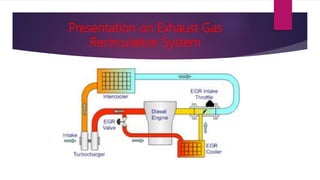
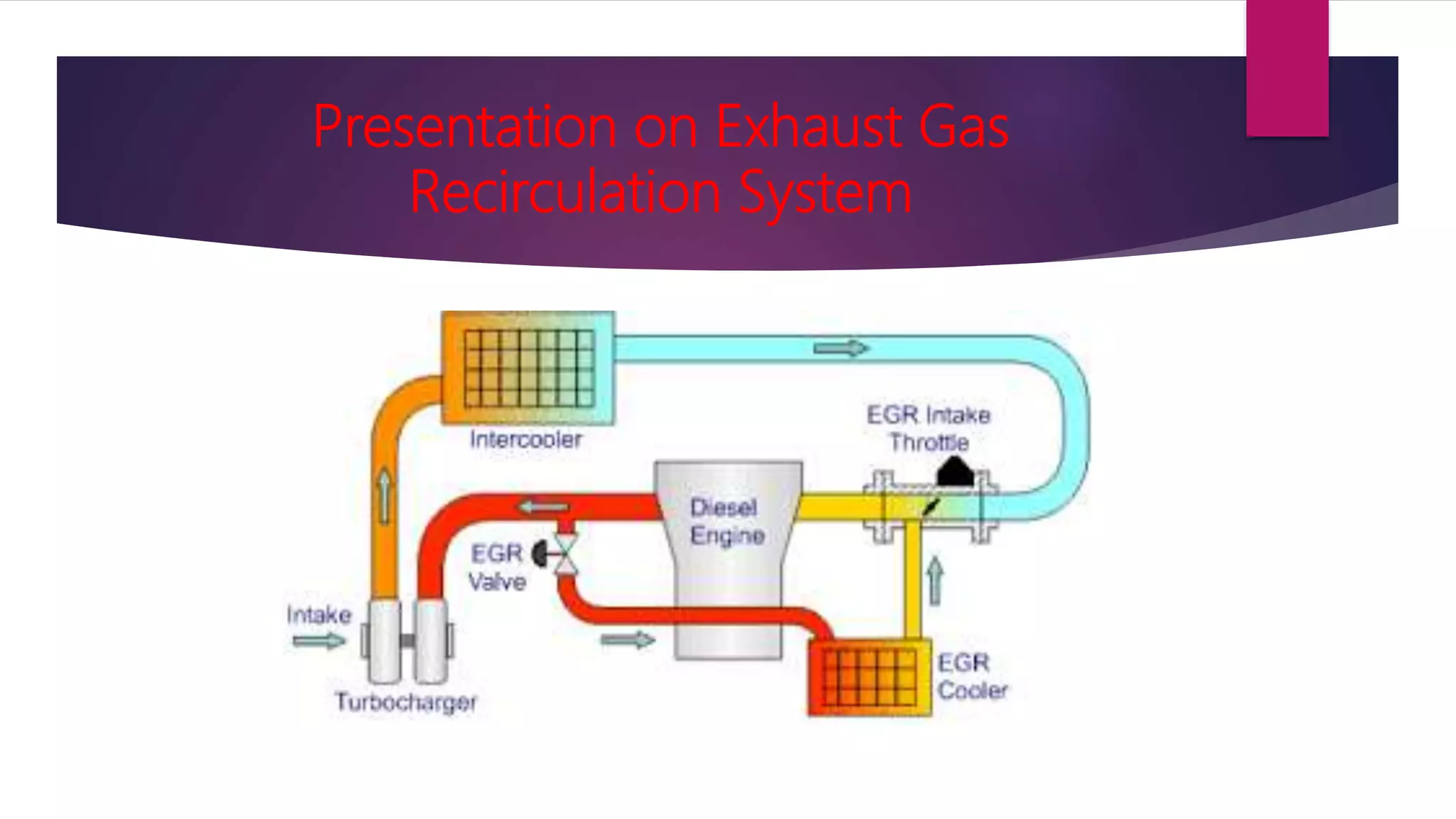
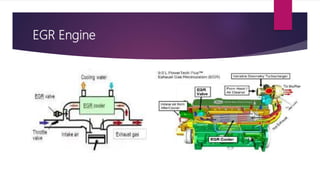
 It works by recirculating a quantity of exhaust gas back to the engine cylinders.
 Recirculation is usually achieved by piping a route from the exhaust manifold to
the intake manifold.
 A control valve within the circuit regulates and times the gas flow.
Basic Parts of EGR
 There are 3 basic parts of EGR
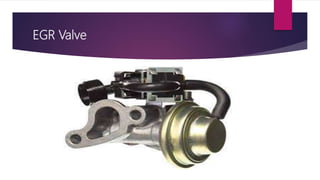
1. EGR Valve
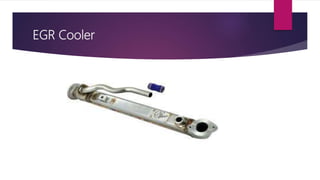
2. EGR Cooler
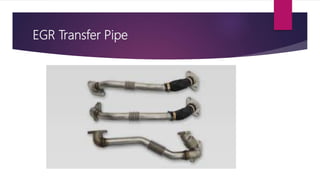
3. EGR Transfer Pipe
EGR Valve
EGR Cooler
EGR Transfer Pipe
EGR Engine
Working Principle
 In internal combustion engines, exhaust gas recirculation (EGR) is a nitrogen
oxide (NOx)emissions reduction technique used in petrol/gasoline and diesel
engines.
 EGR works by recirculating a portion of an engine's exhaust gas back to the
engine cylinders. This dilutes the O2 in the incoming air stream and provides
gases inert to combustion to act as absorbents of combustion heat to reduce
peak in-cylinder temperatures.
 NOx is produced in high temperature mixtures of atmospheric nitrogen and
oxygen that occur in the combustion cylinder, and this usually occurs at cylinder
peak pressure. Another primary benefit of external EGR valves on a spark
ignition engine is an increase in efficiency, as charge dilution allows a larger
throttle position and reduces associated pumping losses.
Advantages
 It reduce Nox and save the environment.
 It decreases the engine temperature.
 Improve Engine life through reduced cylinder temperature.
Disadvantages
 As EGR reduce O2 so it is difficult to combust the fuel.
 Continues reduction of O2 reduce the peak power required for the engine.
 EGR valves can’t responds all the time and it will take time to flow the EGR
gases.
 As the amount of recirculated gas is less so for multi-cylinder engine the EGR
gas is not reach in proper ratio.
Conclusion
 Using Exhaust Gas Recirculation Technique in engines, the emissions are vary
much controlled due to lesser amounts of NOx entering the atmosphere.
 Exhaust Gas Recirculation is a very simple method. It has proven to be very
useful and it is being modified further to attain better standards.
 This method is very reliable in terms of fuel consumption.
Thank You

Exhaust gas recirculation system

  • 1.
    Presentation on ExhaustGas Recirculation System
  • 2.
    Contents  Intro  Formationof Nox.  How can Nox be Reduced  Exhaust Gas Recirculation  Basic Parts of EGR  Working Principle  Advantages  Disadvantages  Conclusion
  • 3.
    Introduction  Major problemenvironmental pollution is faced by today’s world.  For which, vehicular traffic is a major contributor. Exhaust gases from vehicles includes CO,CO2,HC,Noxs etc.  Of these NOx is particularly very harmful.  These are one of the chief constituents of smog, which have an adverse effect on ecological systems.  They are also contribute to the formation of acid rain. NOx also cause breathing illness in human beings
  • 4.
    Formation of NOx The factors that cause diesel engines to run more efficiently than gasoline engines also cause them to run at higher temperature.  This leads to the creation of Nitrogen Oxides (NOx).  Fuel in any engine is burned with extra air and some of the OXYGEN is used to burn the fuel.  When the peak temperatures are high enough for long periods of time, the NITROGEN and OXYGEN in the air combines to form NITROGEN OXIDES.
  • 5.
    How can Noxbe Reduced  In order to reduce NOx an engine should run at a lower temperature than the normal temperature.  Reduced cylinder temperatures can be achieved in three ways.  Enriching the air fuel mixture  Lowering the compression ratio and retarding ignition timings  Reducing the amount of Oxygen in the cylinder
  • 6.
    Exhaust Gas Recirculation Exhaust Gas Recirculation is an efficient method to reduce NOx emissions from the engine.  It works by recirculating a quantity of exhaust gas back to the engine cylinders.  Recirculation is usually achieved by piping a route from the exhaust manifold to the intake manifold.  A control valve within the circuit regulates and times the gas flow.
  • 7.
    Basic Parts ofEGR  There are 3 basic parts of EGR 1. EGR Valve 2. EGR Cooler 3. EGR Transfer Pipe
  • 8.
  • 9.
  • 10.
  • 11.
  • 12.
    Working Principle  Ininternal combustion engines, exhaust gas recirculation (EGR) is a nitrogen oxide (NOx)emissions reduction technique used in petrol/gasoline and diesel engines.  EGR works by recirculating a portion of an engine's exhaust gas back to the engine cylinders. This dilutes the O2 in the incoming air stream and provides gases inert to combustion to act as absorbents of combustion heat to reduce peak in-cylinder temperatures.  NOx is produced in high temperature mixtures of atmospheric nitrogen and oxygen that occur in the combustion cylinder, and this usually occurs at cylinder peak pressure. Another primary benefit of external EGR valves on a spark ignition engine is an increase in efficiency, as charge dilution allows a larger throttle position and reduces associated pumping losses.
  • 13.
    Advantages  It reduceNox and save the environment.  It decreases the engine temperature.  Improve Engine life through reduced cylinder temperature.
  • 14.
    Disadvantages  As EGRreduce O2 so it is difficult to combust the fuel.  Continues reduction of O2 reduce the peak power required for the engine.  EGR valves can’t responds all the time and it will take time to flow the EGR gases.  As the amount of recirculated gas is less so for multi-cylinder engine the EGR gas is not reach in proper ratio.
  • 15.
    Conclusion  Using ExhaustGas Recirculation Technique in engines, the emissions are vary much controlled due to lesser amounts of NOx entering the atmosphere.  Exhaust Gas Recirculation is a very simple method. It has proven to be very useful and it is being modified further to attain better standards.  This method is very reliable in terms of fuel consumption.
  • 16.