Technical Seminar presentation on
CRYOCARCRYOCAR
Presented by
Chethan S A 4BB13ME015
Under the Guidance of
Mr.Theju H.S. B.E., M.tech.,
Assistant Professor
DEPARTMENT OF MECHANICAL ENGINEERINGDEPARTMENT OF MECHANICAL ENGINEERING
Bahubali College of Engineering
Shravanabelgola-573 135
2016-17
1
CONTENTSCONTENTS
1. Introduction
2. History
3. LN2000’s Liquid Nitrogen Propulsion System
4. Parts of a Liquid Nitrogen Propulsion System
5. Power Cycle
6. Advantages
7. Disadvantages
8. LN2000 Vehicle
9. Conclusion
10. References
2
INTRODUCTIONINTRODUCTION
3
The importance of cars in the present world is increasing day
by day.
There are various factors that influence the choice of the car.
These include performance, fuel consumption, pollution etc.
As the prices for fuels are increasing and the availability is
decreasing we have to go for alternative choice.
Here an automotive propulsion concept is presented which
utilizes liquid nitrogen as the working fluid.
HISTORYHISTORY
Researchers at the University of Washington are developing a
new zero-emission automobile propulsion concept.
That uses liquid nitrogen as the fuel. The principle of operation
is like that of a steam engine(open Rankine cycle).
In this liquid nitrogen at –320° F (–196° C) is pressurized and
then vaporized in a heat exchanger.
This heat exchanger is like the radiator of a car.
4
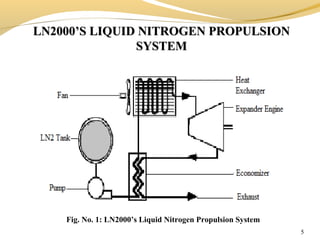
LN2000’S LIQUID NITROGEN PROPULSIONLN2000’S LIQUID NITROGEN PROPULSION
SYSTEMSYSTEM
5
Fig. No. 1: LN2000’s Liquid Nitrogen Propulsion System
PARTS OF A LIQUID NITROGEN PROPULSIONPARTS OF A LIQUID NITROGEN PROPULSION
SYSTEMSYSTEM
6
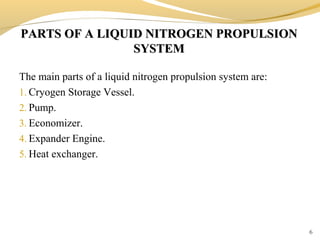
The main parts of a liquid nitrogen propulsion system are:
1. Cryogen Storage Vessel.
2. Pump.
3. Economizer.
4. Expander Engine.
5. Heat exchanger.
1. CRYOGEN STORAGE VESSEL1. CRYOGEN STORAGE VESSEL
7
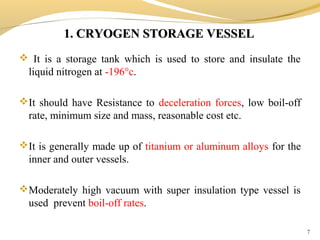
 It is a storage tank which is used to store and insulate the
liquid nitrogen at -196°c.
It should have Resistance to deceleration forces, low boil-off
rate, minimum size and mass, reasonable cost etc.
It is generally made up of titanium or aluminum alloys for the
inner and outer vessels.
Moderately high vacuum with super insulation type vessel is
used prevent boil-off rates.
2. PUMP2. PUMP
8
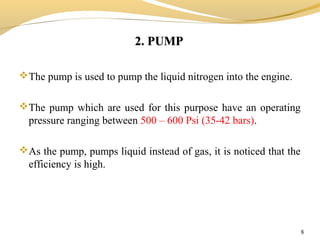
The pump is used to pump the liquid nitrogen into the engine.
The pump which are used for this purpose have an operating
pressure ranging between 500 – 600 Psi (35-42 bars).
As the pump, pumps liquid instead of gas, it is noticed that the
efficiency is high.
3. ECONOMIZER3. ECONOMIZER
A pre heater, called an economizer, uses leftover heat in the
engine's exhaust to preheat the liquid nitrogen.
Hence the economizer acts as a heat exchanger between the
incoming liquid nitrogen and the exhaust gas which is left out.
This is similar to the regenerative process which is done in
steam power plant.
Hence with the use of the economizer, the efficiency can be
improved.
9
10
LN2 at -320°F(-196°C) is pressurized and then vaporized in a
heat exchanger by ambient temperature of atmosphere.
The heat exchanger used is similar to radiator of car but instead
of using air to cool water, it uses air to heat and boil LN2.
Liquid LN2 passing through the primary heat exchanger
quickly reaches its boiling point.
Heat exchanger is made up of aluminum tubes with outside
diameter of 10mm and wall thickness of 1mm.
4. HEAT EXCHANGER4. HEAT EXCHANGER
11
The maximum work output of the LN2 engine results from an
isothermal expansion stroke.
Thus, engines having expansion chambers with high surface-
to-volume ratios are favored for this application.
Rotary expanders such as the Wankel may also be well suited.
 A secondary fluid could be circulated through the engine
block to help keep the cylinder walls as warm as possible.
5. EXPANDER5. EXPANDER
POWER CYCLEPOWER CYCLE
12
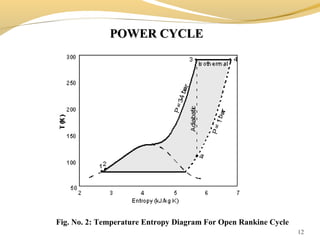
Fig. No. 2: Temperature Entropy Diagram For Open Rankine Cycle
Cont...Cont...
There are many thermodynamic cycles available for utilizing
the thermal potential of liquid nitrogen.
These range from the Brayton cycle, to using two and even
three fluid topping cycles.
The easiest to implement, however, and the one chosen for this
study, is shown in figure 2.(Rankine cycle).
State 1 is the cryogenic liquid in storage at 0.1 MPa and 77 K.
13
Cont...Cont...
The liquid is pumped up to system pressure of 4 MPa
(supercritical) at state 2 and then enters the economizer.
State 3 indicates N2 properties after it is being preheated by the
exhaust gas.
Further heat exchange with ambient air brings to N2 300k at
state 4
Isothermal expansion to 0.11 MPa at state 5 would result in the
N2 exhaust having enough enthalpy to heat the LN2
14
ADVANTAGESADVANTAGES
 The process to manufacture liquid nitrogen in large quantities
can be environmentally very friendly (Liquification).
 Produces no or less air pollution and pollutants to atmosphere
results in greater environmental benefits.
 The operating cost is very less as compared to cost of fossil
fuels.
 LN2 powered car offer many safety advantages over
commercial cars.
15
DISADVANTAGESDISADVANTAGES
The N2 passing through the tubes of the heat exchanger obstruct
the air flow (Icing problem).
The nitrogen car be kept in a poorly ventilated space and, if the
Nitrogen leaks off, it could prove fatal.
Turning N2 gas into a liquid requires a lot of energy.
The principal disadvantage is the inefficient use of primary
energy.
16
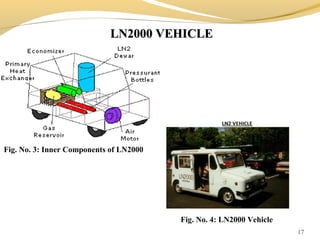
LN2000 VEHICLELN2000 VEHICLE
17
Fig. No. 3: Inner Components of LN2000
Fig. No. 4: LN2000 Vehicle
CONCLUSIONCONCLUSION
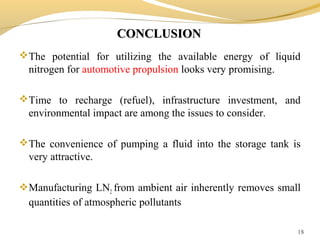
The potential for utilizing the available energy of liquid
nitrogen for automotive propulsion looks very promising.
Time to recharge (refuel), infrastructure investment, and
environmental impact are among the issues to consider.
The convenience of pumping a fluid into the storage tank is
very attractive.
Manufacturing LN2 from ambient air inherently removes small
quantities of atmospheric pollutants
18
REFERENCESREFERENCES
19
JOURNALS
[1] Abilash Vijayrao Nishane, (2016) “Cryogenic Liquid Nitrogen as a Fuel
for Zero Emission Vehicles (Z.E.V)”, International Journal and Magazine
of Engineering, Technology, Management and Research.
[2] Rahul Singh Choudhary, (2015) “Hydrogen as a Non-Polluting Fuel”,
International Journal of Advance Research, IJOAR.org.
[3] Akil Garg, Kartik Jakhu, Kishan Singh, (2015) “Cryogenic Technology
and Rocket Engines” International Journal of Aerospace and Mechanical
Engineering.
[4] Pankaj Soni, Gopal Sahu, Prakash Kumar Sen, Ritesh Sharma, (2014ss)
“A Review on Cryogenic Engine” International Journal for Research in
Science and Engineering Technology (IJRASET).
20

Cryocar

  • 1.
    Technical Seminar presentationon CRYOCARCRYOCAR Presented by Chethan S A 4BB13ME015 Under the Guidance of Mr.Theju H.S. B.E., M.tech., Assistant Professor DEPARTMENT OF MECHANICAL ENGINEERINGDEPARTMENT OF MECHANICAL ENGINEERING Bahubali College of Engineering Shravanabelgola-573 135 2016-17 1
  • 2.
    CONTENTSCONTENTS 1. Introduction 2. History 3.LN2000’s Liquid Nitrogen Propulsion System 4. Parts of a Liquid Nitrogen Propulsion System 5. Power Cycle 6. Advantages 7. Disadvantages 8. LN2000 Vehicle 9. Conclusion 10. References 2
  • 3.
    INTRODUCTIONINTRODUCTION 3 The importance ofcars in the present world is increasing day by day. There are various factors that influence the choice of the car. These include performance, fuel consumption, pollution etc. As the prices for fuels are increasing and the availability is decreasing we have to go for alternative choice. Here an automotive propulsion concept is presented which utilizes liquid nitrogen as the working fluid.
  • 4.
    HISTORYHISTORY Researchers at theUniversity of Washington are developing a new zero-emission automobile propulsion concept. That uses liquid nitrogen as the fuel. The principle of operation is like that of a steam engine(open Rankine cycle). In this liquid nitrogen at –320° F (–196° C) is pressurized and then vaporized in a heat exchanger. This heat exchanger is like the radiator of a car. 4
  • 5.
    LN2000’S LIQUID NITROGENPROPULSIONLN2000’S LIQUID NITROGEN PROPULSION SYSTEMSYSTEM 5 Fig. No. 1: LN2000’s Liquid Nitrogen Propulsion System
  • 6.
    PARTS OF ALIQUID NITROGEN PROPULSIONPARTS OF A LIQUID NITROGEN PROPULSION SYSTEMSYSTEM 6 The main parts of a liquid nitrogen propulsion system are: 1. Cryogen Storage Vessel. 2. Pump. 3. Economizer. 4. Expander Engine. 5. Heat exchanger.
  • 7.
    1. CRYOGEN STORAGEVESSEL1. CRYOGEN STORAGE VESSEL 7  It is a storage tank which is used to store and insulate the liquid nitrogen at -196°c. It should have Resistance to deceleration forces, low boil-off rate, minimum size and mass, reasonable cost etc. It is generally made up of titanium or aluminum alloys for the inner and outer vessels. Moderately high vacuum with super insulation type vessel is used prevent boil-off rates.
  • 8.
    2. PUMP2. PUMP 8 Thepump is used to pump the liquid nitrogen into the engine. The pump which are used for this purpose have an operating pressure ranging between 500 – 600 Psi (35-42 bars). As the pump, pumps liquid instead of gas, it is noticed that the efficiency is high.
  • 9.
    3. ECONOMIZER3. ECONOMIZER Apre heater, called an economizer, uses leftover heat in the engine's exhaust to preheat the liquid nitrogen. Hence the economizer acts as a heat exchanger between the incoming liquid nitrogen and the exhaust gas which is left out. This is similar to the regenerative process which is done in steam power plant. Hence with the use of the economizer, the efficiency can be improved. 9
  • 10.
    10 LN2 at -320°F(-196°C)is pressurized and then vaporized in a heat exchanger by ambient temperature of atmosphere. The heat exchanger used is similar to radiator of car but instead of using air to cool water, it uses air to heat and boil LN2. Liquid LN2 passing through the primary heat exchanger quickly reaches its boiling point. Heat exchanger is made up of aluminum tubes with outside diameter of 10mm and wall thickness of 1mm. 4. HEAT EXCHANGER4. HEAT EXCHANGER
  • 11.
    11 The maximum workoutput of the LN2 engine results from an isothermal expansion stroke. Thus, engines having expansion chambers with high surface- to-volume ratios are favored for this application. Rotary expanders such as the Wankel may also be well suited.  A secondary fluid could be circulated through the engine block to help keep the cylinder walls as warm as possible. 5. EXPANDER5. EXPANDER
  • 12.
    POWER CYCLEPOWER CYCLE 12 Fig.No. 2: Temperature Entropy Diagram For Open Rankine Cycle
  • 13.
    Cont...Cont... There are manythermodynamic cycles available for utilizing the thermal potential of liquid nitrogen. These range from the Brayton cycle, to using two and even three fluid topping cycles. The easiest to implement, however, and the one chosen for this study, is shown in figure 2.(Rankine cycle). State 1 is the cryogenic liquid in storage at 0.1 MPa and 77 K. 13
  • 14.
    Cont...Cont... The liquid ispumped up to system pressure of 4 MPa (supercritical) at state 2 and then enters the economizer. State 3 indicates N2 properties after it is being preheated by the exhaust gas. Further heat exchange with ambient air brings to N2 300k at state 4 Isothermal expansion to 0.11 MPa at state 5 would result in the N2 exhaust having enough enthalpy to heat the LN2 14
  • 15.
    ADVANTAGESADVANTAGES  The processto manufacture liquid nitrogen in large quantities can be environmentally very friendly (Liquification).  Produces no or less air pollution and pollutants to atmosphere results in greater environmental benefits.  The operating cost is very less as compared to cost of fossil fuels.  LN2 powered car offer many safety advantages over commercial cars. 15
  • 16.
    DISADVANTAGESDISADVANTAGES The N2 passingthrough the tubes of the heat exchanger obstruct the air flow (Icing problem). The nitrogen car be kept in a poorly ventilated space and, if the Nitrogen leaks off, it could prove fatal. Turning N2 gas into a liquid requires a lot of energy. The principal disadvantage is the inefficient use of primary energy. 16
  • 17.
    LN2000 VEHICLELN2000 VEHICLE 17 Fig.No. 3: Inner Components of LN2000 Fig. No. 4: LN2000 Vehicle
  • 18.
    CONCLUSIONCONCLUSION The potential forutilizing the available energy of liquid nitrogen for automotive propulsion looks very promising. Time to recharge (refuel), infrastructure investment, and environmental impact are among the issues to consider. The convenience of pumping a fluid into the storage tank is very attractive. Manufacturing LN2 from ambient air inherently removes small quantities of atmospheric pollutants 18
  • 19.
    REFERENCESREFERENCES 19 JOURNALS [1] Abilash VijayraoNishane, (2016) “Cryogenic Liquid Nitrogen as a Fuel for Zero Emission Vehicles (Z.E.V)”, International Journal and Magazine of Engineering, Technology, Management and Research. [2] Rahul Singh Choudhary, (2015) “Hydrogen as a Non-Polluting Fuel”, International Journal of Advance Research, IJOAR.org. [3] Akil Garg, Kartik Jakhu, Kishan Singh, (2015) “Cryogenic Technology and Rocket Engines” International Journal of Aerospace and Mechanical Engineering. [4] Pankaj Soni, Gopal Sahu, Prakash Kumar Sen, Ritesh Sharma, (2014ss) “A Review on Cryogenic Engine” International Journal for Research in Science and Engineering Technology (IJRASET).
  • 20.