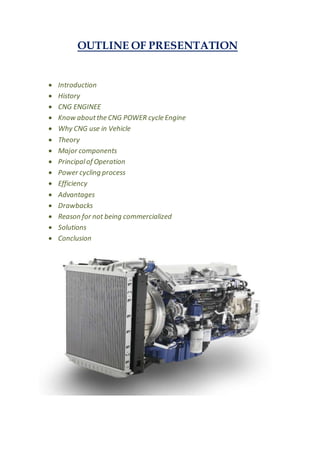
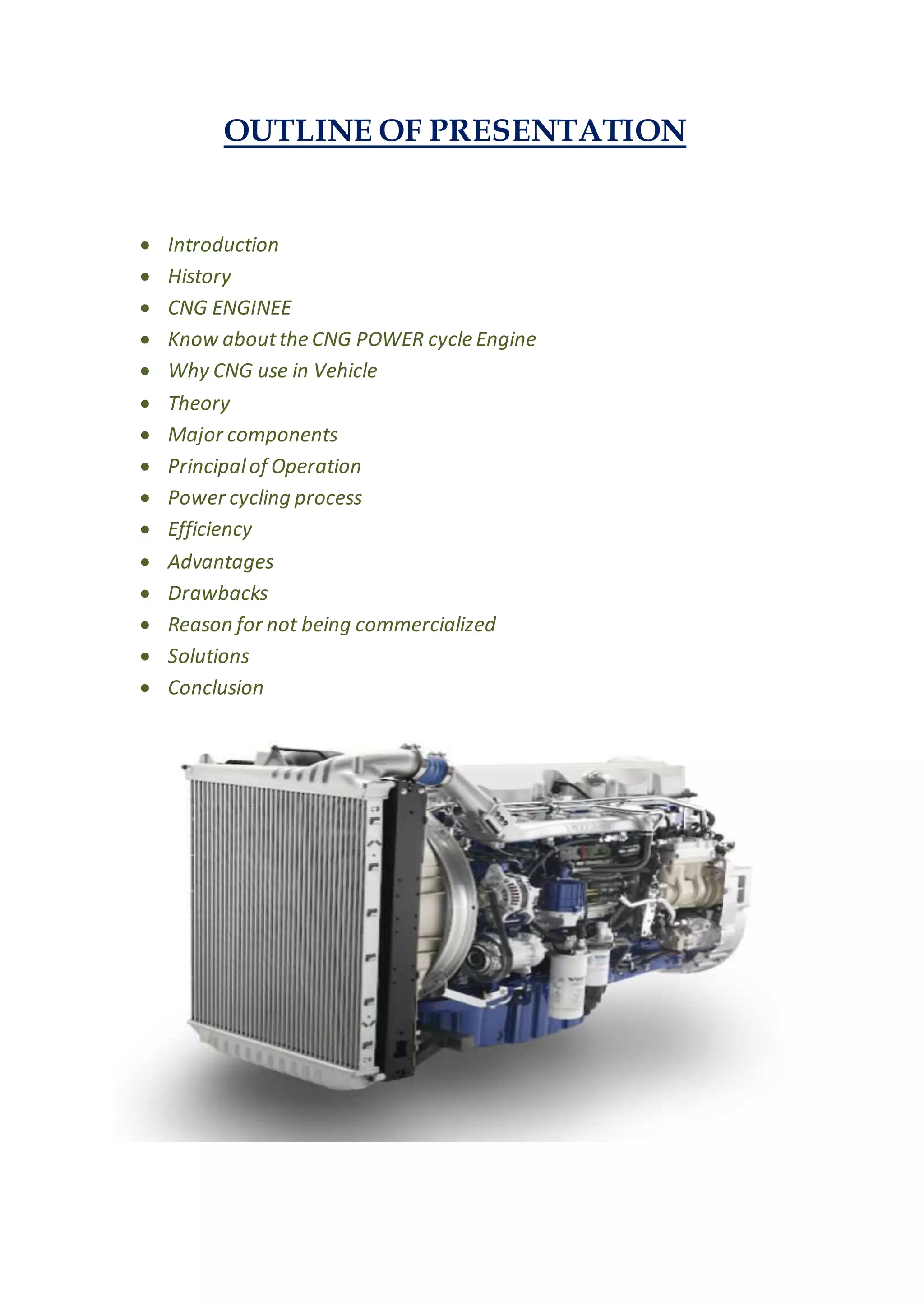
OUTLINE OF PRESENTATION
 Introduction
 History
 CNG ENGINEE
 Know aboutthe CNG POWER cycle Engine
 Why CNG use in Vehicle
 Theory
 Major components
 Principalof Operation
 Power cycling process
 Efficiency
 Advantages
 Drawbacks
 Reason for not being commercialized
 Solutions
 Conclusion
ITRODUCTION
Natural gas is a fossil fuel comprised mostly of 87% methane,
andvis one of the cleanest burning alternative fuels.
It can be used in the form of;
Compressed natural gas
Liquefied natural gas
Compressed natural gas is an excellent alternative to conventional fuel. It is known as a
“green fuel” because of its inherent benefits to the environment. It is better for the
atmosphere, landfills, soil, and it is affordable. CNG is sweeping the nation, especially in
regard to commercial transportation.
CNG engine uses compressed natural gas to power the car. CNG is a substitute for
gas and diesel fuel, and is considered to be much cheaper and cleaner than gas or
diesel. As an efficient and environmentally-friendly alternative to gas powered cars,
the CNG engine has become increasingly popular, and many people choose to
convert their cars using professional mechanics.
.
Compressed Natural Gas is one of the most viable alternative fuel options today. Natural
gas has been used as fuel in domestic households for many years but it hasn’t achieved
mainstream use as fuel for automobiles. As an alternative to buying a new NGV, car
owners can also choosing to convert an existing vehicle to run on CNG.
HISTORY ABOUT CNG MACHINE
In 1996, CSE published its report on urban air pollution[1]. This report found that the
problem of vehicular pollution in India was the result of a combination of outdated
engine technology, poor fuel quality, defective transportation planning and bad
maintenance of vehicles on the read. No statistics of energy input and pollution
output were available, put it was estimated that vehicles were responsible for 64% of
emissions (power production for 17, industry for 10%). The conclusion of this report,
and CSE’s objectives for the future, were to press for clean fuels and a rapid
introduction of EUR II standards.
In 1998, three years after the lawyer had filed his case and as a direct result of it, the
Supreme Court published a Directive that specified the date of April 2001 as deadline
to replace or convert all busses, three-wheelers and taxis to CNG. In addition, the
Directive specified that an infrastructure of 70 CNG refueling stations had to be made
available, and asked for financial incentives for the conversion of vehicle fleets.
In January 1998, the National Capital Region of Delhi set up a Commission to study,
write and publish a report on the air pollution problem in Delhi. CSE was a member of
this Commission.
In 1999, the Supreme Court ordered the government to impose the EUR II standard for
gasoline engines by the year 2000 for all new car sales. The Court order attacked the
diesel car promotion, and ordered sulphur levels below 30 ppm, as well as particle
filters for diesel engines.
This re-opened the discussion on CNG. Cleaner diesel had now become available, and
the automotive industry and the Delhi government put forward scientific arguments
against CNG. In fact, the government and the car industry were fighting the bad image
of diesel fuel. Also at stake was the issue of equal rights between Public Transport
and private cars.
Diesel had always been the fuel favored by the government. It was first subsidized,
than less taxed than gasoline. In 2000, despite the 1998 order of the Supreme Court
order, the government still allowed 6’000 new diesel busses to take up service. And
by April 2001 – the original deadline - little progress had been achieved to fulfill the
1998 Supreme Court Directive.
The vehicle industry was against CNG, fundamentally because global mass
production is jeopardized by any local legislation. It continued lobbying in favor of
abolishing the Supreme Court order.
Finally, in April 2002, the Supreme Court published a directive which imposed a
penalty on the government for wasting the court’s time, and in addition, a daily
penalty of 1’000 Rupee per day (approximately 20 US$) for each diesel bus still in
circulation.
By 1st December 2002, the last diesel bus had disappeared from Delhi’s roads, as part
of a programmer to improve public transport by offering more busses, and only
busses running on CNG.
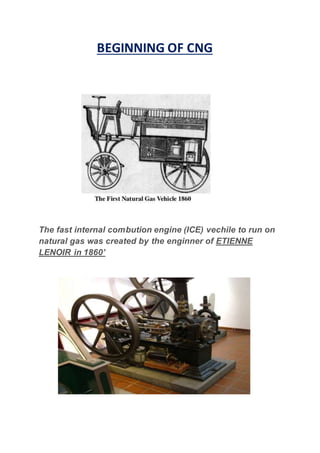
BEGINNING OF CNG
The fast internal combution engine (ICE) vechile to run on
natural gas was created by the enginner of ETIENNE
LENOIR in 1860’
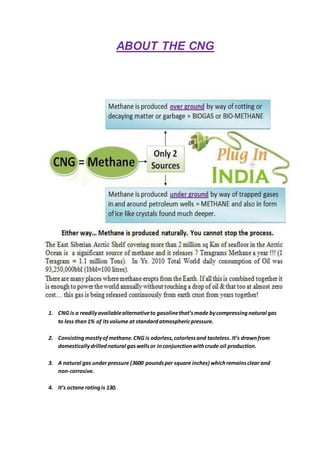
ABOUT THE CNG
1. CNG is a readilyavailablealternativeto gasolinethat’smade bycompressingnatural gas
to less than1% of itsvolume at standardatmosphericpressure.
2. Consistingmostlyofmethane.CNG is odorless,colorlessand tasteless. It’s drawnfrom
domesticallydrillednatural gaswellsor inconjunctionwithcrude oil production.
3. A natural gas under pressure (3600 poundsper square inches) whichremainsclear and
non-corrosive.
4. It’s octane ratingis 130.
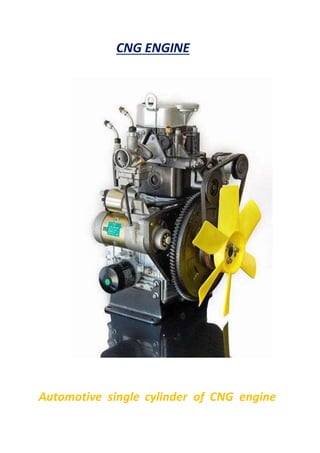
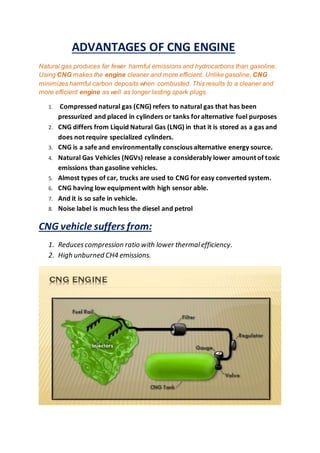
CNG ENGINE
Automotive single cylinder of CNG engine
KNOW ABOUT THE CNG POWER CYCLE ENGINE
In this paper, the potential of combined injection of CNG and
gasoline is studied on a 1.7 L turbocharged, port-injected SI engine and the
best engine performance point for the best conversion efficiency of the
catalytic converters has been investigated. Compressed natural gas (CNG)
as an alternative fuel is used in spark ignition engines to improve fuel
consumption and exhaust emissions. The improvements gave more
advantage in emission but it lowered the performance of the engine. As a
substitute, CNG has a higher octane number and knocking resistance than
gasoline and hence CNG-dedicated engines can have higher compression
ratios and therefore higher indicated efficiencies. Turbocharged bi-fuel,
combined CNG and gasoline, injection engine of is a new concept which
offers direct benefits with regards to gas or gasoline powered vehicles
running separately on each fuels. It also opens very interesting
perspectives for meeting future emission regulations using only a three-
way catalyst, since the stoichiometry condition of combustion is maintained
over the whole engine operating range. Results show that the combined
injection of gasoline and CNG is much better than gasoline mode in terms
of fuel consumption and raw HC and CO emissions. However, as expected
the NO x emission will increase. According to the obtained results at
16.2 bar BMEP, 3000 rpm full load condition with 30% CNG mass fraction,
the BSFC, CO and HC emissions are improved by 16, 66 and 50%,
respectively, compared to gasoline single mode. It was found that a fuel
mixture of 30% CNG mass fraction was the best trade-off point between
engine performance and emission production. Also, significant reductions
of fuel consumption were observed. Full-load tests carried out with a
turbocharged engine enhanced the synergy effect between the two fuels at
full-load condition.
The results showed that the power of CNG-fuelled engine is
lower than that of gasoline-fuelled engine by about 11% over the
speed range 1500–4000 rpm due to higher volumetric efficiency.
On average, when the engine operates with CNG fuel, the ISFC is
reduced roughly by 16% over this speed range.
WHY CNG IS USE IN VEHICLE ?
A. CNG is alternative fuel of diesel and petrol where low pollution created.
B. Environmentally Friendly. Compressed natural gas (CNG) is the cleanest
burning transportation fuel on the market today.
C. CNG burns cleaner than petroleum based products because of its lower
carbon content.
D. CNG produces the fewest emissions of all other fuels and contains
significantly less pollutants than gasoline.
E. As many have noted, compressed natural gas is marginally cheaper than
ordinary gasoline or diesel.
F. CNG burns cleaner when compared to traditional petrol and diesel.
G. Another benefit is that in the case of a leak, CNG does not pose any danger of
contamination of ground water since the fuel is non-toxic
H. In addition, the CNG engine is considered to be more environmentally
friendly.
I. There are considerably less pollutants associated with compressed natural
gas being ignited, and studies show that it gives off 40 percent less
greenhouse gas.
J. On the downside, a CNG engine will usually get fewer miles to the full tank
than a regular gas engine,
K. And you may also struggle to find a suitable engine and tank conversion kit,
which means that the price of converting your vehicle can negate the savings
from the cheaper fuel alternatives.
L. CNG cars also run quieter than gasoline and diesel vehicles, which results in less
noise pollution.
M. It is Cost-effectiveness.
N. In India the price of CNG is Rs.- 40.61 per Kg, which is way less than the price of
petrol and diesel.
THEORY
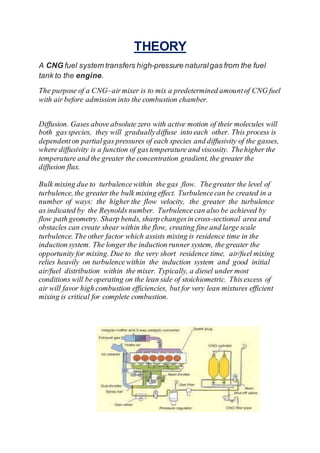
A CNG fuel system transfers high-pressure naturalgas from the fuel
tank to the engine.
The purpose of a CNG–airmixer is to mix a predetermined amountof CNG fuel
with air before admission into the combustion chamber.
Diffusion. Gases above absolute zero with active motion of their molecules will
both gasspecies, they will graduallydiffuse into each other. This process is
dependenton partialgas pressures of each species and diffusivity of the gasses,
where diffusivity is a function of gastemperature and viscosity. Thehigher the
temperature and the greater the concentration gradient, the greater the
diffusion flux.
Bulk mixing due to turbulencewithin the gas flow. Thegreater the level of
turbulence, the greater the bulk mixing effect. Turbulencecan be created in a
number of ways: the higher the flow velocity, the greater the turbulence
as indicated by the Reynolds number. Turbulencecan also be achieved by
flow path geometry. Sharp bends, sharp changesin cross-sectional area and
obstacles can create shear within the flow, creating fine and large scale
turbulence. The other factor which assists mixing is residence time in the
induction system. The longer the induction runner system, the greater the
opportunity for mixing. Due to the very short residence time, air/fuel mixing
relies heavily on turbulencewithin the induction system and good initial
air/fuel distribution within the mixer. Typically, a diesel under most
conditions will be operating on the lean side of stoichiometric. Thisexcess of
air will favor high combustion efficiencies, but for very lean mixtures efficient
mixing is critical for complete combustion.
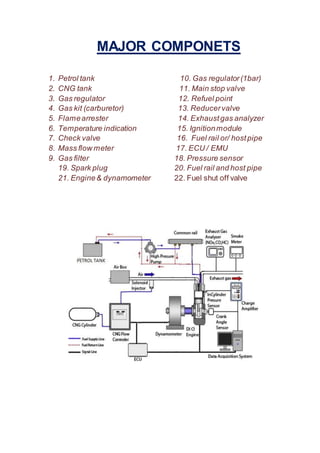
MAJOR COMPONETS
1. Petrol tank 10. Gas regulator(1bar)
2. CNG tank 11. Main stop valve
3. Gas regulator 12. Refuel point
4. Gas kit (carburetor) 13. Reducervalve
5. Flamearrester 14. Exhaustgas analyzer
6. Temperature indication 15. Ignitionmodule
7. Check valve 16. Fuel rail or/ hostpipe
8. Mass flow meter 17. ECU / EMU
9. Gas filter 18. Pressure sensor
19. Spark plug 20. Fuel rail and host pipe
21. Engine& dynamometer 22. Fuel shut off valve
PRINCIPAL OF OPERATION
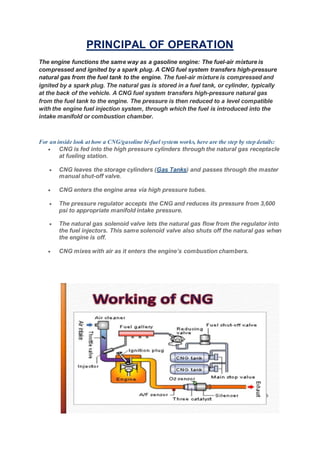
The engine functions the same way as a gasoline engine: The fuel-air mixture is
compressed and ignited by a spark plug. A CNG fuel system transfers high-pressure
natural gas from the fuel tank to the engine. The fuel-air mixture is compressed and
ignited by a spark plug. The natural gas is stored in a fuel tank, or cylinder, typically
at the back of the vehicle. A CNG fuel system transfers high-pressure natural gas
from the fuel tank to the engine. The pressure is then reduced to a level compatible
with the engine fuel injection system, through which the fuel is introduced into the
intake manifold or combustion chamber.
For an inside look at how a CNG/gasoline bi-fuel system works, here are the step by step details:
 CNG is fed into the high pressure cylinders through the natural gas receptacle
at fueling station.
 CNG leaves the storage cylinders (Gas Tanks) and passes through the master
manual shut-off valve.
 CNG enters the engine area via high pressure tubes.
 The pressure regulator accepts the CNG and reduces its pressure from 3,600
psi to appropriate manifold intake pressure.
 The natural gas solenoid valve lets the natural gas flow from the regulator into
the fuel injectors. This same solenoid valve also shuts off the natural gas when
the engine is off.
 CNG mixes with air as it enters the engine’s combustion chambers.
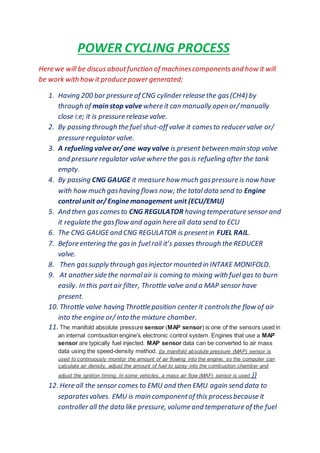
POWER CYCLING PROCESS
Here we will be discus aboutfunction of machinescomponentsand how it will
be work with how it produce power generated;
1. Having 200 bar pressure of CNG cylinder release the gas(CH4) by
through of main stop valve where it can manually open or/manually
close i:e; it is pressure release valve.
2. By passing through the fuel shut-off valve it comesto reducer valve or/
pressure regulator valve.
3. A refueling valveor/one way valve is present between main stop valve
and pressure regulator valve where the gasis refueling after the tank
empty.
4. By passing CNG GAUGE it measure how much gaspressure is now have
with how much gashaving flows now; the total data send to Engine
control unit or/Enginemanagement unit (ECU/EMU)
5. And then gas comesto CNG REGULATOR having temperature sensor and
it regulate the gasflow and again here all data send to ECU
6. The CNG GAUGEand CNG REGULATOR is presentin FUEL RAIL.
7. Before entering the gasin fuelrail it’s passes through the REDUCER
valve.
8. Then gassupply through gasinjector mounted in INTAKE MONIFOLD.
9. At another side the normalair is coming to mixing with fuel gas to burn
easily. In this partair filter, Throttle valve and a MAP sensor have
present.
10. Throttle valve having Throttle position center it controlsthe flow of air
into the engine or/ into the mixture chamber.
11. The manifold absolute pressure sensor (MAP sensor) is one of the sensors used in
an internal combustion engine's electronic control system. Engines that use a MAP
sensor are typically fuel injected. MAP sensor data can be converted to air mass
data using the speed-density method. {(a manifold absolute pressure (MAP) sensor is
used to continuously monitor the amount of air flowing into the engine, so the computer can
calculate air density, adjust the amount of fuel to spray into the combustion chamber and
adjust the ignition timing. In some vehicles, a mass air flow (MAF) sensor is used )}
12. Here all the sensor comes to EMU and then EMU again send data to
separatesvalves. EMU is main componentof this processbecause it
controller all the data like pressure, volume and temperature of the fuel
13. EMU is like a governor system of this processhere it controlsthe piston
speed, fuel volume, fuel pressure, fueltemperature, air flow, air volume
etc.
14. Now when you startthe engine then EMU sense the all valves and
sensor and then by the controlling of EMU cng gasand air enter to
mixture chamber asper required.
15. Mixture of cng gasand air entersthe engine then the piston goes down
and when piston goes up then spark plug give fire and the energy
created or in another word a blastis formed where again piston goes
down. Atlast the piston goesup where all carbon particlesare going out
to environment.
16. CNG engine processis as same as like petrolengine.
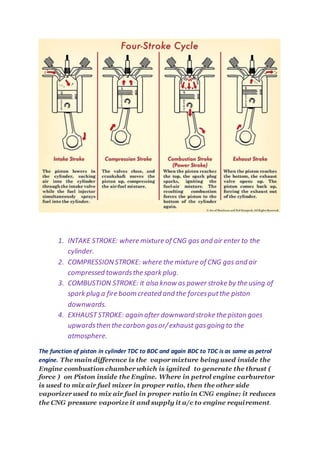
Figureshows parts and their functionscomponentsand process of this cycle
1. INTAKE STROKE: where mixture of CNG gas and air enter to the
cylinder.
2. COMPRESSIONSTROKE: where the mixture of CNG gas and air
compressed towardsthe spark plug.
3. COMBUSTION STROKE: it also know as power stroke by the using of
spark plug a fire boom created and the forcesputthe piston
downwards.
4. EXHAUSTSTROKE: again after downward stroke the piston goes
upwardsthen the carbon gasor/exhaust gasgoing to the
atmosphere.
The function of piston in cylinder TDC to BDC and again BDC to TDC is as same as petrol
engine. The main difference is the vapor mixture being used inside the
Engine combustion chamber which is ignited to generate the thrust (
force ) on Piston inside the Engine. Where in petrol engine carburetor
is used to mix air fuel mixer in proper ratio, then the other side
vaporizer used to mix air fuel in proper ratio in CNG engine; it reduces
the CNG pressure vaporize it and supply it a/c to engine requirement.
EFFICIENCY
Natural gas engines currently have a less desirable power density, fuel economy, and energy
efficiency than traditional fuel engines.
Property Natural Gas
Flammability Limits (volume % in air) 5-15
Auto-Ignition
Temperature (°
F)
842
Peak Flame
Temperature (°
F)
3423
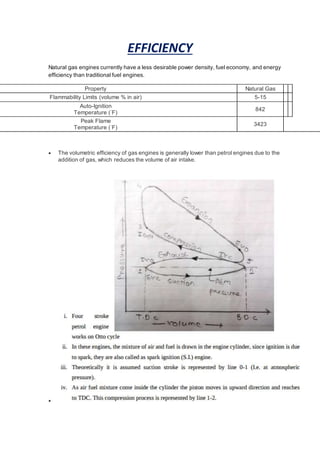
 The volumetric efficiency of gas engines is generally lower than petrol engines due to the
addition of gas, which reduces the volume of air intake.

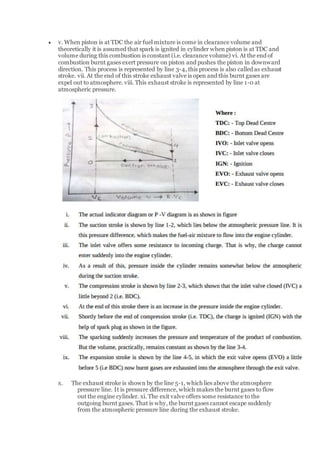
 v. When piston is at TDC the air fuel mixture is come in clearance volume and
theoretically it is assumed that spark is ignited in cylinder when piston is at TDC and
volume during this combustion is constant (i.e. clearance volume) vi. At the end of
combustion burnt gases exert pressure on piston and pushes the piston in downward
direction. This process is represented by line 3-4, this process is also called as exhaust
stroke. vii. At the end of this stroke exhaust valve is open and this burnt gases are
expel out to atmosphere. viii. This exhaust stroke is represented by line 1-0 at
atmospheric pressure.
x. The exhaust stroke is shown by the line 5-1, which lies above the atmosphere
pressure line. It is pressure difference, which makes the burnt gases to flow
out the engine cylinder. xi. The exit valve offers some resistance to the
outgoing burnt gases. That is why, the burnt gases cannot escape suddenly
from the atmospheric pressure line during the exhaust stroke.
SOME IMPORTANT POINTS HERE TO BE NOTICED ON CNG USING
Gas engines are generally categorized as two stroke (SI), four stroke (OSI) and four stroke
(duel fuel). Gas engines operate on similar principles as petrol or diesel engines. However,
there are some differences in the construction and operation of gas engines compared with
other types of internal combustion engines. The differences include:
a. On petrolengine if you use CNG gas then you mustbe start the engine
through petrolfastthen it runs the engine through CNG.
b. We use to start the engine by petrolfor giving combustion due to
differentignition condition of flame propagation and fuelburn
properties.
c. in primary stages engine is powerd by petrol because it burns rapidly compared
to CNG.
d. Thus to get better cranking speed dual fuel engines starts with petrol initially and
when engine rpm reaches predesigned point it switches over other fuel
e. During starting, CNG is unable to deliver the amount of torque required to keep
the engine running and hence manufacturers of bi-fuel engines design the system
so to avoid trouble.
f. Therefore, in view of engine being designed for petrol combustion, the initial
combustion is comfortably set with petrol, however it could be switched over to
CNG after engine has started.
g. Remember we can’tuse CNG is diesel engine because diesel engine don’t
have spark plug there for CNG can’tbe burn (CNG burn by fire it not self-
generated by pressure)
h. If we make some deign to inject CNG in diesel engine it may be work but
the life line of engine is much less then actuallife.
i. If you modified the car without company response thatmeansthe car
warranty periodisdead when you modified.
j. Today by supreme-courtauthorize ituse CNG in vehicle butit better for
you to modify your car from a registered workshop or/it’sbetter way to
you purchasesa cng gar from a manufactured company.
k. Today so many company are made CNG vehicle so it easy to buy and
easy to maintenance.
l.
ADVANTAGES OF CNG ENGINE
Natural gas produces far fewer harmful emissions and hydrocarbons than gasoline.
Using CNG makes the engine cleaner and more efficient. Unlike gasoline, CNG
minimizes harmful carbon deposits when combusted. This results to a cleaner and
more efficient engine as well as longer lasting spark plugs.
1. Compressed natural gas (CNG) refers to natural gas that has been
pressurized and placed in cylinders or tanks foralternative fuel purposes
2. CNG differs from Liquid Natural Gas (LNG) in that it is stored as a gas and
does not require specialized cylinders.
3. CNG is a safe and environmentally conscious alternative energy source.
4. Natural Gas Vehicles (NGVs) release a considerably lower amount of toxic
emissions than gasoline vehicles.
5. Almost types of car, trucks are used to CNG for easy converted system.
6. CNG having low equipment with high sensor able.
7. And it is so safe in vehicle.
8. Noise label is much less the diesel and petrol
CNG vehicle suffers from:
1. Reducescompression ratio with lower thermalefficiency.
2. High unburned CH4 emissions.
DRAWBACKS
1. The temperature in engine is higher than the petroland diesel.
2. Where the life of engine lubrication system is reducesas compare to
anther fuel.
3. If you run the vehicle with only CNG with petrolengine it may be damage
the injector pointof petroland also pumping of petrol.
4. CNG engine need differenttype of lubrication system with different
coolantsystem.
5. CNG engine is low power engine than gasoline.
6. Generally lower power output than the equivalent sized diesel engines.
7. Requires pipeline fuel supply or pressurized storage tanks.
8. Due to the high temperature and soot-free nature of gas combustion, valve
and seat wear may be a problem in some four-stroke gas engines. To combat
this problem, gas engine manufacturers often use more sophisticated valve
and seat materials and wider valve seats.
9. Starting problem in cold weather.
10.Engine life span got shortened.
11. So more frequently routine engine maintains.
12. Increased vehicle weight.
13. Another disadvantagesis that it can harm rubber hosesin some engine.
14. As biofuelcleansthe dirt from the engine, this dirt can then get collected
in the fuel filter, thus closing it; so, filter have to changed or/cleaning
after the first several hoursof running.
WHY CNG IS NOT USE IN ALL COMERCIAL VEHICLES:
A. CNG vehicle are need space for fuel storage.
B. Availability of naturalgasresource.
C. Installation cost is quite high.
D. CNG refueling station is not much available in all over.
E. More complexmechanism.
F. CNG made engine vehicles are costly then the other fuel engine of the
same car.
G. Handling must done under high pressure.
H. Due to it’s faint order, leakage can notbe easily detected.
I. Limited driving range of CNG’s, which is typically aboutthe half that of
gasoline powered vehicle.
J. According to conferencesin IITMumbaiCNG has Radio Active elements,
which is harmfulfor health and may cause of lung cancer.
SOLUTIONS:
a. It necessary to modify the car design the machine design to make more
space with controlthe leakage problem.
b. Create engine capacity to give more peak-up pressure and also need to
be mileage.
c. CNG fuel transportsystem need to be improve then a vehicle can easily
find out.
d. Still we need more research on this because we must be awarenessof
our health, and also of using safe.
e. Still improvesof all this pointwe must use CNG car for better pollution
free and for better environment.
f. It better to notmodified your car by outside source it better porchesfrom
directcompany.
g. CNG engine must be develop on this day to day life then people can be
buy CNG car more than previousdays.
CONCLUSION:
CNG is attractive for five reasons. It is the only fuel cheaper than
gasoline or diesel. It has inherently lower air pollution emissions. It
has lower greenhouse gas emissions. Its use extends petroleum
supplies, and there are large quantities of the fuel available in the
world. There are several major problems needed to be solved when
using natural gas engines, there is the set point for the best
compromise between emissions and fuel economy is not clear, the
optimum air–fuel ratio changes with both operating conditions and
fuel properties.
CNG is best vehicle in the world may be it need to
improve on some technical points but as well as it is better than
diesel and petrol engine. Now India is also huge large amount of CNG
vehicles in day to day life. In consumption of natural gas India is 14th
number of world.

Cng engine projects

  • 1.
    OUTLINE OF PRESENTATION Introduction  History  CNG ENGINEE  Know aboutthe CNG POWER cycle Engine  Why CNG use in Vehicle  Theory  Major components  Principalof Operation  Power cycling process  Efficiency  Advantages  Drawbacks  Reason for not being commercialized  Solutions  Conclusion
  • 2.
    ITRODUCTION Natural gas isa fossil fuel comprised mostly of 87% methane, andvis one of the cleanest burning alternative fuels. It can be used in the form of; Compressed natural gas Liquefied natural gas Compressed natural gas is an excellent alternative to conventional fuel. It is known as a “green fuel” because of its inherent benefits to the environment. It is better for the atmosphere, landfills, soil, and it is affordable. CNG is sweeping the nation, especially in regard to commercial transportation. CNG engine uses compressed natural gas to power the car. CNG is a substitute for gas and diesel fuel, and is considered to be much cheaper and cleaner than gas or diesel. As an efficient and environmentally-friendly alternative to gas powered cars, the CNG engine has become increasingly popular, and many people choose to convert their cars using professional mechanics. . Compressed Natural Gas is one of the most viable alternative fuel options today. Natural gas has been used as fuel in domestic households for many years but it hasn’t achieved mainstream use as fuel for automobiles. As an alternative to buying a new NGV, car owners can also choosing to convert an existing vehicle to run on CNG.
  • 3.
    HISTORY ABOUT CNGMACHINE In 1996, CSE published its report on urban air pollution[1]. This report found that the problem of vehicular pollution in India was the result of a combination of outdated engine technology, poor fuel quality, defective transportation planning and bad maintenance of vehicles on the read. No statistics of energy input and pollution output were available, put it was estimated that vehicles were responsible for 64% of emissions (power production for 17, industry for 10%). The conclusion of this report, and CSE’s objectives for the future, were to press for clean fuels and a rapid introduction of EUR II standards. In 1998, three years after the lawyer had filed his case and as a direct result of it, the Supreme Court published a Directive that specified the date of April 2001 as deadline to replace or convert all busses, three-wheelers and taxis to CNG. In addition, the Directive specified that an infrastructure of 70 CNG refueling stations had to be made available, and asked for financial incentives for the conversion of vehicle fleets. In January 1998, the National Capital Region of Delhi set up a Commission to study, write and publish a report on the air pollution problem in Delhi. CSE was a member of this Commission. In 1999, the Supreme Court ordered the government to impose the EUR II standard for gasoline engines by the year 2000 for all new car sales. The Court order attacked the diesel car promotion, and ordered sulphur levels below 30 ppm, as well as particle filters for diesel engines. This re-opened the discussion on CNG. Cleaner diesel had now become available, and the automotive industry and the Delhi government put forward scientific arguments against CNG. In fact, the government and the car industry were fighting the bad image of diesel fuel. Also at stake was the issue of equal rights between Public Transport and private cars. Diesel had always been the fuel favored by the government. It was first subsidized, than less taxed than gasoline. In 2000, despite the 1998 order of the Supreme Court order, the government still allowed 6’000 new diesel busses to take up service. And by April 2001 – the original deadline - little progress had been achieved to fulfill the 1998 Supreme Court Directive. The vehicle industry was against CNG, fundamentally because global mass production is jeopardized by any local legislation. It continued lobbying in favor of abolishing the Supreme Court order. Finally, in April 2002, the Supreme Court published a directive which imposed a penalty on the government for wasting the court’s time, and in addition, a daily penalty of 1’000 Rupee per day (approximately 20 US$) for each diesel bus still in circulation. By 1st December 2002, the last diesel bus had disappeared from Delhi’s roads, as part of a programmer to improve public transport by offering more busses, and only busses running on CNG.
  • 4.
    BEGINNING OF CNG Thefast internal combution engine (ICE) vechile to run on natural gas was created by the enginner of ETIENNE LENOIR in 1860’
  • 5.
    ABOUT THE CNG 1.CNG is a readilyavailablealternativeto gasolinethat’smade bycompressingnatural gas to less than1% of itsvolume at standardatmosphericpressure. 2. Consistingmostlyofmethane.CNG is odorless,colorlessand tasteless. It’s drawnfrom domesticallydrillednatural gaswellsor inconjunctionwithcrude oil production. 3. A natural gas under pressure (3600 poundsper square inches) whichremainsclear and non-corrosive. 4. It’s octane ratingis 130.
  • 6.
    CNG ENGINE Automotive singlecylinder of CNG engine
  • 7.
    KNOW ABOUT THECNG POWER CYCLE ENGINE In this paper, the potential of combined injection of CNG and gasoline is studied on a 1.7 L turbocharged, port-injected SI engine and the best engine performance point for the best conversion efficiency of the catalytic converters has been investigated. Compressed natural gas (CNG) as an alternative fuel is used in spark ignition engines to improve fuel consumption and exhaust emissions. The improvements gave more advantage in emission but it lowered the performance of the engine. As a substitute, CNG has a higher octane number and knocking resistance than gasoline and hence CNG-dedicated engines can have higher compression ratios and therefore higher indicated efficiencies. Turbocharged bi-fuel, combined CNG and gasoline, injection engine of is a new concept which offers direct benefits with regards to gas or gasoline powered vehicles running separately on each fuels. It also opens very interesting perspectives for meeting future emission regulations using only a three- way catalyst, since the stoichiometry condition of combustion is maintained over the whole engine operating range. Results show that the combined injection of gasoline and CNG is much better than gasoline mode in terms of fuel consumption and raw HC and CO emissions. However, as expected the NO x emission will increase. According to the obtained results at 16.2 bar BMEP, 3000 rpm full load condition with 30% CNG mass fraction, the BSFC, CO and HC emissions are improved by 16, 66 and 50%, respectively, compared to gasoline single mode. It was found that a fuel mixture of 30% CNG mass fraction was the best trade-off point between engine performance and emission production. Also, significant reductions of fuel consumption were observed. Full-load tests carried out with a turbocharged engine enhanced the synergy effect between the two fuels at full-load condition. The results showed that the power of CNG-fuelled engine is lower than that of gasoline-fuelled engine by about 11% over the speed range 1500–4000 rpm due to higher volumetric efficiency. On average, when the engine operates with CNG fuel, the ISFC is reduced roughly by 16% over this speed range.
  • 8.
    WHY CNG ISUSE IN VEHICLE ? A. CNG is alternative fuel of diesel and petrol where low pollution created. B. Environmentally Friendly. Compressed natural gas (CNG) is the cleanest burning transportation fuel on the market today. C. CNG burns cleaner than petroleum based products because of its lower carbon content. D. CNG produces the fewest emissions of all other fuels and contains significantly less pollutants than gasoline. E. As many have noted, compressed natural gas is marginally cheaper than ordinary gasoline or diesel. F. CNG burns cleaner when compared to traditional petrol and diesel. G. Another benefit is that in the case of a leak, CNG does not pose any danger of contamination of ground water since the fuel is non-toxic H. In addition, the CNG engine is considered to be more environmentally friendly. I. There are considerably less pollutants associated with compressed natural gas being ignited, and studies show that it gives off 40 percent less greenhouse gas. J. On the downside, a CNG engine will usually get fewer miles to the full tank than a regular gas engine, K. And you may also struggle to find a suitable engine and tank conversion kit, which means that the price of converting your vehicle can negate the savings from the cheaper fuel alternatives. L. CNG cars also run quieter than gasoline and diesel vehicles, which results in less noise pollution. M. It is Cost-effectiveness. N. In India the price of CNG is Rs.- 40.61 per Kg, which is way less than the price of petrol and diesel.
  • 9.
    THEORY A CNG fuelsystem transfers high-pressure naturalgas from the fuel tank to the engine. The purpose of a CNG–airmixer is to mix a predetermined amountof CNG fuel with air before admission into the combustion chamber. Diffusion. Gases above absolute zero with active motion of their molecules will both gasspecies, they will graduallydiffuse into each other. This process is dependenton partialgas pressures of each species and diffusivity of the gasses, where diffusivity is a function of gastemperature and viscosity. Thehigher the temperature and the greater the concentration gradient, the greater the diffusion flux. Bulk mixing due to turbulencewithin the gas flow. Thegreater the level of turbulence, the greater the bulk mixing effect. Turbulencecan be created in a number of ways: the higher the flow velocity, the greater the turbulence as indicated by the Reynolds number. Turbulencecan also be achieved by flow path geometry. Sharp bends, sharp changesin cross-sectional area and obstacles can create shear within the flow, creating fine and large scale turbulence. The other factor which assists mixing is residence time in the induction system. The longer the induction runner system, the greater the opportunity for mixing. Due to the very short residence time, air/fuel mixing relies heavily on turbulencewithin the induction system and good initial air/fuel distribution within the mixer. Typically, a diesel under most conditions will be operating on the lean side of stoichiometric. Thisexcess of air will favor high combustion efficiencies, but for very lean mixtures efficient mixing is critical for complete combustion.
  • 10.
    MAJOR COMPONETS 1. Petroltank 10. Gas regulator(1bar) 2. CNG tank 11. Main stop valve 3. Gas regulator 12. Refuel point 4. Gas kit (carburetor) 13. Reducervalve 5. Flamearrester 14. Exhaustgas analyzer 6. Temperature indication 15. Ignitionmodule 7. Check valve 16. Fuel rail or/ hostpipe 8. Mass flow meter 17. ECU / EMU 9. Gas filter 18. Pressure sensor 19. Spark plug 20. Fuel rail and host pipe 21. Engine& dynamometer 22. Fuel shut off valve
  • 11.
    PRINCIPAL OF OPERATION Theengine functions the same way as a gasoline engine: The fuel-air mixture is compressed and ignited by a spark plug. A CNG fuel system transfers high-pressure natural gas from the fuel tank to the engine. The fuel-air mixture is compressed and ignited by a spark plug. The natural gas is stored in a fuel tank, or cylinder, typically at the back of the vehicle. A CNG fuel system transfers high-pressure natural gas from the fuel tank to the engine. The pressure is then reduced to a level compatible with the engine fuel injection system, through which the fuel is introduced into the intake manifold or combustion chamber. For an inside look at how a CNG/gasoline bi-fuel system works, here are the step by step details:  CNG is fed into the high pressure cylinders through the natural gas receptacle at fueling station.  CNG leaves the storage cylinders (Gas Tanks) and passes through the master manual shut-off valve.  CNG enters the engine area via high pressure tubes.  The pressure regulator accepts the CNG and reduces its pressure from 3,600 psi to appropriate manifold intake pressure.  The natural gas solenoid valve lets the natural gas flow from the regulator into the fuel injectors. This same solenoid valve also shuts off the natural gas when the engine is off.  CNG mixes with air as it enters the engine’s combustion chambers.
  • 12.
    POWER CYCLING PROCESS Herewe will be discus aboutfunction of machinescomponentsand how it will be work with how it produce power generated; 1. Having 200 bar pressure of CNG cylinder release the gas(CH4) by through of main stop valve where it can manually open or/manually close i:e; it is pressure release valve. 2. By passing through the fuel shut-off valve it comesto reducer valve or/ pressure regulator valve. 3. A refueling valveor/one way valve is present between main stop valve and pressure regulator valve where the gasis refueling after the tank empty. 4. By passing CNG GAUGE it measure how much gaspressure is now have with how much gashaving flows now; the total data send to Engine control unit or/Enginemanagement unit (ECU/EMU) 5. And then gas comesto CNG REGULATOR having temperature sensor and it regulate the gasflow and again here all data send to ECU 6. The CNG GAUGEand CNG REGULATOR is presentin FUEL RAIL. 7. Before entering the gasin fuelrail it’s passes through the REDUCER valve. 8. Then gassupply through gasinjector mounted in INTAKE MONIFOLD. 9. At another side the normalair is coming to mixing with fuel gas to burn easily. In this partair filter, Throttle valve and a MAP sensor have present. 10. Throttle valve having Throttle position center it controlsthe flow of air into the engine or/ into the mixture chamber. 11. The manifold absolute pressure sensor (MAP sensor) is one of the sensors used in an internal combustion engine's electronic control system. Engines that use a MAP sensor are typically fuel injected. MAP sensor data can be converted to air mass data using the speed-density method. {(a manifold absolute pressure (MAP) sensor is used to continuously monitor the amount of air flowing into the engine, so the computer can calculate air density, adjust the amount of fuel to spray into the combustion chamber and adjust the ignition timing. In some vehicles, a mass air flow (MAF) sensor is used )} 12. Here all the sensor comes to EMU and then EMU again send data to separatesvalves. EMU is main componentof this processbecause it controller all the data like pressure, volume and temperature of the fuel
  • 13.
    13. EMU islike a governor system of this processhere it controlsthe piston speed, fuel volume, fuel pressure, fueltemperature, air flow, air volume etc. 14. Now when you startthe engine then EMU sense the all valves and sensor and then by the controlling of EMU cng gasand air enter to mixture chamber asper required. 15. Mixture of cng gasand air entersthe engine then the piston goes down and when piston goes up then spark plug give fire and the energy created or in another word a blastis formed where again piston goes down. Atlast the piston goesup where all carbon particlesare going out to environment. 16. CNG engine processis as same as like petrolengine. Figureshows parts and their functionscomponentsand process of this cycle
  • 14.
    1. INTAKE STROKE:where mixture of CNG gas and air enter to the cylinder. 2. COMPRESSIONSTROKE: where the mixture of CNG gas and air compressed towardsthe spark plug. 3. COMBUSTION STROKE: it also know as power stroke by the using of spark plug a fire boom created and the forcesputthe piston downwards. 4. EXHAUSTSTROKE: again after downward stroke the piston goes upwardsthen the carbon gasor/exhaust gasgoing to the atmosphere. The function of piston in cylinder TDC to BDC and again BDC to TDC is as same as petrol engine. The main difference is the vapor mixture being used inside the Engine combustion chamber which is ignited to generate the thrust ( force ) on Piston inside the Engine. Where in petrol engine carburetor is used to mix air fuel mixer in proper ratio, then the other side vaporizer used to mix air fuel in proper ratio in CNG engine; it reduces the CNG pressure vaporize it and supply it a/c to engine requirement.
  • 15.
    EFFICIENCY Natural gas enginescurrently have a less desirable power density, fuel economy, and energy efficiency than traditional fuel engines. Property Natural Gas Flammability Limits (volume % in air) 5-15 Auto-Ignition Temperature (° F) 842 Peak Flame Temperature (° F) 3423  The volumetric efficiency of gas engines is generally lower than petrol engines due to the addition of gas, which reduces the volume of air intake. 
  • 16.
     v. Whenpiston is at TDC the air fuel mixture is come in clearance volume and theoretically it is assumed that spark is ignited in cylinder when piston is at TDC and volume during this combustion is constant (i.e. clearance volume) vi. At the end of combustion burnt gases exert pressure on piston and pushes the piston in downward direction. This process is represented by line 3-4, this process is also called as exhaust stroke. vii. At the end of this stroke exhaust valve is open and this burnt gases are expel out to atmosphere. viii. This exhaust stroke is represented by line 1-0 at atmospheric pressure. x. The exhaust stroke is shown by the line 5-1, which lies above the atmosphere pressure line. It is pressure difference, which makes the burnt gases to flow out the engine cylinder. xi. The exit valve offers some resistance to the outgoing burnt gases. That is why, the burnt gases cannot escape suddenly from the atmospheric pressure line during the exhaust stroke.
  • 17.
    SOME IMPORTANT POINTSHERE TO BE NOTICED ON CNG USING Gas engines are generally categorized as two stroke (SI), four stroke (OSI) and four stroke (duel fuel). Gas engines operate on similar principles as petrol or diesel engines. However, there are some differences in the construction and operation of gas engines compared with other types of internal combustion engines. The differences include: a. On petrolengine if you use CNG gas then you mustbe start the engine through petrolfastthen it runs the engine through CNG. b. We use to start the engine by petrolfor giving combustion due to differentignition condition of flame propagation and fuelburn properties. c. in primary stages engine is powerd by petrol because it burns rapidly compared to CNG. d. Thus to get better cranking speed dual fuel engines starts with petrol initially and when engine rpm reaches predesigned point it switches over other fuel e. During starting, CNG is unable to deliver the amount of torque required to keep the engine running and hence manufacturers of bi-fuel engines design the system so to avoid trouble. f. Therefore, in view of engine being designed for petrol combustion, the initial combustion is comfortably set with petrol, however it could be switched over to CNG after engine has started. g. Remember we can’tuse CNG is diesel engine because diesel engine don’t have spark plug there for CNG can’tbe burn (CNG burn by fire it not self- generated by pressure) h. If we make some deign to inject CNG in diesel engine it may be work but the life line of engine is much less then actuallife. i. If you modified the car without company response thatmeansthe car warranty periodisdead when you modified. j. Today by supreme-courtauthorize ituse CNG in vehicle butit better for you to modify your car from a registered workshop or/it’sbetter way to you purchasesa cng gar from a manufactured company. k. Today so many company are made CNG vehicle so it easy to buy and easy to maintenance.
  • 18.
  • 19.
    ADVANTAGES OF CNGENGINE Natural gas produces far fewer harmful emissions and hydrocarbons than gasoline. Using CNG makes the engine cleaner and more efficient. Unlike gasoline, CNG minimizes harmful carbon deposits when combusted. This results to a cleaner and more efficient engine as well as longer lasting spark plugs. 1. Compressed natural gas (CNG) refers to natural gas that has been pressurized and placed in cylinders or tanks foralternative fuel purposes 2. CNG differs from Liquid Natural Gas (LNG) in that it is stored as a gas and does not require specialized cylinders. 3. CNG is a safe and environmentally conscious alternative energy source. 4. Natural Gas Vehicles (NGVs) release a considerably lower amount of toxic emissions than gasoline vehicles. 5. Almost types of car, trucks are used to CNG for easy converted system. 6. CNG having low equipment with high sensor able. 7. And it is so safe in vehicle. 8. Noise label is much less the diesel and petrol CNG vehicle suffers from: 1. Reducescompression ratio with lower thermalefficiency. 2. High unburned CH4 emissions.
  • 20.
    DRAWBACKS 1. The temperaturein engine is higher than the petroland diesel. 2. Where the life of engine lubrication system is reducesas compare to anther fuel. 3. If you run the vehicle with only CNG with petrolengine it may be damage the injector pointof petroland also pumping of petrol. 4. CNG engine need differenttype of lubrication system with different coolantsystem. 5. CNG engine is low power engine than gasoline. 6. Generally lower power output than the equivalent sized diesel engines. 7. Requires pipeline fuel supply or pressurized storage tanks. 8. Due to the high temperature and soot-free nature of gas combustion, valve and seat wear may be a problem in some four-stroke gas engines. To combat this problem, gas engine manufacturers often use more sophisticated valve and seat materials and wider valve seats. 9. Starting problem in cold weather. 10.Engine life span got shortened. 11. So more frequently routine engine maintains. 12. Increased vehicle weight. 13. Another disadvantagesis that it can harm rubber hosesin some engine. 14. As biofuelcleansthe dirt from the engine, this dirt can then get collected in the fuel filter, thus closing it; so, filter have to changed or/cleaning after the first several hoursof running.
  • 21.
    WHY CNG ISNOT USE IN ALL COMERCIAL VEHICLES: A. CNG vehicle are need space for fuel storage. B. Availability of naturalgasresource. C. Installation cost is quite high. D. CNG refueling station is not much available in all over. E. More complexmechanism. F. CNG made engine vehicles are costly then the other fuel engine of the same car. G. Handling must done under high pressure. H. Due to it’s faint order, leakage can notbe easily detected. I. Limited driving range of CNG’s, which is typically aboutthe half that of gasoline powered vehicle. J. According to conferencesin IITMumbaiCNG has Radio Active elements, which is harmfulfor health and may cause of lung cancer. SOLUTIONS: a. It necessary to modify the car design the machine design to make more space with controlthe leakage problem. b. Create engine capacity to give more peak-up pressure and also need to be mileage. c. CNG fuel transportsystem need to be improve then a vehicle can easily find out. d. Still we need more research on this because we must be awarenessof our health, and also of using safe. e. Still improvesof all this pointwe must use CNG car for better pollution free and for better environment. f. It better to notmodified your car by outside source it better porchesfrom directcompany. g. CNG engine must be develop on this day to day life then people can be buy CNG car more than previousdays.
  • 22.
    CONCLUSION: CNG is attractivefor five reasons. It is the only fuel cheaper than gasoline or diesel. It has inherently lower air pollution emissions. It has lower greenhouse gas emissions. Its use extends petroleum supplies, and there are large quantities of the fuel available in the world. There are several major problems needed to be solved when using natural gas engines, there is the set point for the best compromise between emissions and fuel economy is not clear, the optimum air–fuel ratio changes with both operating conditions and fuel properties. CNG is best vehicle in the world may be it need to improve on some technical points but as well as it is better than diesel and petrol engine. Now India is also huge large amount of CNG vehicles in day to day life. In consumption of natural gas India is 14th number of world.