CRYOGENICS
PRESENT BY ,
K.DAVID JENNIS
INTRODUCTION
THE MAIN POINTS TO BE DISCUSSE ARE:
 WHAT IS CRYOGENIC TECH
 WHY USES OF DEWAR FLASK IN CYOGENIC
 APPLICATION
 AERO SPACE IN CRYOGENIC
 HISTORY OF CRYOGENIC ROCKET ENGINE
 CRYOGENIC GRINDING
 MERITS & DEMERITS OF CRYOGENICS
CRYOGENIC TECHNOLOGY
 The word ‘cryogenics’ originates from Greek word
‘Cryo’ which means cold.
 Cryogenics is the study of very low temperature. The
temperature as low as-180 C are attained in cryogenic
system.
 Cryogenics is the study of low temperature and
behaviour of material under these low temperature.
 The cryogenic process also has a unique capability for
recycling difficult to separate composite material.
 The extremely low temperature are produced by using
substances called ‘cryogens’. Such as Liquid
Nitrogen(LN2) and Liquid Helium(LH2).
 Liquid Nitrogen are the most commonly used in
cryogenics.
 They have the boiling point of below -150 c.
 Cryogens are stored in vessels called as Dewar flask
which provides good insulation.
DEWAR FLASK
Liquid Nitrogen
 Nitrogen gas makes up the major portion of the
atmosphere (78.03%) by volume.
 Inert, colourless, odourless, non-corrosion, non-flammable
liquid.
 Extremely cold.
 Volume of expansion liquid to gas at 15 c 1atm. i.e 1 litre
of liquid nitrogen evaporated to form 682 litres of nitrogen
gas.
Application of cryogenics
Aerospace – Cryogenic Rocket Engine
Manufacturing field
Medical field
Electronics field
Fuels research
Aero space – Cryogenic Technology
in Rocket Propulsion
The united states was the first country to develop
cryogenic rocket engine.
with RL – 10 engine, registered its first successful
flight in 1963 and is still used on the Atlas V rocket.
On April 15, 2010, India launched communication
satellite GSAT-4 into orbit. The Geo –synchronous
Satellite Launch Vehicle (GSLV).
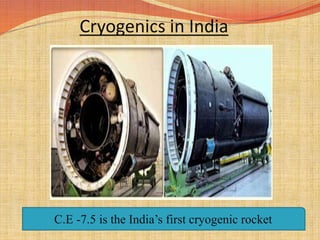
Cryogenics in India
C.E -7.5 is the India’s first cryogenic rocket
PROCESS FLOW
 Some of liquid nitrogen is utillised in cooling engine.
 Pressure of liquid nitrogen is increased from 0.7MPa
to 2.9MPa using turbo pumps.
ADVANTAGES:
High energy per unit mass.
Economical.
DISADVANTAGE:
Handling and storage of cryogenic gases can be
dangerous.
Explosion.
MANUFACTURING FIELD –
CRYOGENIC GRINDING
PROBLEMS FACED IN COVENTIONAL
GRINDING PROCESS:
High heat generation.
Less tool life.
Loss of enteric oil in spice grinding.
Oxidation.
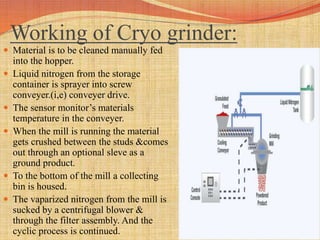
Working of Cryo grinder:
 Material is to be cleaned manually fed
into the hopper.
 Liquid nitrogen from the storage
container is sprayer into screw
conveyer.(i,e) conveyer drive.
 The sensor monitor’s materials
temperature in the conveyer.
 When the mill is running the material
gets crushed between the studs &comes
out through an optional sleve as a
ground product.
 To the bottom of the mill a collecting
bin is housed.
 The vaparized nitrogen from the mill is
sucked by a centrifugal blower &
through the filter assembly. And the
cyclic process is continued.
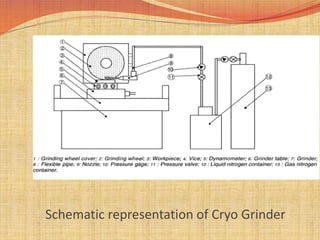
Schematic representation of Cryo Grinder
Merits and De- merits:
 Merits :
 Lower grinding cost.
 Prevent oxidation.
 Finer particle size.
 No heat generation.
 De merits:
 High operation cost.
 High power consumption.
Health hazards of cryogenic liquids
 Skin and eye hazard: cryogens are extremely cold and can
cause instant,severe frostbite. The eye’s fluids will freeze
in cantact with a cryogens, causing permanent eye
damage.
 Cold Embrittlement: at cryogenic temperatures many
materials, such as rubber, plastic and carbon steel can
become so brittle that very little stress can break the
material.
conclusion
 Cryogenic grinding technology can efficiently grind
most tough material and can also facilitate cryogenic
recycling of tough composite materials.
 The cryogenic process also has a unique capability for
recycling difficult to separate composite materials.
Thank you.......

Cryogenics

  • 1.
  • 2.
    INTRODUCTION THE MAIN POINTSTO BE DISCUSSE ARE:  WHAT IS CRYOGENIC TECH  WHY USES OF DEWAR FLASK IN CYOGENIC  APPLICATION  AERO SPACE IN CRYOGENIC  HISTORY OF CRYOGENIC ROCKET ENGINE  CRYOGENIC GRINDING  MERITS & DEMERITS OF CRYOGENICS
  • 3.
    CRYOGENIC TECHNOLOGY  Theword ‘cryogenics’ originates from Greek word ‘Cryo’ which means cold.  Cryogenics is the study of very low temperature. The temperature as low as-180 C are attained in cryogenic system.  Cryogenics is the study of low temperature and behaviour of material under these low temperature.  The cryogenic process also has a unique capability for recycling difficult to separate composite material.
  • 4.
     The extremelylow temperature are produced by using substances called ‘cryogens’. Such as Liquid Nitrogen(LN2) and Liquid Helium(LH2).  Liquid Nitrogen are the most commonly used in cryogenics.  They have the boiling point of below -150 c.  Cryogens are stored in vessels called as Dewar flask which provides good insulation.
  • 5.
  • 6.
    Liquid Nitrogen  Nitrogengas makes up the major portion of the atmosphere (78.03%) by volume.  Inert, colourless, odourless, non-corrosion, non-flammable liquid.  Extremely cold.  Volume of expansion liquid to gas at 15 c 1atm. i.e 1 litre of liquid nitrogen evaporated to form 682 litres of nitrogen gas.
  • 7.
    Application of cryogenics Aerospace– Cryogenic Rocket Engine Manufacturing field Medical field Electronics field Fuels research
  • 8.
    Aero space –Cryogenic Technology in Rocket Propulsion The united states was the first country to develop cryogenic rocket engine. with RL – 10 engine, registered its first successful flight in 1963 and is still used on the Atlas V rocket. On April 15, 2010, India launched communication satellite GSAT-4 into orbit. The Geo –synchronous Satellite Launch Vehicle (GSLV).
  • 9.
    Cryogenics in India C.E-7.5 is the India’s first cryogenic rocket
  • 10.
  • 11.
     Some ofliquid nitrogen is utillised in cooling engine.  Pressure of liquid nitrogen is increased from 0.7MPa to 2.9MPa using turbo pumps.
  • 12.
    ADVANTAGES: High energy perunit mass. Economical. DISADVANTAGE: Handling and storage of cryogenic gases can be dangerous. Explosion.
  • 13.
    MANUFACTURING FIELD – CRYOGENICGRINDING PROBLEMS FACED IN COVENTIONAL GRINDING PROCESS: High heat generation. Less tool life. Loss of enteric oil in spice grinding. Oxidation.
  • 14.
    Working of Cryogrinder:  Material is to be cleaned manually fed into the hopper.  Liquid nitrogen from the storage container is sprayer into screw conveyer.(i,e) conveyer drive.  The sensor monitor’s materials temperature in the conveyer.  When the mill is running the material gets crushed between the studs &comes out through an optional sleve as a ground product.  To the bottom of the mill a collecting bin is housed.  The vaparized nitrogen from the mill is sucked by a centrifugal blower & through the filter assembly. And the cyclic process is continued.
  • 15.
  • 16.
    Merits and De-merits:  Merits :  Lower grinding cost.  Prevent oxidation.  Finer particle size.  No heat generation.  De merits:  High operation cost.  High power consumption.
  • 17.
    Health hazards ofcryogenic liquids  Skin and eye hazard: cryogens are extremely cold and can cause instant,severe frostbite. The eye’s fluids will freeze in cantact with a cryogens, causing permanent eye damage.  Cold Embrittlement: at cryogenic temperatures many materials, such as rubber, plastic and carbon steel can become so brittle that very little stress can break the material.
  • 18.
    conclusion  Cryogenic grindingtechnology can efficiently grind most tough material and can also facilitate cryogenic recycling of tough composite materials.  The cryogenic process also has a unique capability for recycling difficult to separate composite materials.
  • 19.