CRIME AND DEVIANCE
key features and
definitions
deviance
Behaviour that violates
informal social norms.
crime
Behaviour that breaks formal
written laws.
All criminal behaviour is
deviant, while not all deviant
behaviour is criminal.
Which of these behaviours may be seen as criminal
and which as deviant?
drinking alcoholhomosexuality
killing someone suicide
forced marriagetheft
using offensive languagepolygamy
deviance can vary dramatically
across cultures. cultural
norms are relative, which
makes deviant behaviour
relative as well.
polygamous marriage has been made legal in
Kenya in 2014.
drinking alcohol is illegal in Afghanistan,
Bahrain, Bangladesh, Brunei, and india.
forced marriage is legal under Sharia law.
suicide was a criminal act in England and
Wales until 1961.
homosexuality is illegal in 38 african
countries. It is punishable by death in 10
countries in the world.
In 2014 Russia has introduced a ban on swearing
in books, films, theatre and internet blogs.
agencies of social
control
informal social control
Ways in which people get others to
conform to norms. It includes
comments, sarcasm and disapproving
looks as sanctions and words of
praise as rewards.
formal social control
Is enforced by government or its
agencies, such as the police and
courts,or by people in positions of
authority, such as teachers in enforcing
school rules.
police are responsible for investigating
criminal acts and catching offenders.
the law courts that hear charges brought
against people, decide on their guilt or innocence
and impose punishments.
the penal system, including prisons and other
institutions are responsible for overseeing the
punishment that has been imposed by the law courts.
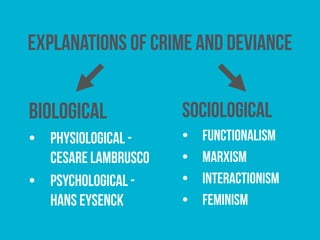
explanations of crime and deviance
biological
• physiological -
cesare lambrusco
• psychological -
hans eysenck
sociological
• functionalism
• marxism
• interactionism
• feminism
biological explanations
of crime and deviance
cesare lambroso
In his work l’unomo delinquente
(1876) he argued that criminals could
be identified through physical
characteristics such as large jaws,
large ears, and high cheekbones.
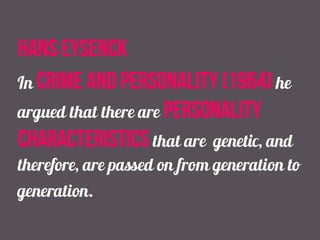
hans Eysenck
In crime and personality (1964) he
argued that there are personality
characteristics that are genetic, and
therefore, are passed on from generation to
generation.
sociological explanations
of crime and deviance
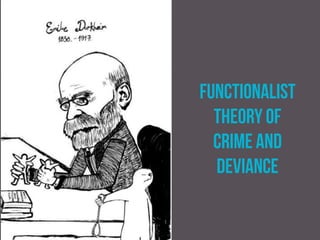
functionalist
theory of
crime and
deviance
the functionalist perspective sees
society as a body of separate but
interdependent parts all of which
must function together for the society
to function properly.
deviant and criminal behaviour is
seen by functionalists as behaviour that is
outwith the norms of society and so is
detrimental to the proper functioning of
society. Therefore, such behaviour is
dysfunctional.
However, at the same time
functionalism also argues that
deviant behaviour has a positive
function to perform. This is because if
there was no deviant behaviour, then
anything falling outside the norms
would be considered deviant.
deviant behaviour reinforces
the norms and values people
share, therefore acting as a
support mechanism for society.
Similarly, criminal behaviour
has a positive function to perform in
that it can also instigate change
and progression within society.
The first functionalist study of
deviance was durkheim’s suicide: a
study in sociology (1897). Durkheim
studies suicide rates across Europe. He
found that suicide rates varies amongst
and within societies.
Durkheim established a link between
suicide and the social factors within
societies, for example economic
depression and war. Durkheim concluded
that suicide was a result of the social
factors of a given society.
robert merton developed the concept of
anomie in his book social theory and
social structure (1938). anomie is when
social bonds and shared value system
between a society and individuals are broken,
so people do not respect these social values
and feel they are outside society.
common system of norms and rules
was abandoned in pursuit of winning at
any cost. This let to anomie. merton
argued that individuals would respond to
such anomie in different ways, including
criminal and deviant behaviour.
strengths
Challenges previous theories,
particularly biological theories.
Explains the resistance of deviance
and crime in a society.
deviant behaviour allows
changes in the society.
weaknesses
Assumes that everyone in a society
shares the same values.
Fails to explain why some turn to
deviant behaviour while others in
identical circumstances do not.
Criticised for arguing that crime has
social purpose in binding societies
together.
marxist
theory of
crime and
deviance
marxism analyses crime and
deviance from a conflict
perspective. Marxists argue that the
ruling classes use agencies of state
to control the proletariat.
the norms and values of the
society are the norms and the values
of the rich and powerful and serve
their interests.
strengths
marxism analyses impact of
economic factors on crime and
deviance.
marxism identifies that criminal
behaviour is carried out by the rich
as well as the poor.
weaknesses
Seen as failing to recognise and
analyse factors such as gender
and ethnicity.
Failure of communist regimes to
tackle crime and deviance.
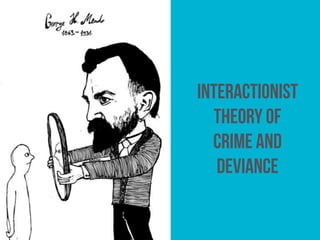
interactionist
theory of
crime and
deviance
interactionist perspective on
crime and deviance differs from
other theories.
Instead of concentrating on deviantsand
factorsin society which are seen as
determinants of behaviour, they concentrate
on the interactionbetween those who are
defined as deviants by the society, and
those who define them as deviant.
It looks at the interaction between
social agents such as the education
system, the judicial system, the
criminal system and the individuals
sych as delinquents and criminals.
Puts emphasis on the meanings
defined by those who are involved in
the interaction, e.g. how a juvenile
delinquent is defined by the police and
how it relates to factors such as
social class, ethnicity and gender.
Rejects other theories by arguing
that they place too much emphasis on
external forces in defining
criminal and deviant behaviour.
strengths
Seen as strong in recognising the
importance of interaction with
respect to crime and deviance.
Recognises the flexible nature of
meanings. As such interactionism
recognises and takes in account of
changing norms and values both
within societies as well as amongst
them.
Has been credited with challenging
long held perceptions of crime, in
ares such as decriminalising cannabis
and the treatment of juveniles.
weaknesses
Criticised for understating the
importance of external factors
such as poverty and deprivation.
Also criticised for defining criminal
and deviant behaviour solely on
the basis of how it is defined by
individuals in the society.
It is also criticised for being too
deterministic in that once an
individual becomes deviant, the only real
option is that their deviant behaviour
simply becomes worse.
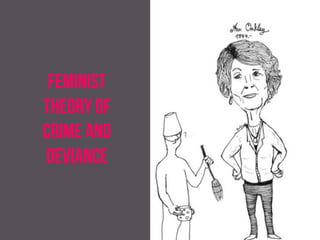
feminist
theory of
crime and
deviance
Until feminist theories emerged
gender was largely ignored or
explained in simplistic biological
terms.
Challenges the view that female
crime is less important and less
threatening than male crime.
Some argue that women are seen more
deviant (goes against patriarchal norms
and values) so are treated more
harshly.
Some argue that women commit
less crime because they have less
opportunity to do so.
strengths
Challenges male oriented theories
that certain types of crime, such as
domestic violence, sexual harassment
and rape, are more acceptable.
Strong in identifying neglected
issue of gender and crime.
weaknesses
Over-emphasise impact of gender on
crime and deviance and neglecting
other areas such as ethnicity and
social class.
Too critical and dismissive
of other theories on crime and
deviance.
Criticised for many statements
that are too general without
specific empirical evidence.
aspects
Aspects
• labelling and the self-fulfilling
prophecy
• crime statistics
• gender
LABELLING AND THE SELF-
FULFILLING PROPHECY
labelling theory argues that
the agents of social control
within society define and project
certain groups within society as
stereotypes.
labelling theory is associated with
interactionist theory, so based on
an interaction of individuals and
meanings given to these actions both
by actors and by society.
self-fulfilling prophecy is
when the deviant starts acting
in accordance with the label
they have been assigned.
Becker (1963) outsiders
Argues that deviance is defined not
by the act but by the definition of
the of the act by society.
Becker (1963) outsiders
deviance is determined by a
number of factors: who is carrying
out the act, who is observing it,
the interaction between the actors.
Becker (1963) outsiders
He argued that such definition of
deviant behaviour led to self-
fulfilling prophecy because it
overrode other definitions in the
society.
Becker (1963) outsiders
Is strong in challenging other
sociological theories by identifying
and recognising importance of individual
perceptions of deviant behaviour and
crime.
Becker (1963) outsiders
Criticised for arguing that
deviance is defined by society.
goffman (1968) asylums
Based his study on treatment of
patients in mental institution. Saw
such institutions as merely another
means whereby society confirmed
deviance.
goffman (1968) asylums
Concluded that mental institutions re-
inforced the labelling of patients as
deviants and encouraged them to accept
such a definition, in other words
encouraging a self-fulfiling prophecy.
goffman (1968) asylums
The strength of this study is that it has
shown how the hospitalisation of the
mentally ill leads to mortification,
self-fulfilling prophecies and in
some cases institutionalisation.
goffman (1968) asylums
Is criticised for reinforcing labelling
and self-fulfilling prophecy.
lemert (1979) primary and
secondary deviation
Emphasized the importance of
societal reaction - the reaction of
others to the deviant.
lemert (1979) primary and secondary
deviation
Defines primary deviance as the action or
behaviour that the individual commits
initially, and secondary deviance that
refers to the reaction of society to that action
or behaviour.
lemert (1979) primary and secondary
deviation
The strength of this study is that it seeks to
explain deviance within the context of
society, thus giving better understanding of
how societies address and respond to crime
and deviance.
lemert (1979) primary and secondary
deviation
Is criticised for being deterministic, in that
it implies that deviant behaviour is largely
outside the control of the individual and
within the norms and values of the society.
CRIME STATISTICS
One of the main sources of information
about crime is official statistics.
These are often taken at face value and
assumptions are made from them
about the extent of crime and the
characteristics of offenders.
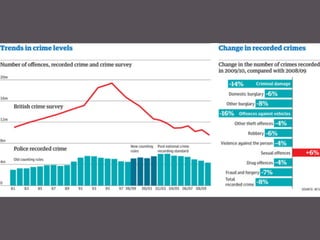
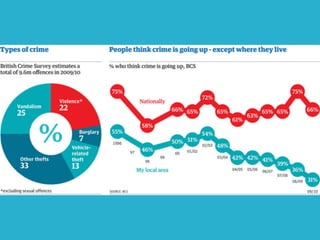
The number of crimes is far higher
than the official statistics
suggest, because of the use of self-
report studies and victim
surveys.
self reported surveys are
anonymous questionnaires
where people own up to
committing crimes, whether
the have been discovered or not.
victim surveys involve people
admitting to being the victim of
a crime, whether or not they
report it.
reported crime
A crime, which the public has
reported to the police. 90% of
all crime the police deal with is
reported to them by the public.
recorded crime
A crime, which has been recorded by
the police as a crime. only 40% of
reported crime is then recorded
due to discretionary powers of the
police.
The Crime Survey for England
and Wales
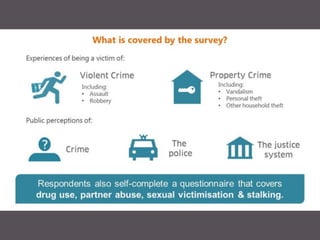
Measures the extent of crime in
England and wales by asking people
whether they have experienced any
crime in the past year.
The Crime Survey for England and
Wales
Records crimes that may not have been
reported to the police and it is therefore
used alongside the police recorded crime
figures to show a more accurate picture of the
level of crime in the country.
Scottish crime and justice survey
Provides a picture of crime in
Scotland, including crimes that
haven’t been reported to, or
recorded by the police.
There are many reasons why
using official statistics can
be useful: they are cheap,
readily available, and provide
data for the whole country.
They are criticised for: there may
be reasons why the public may not
report crimes to the police, who
then may not take action against
all offences known to them.
box (1981) deviance, reality and
society
Analysed criminal statistics on
class basis. It supports the marxist
analysis of crime and deviance.
box (1981) deviance, reality
and society
Attempted to measure unreported
as well as reported crime and
used victimisation studies.
box (1981) deviance, reality
and society
The strength of this study is that it
gives more comprehensive
picture to police figures.
box (1981) deviance, reality and
society
The weakness is that it can only make
estimates of crime rates and
neglects areas such as crimes against
women.
heidensohn (1989) crime and
society
Criticised official statistics for
omitting crimes against women
because of lack of confidence or fear.
heidensohn (1989) crime and
society
Argued that women are neglected and
inadequately dealt with by the
criminal system, thereby elected in
statistics.
heidensohn (1989) crime and
society
The strength of this study is that it
identifies and raises profile of
gender.
heidensohn (1989) crime and
society
Criticised for analysing criminal
statistics from a very restricted
gender view, ignoring other factors such
as class and ethnicity.
CRIME AND GENDER
gender is seen as and issue that
was by and large ignored within the
context of crime and gender.
Official statistics show that males
are responsible for several times
as many crimes than females
and that there are more male than
female criminals.
There are differences between the
types of offences men and
women commit. One crime for which
numbers of offences by men and
women are similar is shoplifting.
heidensohn (1987) gender and
crime
Analysed criminal statistics
trying to explain why female crime
rates are lower than male statistics.
heidensohn (1987) gender and
crime
Shows that although women commit
fewer crimes than men, the
punishments women receive are
often harsher.
heidensohn (1987) gender and
crime
Presents a plausible explanation of
why such a gap remains between
men’s and women crime rates.
heidensohn (1987) gender and
crime
Many arguments are based upon
generalisations, such as that being a
housewife directly restricts women by
limiting their opportunities for
criminality.
pollack (1950) the criminality of
women
Highly critical of criminal statistics
relating to female crime. Argued that
criminal statistics seriously
underestimated level of female crime.
pollack (1950) the criminality of
women
Argued that such statistics were
misleading. Certain crimes, which are
unlikely to be recorded, for example
shoplifting, are almost totally committed by
women.
pollack (1950) the criminality
of women
It was one of the first studies to address
neglected issue of gender within the
context of crime and deviance.
pollack (1950) the criminality of
women
Heavily criticised for failing to
justify conclusions. Much of the
crime he describes as done by women
is also done by men.
carlen (1985) women crime
and poverty
Based on lengthy unstructured
interviews of women in custody.
carlen (1985) women crime and
poverty
Concluded that most female
criminals came from working class
backgrounds. Often they were women
for whom stable employment was
not available.
carlen (1985) women crime and
poverty
Is seen as particularly strong in
establishing links between female
criminal behaviour and poverty.
carlen (1985) women crime and
poverty
criticisedfor basing study on a very small
sample of women from which it is dangerous
to draw general conclusions. Out of 39
women interviewed, most were from working
class background and from london.
Next workshop is on 14 march.
Finish tutorial on crime and deviance.
Tutorial on education.

Crime and Deviance

  • 1.
  • 2.
  • 3.
  • 4.
    crime Behaviour that breaksformal written laws.
  • 5.
    All criminal behaviouris deviant, while not all deviant behaviour is criminal.
  • 6.
    Which of thesebehaviours may be seen as criminal and which as deviant? drinking alcoholhomosexuality killing someone suicide forced marriagetheft using offensive languagepolygamy
  • 7.
    deviance can varydramatically across cultures. cultural norms are relative, which makes deviant behaviour relative as well.
  • 8.
    polygamous marriage hasbeen made legal in Kenya in 2014.
  • 9.
    drinking alcohol isillegal in Afghanistan, Bahrain, Bangladesh, Brunei, and india.
  • 10.
    forced marriage islegal under Sharia law.
  • 11.
    suicide was acriminal act in England and Wales until 1961.
  • 12.
    homosexuality is illegalin 38 african countries. It is punishable by death in 10 countries in the world.
  • 13.
    In 2014 Russiahas introduced a ban on swearing in books, films, theatre and internet blogs.
  • 14.
  • 15.
    informal social control Waysin which people get others to conform to norms. It includes comments, sarcasm and disapproving looks as sanctions and words of praise as rewards.
  • 16.
    formal social control Isenforced by government or its agencies, such as the police and courts,or by people in positions of authority, such as teachers in enforcing school rules.
  • 17.
    police are responsiblefor investigating criminal acts and catching offenders.
  • 18.
    the law courtsthat hear charges brought against people, decide on their guilt or innocence and impose punishments.
  • 19.
    the penal system,including prisons and other institutions are responsible for overseeing the punishment that has been imposed by the law courts.
  • 20.
    explanations of crimeand deviance biological • physiological - cesare lambrusco • psychological - hans eysenck sociological • functionalism • marxism • interactionism • feminism
  • 21.
  • 22.
    cesare lambroso In hiswork l’unomo delinquente (1876) he argued that criminals could be identified through physical characteristics such as large jaws, large ears, and high cheekbones.
  • 23.
    hans Eysenck In crimeand personality (1964) he argued that there are personality characteristics that are genetic, and therefore, are passed on from generation to generation.
  • 24.
  • 25.
  • 26.
    the functionalist perspectivesees society as a body of separate but interdependent parts all of which must function together for the society to function properly.
  • 27.
    deviant and criminalbehaviour is seen by functionalists as behaviour that is outwith the norms of society and so is detrimental to the proper functioning of society. Therefore, such behaviour is dysfunctional.
  • 28.
    However, at thesame time functionalism also argues that deviant behaviour has a positive function to perform. This is because if there was no deviant behaviour, then anything falling outside the norms would be considered deviant.
  • 29.
    deviant behaviour reinforces thenorms and values people share, therefore acting as a support mechanism for society.
  • 30.
    Similarly, criminal behaviour hasa positive function to perform in that it can also instigate change and progression within society.
  • 31.
    The first functionaliststudy of deviance was durkheim’s suicide: a study in sociology (1897). Durkheim studies suicide rates across Europe. He found that suicide rates varies amongst and within societies.
  • 32.
    Durkheim established alink between suicide and the social factors within societies, for example economic depression and war. Durkheim concluded that suicide was a result of the social factors of a given society.
  • 33.
    robert merton developedthe concept of anomie in his book social theory and social structure (1938). anomie is when social bonds and shared value system between a society and individuals are broken, so people do not respect these social values and feel they are outside society.
  • 34.
    common system ofnorms and rules was abandoned in pursuit of winning at any cost. This let to anomie. merton argued that individuals would respond to such anomie in different ways, including criminal and deviant behaviour.
  • 35.
  • 36.
  • 37.
    Explains the resistanceof deviance and crime in a society.
  • 38.
  • 39.
  • 40.
    Assumes that everyonein a society shares the same values.
  • 41.
    Fails to explainwhy some turn to deviant behaviour while others in identical circumstances do not.
  • 42.
    Criticised for arguingthat crime has social purpose in binding societies together.
  • 43.
  • 44.
    marxism analyses crimeand deviance from a conflict perspective. Marxists argue that the ruling classes use agencies of state to control the proletariat.
  • 45.
    the norms andvalues of the society are the norms and the values of the rich and powerful and serve their interests.
  • 46.
  • 47.
    marxism analyses impactof economic factors on crime and deviance.
  • 48.
    marxism identifies thatcriminal behaviour is carried out by the rich as well as the poor.
  • 49.
  • 50.
    Seen as failingto recognise and analyse factors such as gender and ethnicity.
  • 51.
    Failure of communistregimes to tackle crime and deviance.
  • 52.
  • 53.
    interactionist perspective on crimeand deviance differs from other theories.
  • 54.
    Instead of concentratingon deviantsand factorsin society which are seen as determinants of behaviour, they concentrate on the interactionbetween those who are defined as deviants by the society, and those who define them as deviant.
  • 55.
    It looks atthe interaction between social agents such as the education system, the judicial system, the criminal system and the individuals sych as delinquents and criminals.
  • 56.
    Puts emphasis onthe meanings defined by those who are involved in the interaction, e.g. how a juvenile delinquent is defined by the police and how it relates to factors such as social class, ethnicity and gender.
  • 57.
    Rejects other theoriesby arguing that they place too much emphasis on external forces in defining criminal and deviant behaviour.
  • 58.
  • 59.
    Seen as strongin recognising the importance of interaction with respect to crime and deviance.
  • 60.
    Recognises the flexiblenature of meanings. As such interactionism recognises and takes in account of changing norms and values both within societies as well as amongst them.
  • 61.
    Has been creditedwith challenging long held perceptions of crime, in ares such as decriminalising cannabis and the treatment of juveniles.
  • 62.
  • 63.
    Criticised for understatingthe importance of external factors such as poverty and deprivation.
  • 64.
    Also criticised fordefining criminal and deviant behaviour solely on the basis of how it is defined by individuals in the society.
  • 65.
    It is alsocriticised for being too deterministic in that once an individual becomes deviant, the only real option is that their deviant behaviour simply becomes worse.
  • 66.
  • 67.
    Until feminist theoriesemerged gender was largely ignored or explained in simplistic biological terms.
  • 68.
    Challenges the viewthat female crime is less important and less threatening than male crime.
  • 69.
    Some argue thatwomen are seen more deviant (goes against patriarchal norms and values) so are treated more harshly.
  • 70.
    Some argue thatwomen commit less crime because they have less opportunity to do so.
  • 71.
  • 72.
    Challenges male orientedtheories that certain types of crime, such as domestic violence, sexual harassment and rape, are more acceptable.
  • 73.
    Strong in identifyingneglected issue of gender and crime.
  • 74.
  • 75.
    Over-emphasise impact ofgender on crime and deviance and neglecting other areas such as ethnicity and social class.
  • 76.
    Too critical anddismissive of other theories on crime and deviance.
  • 77.
    Criticised for manystatements that are too general without specific empirical evidence.
  • 78.
  • 79.
    Aspects • labelling andthe self-fulfilling prophecy • crime statistics • gender
  • 80.
    LABELLING AND THESELF- FULFILLING PROPHECY
  • 81.
    labelling theory arguesthat the agents of social control within society define and project certain groups within society as stereotypes.
  • 82.
    labelling theory isassociated with interactionist theory, so based on an interaction of individuals and meanings given to these actions both by actors and by society.
  • 83.
    self-fulfilling prophecy is whenthe deviant starts acting in accordance with the label they have been assigned.
  • 84.
    Becker (1963) outsiders Arguesthat deviance is defined not by the act but by the definition of the of the act by society.
  • 85.
    Becker (1963) outsiders devianceis determined by a number of factors: who is carrying out the act, who is observing it, the interaction between the actors.
  • 86.
    Becker (1963) outsiders Heargued that such definition of deviant behaviour led to self- fulfilling prophecy because it overrode other definitions in the society.
  • 87.
    Becker (1963) outsiders Isstrong in challenging other sociological theories by identifying and recognising importance of individual perceptions of deviant behaviour and crime.
  • 88.
    Becker (1963) outsiders Criticisedfor arguing that deviance is defined by society.
  • 89.
    goffman (1968) asylums Basedhis study on treatment of patients in mental institution. Saw such institutions as merely another means whereby society confirmed deviance.
  • 90.
    goffman (1968) asylums Concludedthat mental institutions re- inforced the labelling of patients as deviants and encouraged them to accept such a definition, in other words encouraging a self-fulfiling prophecy.
  • 91.
    goffman (1968) asylums Thestrength of this study is that it has shown how the hospitalisation of the mentally ill leads to mortification, self-fulfilling prophecies and in some cases institutionalisation.
  • 92.
    goffman (1968) asylums Iscriticised for reinforcing labelling and self-fulfilling prophecy.
  • 93.
    lemert (1979) primaryand secondary deviation Emphasized the importance of societal reaction - the reaction of others to the deviant.
  • 94.
    lemert (1979) primaryand secondary deviation Defines primary deviance as the action or behaviour that the individual commits initially, and secondary deviance that refers to the reaction of society to that action or behaviour.
  • 95.
    lemert (1979) primaryand secondary deviation The strength of this study is that it seeks to explain deviance within the context of society, thus giving better understanding of how societies address and respond to crime and deviance.
  • 96.
    lemert (1979) primaryand secondary deviation Is criticised for being deterministic, in that it implies that deviant behaviour is largely outside the control of the individual and within the norms and values of the society.
  • 97.
  • 98.
    One of themain sources of information about crime is official statistics. These are often taken at face value and assumptions are made from them about the extent of crime and the characteristics of offenders.
  • 99.
    The number ofcrimes is far higher than the official statistics suggest, because of the use of self- report studies and victim surveys.
  • 100.
    self reported surveysare anonymous questionnaires where people own up to committing crimes, whether the have been discovered or not.
  • 101.
    victim surveys involvepeople admitting to being the victim of a crime, whether or not they report it.
  • 102.
    reported crime A crime,which the public has reported to the police. 90% of all crime the police deal with is reported to them by the public.
  • 103.
    recorded crime A crime,which has been recorded by the police as a crime. only 40% of reported crime is then recorded due to discretionary powers of the police.
  • 104.
    The Crime Surveyfor England and Wales Measures the extent of crime in England and wales by asking people whether they have experienced any crime in the past year.
  • 105.
    The Crime Surveyfor England and Wales Records crimes that may not have been reported to the police and it is therefore used alongside the police recorded crime figures to show a more accurate picture of the level of crime in the country.
  • 108.
    Scottish crime andjustice survey Provides a picture of crime in Scotland, including crimes that haven’t been reported to, or recorded by the police.
  • 112.
    There are manyreasons why using official statistics can be useful: they are cheap, readily available, and provide data for the whole country.
  • 113.
    They are criticisedfor: there may be reasons why the public may not report crimes to the police, who then may not take action against all offences known to them.
  • 114.
    box (1981) deviance,reality and society Analysed criminal statistics on class basis. It supports the marxist analysis of crime and deviance.
  • 115.
    box (1981) deviance,reality and society Attempted to measure unreported as well as reported crime and used victimisation studies.

  • 116.
    box (1981) deviance,reality and society The strength of this study is that it gives more comprehensive picture to police figures.
  • 117.
    box (1981) deviance,reality and society The weakness is that it can only make estimates of crime rates and neglects areas such as crimes against women.
  • 118.
    heidensohn (1989) crimeand society Criticised official statistics for omitting crimes against women because of lack of confidence or fear.
  • 119.
    heidensohn (1989) crimeand society Argued that women are neglected and inadequately dealt with by the criminal system, thereby elected in statistics.
  • 120.

    heidensohn (1989) crimeand society The strength of this study is that it identifies and raises profile of gender.
  • 121.
    heidensohn (1989) crimeand society Criticised for analysing criminal statistics from a very restricted gender view, ignoring other factors such as class and ethnicity.
  • 122.
  • 123.
    gender is seenas and issue that was by and large ignored within the context of crime and gender.
  • 124.
    Official statistics showthat males are responsible for several times as many crimes than females and that there are more male than female criminals.
  • 125.
    There are differencesbetween the types of offences men and women commit. One crime for which numbers of offences by men and women are similar is shoplifting.
  • 126.
    heidensohn (1987) genderand crime Analysed criminal statistics trying to explain why female crime rates are lower than male statistics.
  • 127.
    heidensohn (1987) genderand crime Shows that although women commit fewer crimes than men, the punishments women receive are often harsher.
  • 128.
    heidensohn (1987) genderand crime Presents a plausible explanation of why such a gap remains between men’s and women crime rates.

  • 129.
    heidensohn (1987) genderand crime Many arguments are based upon generalisations, such as that being a housewife directly restricts women by limiting their opportunities for criminality.
  • 130.
    pollack (1950) thecriminality of women Highly critical of criminal statistics relating to female crime. Argued that criminal statistics seriously underestimated level of female crime.
  • 131.
    pollack (1950) thecriminality of women Argued that such statistics were misleading. Certain crimes, which are unlikely to be recorded, for example shoplifting, are almost totally committed by women.
  • 132.
    pollack (1950) thecriminality of women It was one of the first studies to address neglected issue of gender within the context of crime and deviance.
  • 133.
    pollack (1950) thecriminality of women Heavily criticised for failing to justify conclusions. Much of the crime he describes as done by women is also done by men.
  • 134.
    carlen (1985) womencrime and poverty Based on lengthy unstructured interviews of women in custody.
  • 135.
    carlen (1985) womencrime and poverty Concluded that most female criminals came from working class backgrounds. Often they were women for whom stable employment was not available.
  • 136.
    carlen (1985) womencrime and poverty Is seen as particularly strong in establishing links between female criminal behaviour and poverty.
  • 137.
    carlen (1985) womencrime and poverty criticisedfor basing study on a very small sample of women from which it is dangerous to draw general conclusions. Out of 39 women interviewed, most were from working class background and from london.
  • 138.
    Next workshop ison 14 march. Finish tutorial on crime and deviance. Tutorial on education.