Crime is behaviour that
breaks the formal written laws
   of a society. If someone
commits a crime they can be
   arrested, charged and
 prosecuted. Actions can be
    illegal but not deviant.
Deviance is behaviour which
  does not comply with the
dominant norms of a specific
society. If people are seen as
    deviant it can lead to
 negative sanctions such as
  being told off or ridiculed.
Gary, walked through his local
library whilst talking loudly on
       his mobile phone.
 This is legally deviant as he is
not breaking any law, he is just
acting socially unacceptable.
Robert, punched a pregnant
      lady in the face.

 This is illegally deviant as he
  committed an assault, the
   fact that he punched a
pregnant lady also makes the
            mater worse.
Sam, illegally downloads
  thousands of songs for her
          mp3 player.

    Sam is a criminal as she is
breaking the copyright act. She is
not a deviant as what she is doing
      is not hurting anyone.
VALUE; InArab culture family honour is
          dependant on female purity.
     CRIMINAL             Social Code             DEVIANT

   Public nudity       Separation of sexes
                                              Taking photos of
Sex outside marriage    Modesty in dress
                                                   women
   Homosexuality            Marriage
 Talking to random     Jobs for women at       Showing thighs,
women in the street    home or in the care   shoulders, cleavage
 Public displays of     industry - Nurses,       and midriff
    affection              Teachers
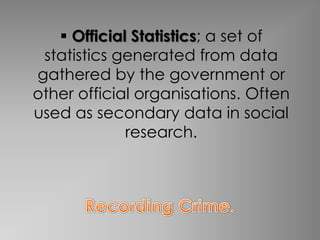
 Official Statistics; a set of
 statistics generated from data
gathered by the government or
other official organisations. Often
used as secondary data in social
             research.
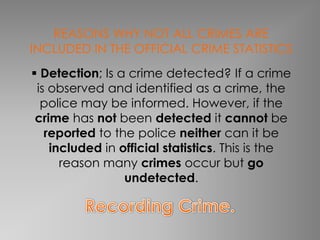
REASONS WHY NOT ALL CRIMES ARE
INCLUDED IN THE OFFICIAL CRIME STATISTICS
 Detection; Is a crime detected? If a crime
 is observed and identified as a crime, the
  police may be informed. However, if the
 crime has not been detected it cannot be
   reported to the police neither can it be
    included in official statistics. This is the
      reason many crimes occur but go
                 undetected.
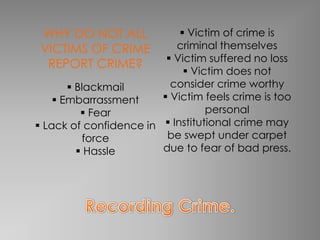
WHY DO NOT ALL              Victim of crime is
 VICTIMS OF CRIME          criminal themselves
                          Victim suffered no loss
  REPORT CRIME?
                              Victim does not
        Blackmail        consider crime worthy
     Embarrassment      Victim feels crime is too
           Fear                  personal
 Lack of confidence in  Institutional crime may
          force          be swept under carpet
          Hassle       due to fear of bad press.
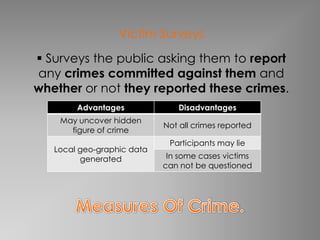
Victim Surveys
 Surveys the public asking them to report
any crimes committed against them and
whether or not they reported these crimes.
        Advantages             Disadvantages
    May uncover hidden
                            Not all crimes reported
      figure of crime
                             Participants may lie
   Local geo-graphic data
         generated           In some cases victims
                            can not be questioned
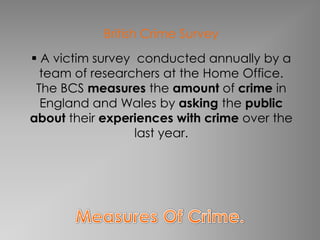
British Crime Survey
 A victim survey conducted annually by a
  team of researchers at the Home Office.
 The BCS measures the amount of crime in
  England and Wales by asking the public
about their experiences with crime over the
                  last year.
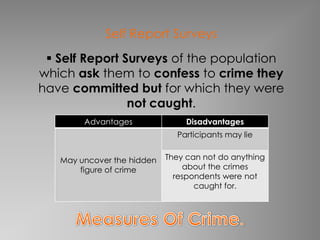
Self Report Surveys
  Self Report Surveys of the population
which ask them to confess to crime they
have committed but for which they were
                not caught.
        Advantages               Disadvantages
                              Participants may lie


   May uncover the hidden   They can not do anything
       figure of crime           about the crimes
                              respondents were not
                                   caught for.
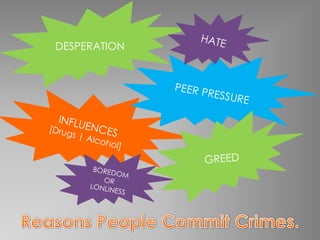
DESPERATION
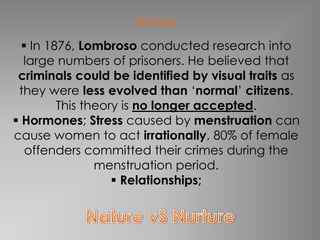
Nature
   In 1876, Lombroso conducted research into
  large numbers of prisoners. He believed that
 criminals could be identified by visual traits as
 they were less evolved than ‘normal’ citizens.
         This theory is no longer accepted.
 Hormones; Stress caused by menstruation can
cause women to act irrationally, 80% of female
   offenders committed their crimes during the
                menstruation period.
                    Relationships;
Nature

 Hormones; Stress caused by menstruation can
cause women to act irrationally, 80% of female
  offenders committed their crimes during the
             menstruation period.
Nature
  Relationships; Early childhood deprivation,
     lack of emotional security and secure
 attachment in childhood can lead to people
developing criminal personalities as they crave
             affection and attention.
Nurture: Sociological Explanations Of Crime
Peer Groups & Subcultures; Some sociologists
 pin criminal activity on influences from other
parties - mainly peers - known as peer pressure.
Being in a group gives us a sense of belonging
 and acceptance, for some these feelings are
     so important, so much so that they risk
  breaking the law and being caught, just to
    remain in a certain social circle. As the
members of the group feel that illegal activities
    are acceptable they are classified as a
              negative subculture.
Nurture: Sociological Explanations Of Crime
   Socialisation; People who do not receive a
     decent level of socialisation during their
       childhood, do not know how to act
     appropriately in society as they can not
 comprehend the norms and values. This may
  lead to them braking laws / acting deviantly
          because they know no better.
 Another way socialisation can affect whether
people go on to commit crimes, is if a person is
     brought up with a criminal role model -
    meaning they developed criminal values.
Nurture: Sociological Explanations Of Crime
   Socialisation; People who do not receive a
     decent level of socialisation during their
       childhood, do not know how to act
     appropriately in society as they can not
 comprehend the norms and values. This may
  lead to them braking laws / acting deviantly
          because they know no better.
 Another way socialisation can affect whether
people go on to commit crimes, is if a person is
     brought up with a criminal role model -
    meaning they developed criminal values.
Nurture: Sociological Explanations Of Crime
    Labelling; Labelling is giving someone in
 society a ‘tag’. Labelling someone a criminal /
negatively can have serious consequences on
their identity, if the label sticks and the person is
  viewed as a criminal by everyone then they
   may develop self-fulfilling prophecies and
   break the law as it’s all they think they can
                        achieve.
Nurture: Sociological Explanations Of Crime
      Relative Deprivation; When a person is
 brought up amongst poverty and do not own
 luxuries such as a mobile phone or computer,
they may act illegally to obtain such desirables.
   This is a Marxist explanation of crime as it is
 caused by social inequality; the working class
 seeing the rich with personal possessions and
   wanting them but not being able to obtain
                 them legitimately.
Nurture: Sociological Explanations Of Crime
      Relative Deprivation; When a person is
 brought up amongst poverty and do not own
 luxuries such as a mobile phone or computer,
they may act illegally to obtain such desirables.
   This is a Marxist explanation of crime as it is
 caused by social inequality; the working class
 seeing the rich with personal possessions and
   wanting them but not being able to obtain
                 them legitimately.
Nurture: Sociological Explanations Of Crime
    Media; The media reports on crime in a
  selective way. Amplification of deviancy is
   when moral panic is created by the mass
 media, which then causes a frenzy of worry,
and the police take drastic action to deal with
      it, starting the cycle all over again.
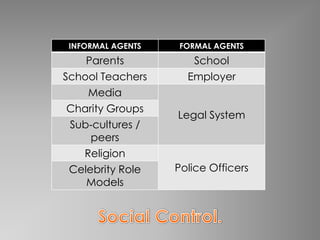
INFORMAL AGENTS   FORMAL AGENTS
    Parents           School
School Teachers      Employer
    Media
 Charity Groups
                   Legal System
 Sub-cultures /
     peers
   Religion
 Celebrity Role    Police Officers
    Models
Why Males Commit More Crime Than Females

  Different Socialisation Processes;
  Boys are more likely to be taught
 values associated with toughness
and aggression. Whereas girls adopt
qualities and expectations which see
        them abide by the law.
Why Males Commit More Crime Than Females

  Different Opportunities to Commit
 Crime; Generally teenage girls are
 subjected to restrictions and close
supervision and then in later life they
       are usually occupied with
maintaining the home and caring for
              the family.
Why Males Commit More Crime Than Females

 Social Control; Men may constrain
women into ‘home’ lives limiting their
   freedom due to the care of the
   family being imposed on them.
 The media creates expectations of
            women too.
Why Males Commit More Crime Than Females

  Chivalry Thesis; This is a common
  belief that the male-dominated
 police force and courts, are easier
 on women due to them not being
considered a threat. Whereas a man
  may be arrested, police may let
     women off with a warning.
Why Males Commit More Crime Than Females

    Inaccurate Statistics; Statistics
which show men commit more crime
        than women could be
  representative of the labelling of
 men as criminals and police going
    out to look for male offenders
      ignoring female criminals.
Reasons why some ethnic groups seem to commit
                 more crime

  Institutional Racism; Police officials
belonging to certain ethnic groups may
  set out to punish members of other
  ethnic groups whilst protecting their
                   own.
Reasons why some ethnic groups seem to commit
                 more crime

 Relative Deprivation; Foreign workers
are usually left with low paying manual
 jobs, thus meaning they may not be
 able to afford material goods and so
   obtain these desirables illegally.
Reasons why some ethnic groups seem to commit
                 more crime

 Labelling; If a police officer labels a
particular ethnic group as criminals he
 will go out and arrest more criminals
 belonging to that ethnic group, whilst
         ignoring other crimes.
Reasons why some ethnic groups seem to commit
                 more crime

   Racism; White police officers may
purposely prosecute or dig deeper into
crimes involving different ethnic groups
due to a racial hatred for such a group.
 This may also mean they ignore cases
  where a certain ethnic minority has
   fallen victim eg. Steven Lawrence.
Reasons why some ethnic groups seem to commit
                 more crime

   Racism; White police officers may
even frame Black or Asian criminals with
      crimes they did not commit.
Reasons why some ethnic groups seem to commit
                 more crime

 Media; Creates the moral panic and
 then promotes labelling in the force.
Reasons why some ethnic groups seem to commit
                 more crime

   Inaccuracy of Figures; The figures
  could just be a reflection of racism
            within the force.
Reasons why the poor commit more crime.

               Poor Socialisation
             Relative Deprivation
 Anomie; Society does not provide enough
    opportunities for people to succeed,
  therefore some turn their back on society
              and cause trouble
 Education; More likely to be in low sets, get
low paying job, struggle for money, so turn to
         illegal ways of obtaining it.
WHITE COLLAR CRIME

 White Colour Crime; Involves middle class
  people, who commit crimes during work
                   hours.
               4 Main Types:
           Occupational Crime
            Proffessional Crime
             Corporate Crime
             Computer Crime
WHITE COLLAR CRIME

 White Colour Crime is difficult to deal with
                      as;
     Judges Are Often From Similar Social
    Backgrounds To White Collar Criminals
 Compared to Burglary and Assault it is not
           dangerous to the public.
   There are usually no victims and no one
              person is impaired
 The media does not show WCC as serious

Sociology crime and deviance

  • 2.
    Crime is behaviourthat breaks the formal written laws of a society. If someone commits a crime they can be arrested, charged and prosecuted. Actions can be illegal but not deviant.
  • 3.
    Deviance is behaviourwhich does not comply with the dominant norms of a specific society. If people are seen as deviant it can lead to negative sanctions such as being told off or ridiculed.
  • 4.
    Gary, walked throughhis local library whilst talking loudly on his mobile phone. This is legally deviant as he is not breaking any law, he is just acting socially unacceptable.
  • 5.
    Robert, punched apregnant lady in the face. This is illegally deviant as he committed an assault, the fact that he punched a pregnant lady also makes the mater worse.
  • 6.
    Sam, illegally downloads thousands of songs for her mp3 player. Sam is a criminal as she is breaking the copyright act. She is not a deviant as what she is doing is not hurting anyone.
  • 7.
    VALUE; InArab culturefamily honour is dependant on female purity. CRIMINAL Social Code DEVIANT Public nudity Separation of sexes Taking photos of Sex outside marriage Modesty in dress women Homosexuality Marriage Talking to random Jobs for women at Showing thighs, women in the street home or in the care shoulders, cleavage Public displays of industry - Nurses, and midriff affection Teachers
  • 8.
     Official Statistics;a set of statistics generated from data gathered by the government or other official organisations. Often used as secondary data in social research.
  • 9.
    REASONS WHY NOTALL CRIMES ARE INCLUDED IN THE OFFICIAL CRIME STATISTICS  Detection; Is a crime detected? If a crime is observed and identified as a crime, the police may be informed. However, if the crime has not been detected it cannot be reported to the police neither can it be included in official statistics. This is the reason many crimes occur but go undetected.
  • 10.
    WHY DO NOTALL  Victim of crime is VICTIMS OF CRIME criminal themselves  Victim suffered no loss REPORT CRIME?  Victim does not  Blackmail consider crime worthy  Embarrassment  Victim feels crime is too  Fear personal  Lack of confidence in  Institutional crime may force be swept under carpet  Hassle due to fear of bad press.
  • 11.
    Victim Surveys  Surveysthe public asking them to report any crimes committed against them and whether or not they reported these crimes. Advantages Disadvantages May uncover hidden Not all crimes reported figure of crime Participants may lie Local geo-graphic data generated In some cases victims can not be questioned
  • 12.
    British Crime Survey A victim survey conducted annually by a team of researchers at the Home Office. The BCS measures the amount of crime in England and Wales by asking the public about their experiences with crime over the last year.
  • 13.
    Self Report Surveys  Self Report Surveys of the population which ask them to confess to crime they have committed but for which they were not caught. Advantages Disadvantages Participants may lie May uncover the hidden They can not do anything figure of crime about the crimes respondents were not caught for.
  • 14.
  • 15.
    Nature In 1876, Lombroso conducted research into large numbers of prisoners. He believed that criminals could be identified by visual traits as they were less evolved than ‘normal’ citizens. This theory is no longer accepted.  Hormones; Stress caused by menstruation can cause women to act irrationally, 80% of female offenders committed their crimes during the menstruation period.  Relationships;
  • 16.
    Nature  Hormones; Stresscaused by menstruation can cause women to act irrationally, 80% of female offenders committed their crimes during the menstruation period.
  • 17.
    Nature Relationships;Early childhood deprivation, lack of emotional security and secure attachment in childhood can lead to people developing criminal personalities as they crave affection and attention.
  • 18.
    Nurture: Sociological ExplanationsOf Crime Peer Groups & Subcultures; Some sociologists pin criminal activity on influences from other parties - mainly peers - known as peer pressure. Being in a group gives us a sense of belonging and acceptance, for some these feelings are so important, so much so that they risk breaking the law and being caught, just to remain in a certain social circle. As the members of the group feel that illegal activities are acceptable they are classified as a negative subculture.
  • 19.
    Nurture: Sociological ExplanationsOf Crime Socialisation; People who do not receive a decent level of socialisation during their childhood, do not know how to act appropriately in society as they can not comprehend the norms and values. This may lead to them braking laws / acting deviantly because they know no better.  Another way socialisation can affect whether people go on to commit crimes, is if a person is brought up with a criminal role model - meaning they developed criminal values.
  • 20.
    Nurture: Sociological ExplanationsOf Crime Socialisation; People who do not receive a decent level of socialisation during their childhood, do not know how to act appropriately in society as they can not comprehend the norms and values. This may lead to them braking laws / acting deviantly because they know no better.  Another way socialisation can affect whether people go on to commit crimes, is if a person is brought up with a criminal role model - meaning they developed criminal values.
  • 21.
    Nurture: Sociological ExplanationsOf Crime  Labelling; Labelling is giving someone in society a ‘tag’. Labelling someone a criminal / negatively can have serious consequences on their identity, if the label sticks and the person is viewed as a criminal by everyone then they may develop self-fulfilling prophecies and break the law as it’s all they think they can achieve.
  • 22.
    Nurture: Sociological ExplanationsOf Crime  Relative Deprivation; When a person is brought up amongst poverty and do not own luxuries such as a mobile phone or computer, they may act illegally to obtain such desirables.  This is a Marxist explanation of crime as it is caused by social inequality; the working class seeing the rich with personal possessions and wanting them but not being able to obtain them legitimately.
  • 23.
    Nurture: Sociological ExplanationsOf Crime  Relative Deprivation; When a person is brought up amongst poverty and do not own luxuries such as a mobile phone or computer, they may act illegally to obtain such desirables.  This is a Marxist explanation of crime as it is caused by social inequality; the working class seeing the rich with personal possessions and wanting them but not being able to obtain them legitimately.
  • 24.
    Nurture: Sociological ExplanationsOf Crime  Media; The media reports on crime in a selective way. Amplification of deviancy is when moral panic is created by the mass media, which then causes a frenzy of worry, and the police take drastic action to deal with it, starting the cycle all over again.
  • 25.
    INFORMAL AGENTS FORMAL AGENTS Parents School School Teachers Employer Media Charity Groups Legal System Sub-cultures / peers Religion Celebrity Role Police Officers Models
  • 26.
    Why Males CommitMore Crime Than Females  Different Socialisation Processes; Boys are more likely to be taught values associated with toughness and aggression. Whereas girls adopt qualities and expectations which see them abide by the law.
  • 27.
    Why Males CommitMore Crime Than Females  Different Opportunities to Commit Crime; Generally teenage girls are subjected to restrictions and close supervision and then in later life they are usually occupied with maintaining the home and caring for the family.
  • 28.
    Why Males CommitMore Crime Than Females  Social Control; Men may constrain women into ‘home’ lives limiting their freedom due to the care of the family being imposed on them.  The media creates expectations of women too.
  • 29.
    Why Males CommitMore Crime Than Females  Chivalry Thesis; This is a common belief that the male-dominated police force and courts, are easier on women due to them not being considered a threat. Whereas a man may be arrested, police may let women off with a warning.
  • 30.
    Why Males CommitMore Crime Than Females  Inaccurate Statistics; Statistics which show men commit more crime than women could be representative of the labelling of men as criminals and police going out to look for male offenders ignoring female criminals.
  • 31.
    Reasons why someethnic groups seem to commit more crime  Institutional Racism; Police officials belonging to certain ethnic groups may set out to punish members of other ethnic groups whilst protecting their own.
  • 32.
    Reasons why someethnic groups seem to commit more crime  Relative Deprivation; Foreign workers are usually left with low paying manual jobs, thus meaning they may not be able to afford material goods and so obtain these desirables illegally.
  • 33.
    Reasons why someethnic groups seem to commit more crime  Labelling; If a police officer labels a particular ethnic group as criminals he will go out and arrest more criminals belonging to that ethnic group, whilst ignoring other crimes.
  • 34.
    Reasons why someethnic groups seem to commit more crime  Racism; White police officers may purposely prosecute or dig deeper into crimes involving different ethnic groups due to a racial hatred for such a group. This may also mean they ignore cases where a certain ethnic minority has fallen victim eg. Steven Lawrence.
  • 35.
    Reasons why someethnic groups seem to commit more crime  Racism; White police officers may even frame Black or Asian criminals with crimes they did not commit.
  • 36.
    Reasons why someethnic groups seem to commit more crime  Media; Creates the moral panic and then promotes labelling in the force.
  • 37.
    Reasons why someethnic groups seem to commit more crime  Inaccuracy of Figures; The figures could just be a reflection of racism within the force.
  • 38.
    Reasons why thepoor commit more crime.  Poor Socialisation Relative Deprivation Anomie; Society does not provide enough opportunities for people to succeed, therefore some turn their back on society and cause trouble Education; More likely to be in low sets, get low paying job, struggle for money, so turn to illegal ways of obtaining it.
  • 39.
    WHITE COLLAR CRIME White Colour Crime; Involves middle class people, who commit crimes during work hours.  4 Main Types:  Occupational Crime  Proffessional Crime  Corporate Crime  Computer Crime
  • 40.
    WHITE COLLAR CRIME White Colour Crime is difficult to deal with as;  Judges Are Often From Similar Social Backgrounds To White Collar Criminals  Compared to Burglary and Assault it is not dangerous to the public.  There are usually no victims and no one person is impaired The media does not show WCC as serious