& DÉVIANCE
 The cultures that societies create are built out
of norms.
 These norms represent the values of the
group.
 When individuals and groups deviate from
norms, society responds.
 Deviance can range from chewing gum in the
wrong place to capital murder and beyond.
Crime is behaviour that breaks the
formal written laws of a society. If
someone commits a crime they can
be arrested, charged and
prosecuted. Actions can be illegal
but not deviant.
Deviance is behaviour which does
not comply with the dominant
norms of a specific society. If
people are seen as deviant it can
lead to negative sanctions such
as being told off or ridiculed.
Gary, walked through his
local library whilst talking
loudly on his mobile phone.
This is legally deviant as he
is not breaking any law, he is
just acting socially
unacceptable.
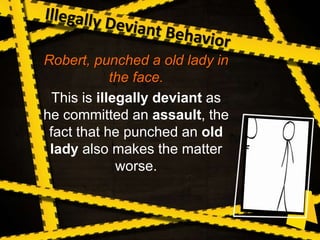
Robert, punched a old lady in
the face.
This is illegally deviant as
he committed an assault, the
fact that he punched an old
lady also makes the matter
worse.
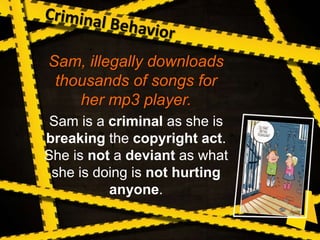
Sam, illegally downloads
thousands of songs for
her mp3 player.
Sam is a criminal as she is
breaking the copyright act.
She is not a deviant as what
she is doing is not hurting
anyone.
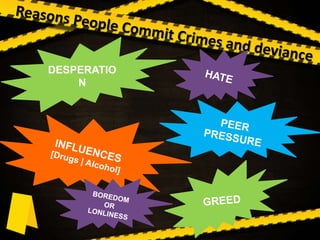
DESPERATIO
N
 Not all deviance is crime,
and not all crime is deviant.
 Deviance is in the “eye of
the beholder.”
• Deviance occurs, not only at the individual
level, but also among groups.
• Corporations, governments, organizations,
and social groups can all take part in
deviance.
• There are deviant subcultures, ranging from
the homeless to religious cults to punks.
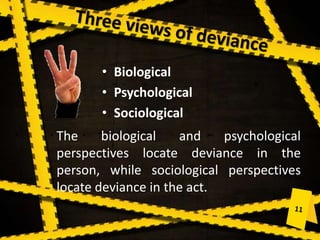
• Biological
• Psychological
• Sociological
The biological and psychological
perspectives locate deviance in the
person, while sociological perspectives
locate deviance in the act.
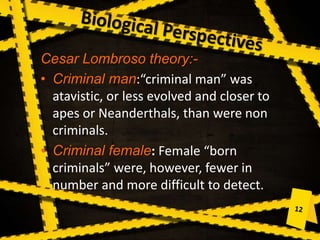
Cesar Lombroso theory:-
• Criminal man:“criminal man” was
atavistic, or less evolved and closer to
apes or Neanderthals, than were non
criminals.
• Criminal female: Female “born
criminals” were, however, fewer in
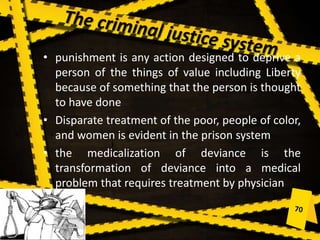
number and more difficult to detect.
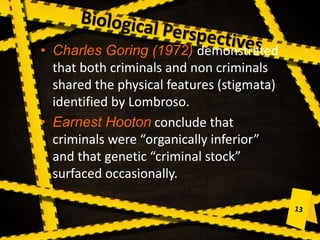
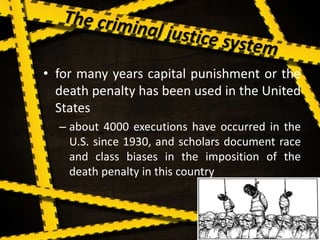
• Charles Goring (1972) demonstrated
that both criminals and non criminals
shared the physical features (stigmata)
identified by Lombroso.
• Earnest Hooton conclude that
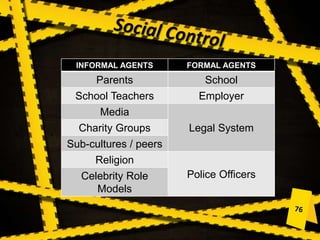
criminals were “organically inferior”
and that genetic “criminal stock”
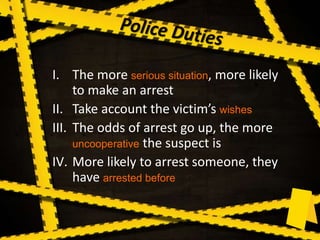
surfaced occasionally.
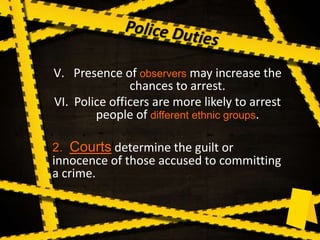
• William Sheldon
concluded that muscular bodies
(which he associated with aggression)
indicated a criminal type.
• Psychophysiology
The science that deals with the
interplay between psychological and
physiological processes.
–Functionalist
–Reinforcement
–Conflict
–Symbolic integrationists
–Chicago School
Durkheim Influence:
-Moral boundaries
• a shared sense of acceptable behavior that
establishes right and wrong as well as
sanctions for behaviors that fall outside
permissible bounds
Social Bonds
Durkheim argued that social bonds were stronger
in preindustrial societies than in industrial societies
Anomie
Uncomfortable and unfamiliar state of normalessness
that results when shared norms or guidelines break down.
structural-strain theory
Anomie results from inconsistencies between the culturally
approved means to achieve goals and those actual goals.
Innovation
People accept culturally approved goals
Rejection
Rejection of the culturally approved goals
Ritualism
It occurs when someone is unsuccessful at achieving the goals
Retreatism
It occurs when both culturally approved goals and means are
rejected.
Opportunity Structures
Richard Cloward and Lloyd Ohlin explained deviance as :
to achieve legitimate goals, a person also has to have access to
illegitimate opportunities.
Albert Cohen theory
Blocked opportunities lead to subcultures that value other
attributes (e.g., stealing rather than buying).
Social-control theories
This theory ask not why people deviate, but rather why they
conform.
• Deviance is seen as learned, even normalized,
behavior.
• We act based on perceived rewards and costs,
which may be economic, social, and so on.
• Differential association is one of the better
known reinforcement theories.
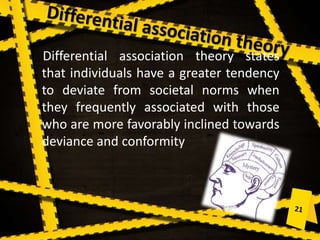
Differential association theory states
that individuals have a greater tendency
to deviate from societal norms when
they frequently associated with those
who are more favorably inclined towards
deviance and conformity
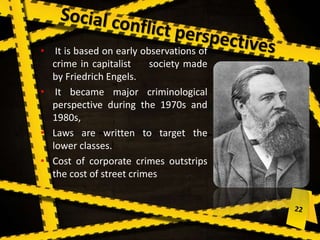
• It is based on early observations of
crime in capitalist society made
by Friedrich Engels.
• It became major criminological
perspective during the 1970s and
1980s,
• Laws are written to target the
lower classes.
• Cost of corporate crimes outstrips
the cost of street crimes
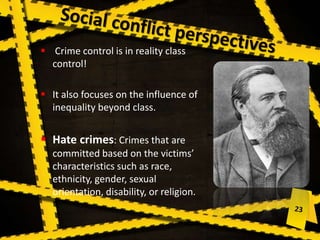
 Crime control is in reality class
control!
 It also focuses on the influence of
inequality beyond class.
 Hate crimes: Crimes that are
committed based on the victims’
characteristics such as race,
ethnicity, gender, sexual
orientation, disability, or religion.
• It contains three theories:
Labeling theory
Medicalization of deviance
Cultural transmission theory
• These theories focus on our definitions of
situations and the argument that our self-
concepts are based on other’s
perceptions.
It is the response of others that defines (labels) the
behavior as deviant and impacts further deviance.
Primary deviance: It is violations of social norms
that go undiscovered or are considered excusable by
others.
Secondary deviance: Deviance committed as a
result of the reactions of others to previous deviant
behavior.
Self-fulfilling prophecy: The person develops a
self-concept based on the label and acts based upon
that self-concept.
An art student told that she
had excellent talent
An art student told that she
had no talent
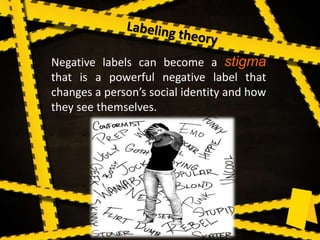
Negative labels can become a stigma
that is a powerful negative label that
changes a person’s social identity and how
they see themselves.
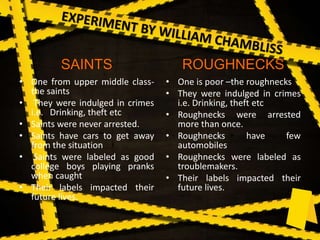
• One from upper middle class-
the saints
• They were indulged in crimes
i.e. Drinking, theft etc
• Saints were never arrested.
• Saints have cars to get away
from the situation
• Saints were labeled as good
college boys playing pranks
when caught
• Their labels impacted their
future lives.
• One is poor –the roughnecks
• They were indulged in crimes
i.e. Drinking, theft etc
• Roughnecks were arrested
more than once.
• Roughnecks have few
automobiles
• Roughnecks were labeled as
troublemakers.
• Their labels impacted their
future lives.
SAINTS ROUGHNECKS
 This means that, issues that were
formerly defined in moral or legal
terms have become redefined as medical
issues.
 Mental illness is a highly debated and
highly stigmatized disorder .
 Social psychologist D. L. Rosenhan
demonstrated how powerfully these
labels of mental illness stick.
 He sent eight volunteer pseudo patients to a
mental hospital
 Each complained only of hearing voices that
mentioned the emptiness of life
 Each pseudo-student was diagnosed as
schizophrenia
 No staff ever recognized any of these pseudo
patients as frauds.
 Other patients, however, did suspect them of
being “not crazy”
 When cured they were labeled as schizophrenia
“in remission”
• Says that deviance is learned and shared
through interaction with others.
• A widely tested theory drawing from this
perspective is the theory of differential
association.
• It says that deviance results from interacting
with deviant associates.
• Critics of differential association note that
children having weak bonds to their parents
are those most likely to engage in deviance .
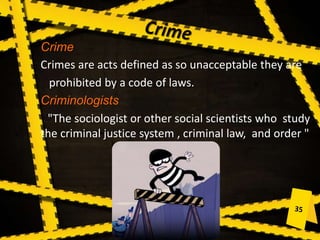
Crime
Crimes are acts defined as so unacceptable they are
prohibited by a code of laws.
Criminologists
"The sociologist or other social scientists who study
the criminal justice system , criminal law, and order "
crimes are divided into felonies and misdemeanors
based on a seriousness of the crime
sociologists categorize crimes based on how they are
committed and how society views the offense
conventional or street crime is all violent crime.
Following are types of crime:
Occupational or white collar crime
Corporate crime
Organized crime
Political crime
Occupational or white-collar
"These crimes are illegal activities committed by
people in the course of their employment or
financial affairs“
White collar crimes generally generates less
concern in the public mind than other types of
crime.
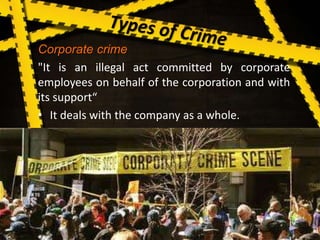
Corporate crime
"It is an illegal act committed by corporate
employees on behalf of the corporation and with
its support“
• It deals with the company as a whole.
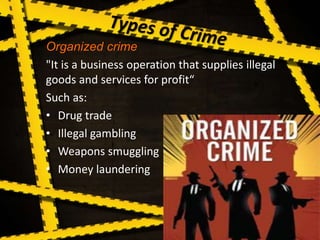
Organized crime
"It is a business operation that supplies illegal
goods and services for profit“
Such as:
• Drug trade
• Illegal gambling
• Weapons smuggling
• Money laundering
Political crime
"It refers to illegal or unethical acts involving
the usurpation of power by government officials“
• illegal unethical acts perpetrated against the
government by outsiders seeking to make a
political statement.
• UCR—Uniform Crime Reports
• NCVS—National Crime Victimization
Survey
Uniform Crime Report:
The Uniform Crime Reports
(UCR), as its name suggests, is a record of all
officially reported criminal activity. It does not
represent prosecutions, but rather represents
actual crime reported to law enforcement.
Additionally, the UCR focuses on serious, often
violent, crime.
National Crime Victimization Survey (NCVS)
This survey compiles data based on self-
report by victims, as collected by workers from
the Bureau of the Census. As estimates of
unreported crime go as high as 50 percent, it
seems especially critical to include unreported
crime to some degree.
Official Statistics
A set of statistics generated from data
gathered by the government or other official
organizations. Often used as secondary data
in social research.
If a crime is observed and identified as a
crime, the police may be informed.
However, if the crime has not been detected
it cannot be reported to the police neither
can it be included in official statistics. This is
the reason many crimes occur but go
undetected
Reasons why not all crimes are included in the official crime
statistics:
• Victim of crime is a criminal themselves
• Victim feels crime is too personal.
• Institutional crime may be swept under carpet.
• Due to fear of bad press.
• Lack of confidence.
• Blackmailing.
• Embarrassment.
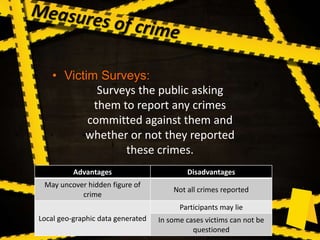
• Victim Surveys:
Surveys the public asking
them to report any crimes
committed against them and
whether or not they reported
these crimes.
Advantages Disadvantages
May uncover hidden figure of
crime
Not all crimes reported
Local geo-graphic data generated
Participants may lie
In some cases victims can not be
questioned
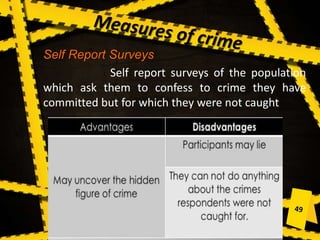
Self Report Surveys
Self report surveys of the population
which ask them to confess to crime they have
committed but for which they were not caught
 More crimes appear to be committed
by males
• Females more likely to be involved in
property offences or shoplifting
• Males involve in violence and sexual
offences
Why Males Commit More Crimes Than Females
Men have more social pressure to provide for a
family, and less social support when they need
it...which is why men represent between 70%
and 90% of the homeless, and men also
successfully commit suicide between 3 and 4
times more often than women.

Why Males Commit More Crimes Than Females
Different Socialisation Processes:
socialisation play its part encouraging males from
a young age to take risks, to be tough and
aggressive. Whereas girls adopt qualities and
expectations which see them abide by the law.
Why Males Commit More Crimes Than
Females
 Social Control: Men may constrain
women into ‘home’ lives limiting their
freedom due to the care of the family
being imposed on them.
 The media creates expectations of
women too.
Why Males Commit More Crimes Than Females
 Chivalry thesis: it means treating others
especially women with courtesy, sympathy and
respect. It states that women are treated more
leniently than men by criminal justice system. A
man may be arrested, police may let women off
with a warning.
Why Males Commit More Crimes Than Females
• Chivalry thesis:It is also a fact that men on
average receive much longer and harsher
sentences for the exact same crimes as women
do. In many cases a woman gets a slap on the
wrist for committing a crime while a man will
get jail time for it. Our society is effete up and
the justice system shows a lot of favoritism
toward females.
Why Males Commit More Crimes Than Females
• Inaccurate Statistics: Statistics which show
men commit more crime than women could be
representative of the labelling of men as
criminals and police going out to look for male
offenders ignoring female criminals.
• Arrest rates for crimes are highest for people
between the ages of 13 and 25, with the most
between 16 and 17.
• Rates of arrest are higher for males than
females at every age and for nearly all offences.
• An ethnic group or ethnicity is a socially-defined
category of people who identify with each
other based on common ancestral, social,
cultural or national experience.
Example:
many American citizens share certain cultural
characteristics, such as celebrating Thanksgiving
and valuing democracy, despite varying racial
origins
Institutional racism
“is a pattern of social institutions — such as
governmental organizations, schools, banks,
and courts of law — giving negative
treatment to a group of people based on
their race”
• One example of institutional racism is
the barring of African-American
students from attending certain public
schools, which limited the students'
educational opportunities and helped
prevent them from achieving a status
equal to that of others
Reasons why some ethnic groups seem to commit
more crime
Institutional Racism; Police officials belonging to
certain ethnic groups may set out to punish
members of other ethnic groups whilst protecting
their own.
Reasons why some ethnic groups seem to commit
more crime
Relative Deprivation; Foreign workers are usually
left with low paying manual jobs, thus meaning
they may not be able to afford material goods and
so obtain these desirables illegally.
Reasons why some ethnic groups seem to commit
more crime
Labelling; If a police officer labels a particular
ethnic group as criminals he will go out and
arrest more criminals belonging to that ethnic
group, whilst ignoring other crimes.
Reasons why some ethnic groups seem to commit
more crime
 Racism; White police officers may purposely prosecute or
dig deeper into crimes involving different ethnic groups
due to a racial hatred for such a group. This may also mean
they ignore cases where a certain ethnic minority has fallen
victim .
 Racism; White police officers may even frame Black or
Asian criminals with crimes they did not commit.
Reasons why the poor commit more crime.
 Poor Socialisation
 Relative Deprivation
 Anomie; Society does not provide enough
opportunities for people to succeed, therefore
some turn their back on society and cause
trouble
 Education; More likely to be in low sets, get low
paying job, struggle for money, so turn to illegal
ways of obtaining it.
Reasons why the poor commit more crime.
 Poor Socialisation
 Relative Deprivation
 Anomie; Society does not provide enough
opportunities for people to succeed, therefore
some turn their back on society and cause
trouble
 Education; More likely to be in low sets, get low
paying job, struggle for money, so turn to illegal
ways of obtaining it.
 White Colour Crime; Involves middle class people,
who commit crimes during work hours.
 4 Main Types:
 Occupational Crime
 Professional Crime
 Corporate Crime
 Computer Crime
WHITE COLLAR CRIME
• White Colour Crime is difficult to deal with as;
• Judges Are Often From Similar Social
Backgrounds To White Collar Criminals
• Compared to Burglary and Assault it is not
dangerous to the public.
• There are usually no victims and no one person
is impaired
• The media does not show WCC as serious
• the criminal justice system includes the police,
the courts, and prisons
• the system is a collection of bureaucracies
– The system possesses considerable discretion
• the use of personal judgment regarding whether to take
action on a situation and so what kind of action to take
• the police are responsible for crime control and
maintenance of order
• the courts determine the guilt or innocence of
those accused to committing a crime
• punishment is any action designed to deprive a
person of the things of value including Liberty
because of something that the person is thought
to have done
• Disparate treatment of the poor, people of color,
and women is evident in the prison system
• the medicalization of deviance is the
transformation of deviance into a medical
problem that requires treatment by physician
• for many years capital punishment or the
death penalty has been used in the United
States
– about 4000 executions have occurred in the
U.S. since 1930, and scholars document race
and class biases in the imposition of the
death penalty in this country
• Although many people in the United States
agree that crime is one of the most important
problems facing the country, they are divided
about what to do about it
• the best approach for reducing delinquency and
crime is prevention
– work with people before they become juvenile
offenders so as to help them establish family
relationships, of self-esteem, choose a career, and
get an education which will help them pursue the
Career
• as long as racism, sexism, the class system, and
ageism exist in our society people will see
deviant and criminal behavior through selective
lenses
• global crime
– networking of powerful criminal organizations and
their associates and shared activities around the
world is relatively new phenomenon
• networking and strategic alliances between
criminal networks have been key factors in
successive criminal organizations that have
sought to expand the criminal activities over the
past two decades
• recent studies have concluded that reducing
global crime will require a global response
including the cooperation of law-enforcement
agencies prosecutors and intelligence services
across geopolitical boundaries.
INFORMAL AGENTS FORMAL AGENTS
Parents School
School Teachers Employer
Media
Legal SystemCharity Groups
Sub-cultures / peers
Religion
Police OfficersCelebrity Role
Models
The system is a collection of bureaucracies
– The system possesses considerable discretion
• the use of personal judgment regarding whether to take
action on a situation and so what kind of action to take
• The criminal justice system includes the police,
the courts, and system of punishment.
1. Police is responsible for crime control and
maintenance of order
I. The more serious situation, more likely
to make an arrest
II. Take account the victim’s wishes
III. The odds of arrest go up, the more
uncooperative the suspect is
IV. More likely to arrest someone, they
have arrested before
V. Presence of observers may increase the
chances to arrest.
VI. Police officers are more likely to arrest
people of different ethnic groups.
2. Courts determine the guilt or
innocence of those accused to committing
a crime.
Guilty plea is a legal negotiation in which a prosecutor reduces a
charge in exchange for a defendant’s guilty appeal.
3. Punishment is any action designed to
deprive a person of the things of value
including Liberty because of something that the
person is thought to have done.
There are four justifications of
punishments given as:
• Retribution.
• Deterrence.
• Rehabilitation.
• Societal protection.
• An act of moral vengeance by which
society makes the offender suffer as
much as the suffering caused by the
crime.
• It is the oldest justification to satisfy
people’s need for Retribution.
• Deterrence is the attempt to
discourage criminality through the use
of punishment.
– Specific deterrence is used to convince an
individual offender that crime doesn’t pay
– General Deterrence says that the
punishment of one person serves as an
example to others.
• A program for reforming the offender
to prevent later offenses.
• It is the third justification of
punishment and it arose in nineteenth
century.
• Societal protection is rendering an
offender incapable of further
offenses temporarily through
imprisonment or permanently by
execution.
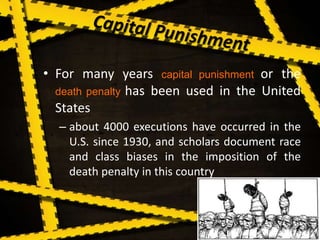
• For many years capital punishment or the
death penalty has been used in the United
States
– about 4000 executions have occurred in the
U.S. since 1930, and scholars document race
and class biases in the imposition of the
death penalty in this country
• Although many people in the world agree that
crime is one of the most important problems
facing the country, they are divided about what
to do about it, the best approach for reducing
delinquency and crime is prevention
– work with people before they become juvenile
offenders so as to help them establish family
relationships, of self-esteem, choose a career, and
get an education which will help them pursue the
Career
• As long as racism, sexism, the class system, and
ageism exist in our society people will see
deviant and criminal behavior through selective
lenses
• Social control refers generally to
societal and political mechanisms or
processes that regulate individual
and group behavior in an attempt to
gain conformity and compliance to
the rules of a given society, state,
or social group.

Crime and Deviance

  • 1.
  • 2.
     The culturesthat societies create are built out of norms.  These norms represent the values of the group.  When individuals and groups deviate from norms, society responds.  Deviance can range from chewing gum in the wrong place to capital murder and beyond.
  • 3.
    Crime is behaviourthat breaks the formal written laws of a society. If someone commits a crime they can be arrested, charged and prosecuted. Actions can be illegal but not deviant.
  • 4.
    Deviance is behaviourwhich does not comply with the dominant norms of a specific society. If people are seen as deviant it can lead to negative sanctions such as being told off or ridiculed.
  • 5.
    Gary, walked throughhis local library whilst talking loudly on his mobile phone. This is legally deviant as he is not breaking any law, he is just acting socially unacceptable.
  • 6.
    Robert, punched aold lady in the face. This is illegally deviant as he committed an assault, the fact that he punched an old lady also makes the matter worse.
  • 7.
    Sam, illegally downloads thousandsof songs for her mp3 player. Sam is a criminal as she is breaking the copyright act. She is not a deviant as what she is doing is not hurting anyone.
  • 8.
  • 9.
     Not alldeviance is crime, and not all crime is deviant.  Deviance is in the “eye of the beholder.”
  • 10.
    • Deviance occurs,not only at the individual level, but also among groups. • Corporations, governments, organizations, and social groups can all take part in deviance. • There are deviant subcultures, ranging from the homeless to religious cults to punks.
  • 11.
    • Biological • Psychological •Sociological The biological and psychological perspectives locate deviance in the person, while sociological perspectives locate deviance in the act.
  • 12.
    Cesar Lombroso theory:- •Criminal man:“criminal man” was atavistic, or less evolved and closer to apes or Neanderthals, than were non criminals. • Criminal female: Female “born criminals” were, however, fewer in number and more difficult to detect.
  • 13.
    • Charles Goring(1972) demonstrated that both criminals and non criminals shared the physical features (stigmata) identified by Lombroso. • Earnest Hooton conclude that criminals were “organically inferior” and that genetic “criminal stock” surfaced occasionally.
  • 14.
    • William Sheldon concludedthat muscular bodies (which he associated with aggression) indicated a criminal type. • Psychophysiology The science that deals with the interplay between psychological and physiological processes.
  • 15.
  • 16.
    Durkheim Influence: -Moral boundaries •a shared sense of acceptable behavior that establishes right and wrong as well as sanctions for behaviors that fall outside permissible bounds
  • 17.
    Social Bonds Durkheim arguedthat social bonds were stronger in preindustrial societies than in industrial societies Anomie Uncomfortable and unfamiliar state of normalessness that results when shared norms or guidelines break down. structural-strain theory Anomie results from inconsistencies between the culturally approved means to achieve goals and those actual goals.
  • 18.
    Innovation People accept culturallyapproved goals Rejection Rejection of the culturally approved goals Ritualism It occurs when someone is unsuccessful at achieving the goals Retreatism It occurs when both culturally approved goals and means are rejected.
  • 19.
    Opportunity Structures Richard Clowardand Lloyd Ohlin explained deviance as : to achieve legitimate goals, a person also has to have access to illegitimate opportunities. Albert Cohen theory Blocked opportunities lead to subcultures that value other attributes (e.g., stealing rather than buying). Social-control theories This theory ask not why people deviate, but rather why they conform.
  • 20.
    • Deviance isseen as learned, even normalized, behavior. • We act based on perceived rewards and costs, which may be economic, social, and so on. • Differential association is one of the better known reinforcement theories.
  • 21.
    Differential association theorystates that individuals have a greater tendency to deviate from societal norms when they frequently associated with those who are more favorably inclined towards deviance and conformity
  • 22.
    • It isbased on early observations of crime in capitalist society made by Friedrich Engels. • It became major criminological perspective during the 1970s and 1980s, • Laws are written to target the lower classes. • Cost of corporate crimes outstrips the cost of street crimes
  • 23.
     Crime controlis in reality class control!  It also focuses on the influence of inequality beyond class.  Hate crimes: Crimes that are committed based on the victims’ characteristics such as race, ethnicity, gender, sexual orientation, disability, or religion.
  • 24.
    • It containsthree theories: Labeling theory Medicalization of deviance Cultural transmission theory • These theories focus on our definitions of situations and the argument that our self- concepts are based on other’s perceptions.
  • 25.
    It is theresponse of others that defines (labels) the behavior as deviant and impacts further deviance. Primary deviance: It is violations of social norms that go undiscovered or are considered excusable by others. Secondary deviance: Deviance committed as a result of the reactions of others to previous deviant behavior. Self-fulfilling prophecy: The person develops a self-concept based on the label and acts based upon that self-concept.
  • 26.
    An art studenttold that she had excellent talent An art student told that she had no talent
  • 27.
    Negative labels canbecome a stigma that is a powerful negative label that changes a person’s social identity and how they see themselves.
  • 29.
    • One fromupper middle class- the saints • They were indulged in crimes i.e. Drinking, theft etc • Saints were never arrested. • Saints have cars to get away from the situation • Saints were labeled as good college boys playing pranks when caught • Their labels impacted their future lives. • One is poor –the roughnecks • They were indulged in crimes i.e. Drinking, theft etc • Roughnecks were arrested more than once. • Roughnecks have few automobiles • Roughnecks were labeled as troublemakers. • Their labels impacted their future lives. SAINTS ROUGHNECKS
  • 30.
     This meansthat, issues that were formerly defined in moral or legal terms have become redefined as medical issues.  Mental illness is a highly debated and highly stigmatized disorder .  Social psychologist D. L. Rosenhan demonstrated how powerfully these labels of mental illness stick.
  • 31.
     He senteight volunteer pseudo patients to a mental hospital  Each complained only of hearing voices that mentioned the emptiness of life  Each pseudo-student was diagnosed as schizophrenia  No staff ever recognized any of these pseudo patients as frauds.  Other patients, however, did suspect them of being “not crazy”  When cured they were labeled as schizophrenia “in remission”
  • 32.
    • Says thatdeviance is learned and shared through interaction with others. • A widely tested theory drawing from this perspective is the theory of differential association.
  • 33.
    • It saysthat deviance results from interacting with deviant associates. • Critics of differential association note that children having weak bonds to their parents are those most likely to engage in deviance .
  • 35.
    Crime Crimes are actsdefined as so unacceptable they are prohibited by a code of laws. Criminologists "The sociologist or other social scientists who study the criminal justice system , criminal law, and order "
  • 36.
    crimes are dividedinto felonies and misdemeanors based on a seriousness of the crime sociologists categorize crimes based on how they are committed and how society views the offense conventional or street crime is all violent crime.
  • 37.
    Following are typesof crime: Occupational or white collar crime Corporate crime Organized crime Political crime
  • 38.
    Occupational or white-collar "Thesecrimes are illegal activities committed by people in the course of their employment or financial affairs“ White collar crimes generally generates less concern in the public mind than other types of crime.
  • 39.
    Corporate crime "It isan illegal act committed by corporate employees on behalf of the corporation and with its support“ • It deals with the company as a whole.
  • 40.
    Organized crime "It isa business operation that supplies illegal goods and services for profit“ Such as: • Drug trade • Illegal gambling • Weapons smuggling • Money laundering
  • 41.
    Political crime "It refersto illegal or unethical acts involving the usurpation of power by government officials“ • illegal unethical acts perpetrated against the government by outsiders seeking to make a political statement.
  • 42.
    • UCR—Uniform CrimeReports • NCVS—National Crime Victimization Survey
  • 43.
    Uniform Crime Report: TheUniform Crime Reports (UCR), as its name suggests, is a record of all officially reported criminal activity. It does not represent prosecutions, but rather represents actual crime reported to law enforcement. Additionally, the UCR focuses on serious, often violent, crime.
  • 44.
    National Crime VictimizationSurvey (NCVS) This survey compiles data based on self- report by victims, as collected by workers from the Bureau of the Census. As estimates of unreported crime go as high as 50 percent, it seems especially critical to include unreported crime to some degree.
  • 45.
    Official Statistics A setof statistics generated from data gathered by the government or other official organizations. Often used as secondary data in social research.
  • 46.
    If a crimeis observed and identified as a crime, the police may be informed. However, if the crime has not been detected it cannot be reported to the police neither can it be included in official statistics. This is the reason many crimes occur but go undetected
  • 47.
    Reasons why notall crimes are included in the official crime statistics: • Victim of crime is a criminal themselves • Victim feels crime is too personal. • Institutional crime may be swept under carpet. • Due to fear of bad press. • Lack of confidence. • Blackmailing. • Embarrassment.
  • 48.
    • Victim Surveys: Surveysthe public asking them to report any crimes committed against them and whether or not they reported these crimes. Advantages Disadvantages May uncover hidden figure of crime Not all crimes reported Local geo-graphic data generated Participants may lie In some cases victims can not be questioned
  • 49.
    Self Report Surveys Selfreport surveys of the population which ask them to confess to crime they have committed but for which they were not caught
  • 50.
     More crimesappear to be committed by males • Females more likely to be involved in property offences or shoplifting • Males involve in violence and sexual offences
  • 51.
    Why Males CommitMore Crimes Than Females Men have more social pressure to provide for a family, and less social support when they need it...which is why men represent between 70% and 90% of the homeless, and men also successfully commit suicide between 3 and 4 times more often than women.
  • 52.
    Why Males CommitMore Crimes Than Females Different Socialisation Processes: socialisation play its part encouraging males from a young age to take risks, to be tough and aggressive. Whereas girls adopt qualities and expectations which see them abide by the law.
  • 53.
    Why Males CommitMore Crimes Than Females  Social Control: Men may constrain women into ‘home’ lives limiting their freedom due to the care of the family being imposed on them.  The media creates expectations of women too.

  • 54.
    Why Males CommitMore Crimes Than Females  Chivalry thesis: it means treating others especially women with courtesy, sympathy and respect. It states that women are treated more leniently than men by criminal justice system. A man may be arrested, police may let women off with a warning.
  • 55.
    Why Males CommitMore Crimes Than Females • Chivalry thesis:It is also a fact that men on average receive much longer and harsher sentences for the exact same crimes as women do. In many cases a woman gets a slap on the wrist for committing a crime while a man will get jail time for it. Our society is effete up and the justice system shows a lot of favoritism toward females.
  • 56.
    Why Males CommitMore Crimes Than Females • Inaccurate Statistics: Statistics which show men commit more crime than women could be representative of the labelling of men as criminals and police going out to look for male offenders ignoring female criminals.
  • 57.
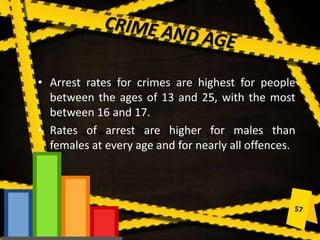
    • Arrest ratesfor crimes are highest for people between the ages of 13 and 25, with the most between 16 and 17. • Rates of arrest are higher for males than females at every age and for nearly all offences.
  • 58.
    • An ethnicgroup or ethnicity is a socially-defined category of people who identify with each other based on common ancestral, social, cultural or national experience. Example: many American citizens share certain cultural characteristics, such as celebrating Thanksgiving and valuing democracy, despite varying racial origins
  • 59.
    Institutional racism “is apattern of social institutions — such as governmental organizations, schools, banks, and courts of law — giving negative treatment to a group of people based on their race”
  • 60.
    • One exampleof institutional racism is the barring of African-American students from attending certain public schools, which limited the students' educational opportunities and helped prevent them from achieving a status equal to that of others
  • 61.
    Reasons why someethnic groups seem to commit more crime Institutional Racism; Police officials belonging to certain ethnic groups may set out to punish members of other ethnic groups whilst protecting their own.
  • 62.
    Reasons why someethnic groups seem to commit more crime Relative Deprivation; Foreign workers are usually left with low paying manual jobs, thus meaning they may not be able to afford material goods and so obtain these desirables illegally.
  • 63.
    Reasons why someethnic groups seem to commit more crime Labelling; If a police officer labels a particular ethnic group as criminals he will go out and arrest more criminals belonging to that ethnic group, whilst ignoring other crimes.
  • 64.
    Reasons why someethnic groups seem to commit more crime  Racism; White police officers may purposely prosecute or dig deeper into crimes involving different ethnic groups due to a racial hatred for such a group. This may also mean they ignore cases where a certain ethnic minority has fallen victim .  Racism; White police officers may even frame Black or Asian criminals with crimes they did not commit.
  • 65.
    Reasons why thepoor commit more crime.  Poor Socialisation  Relative Deprivation  Anomie; Society does not provide enough opportunities for people to succeed, therefore some turn their back on society and cause trouble  Education; More likely to be in low sets, get low paying job, struggle for money, so turn to illegal ways of obtaining it.
  • 66.
    Reasons why thepoor commit more crime.  Poor Socialisation  Relative Deprivation  Anomie; Society does not provide enough opportunities for people to succeed, therefore some turn their back on society and cause trouble  Education; More likely to be in low sets, get low paying job, struggle for money, so turn to illegal ways of obtaining it.
  • 67.
     White ColourCrime; Involves middle class people, who commit crimes during work hours.  4 Main Types:  Occupational Crime  Professional Crime  Corporate Crime  Computer Crime
  • 68.
    WHITE COLLAR CRIME •White Colour Crime is difficult to deal with as; • Judges Are Often From Similar Social Backgrounds To White Collar Criminals • Compared to Burglary and Assault it is not dangerous to the public. • There are usually no victims and no one person is impaired • The media does not show WCC as serious
  • 69.
    • the criminaljustice system includes the police, the courts, and prisons • the system is a collection of bureaucracies – The system possesses considerable discretion • the use of personal judgment regarding whether to take action on a situation and so what kind of action to take • the police are responsible for crime control and maintenance of order • the courts determine the guilt or innocence of those accused to committing a crime
  • 70.
    • punishment isany action designed to deprive a person of the things of value including Liberty because of something that the person is thought to have done • Disparate treatment of the poor, people of color, and women is evident in the prison system • the medicalization of deviance is the transformation of deviance into a medical problem that requires treatment by physician
  • 71.
    • for manyyears capital punishment or the death penalty has been used in the United States – about 4000 executions have occurred in the U.S. since 1930, and scholars document race and class biases in the imposition of the death penalty in this country
  • 72.
    • Although manypeople in the United States agree that crime is one of the most important problems facing the country, they are divided about what to do about it • the best approach for reducing delinquency and crime is prevention – work with people before they become juvenile offenders so as to help them establish family relationships, of self-esteem, choose a career, and get an education which will help them pursue the Career
  • 73.
    • as longas racism, sexism, the class system, and ageism exist in our society people will see deviant and criminal behavior through selective lenses
  • 74.
    • global crime –networking of powerful criminal organizations and their associates and shared activities around the world is relatively new phenomenon • networking and strategic alliances between criminal networks have been key factors in successive criminal organizations that have sought to expand the criminal activities over the past two decades
  • 75.
    • recent studieshave concluded that reducing global crime will require a global response including the cooperation of law-enforcement agencies prosecutors and intelligence services across geopolitical boundaries.
  • 76.
    INFORMAL AGENTS FORMALAGENTS Parents School School Teachers Employer Media Legal SystemCharity Groups Sub-cultures / peers Religion Police OfficersCelebrity Role Models
  • 77.
    The system isa collection of bureaucracies – The system possesses considerable discretion • the use of personal judgment regarding whether to take action on a situation and so what kind of action to take • The criminal justice system includes the police, the courts, and system of punishment. 1. Police is responsible for crime control and maintenance of order
  • 78.
    I. The moreserious situation, more likely to make an arrest II. Take account the victim’s wishes III. The odds of arrest go up, the more uncooperative the suspect is IV. More likely to arrest someone, they have arrested before
  • 79.
    V. Presence ofobservers may increase the chances to arrest. VI. Police officers are more likely to arrest people of different ethnic groups. 2. Courts determine the guilt or innocence of those accused to committing a crime.
  • 80.
    Guilty plea isa legal negotiation in which a prosecutor reduces a charge in exchange for a defendant’s guilty appeal. 3. Punishment is any action designed to deprive a person of the things of value including Liberty because of something that the person is thought to have done.
  • 81.
    There are fourjustifications of punishments given as: • Retribution. • Deterrence. • Rehabilitation. • Societal protection.
  • 82.
    • An actof moral vengeance by which society makes the offender suffer as much as the suffering caused by the crime. • It is the oldest justification to satisfy people’s need for Retribution.
  • 83.
    • Deterrence isthe attempt to discourage criminality through the use of punishment. – Specific deterrence is used to convince an individual offender that crime doesn’t pay – General Deterrence says that the punishment of one person serves as an example to others.
  • 84.
    • A programfor reforming the offender to prevent later offenses. • It is the third justification of punishment and it arose in nineteenth century.
  • 85.
    • Societal protectionis rendering an offender incapable of further offenses temporarily through imprisonment or permanently by execution.
  • 86.
    • For manyyears capital punishment or the death penalty has been used in the United States – about 4000 executions have occurred in the U.S. since 1930, and scholars document race and class biases in the imposition of the death penalty in this country
  • 87.
    • Although manypeople in the world agree that crime is one of the most important problems facing the country, they are divided about what to do about it, the best approach for reducing delinquency and crime is prevention – work with people before they become juvenile offenders so as to help them establish family relationships, of self-esteem, choose a career, and get an education which will help them pursue the Career
  • 88.
    • As longas racism, sexism, the class system, and ageism exist in our society people will see deviant and criminal behavior through selective lenses
  • 89.
    • Social controlrefers generally to societal and political mechanisms or processes that regulate individual and group behavior in an attempt to gain conformity and compliance to the rules of a given society, state, or social group.