Social Control Theory
By: Robert Platos
Definition
• The Social Control theory explains how social
factors such as religion, economics, family and
education relate to the choices and actions of
an individual.
Travis Hirschi
• Author of the Social Bond Theory
• Hirschi was born in 1935 and graduated from
University of Arizona
• His theories integrated different theories and
attempted to disprove the consistencies of
other theories.
• His theories show little interest in race,
gender, and class.
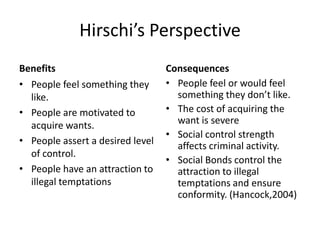
Hirschi’s Perspective
Benefits
• People feel something they
like.
• People are motivated to
acquire wants.
• People assert a desired level
of control.
• People have an attraction to
illegal temptations
Consequences
• People feel or would feel
something they don’t like.
• The cost of acquiring the
want is severe
• Social control strength
affects criminal activity.
• Social Bonds control the
attraction to illegal
temptations and ensure
conformity. (Hancock,2004)
Hirschi’s Social Bond Theory
of Deliquency
• Attachments
• Commitment
• Involvement
• Belief
Attachments
(Hirschi’s Social Bond)
• The relationships established with
others, especially parents. Attachments are
formed through the use of intimate
communication.
• Parents can develop a method of indirect
control. Which means, youngsters refrain from
deviant behavior because the parents
relationship is psychologically present. They
do want to disappoint.
Attachments
• “Social attachments can also be fruitfully thought of as investments. The development
and cultivation of enduring attachments to family, friends, and co-workers requires
personal sacrifice -- committing one's time and energy and, frequently, financial
resources to meeting the needs of others rather than oneself. Attachments also yield a
return, albeit intangible -- the long-term good esteem, companionship, and love of
others (Nagin 1994,581)”.
Commitment
• The higher educational and occupational aspirations an
individual holds, the higher the cost for turning to crime.
Conforming to social standards becomes a higher priority in
achieving specific set goals. (Lily,2011)
• It is only rational for a person to be concerned with his or her
own self-interest
Involvement
• People are less likely to be involved in criminal activity
when involved in activities such as sports, school
activities, homework, and thier recreational pursuits.
• The less time available for leisure equals less time to
get in trouble.
• Devoting energy to productive task reduces the
chances to offend.
Belief
• People with a strong moral
belief in the law are less likely
to engage in criminal activity.
• Beliefs are based on a constant
social reinforcement.
• A fundamental understanding
of right and wrong is crucial to
reducing criminal activity.
• Core Values
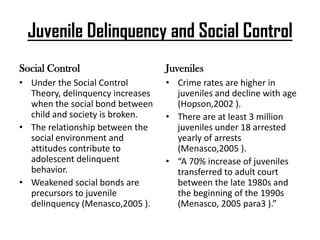
Juvenile Delinquency and Social Control
Social Control
• Under the Social Control
Theory, delinquency increases
when the social bond between
child and society is broken.
• The relationship between the
social environment and
attitudes contribute to
adolescent delinquent
behavior.
• Weakened social bonds are
precursors to juvenile
delinquency (Menasco,2005 ).
Juveniles
• Crime rates are higher in
juveniles and decline with age
(Hopson,2002 ).
• There are at least 3 million
juveniles under 18 arrested
yearly of arrests
(Menasco,2005 ).
• “A 70% increase of juveniles
transferred to adult court
between the late 1980s and
the beginning of the 1990s
(Menasco, 2005 para3 ).”
Benefits in Applying the Social Control
Theory to Juveniles
• Juveniles are impressionable and can be
influenced by positive social bonds.
• Juveniles are not as set in their ways as
adults. Overcoming bad habits is easier.
• Juveniles have several life decisions to
make which affect them for years to come.
• Juveniles also undergo many physical
changes which adjust hormone levels .
Conclusion
• Juveniles need to be provided with the
appropriate social bonds. Future crime
rates can only be affected if the
Criminal Justice System begins to apply
the principles of the Social Control
Theory. Give the youth of America set
expectations, guidance, support, and the
solution begins.
Work Cited
.
• Hopson, R. K., & Obidah, J. E. (2002). When getting tough means getting tougher: Historical and conceptual understandings
of juveniles of color sentenced as adults in the united states. The Journal of Negro Education, 71(3), 158-174. Retrieved from
http://search.proquest.com/docview/222122598?accountid=27966
• Nagin, D. S., & Paternoster, R. (1994). Personal capital and social control: The deterrence implications of a theory of
individual differences in criminal offending. Criminology, 32(4), 581-581. Retrieved from
http://search.proquest.com/docview/220697081?accountid=27966
• Lilly, J. R., Cullen, F. T. & Ball, R. A. (2011). Criminological theory: Context and consequences (5th Ed.). Washington D.C: Sage
Publications.
• Menasco, M. A. (2005). A reconsideration of social control theory: Understanding the interwoven nature of the social
bond, academic performance and juvenile delinquency. State University of New York at Buffalo). ProQuest Dissertations and
Theses, , 232-232 p. Retrieved from http://search.proquest.com/docview/305382943?accountid=27966. (305382943).

Social control theory

  • 1.
  • 2.
    Definition • The SocialControl theory explains how social factors such as religion, economics, family and education relate to the choices and actions of an individual.
  • 3.
    Travis Hirschi • Authorof the Social Bond Theory • Hirschi was born in 1935 and graduated from University of Arizona • His theories integrated different theories and attempted to disprove the consistencies of other theories. • His theories show little interest in race, gender, and class.
  • 4.
    Hirschi’s Perspective Benefits • Peoplefeel something they like. • People are motivated to acquire wants. • People assert a desired level of control. • People have an attraction to illegal temptations Consequences • People feel or would feel something they don’t like. • The cost of acquiring the want is severe • Social control strength affects criminal activity. • Social Bonds control the attraction to illegal temptations and ensure conformity. (Hancock,2004)
  • 5.
    Hirschi’s Social BondTheory of Deliquency • Attachments • Commitment • Involvement • Belief
  • 6.
    Attachments (Hirschi’s Social Bond) •The relationships established with others, especially parents. Attachments are formed through the use of intimate communication. • Parents can develop a method of indirect control. Which means, youngsters refrain from deviant behavior because the parents relationship is psychologically present. They do want to disappoint.
  • 7.
    Attachments • “Social attachmentscan also be fruitfully thought of as investments. The development and cultivation of enduring attachments to family, friends, and co-workers requires personal sacrifice -- committing one's time and energy and, frequently, financial resources to meeting the needs of others rather than oneself. Attachments also yield a return, albeit intangible -- the long-term good esteem, companionship, and love of others (Nagin 1994,581)”.
  • 8.
    Commitment • The highereducational and occupational aspirations an individual holds, the higher the cost for turning to crime. Conforming to social standards becomes a higher priority in achieving specific set goals. (Lily,2011) • It is only rational for a person to be concerned with his or her own self-interest
  • 9.
    Involvement • People areless likely to be involved in criminal activity when involved in activities such as sports, school activities, homework, and thier recreational pursuits. • The less time available for leisure equals less time to get in trouble. • Devoting energy to productive task reduces the chances to offend.
  • 10.
    Belief • People witha strong moral belief in the law are less likely to engage in criminal activity. • Beliefs are based on a constant social reinforcement. • A fundamental understanding of right and wrong is crucial to reducing criminal activity. • Core Values
  • 11.
    Juvenile Delinquency andSocial Control Social Control • Under the Social Control Theory, delinquency increases when the social bond between child and society is broken. • The relationship between the social environment and attitudes contribute to adolescent delinquent behavior. • Weakened social bonds are precursors to juvenile delinquency (Menasco,2005 ). Juveniles • Crime rates are higher in juveniles and decline with age (Hopson,2002 ). • There are at least 3 million juveniles under 18 arrested yearly of arrests (Menasco,2005 ). • “A 70% increase of juveniles transferred to adult court between the late 1980s and the beginning of the 1990s (Menasco, 2005 para3 ).”
  • 12.
    Benefits in Applyingthe Social Control Theory to Juveniles • Juveniles are impressionable and can be influenced by positive social bonds. • Juveniles are not as set in their ways as adults. Overcoming bad habits is easier. • Juveniles have several life decisions to make which affect them for years to come. • Juveniles also undergo many physical changes which adjust hormone levels .
  • 13.
    Conclusion • Juveniles needto be provided with the appropriate social bonds. Future crime rates can only be affected if the Criminal Justice System begins to apply the principles of the Social Control Theory. Give the youth of America set expectations, guidance, support, and the solution begins.
  • 14.
    Work Cited . • Hopson,R. K., & Obidah, J. E. (2002). When getting tough means getting tougher: Historical and conceptual understandings of juveniles of color sentenced as adults in the united states. The Journal of Negro Education, 71(3), 158-174. Retrieved from http://search.proquest.com/docview/222122598?accountid=27966 • Nagin, D. S., & Paternoster, R. (1994). Personal capital and social control: The deterrence implications of a theory of individual differences in criminal offending. Criminology, 32(4), 581-581. Retrieved from http://search.proquest.com/docview/220697081?accountid=27966 • Lilly, J. R., Cullen, F. T. & Ball, R. A. (2011). Criminological theory: Context and consequences (5th Ed.). Washington D.C: Sage Publications. • Menasco, M. A. (2005). A reconsideration of social control theory: Understanding the interwoven nature of the social bond, academic performance and juvenile delinquency. State University of New York at Buffalo). ProQuest Dissertations and Theses, , 232-232 p. Retrieved from http://search.proquest.com/docview/305382943?accountid=27966. (305382943).