radio
lesson objectives
one
Understand how BBC and
commercial radio stations
are funded and how this affects
their schedules and content
two
Understand how music,
speech and sound effects are
used by radio stations to
create a house style
three
Understand how radio
stations research their
target audiences
four
Understand how
technology is changing the
radio industry
facts
over90%of the UK adult
population tune in to the
radioeach week.
On average a person spends
3 hours 3 minutes
listening to radio each day.
37% of listener hours are
through a digital
platform.
funding
The uk radio market is split
roughly 50/50 between
stations owned and operated by
the bbc and commercial
groups.
the bBC is primarily funded
by the tv licence fee, while
commercial stations are
funded through advertising
revenue.
Of the monthly £12 it earns
from each licence fee, the
bbc spends £2 on radio.
Most commercial stations
serve a local or regional
area and are owned by one of
three big groups which
dominate the sector.
global radio
heart
capital fm
bauer media
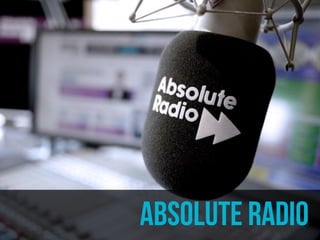
absolute radio
kiss fm
utv media
talksport
There are over 200 community
radio stations now operating
under ofcom licenses for the
benefit of local communities
and interest groups.
style
Compared with television,
radio is really simple to
produce.
There are only three
ingredients that programme
producers can mix together:
speech, music and sound
effects.
Those three simple ingredients
can be made to sound very
different and thus create a
house style for a radio
station.
house style is radio
station’s preferred
manner of presentation
which appeals to their
audience.
target audiences
radio is no different from
any other media form when
it comes to thinking about
audiences. It needs to know
clearly who it is talking to.
Bbc radio stations have to
prove that enough people
listen to them to justify
public funding.
commercial radio stations
only exist if they can
persuade businesses to
buy time to advertise.
Even though radio stations
have a clear idea about the
types of people they think are
listening, they constantly need
to check on their audience
share.
audience share is the
number of listeners
a radio station attracts
compared to its competitors.
radio and technology
56.4% radio listening is
done through fm/am.
37.8% of radio listening
is through digital
platforms.
digital transmissions via
dab are growing in
popularity with 24.5%
listening using this platform.
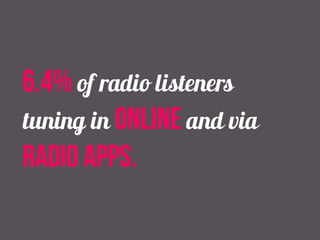
6.4% of radio listeners
tuning in online and via
radio apps.
While 5% of listeners use
digital television to listen
to their chosen radio
stations.

17. Radio