DEVOLUTION
learning objectives
• Understand the process of political devolution in the UK.

• Explain the background and role of nationalism and the
subsequent drive towards political devolution within
the UK.
• Identify powers the devolved bodies have.
• Understand the impact devolution has had on the UK
politics and political system.
the union
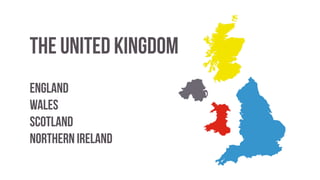
the united kingdom
England
wales
scotland
northern Ireland
!
wales
Between 1536 and 1542, Wales became part of England,
having previously only been subject to indirect control.
After 1542, English law applied also in Wales, and English
was established as the only permissible language for
official purposes. Wales, in turn, gained representation in
the Westminster Parliament.
Scotland
Scotland was an independent state with its own parliament
until the 1707 Act of Union, which formally united England
and Scotland, creating the Kingdom of Great Britain. Under
this, the English and the Scottish Parliaments were both
abolished and replaced by a new Parliament at
Westminster.
northern Ireland
Under the Act of Union of 1800, the Kingdom of Great Britain
merged with the Kingdom of Ireland to form the United
Kingdom of Great Britain and Ireland. When the Irish Free
State was established in 1922 (later to become the Republic
of Ireland), the UK became the United Kingdom of Great
Britain and Northern Ireland.
The unity of the UK is embodied in
the principle of parliamentary
sovereignty. This makes the UK a
unitary state.
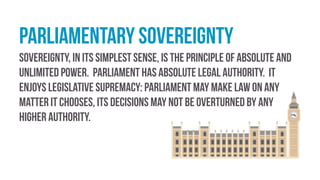
Parliamentary sovereignty
Sovereignty, in its simplest sense, is the principle of absolute and
unlimited power. parliament has absolute legal authority. It
enjoys legislative supremacy: parliament may make law on any
matter it chooses, its decisions may not be overturned by any
higher authority.
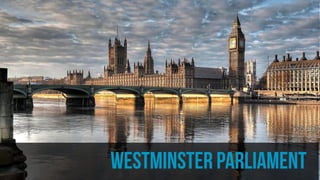
WESTMINSTER PARLIAMENT
Unitary statee
A state in which sovereignty is concentrated in a single
institution of central government; the centre
therefore determines the powers and responsibilities
of lower levels of government.
what is devolution?
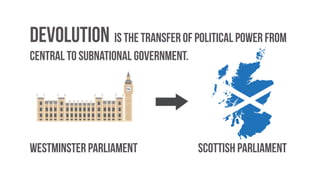
Devolution is The transfer of political power from
central to subnational government.
westminster parliament scottish parliament
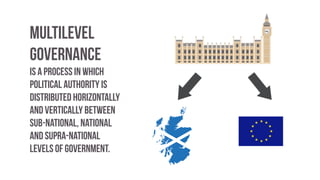
Multilevel
governance 

is a process in which
political authority is
distributed horizontally
and vertically between
sub-national, national
and supra-national
levels of government.
types of devolution in the UK
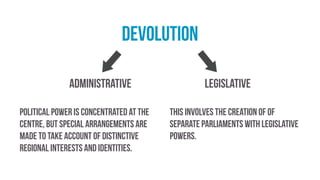
devolution
administrative legislative
Political power is concentrated at the
centre, but special arrangements are
made to take account of distinctive
regional interests and identities.
This involves the creation of of
separate parliaments with legislative
powers.
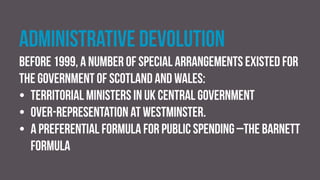
Administrative devolution
Before 1999, a number of special arrangements existed for
the government of Scotland and Wales:
• Territorial ministers in UK central government
• Over-representation at Westminster.
• A preferential formula for public spending –The Barnett
formula
The Barnett formula
translates changes in public spending in England into
equivalent changes in block grants for Scotland, Wales
and Northern Ireland, calculated on the basis of
population. Under the formula, Scotland, Wales and
Northern Ireland have higher public spending per person
than England.
legislative devolution
creation of devolved institutions has been the most
significant change to the UK’s constitutional
arrangements since 1997. The first elections for the
Scottish Parliament and the National Assembly for Wales
were held in May 1999, following successful referendums
in May 1997
in the uk we have asymmetric
devolution.
this means that each devolved
institution has different powers and
distinctive features.
The issues upon which the Scottish
Parliament and the Welsh Assembly
can make laws are known as
devolved powers.
The issues upon which only the UK
Parliament can make laws are
known as reserved powers.
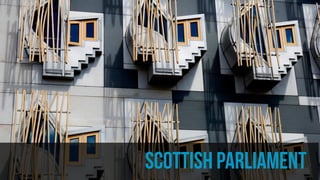
SCOTTISH PARLIAMENT
The Scottish Parliament has 129
members (MSPs) elected by the
additional member system.
It has primary legislative powers in
a range of policy areas, including
law and order, health, education,
transport, the environment and
economic development.
from 2016 under The Scotland Act
(2012) the Scottish parliament will
be able to set a Scottish rate of
income tax higher or lower than
that in the UK.
Funding comes from a Treasury
block grant (£27 billion in 2012)
determined by the Barnett
formula.
devolution options for Scotland
• Further devolution
• Full devolution (‘devo max’)
• Independence
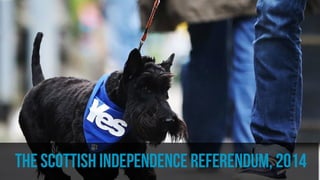
THE SCOTTISH INDEPENDENCE REFERENDUM, 2014
Legal referendum
The UK government gave temporary
powers to the Scottish Parliament,
under section 30 of the Scotland Act
(1998) to hold a referendum in 2014.
one question
Should Scotland be an independent
country?
Franchise
16- and 17-year-olds were able to
vote for the first time
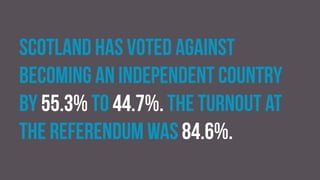
Scotland has voted against
becoming an independent country
by 55.3% to 44.7%. The turnout at
the referendum was 84.6%.
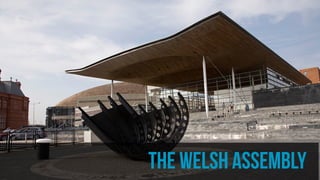
THE WELSH ASSEMBLY
The National Assembly for Wales,
commonly known as the Welsh
Assembly, has 60 members elected
by the additional member system.
The Government of Wales Act (1998)
specified the devolved policy areas.
These include education, health,
transport, the environment and
economic development.
Funding comes from a Treasury block grant
(£15 billion in 2012) determined by the
Barnett formula. The assembly decides how
to allocate this money and can alter the
basis of local taxation, but does not have
tax varying powers.
further powers were devolved by
the Westminster government when it
passed the Wales Act (2014).
these include policing, criminal
justice and road safety.
the impact of devolution
new politics
Hopes were high in Scotland and Wales that legislative
devolution would usher in a different style of
politics. Whereas Westminster politics was seen as
adversarial and elitist, the hope was that post-
devolution politics would be consensual and more
democratic.
Multi-party politics
the additional member system used in election
for the scottish parliament and the wlsh
assembly produces more proportional outcomes
that are found at Westminster elections.
Minority and coalition governments
Elections to the Scottish Parliament and Welsh
Assembly have produced different types of
government. Since the advent of devolution, both
coalitions and long-lived minority governments have
become part of the fabric of politics in Scotland and
Wales.
Policy divergence
Devolution has allowed governments in Scotland,
Wales and Northern Ireland to adopt policies
which differ from those pursued by the UK
government in England.
Funding
The devolved administrations are funded by block grants
from the UK. Treasury, the size of which is settled by the
Barnett formula. Scotland, Wales and Northern Ireland
receive more public spending per head of population than in
England. For 2008/09, if the UK level was taken as 100, then
government funding for England would be 97, for Wales 111,
for Scotland 116, and for Northern Ireland 122.
Intergovernmental relations
New mechanisms to handle relations between the
UK government and the devolved bodies have been
established to foster cooperation and resolve
disputes.
The West Lothian Question
Why should Scottish MPs be able to vote on
English matters at Westminster when English MPs
cannot vote on matters devolved to the Scottish
Parliament?
the english question
how England should be governed within the post-
devolution Union? underpinning it is a sense that
English interests and identity are not recognised
explicitly.
Britishness
Britishness is an umbrella identity that provides
a common bond between the peoples of the UK, but
which also enables them to retain their
distinctive national (i.e. English, Welsh, Scottish
and Northern Irish) identities.

Week 2: Devolution

  • 1.
  • 2.
    learning objectives • Understandthe process of political devolution in the UK. • Explain the background and role of nationalism and the subsequent drive towards political devolution within the UK. • Identify powers the devolved bodies have. • Understand the impact devolution has had on the UK politics and political system.
  • 3.
  • 4.
  • 5.
    wales Between 1536 and1542, Wales became part of England, having previously only been subject to indirect control. After 1542, English law applied also in Wales, and English was established as the only permissible language for official purposes. Wales, in turn, gained representation in the Westminster Parliament.
  • 6.
    Scotland Scotland was anindependent state with its own parliament until the 1707 Act of Union, which formally united England and Scotland, creating the Kingdom of Great Britain. Under this, the English and the Scottish Parliaments were both abolished and replaced by a new Parliament at Westminster.
  • 7.
    northern Ireland Under theAct of Union of 1800, the Kingdom of Great Britain merged with the Kingdom of Ireland to form the United Kingdom of Great Britain and Ireland. When the Irish Free State was established in 1922 (later to become the Republic of Ireland), the UK became the United Kingdom of Great Britain and Northern Ireland.
  • 8.
    The unity ofthe UK is embodied in the principle of parliamentary sovereignty. This makes the UK a unitary state.
  • 9.
    Parliamentary sovereignty Sovereignty, inits simplest sense, is the principle of absolute and unlimited power. parliament has absolute legal authority. It enjoys legislative supremacy: parliament may make law on any matter it chooses, its decisions may not be overturned by any higher authority.
  • 10.
  • 11.
    Unitary statee A statein which sovereignty is concentrated in a single institution of central government; the centre therefore determines the powers and responsibilities of lower levels of government.
  • 12.
  • 13.
    Devolution is Thetransfer of political power from central to subnational government. westminster parliament scottish parliament
  • 14.
    Multilevel governance 
 is aprocess in which political authority is distributed horizontally and vertically between sub-national, national and supra-national levels of government.
  • 15.
  • 16.
    devolution administrative legislative Political poweris concentrated at the centre, but special arrangements are made to take account of distinctive regional interests and identities. This involves the creation of of separate parliaments with legislative powers.
  • 17.
    Administrative devolution Before 1999,a number of special arrangements existed for the government of Scotland and Wales: • Territorial ministers in UK central government • Over-representation at Westminster. • A preferential formula for public spending –The Barnett formula
  • 18.
    The Barnett formula translateschanges in public spending in England into equivalent changes in block grants for Scotland, Wales and Northern Ireland, calculated on the basis of population. Under the formula, Scotland, Wales and Northern Ireland have higher public spending per person than England.
  • 19.
    legislative devolution creation ofdevolved institutions has been the most significant change to the UK’s constitutional arrangements since 1997. The first elections for the Scottish Parliament and the National Assembly for Wales were held in May 1999, following successful referendums in May 1997
  • 20.
    in the ukwe have asymmetric devolution. this means that each devolved institution has different powers and distinctive features.
  • 21.
    The issues uponwhich the Scottish Parliament and the Welsh Assembly can make laws are known as devolved powers.
  • 22.
    The issues uponwhich only the UK Parliament can make laws are known as reserved powers.
  • 23.
  • 24.
    The Scottish Parliamenthas 129 members (MSPs) elected by the additional member system.
  • 25.
    It has primarylegislative powers in a range of policy areas, including law and order, health, education, transport, the environment and economic development.
  • 26.
    from 2016 underThe Scotland Act (2012) the Scottish parliament will be able to set a Scottish rate of income tax higher or lower than that in the UK.
  • 27.
    Funding comes froma Treasury block grant (£27 billion in 2012) determined by the Barnett formula.
  • 28.
    devolution options forScotland • Further devolution • Full devolution (‘devo max’) • Independence
  • 29.
    THE SCOTTISH INDEPENDENCEREFERENDUM, 2014
  • 30.
    Legal referendum The UKgovernment gave temporary powers to the Scottish Parliament, under section 30 of the Scotland Act (1998) to hold a referendum in 2014.
  • 31.
    one question Should Scotlandbe an independent country?
  • 32.
    Franchise 16- and 17-year-oldswere able to vote for the first time
  • 33.
    Scotland has votedagainst becoming an independent country by 55.3% to 44.7%. The turnout at the referendum was 84.6%.
  • 34.
  • 35.
    The National Assemblyfor Wales, commonly known as the Welsh Assembly, has 60 members elected by the additional member system.
  • 36.
    The Government ofWales Act (1998) specified the devolved policy areas. These include education, health, transport, the environment and economic development.
  • 37.
    Funding comes froma Treasury block grant (£15 billion in 2012) determined by the Barnett formula. The assembly decides how to allocate this money and can alter the basis of local taxation, but does not have tax varying powers.
  • 38.
    further powers weredevolved by the Westminster government when it passed the Wales Act (2014). these include policing, criminal justice and road safety.
  • 39.
    the impact ofdevolution
  • 40.
    new politics Hopes werehigh in Scotland and Wales that legislative devolution would usher in a different style of politics. Whereas Westminster politics was seen as adversarial and elitist, the hope was that post- devolution politics would be consensual and more democratic.
  • 41.
    Multi-party politics the additionalmember system used in election for the scottish parliament and the wlsh assembly produces more proportional outcomes that are found at Westminster elections.
  • 42.
    Minority and coalitiongovernments Elections to the Scottish Parliament and Welsh Assembly have produced different types of government. Since the advent of devolution, both coalitions and long-lived minority governments have become part of the fabric of politics in Scotland and Wales.
  • 43.
    Policy divergence Devolution hasallowed governments in Scotland, Wales and Northern Ireland to adopt policies which differ from those pursued by the UK government in England.
  • 44.
    Funding The devolved administrationsare funded by block grants from the UK. Treasury, the size of which is settled by the Barnett formula. Scotland, Wales and Northern Ireland receive more public spending per head of population than in England. For 2008/09, if the UK level was taken as 100, then government funding for England would be 97, for Wales 111, for Scotland 116, and for Northern Ireland 122.
  • 45.
    Intergovernmental relations New mechanismsto handle relations between the UK government and the devolved bodies have been established to foster cooperation and resolve disputes.
  • 46.
    The West LothianQuestion Why should Scottish MPs be able to vote on English matters at Westminster when English MPs cannot vote on matters devolved to the Scottish Parliament?
  • 47.
    the english question howEngland should be governed within the post- devolution Union? underpinning it is a sense that English interests and identity are not recognised explicitly.
  • 48.
    Britishness Britishness is anumbrella identity that provides a common bond between the peoples of the UK, but which also enables them to retain their distinctive national (i.e. English, Welsh, Scottish and Northern Irish) identities.