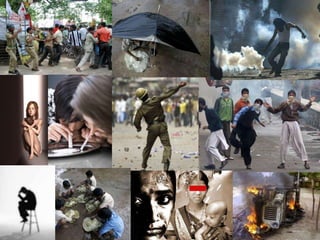
Anomieand its manifestations in society
SOCIAL STRUCTUREDefinition and Concept
Social StructureDefinitionsRadcliffe Browndefines social structure as “an arrangement of persons in institutionally controlled or defined relationships, (such as the relationship of king and subject, or that of husband and wife)”.Morris Ginsberg regardssocial structure as “the complex of principal groups and institutions which constitute societies”.
Social Structure…DefinitionsOgburn and Nimkoff are of the opinion that “In society, the organization of a group of persons is the social structure. What the group does is the function”.Many sociologists have used the term ‘social structure’  to refer to “the enduring,  orderly and patterned relationships between elements of a society”.
Social StructureUnderstanding Social StructureThe term  ‘structure’ refers to “some sort of ordered arrangements of parts or components”A musical composition, a sentence, a building, a molecule or an animal have a structure.Similarly, society too has its own structure called ‘social structure’.The components or units of social structure are “persons”.
Social StructureElementsAccording to H.M John, the main elements of social structure are as follows:Subgroups of various types;
Roles of various types;
Regulative norms governing sub-groups and roles;
Cultural values (any one of these elements – a sub-group, a 		role, a social norm, or a value-may be called a 		“partial structure”)
Social StructurePartsAccording to Radcliffe Brown, the parts of a social structure are;all social relations of person to person;
different social roles of individuals;
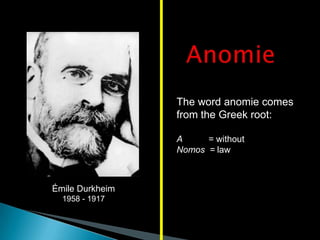
differentiated social positionsAnomieThe word anomie comes from the Greek root:A 	= withoutNomos  = lawÉmile Durkheim1958 - 1917
AnomieBackgroundThe demise of traditional communities and the disruption of norms, values, and a familiar way of life were major concerns of nineteenth-century philosophers and sociologists. Hence, the concept anomie was used by early sociologists to describe changes in society produced by the Industrial Revolution.Durkheim introduced the concept of anomie as a basis of deviant behavior
AnomieDurkheim defined the term anomie as a condition where social and/or moral norms are confused, unclear, or simply not present. Durkheim felt that this lack of norms or pre-accepted limits on behavior in a society led to deviant behaviour. ∴Anomie = Lack of Regulation/Breakdown of Norms Anomie refers to an environmental state where society fails to exercise adequate regulation or constraint over the goals and desires of its individual members
AnomieDurkheim believed that anomie is common 		when the surrounding society has undergone significant 	changes in its economic fortunes, whether for good or for 	worse 	and, more generally, when there is a significant discrepancy 	between the ideological theories and values commonly professed 	and what was actually achievable in everyday life.Anomie is a breakdown of social norms and it is a condition where norms no longer control the activities of members in society.
Individuals cannot find their place in society without clear rules to help guide them. Changing conditions as well as adjustment of life leads to dissatisfaction, conflict, and deviance.
He observed that social periods of disruption leads to higher rates of suicide.AnomieRobert King Merton also adopted the idea of anomie to develop Strain Theory to explain deviant behavior, defining it as the discrepancy between common social goals and the legitimate means to attain those goals. In other words, an individual suffering from anomie would strive to attain the common goals of a specific society yet would not be able to reach these goals legitimately because of the structural limitations in society. As a result the individual would exhibit deviant behavior.AnomieMerton discussed deviance in terms of goals and means as part of his strain/anomie theory. For Merton, anomie is the state in which social goals and the legitimate means to achieve them do not correspond.
AnomieAnomie = Anarchy?According to Durkheim, anomie is a reaction against or a retreat from the regulatory social controls of society, and is a completely separate concept from anarchy which is an absence of effective rulers or leaders.Anarchy denotes lack of rulers, hierarchy, and commandwhereas anomie denotes lack of rules, structure, and organization.
Anomieand Its manifestations in Society
CASTEA sociologist would define caste as a hereditary, endogamous, usually localized group, having a traditional association with an occupation, and a particular position in the local hierarchy of castes. Relations between castes are governed, among other things, by the concepts of pollution and purity, and generally, maximum commensality occurs within the casteCaste in IndiaJaati is the term used to denote communities and sub-communities in India. It is a term used across religions.
CASTEVarnaEarly Indian texts like the Rigveda, Manusmriti and the Puranas speak of 'Varna,' which means order, category, type, colour (of things), and groups the human society into four main types as follows Brahmin-the class of educators, law makers, scholars and 	preachers of Dharma in Hinduism. Kshatriya - WarriorVaishya - merchants, artisans, and cultivatorsShudra - workers, farmers and service providers
CASTEIn Durkheim's usage, anomiereferred to a situation in which cultural norms break down because of rapid change. Merton changes the concept slightly, to refer to a situation in which there is an apparent lack of fit between the culture's norms about what constitutes success in life (goals) and the culture's norms about the appropriate ways to achieve those goals (means).
CASTECasteism leading to anomieDifferent ways of following and interpreting existing norms-no collective consciousnessState of norm-lessness in between normal and pathological conditions Anomie leading to casteismNeed to have a collective consciousness
COMMUNALISMCommunalismCommunalism is an ideology which states that society is divided into religious communities whose interests differ and are, at times even opposed to each other the antagonism practiced by the people of one  community against the people of other community or religion can be termed “communalism”.T.K.Oommen has suggested six dimensions of communalism:Assimilationist: scheduled tribes are Hindus.Welfarist:  Parsi association working for the uplift of Parsis.Retreatist: Bahai community.Retaliatory.Separatist: Bodos in Assam, Gorkhas in west Bengal.Secessionist: Sikh population demanding for Khalistan.
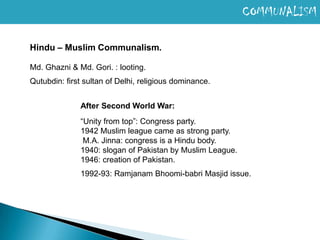
COMMUNALISMHindu – Muslim Communalism.Md. Ghazni & Md. Gori. : looting.	Qutubdin: first sultan of Delhi, religious dominance.After Second World War:“Unity from top”: Congress party.1942 Muslim league came as strong party. M.A. Jinna: congress is a Hindu body.1940: slogan of Pakistan by Muslim League.1946: creation of Pakistan.1992-93: Ramjanam Bhoomi-babri Masjid issue.
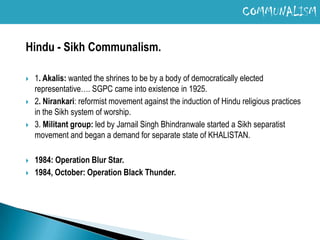
COMMUNALISMHindu - Sikh Communalism. 1. Akalis: wanted the shrines to be by a body of democratically elected representative…. SGPC came into existence in 1925.2. Nirankari: reformist movement against the induction of Hindu religious practices in the Sikh system of worship.3. Militant group: led by Jarnail Singh Bhindranwale started a Sikh separatist movement and began a demand for separate state of KHALISTAN.1984: Operation Blur Star.1984, October: Operation Black Thunder.
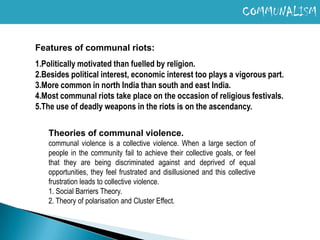
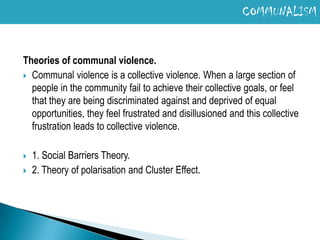
COMMUNALISMFeatures of communal riots:Politically motivated than fuelled by religion.Besides political interest, economic interest too plays a vigorous part.More common in north India than south and east India.Most communal riots take place on the occasion of religious festivals.The use of deadly weapons in the riots is on the ascendancy.Theories of communal violence.communalviolence is a collective violence. When a large section of people in the community fail to achieve their collective goals, or feel that they are being discriminated against and deprived of equal opportunities, they feel frustrated and disillusioned and this collective frustration leads to collective violence.1. Social Barriers Theory.2. Theory of polarisation and Cluster Effect.

C2 Anomie

  • 1.
  • 2.
  • 3.
    Social StructureDefinitionsRadcliffe Browndefinessocial structure as “an arrangement of persons in institutionally controlled or defined relationships, (such as the relationship of king and subject, or that of husband and wife)”.Morris Ginsberg regardssocial structure as “the complex of principal groups and institutions which constitute societies”.
  • 4.
    Social Structure…DefinitionsOgburn andNimkoff are of the opinion that “In society, the organization of a group of persons is the social structure. What the group does is the function”.Many sociologists have used the term ‘social structure’ to refer to “the enduring, orderly and patterned relationships between elements of a society”.
  • 5.
    Social StructureUnderstanding SocialStructureThe term ‘structure’ refers to “some sort of ordered arrangements of parts or components”A musical composition, a sentence, a building, a molecule or an animal have a structure.Similarly, society too has its own structure called ‘social structure’.The components or units of social structure are “persons”.
  • 6.
    Social StructureElementsAccording toH.M John, the main elements of social structure are as follows:Subgroups of various types;
  • 7.
  • 8.
    Regulative norms governingsub-groups and roles;
  • 9.
    Cultural values (anyone of these elements – a sub-group, a role, a social norm, or a value-may be called a “partial structure”)
  • 10.
    Social StructurePartsAccording toRadcliffe Brown, the parts of a social structure are;all social relations of person to person;
  • 11.
    different social rolesof individuals;
  • 12.
    differentiated social positionsAnomieTheword anomie comes from the Greek root:A = withoutNomos = lawÉmile Durkheim1958 - 1917
  • 13.
    AnomieBackgroundThe demise oftraditional communities and the disruption of norms, values, and a familiar way of life were major concerns of nineteenth-century philosophers and sociologists. Hence, the concept anomie was used by early sociologists to describe changes in society produced by the Industrial Revolution.Durkheim introduced the concept of anomie as a basis of deviant behavior
  • 14.
    AnomieDurkheim defined theterm anomie as a condition where social and/or moral norms are confused, unclear, or simply not present. Durkheim felt that this lack of norms or pre-accepted limits on behavior in a society led to deviant behaviour. ∴Anomie = Lack of Regulation/Breakdown of Norms Anomie refers to an environmental state where society fails to exercise adequate regulation or constraint over the goals and desires of its individual members
  • 15.
    AnomieDurkheim believed thatanomie is common when the surrounding society has undergone significant changes in its economic fortunes, whether for good or for worse and, more generally, when there is a significant discrepancy between the ideological theories and values commonly professed and what was actually achievable in everyday life.Anomie is a breakdown of social norms and it is a condition where norms no longer control the activities of members in society.
  • 16.
    Individuals cannot findtheir place in society without clear rules to help guide them. Changing conditions as well as adjustment of life leads to dissatisfaction, conflict, and deviance.
  • 17.
    He observed thatsocial periods of disruption leads to higher rates of suicide.AnomieRobert King Merton also adopted the idea of anomie to develop Strain Theory to explain deviant behavior, defining it as the discrepancy between common social goals and the legitimate means to attain those goals. In other words, an individual suffering from anomie would strive to attain the common goals of a specific society yet would not be able to reach these goals legitimately because of the structural limitations in society. As a result the individual would exhibit deviant behavior.AnomieMerton discussed deviance in terms of goals and means as part of his strain/anomie theory. For Merton, anomie is the state in which social goals and the legitimate means to achieve them do not correspond.
  • 18.
    AnomieAnomie = Anarchy?Accordingto Durkheim, anomie is a reaction against or a retreat from the regulatory social controls of society, and is a completely separate concept from anarchy which is an absence of effective rulers or leaders.Anarchy denotes lack of rulers, hierarchy, and commandwhereas anomie denotes lack of rules, structure, and organization.
  • 19.
  • 20.
    CASTEA sociologist woulddefine caste as a hereditary, endogamous, usually localized group, having a traditional association with an occupation, and a particular position in the local hierarchy of castes. Relations between castes are governed, among other things, by the concepts of pollution and purity, and generally, maximum commensality occurs within the casteCaste in IndiaJaati is the term used to denote communities and sub-communities in India. It is a term used across religions.
  • 21.
    CASTEVarnaEarly Indian textslike the Rigveda, Manusmriti and the Puranas speak of 'Varna,' which means order, category, type, colour (of things), and groups the human society into four main types as follows Brahmin-the class of educators, law makers, scholars and preachers of Dharma in Hinduism. Kshatriya - WarriorVaishya - merchants, artisans, and cultivatorsShudra - workers, farmers and service providers
  • 22.
    CASTEIn Durkheim's usage,anomiereferred to a situation in which cultural norms break down because of rapid change. Merton changes the concept slightly, to refer to a situation in which there is an apparent lack of fit between the culture's norms about what constitutes success in life (goals) and the culture's norms about the appropriate ways to achieve those goals (means).
  • 23.
    CASTECasteism leading toanomieDifferent ways of following and interpreting existing norms-no collective consciousnessState of norm-lessness in between normal and pathological conditions Anomie leading to casteismNeed to have a collective consciousness
  • 24.
    COMMUNALISMCommunalismCommunalism is anideology which states that society is divided into religious communities whose interests differ and are, at times even opposed to each other the antagonism practiced by the people of one community against the people of other community or religion can be termed “communalism”.T.K.Oommen has suggested six dimensions of communalism:Assimilationist: scheduled tribes are Hindus.Welfarist: Parsi association working for the uplift of Parsis.Retreatist: Bahai community.Retaliatory.Separatist: Bodos in Assam, Gorkhas in west Bengal.Secessionist: Sikh population demanding for Khalistan.
  • 25.
    COMMUNALISMHindu – MuslimCommunalism.Md. Ghazni & Md. Gori. : looting. Qutubdin: first sultan of Delhi, religious dominance.After Second World War:“Unity from top”: Congress party.1942 Muslim league came as strong party. M.A. Jinna: congress is a Hindu body.1940: slogan of Pakistan by Muslim League.1946: creation of Pakistan.1992-93: Ramjanam Bhoomi-babri Masjid issue.
  • 26.
    COMMUNALISMHindu - SikhCommunalism. 1. Akalis: wanted the shrines to be by a body of democratically elected representative…. SGPC came into existence in 1925.2. Nirankari: reformist movement against the induction of Hindu religious practices in the Sikh system of worship.3. Militant group: led by Jarnail Singh Bhindranwale started a Sikh separatist movement and began a demand for separate state of KHALISTAN.1984: Operation Blur Star.1984, October: Operation Black Thunder.
  • 27.
    COMMUNALISMFeatures of communalriots:Politically motivated than fuelled by religion.Besides political interest, economic interest too plays a vigorous part.More common in north India than south and east India.Most communal riots take place on the occasion of religious festivals.The use of deadly weapons in the riots is on the ascendancy.Theories of communal violence.communalviolence is a collective violence. When a large section of people in the community fail to achieve their collective goals, or feel that they are being discriminated against and deprived of equal opportunities, they feel frustrated and disillusioned and this collective frustration leads to collective violence.1. Social Barriers Theory.2. Theory of polarisation and Cluster Effect.