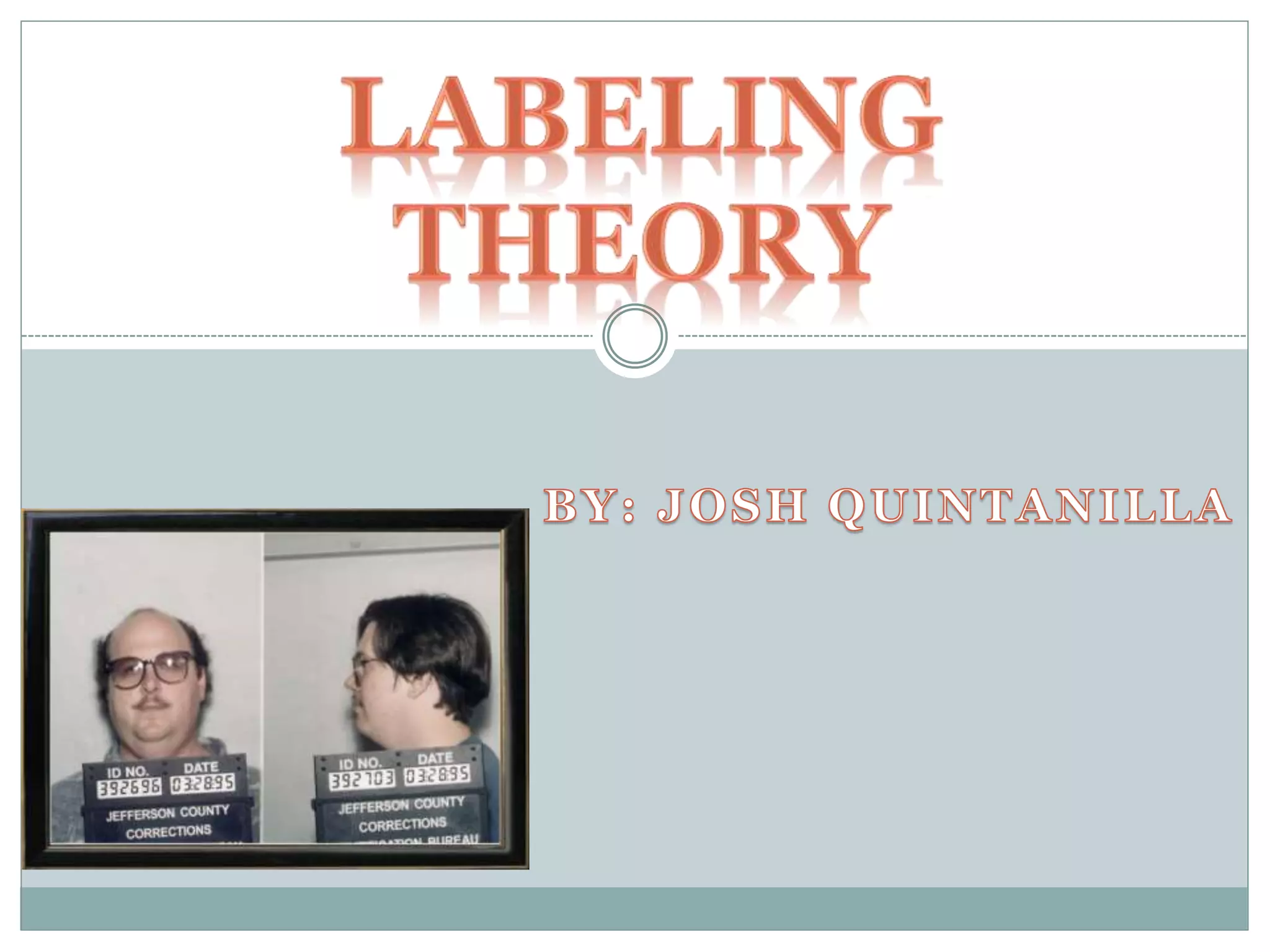
Labeling theory argues that deviance is not determined by the act itself, but rather by the societal reaction to that act. Society applies labels like "criminal" or "mentally ill" to individuals who commit certain acts, influencing how those individuals see themselves and potentially causing them to engage in further deviant acts. The theory was developed in the 1960s by sociologists like Howard Becker, who argued that deviance is a result of social labeling and interaction, not inherent to the individuals or acts themselves.
In this document
Powered by AI
Labeling theory, popularized by Scheff and Becker, explores how societal labels affect deviance.
Tannenbaum and others discuss how labels like 'deviant' influence behavior and opportunities for labeled individuals.
Symbolic interactionism shows that labeling affects societal views, creating deviance through societal reactions.
Labeling leads to self-fulfilling prophecies, stigmatization, and a deviant self-concept.
Discussion on how lower-class individuals are more likely to be labeled deviant, while ignoring white-collar crimes. Criticism of the theory's focus.
List of references supporting the concepts discussed in labeling theory and associated research.
Popularity
Labeling theorywas popular in the 1960s and early
1970s.
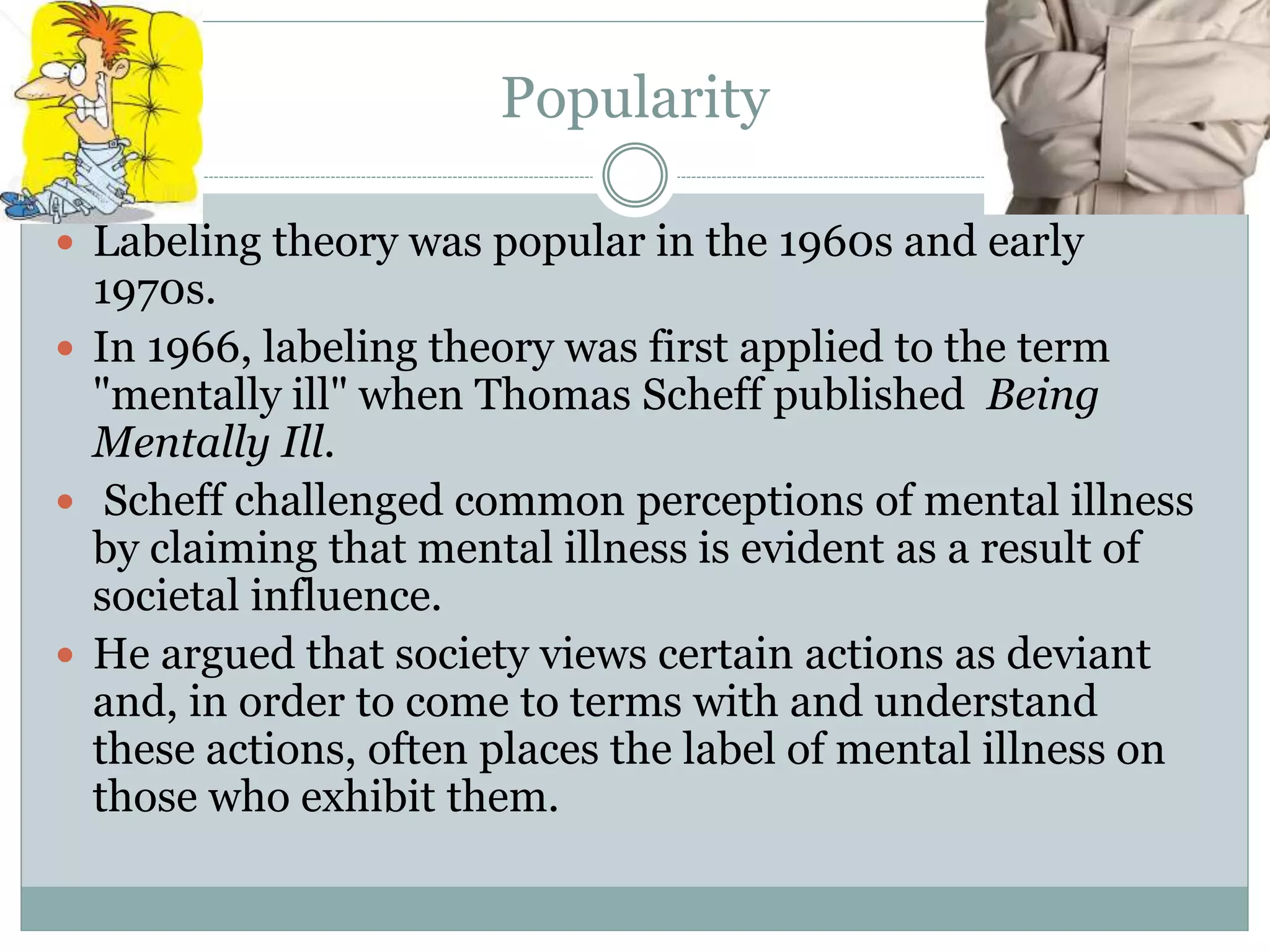
In 1966, labeling theory was first applied to the term
"mentally ill" when Thomas Scheff published Being
Mentally Ill.
Scheff challenged common perceptions of mental illness
by claiming that mental illness is evident as a result of
societal influence.
He argued that society views certain actions as deviant
and, in order to come to terms with and understand
these actions, often places the label of mental illness on
those who exhibit them.
3.
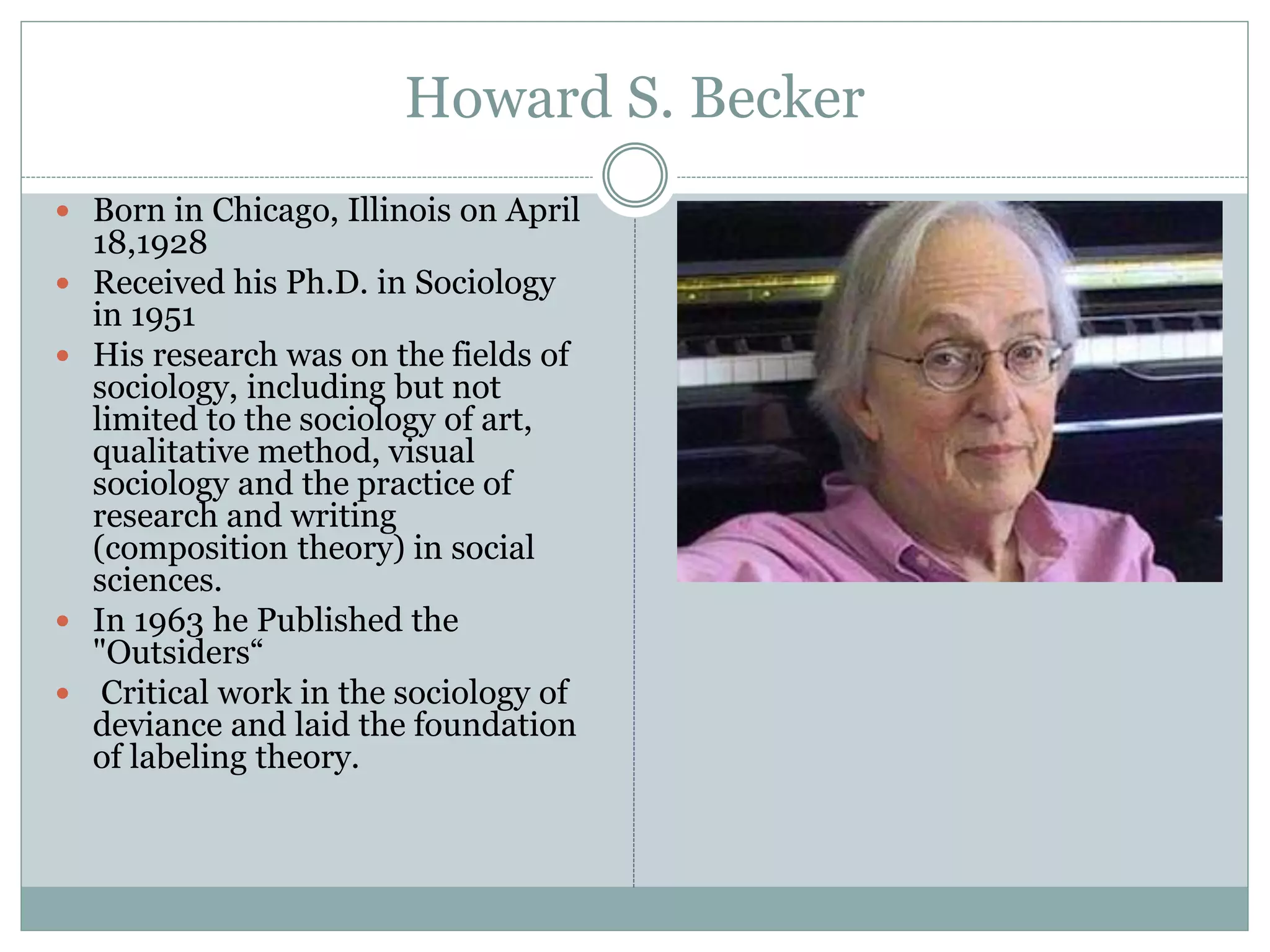
Howard S. Becker
Born in Chicago, Illinois on April
18,1928
Received his Ph.D. in Sociology
in 1951
His research was on the fields of
sociology, including but not
limited to the sociology of art,
qualitative method, visual
sociology and the practice of
research and writing
(composition theory) in social
sciences.
In 1963 he Published the
"Outsiders“
Critical work in the sociology of
deviance and laid the foundation
of labeling theory.
4.
Founder of LabelingTheory
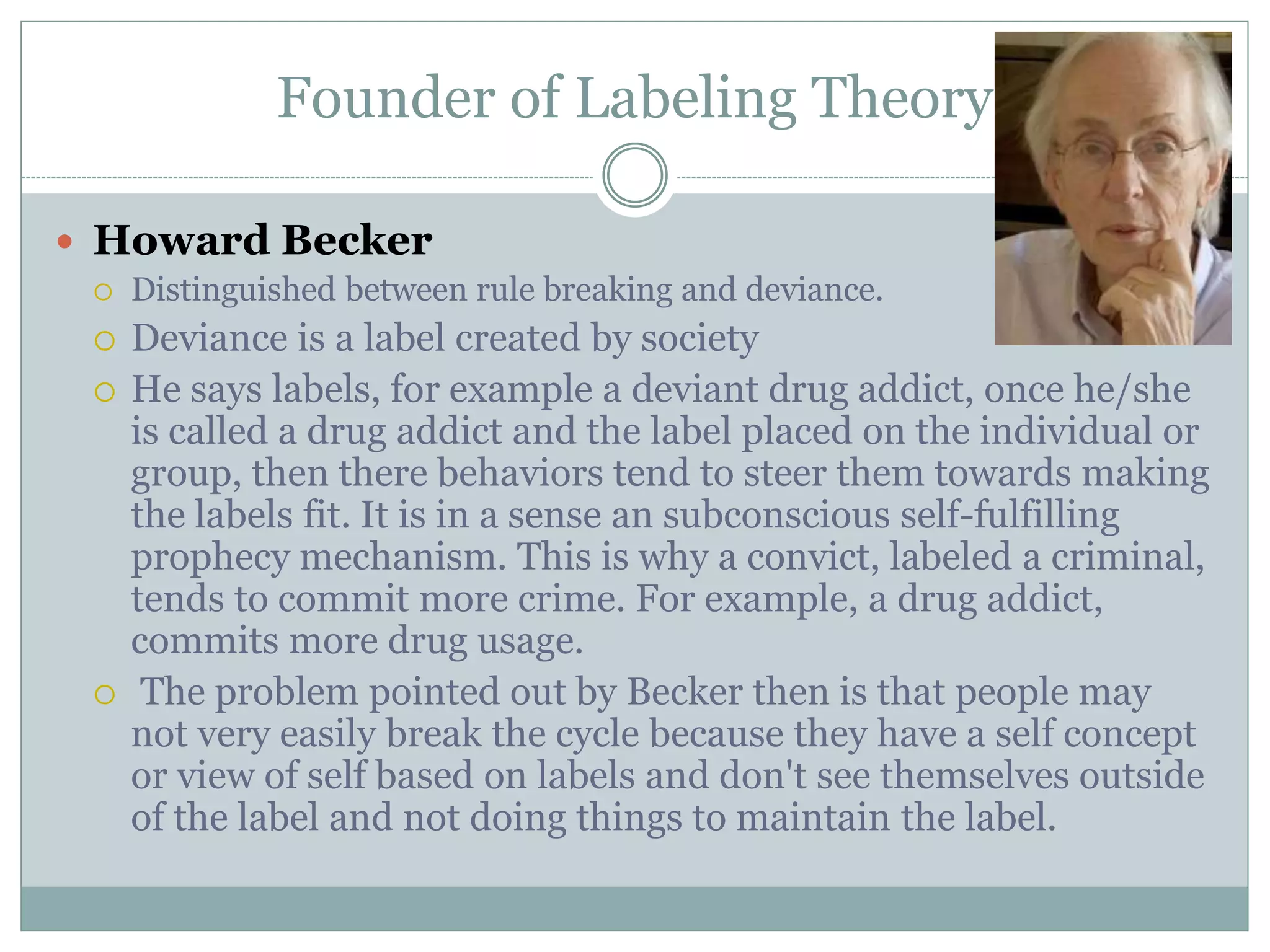
Howard Becker
Distinguished between rule breaking and deviance.
Deviance is a label created by society
He says labels, for example a deviant drug addict, once he/she
is called a drug addict and the label placed on the individual or
group, then there behaviors tend to steer them towards making
the labels fit. It is in a sense an subconscious self-fulfilling
prophecy mechanism. This is why a convict, labeled a criminal,
tends to commit more crime. For example, a drug addict,
commits more drug usage.
The problem pointed out by Becker then is that people may
not very easily break the cycle because they have a self concept
or view of self based on labels and don't see themselves outside
of the label and not doing things to maintain the label.
5.
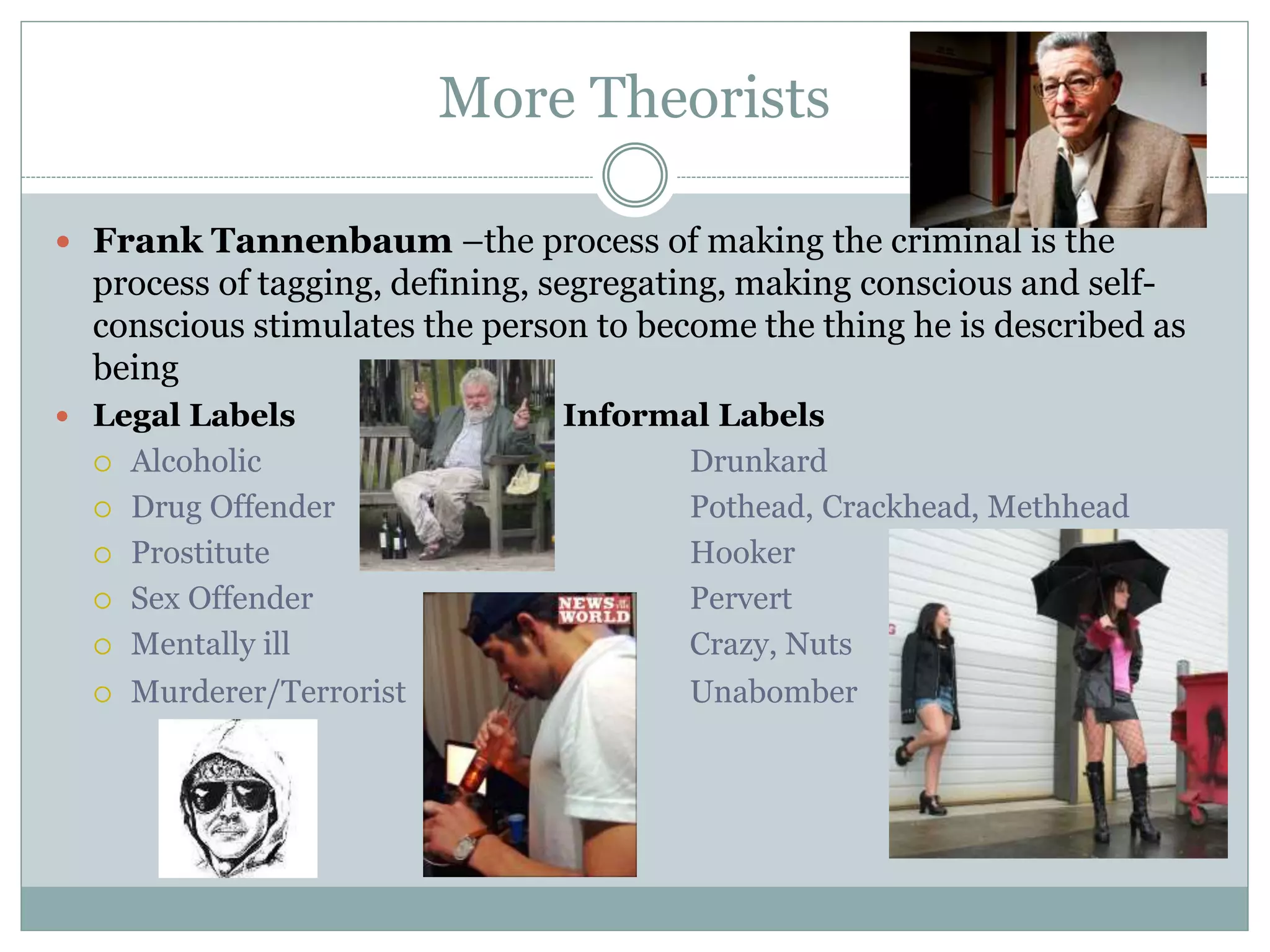
More Theorists
FrankTannenbaum –the process of making the criminal is the
process of tagging, defining, segregating, making conscious and self-
conscious stimulates the person to become the thing he is described as
being
Legal Labels Informal Labels
Alcoholic Drunkard
Drug Offender Pothead, Crackhead, Methhead
Prostitute Hooker
Sex Offender Pervert
Mentally ill Crazy, Nuts
Murderer/Terrorist Unabomber
6.
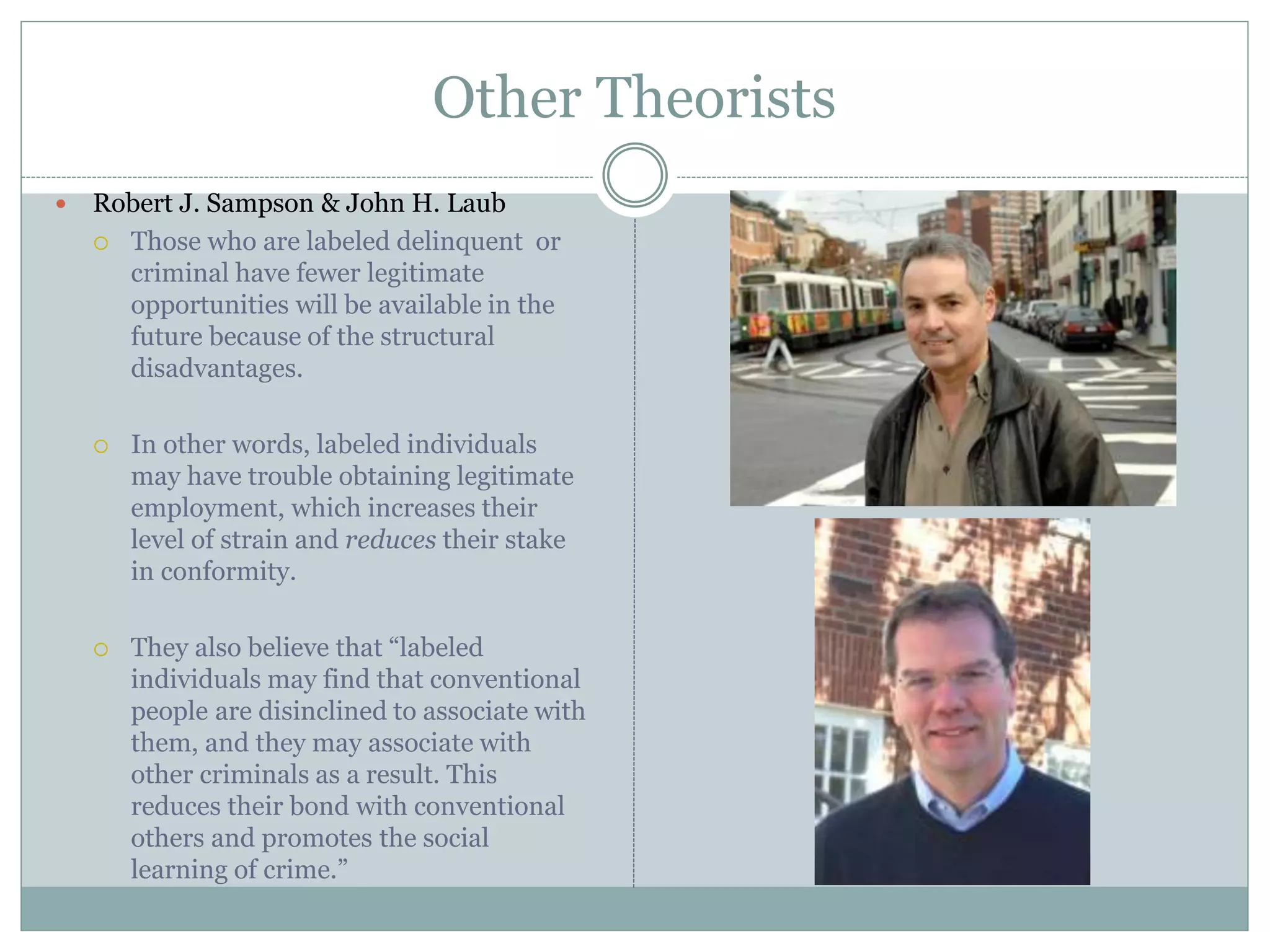
Other Theorists
RobertJ. Sampson & John H. Laub
Those who are labeled delinquent or
criminal have fewer legitimate
opportunities will be available in the
future because of the structural
disadvantages.
In other words, labeled individuals
may have trouble obtaining legitimate
employment, which increases their
level of strain and reduces their stake
in conformity.
They also believe that “labeled
individuals may find that conventional
people are disinclined to associate with
them, and they may associate with
other criminals as a result. This
reduces their bond with conventional
others and promotes the social
learning of crime.”
7.
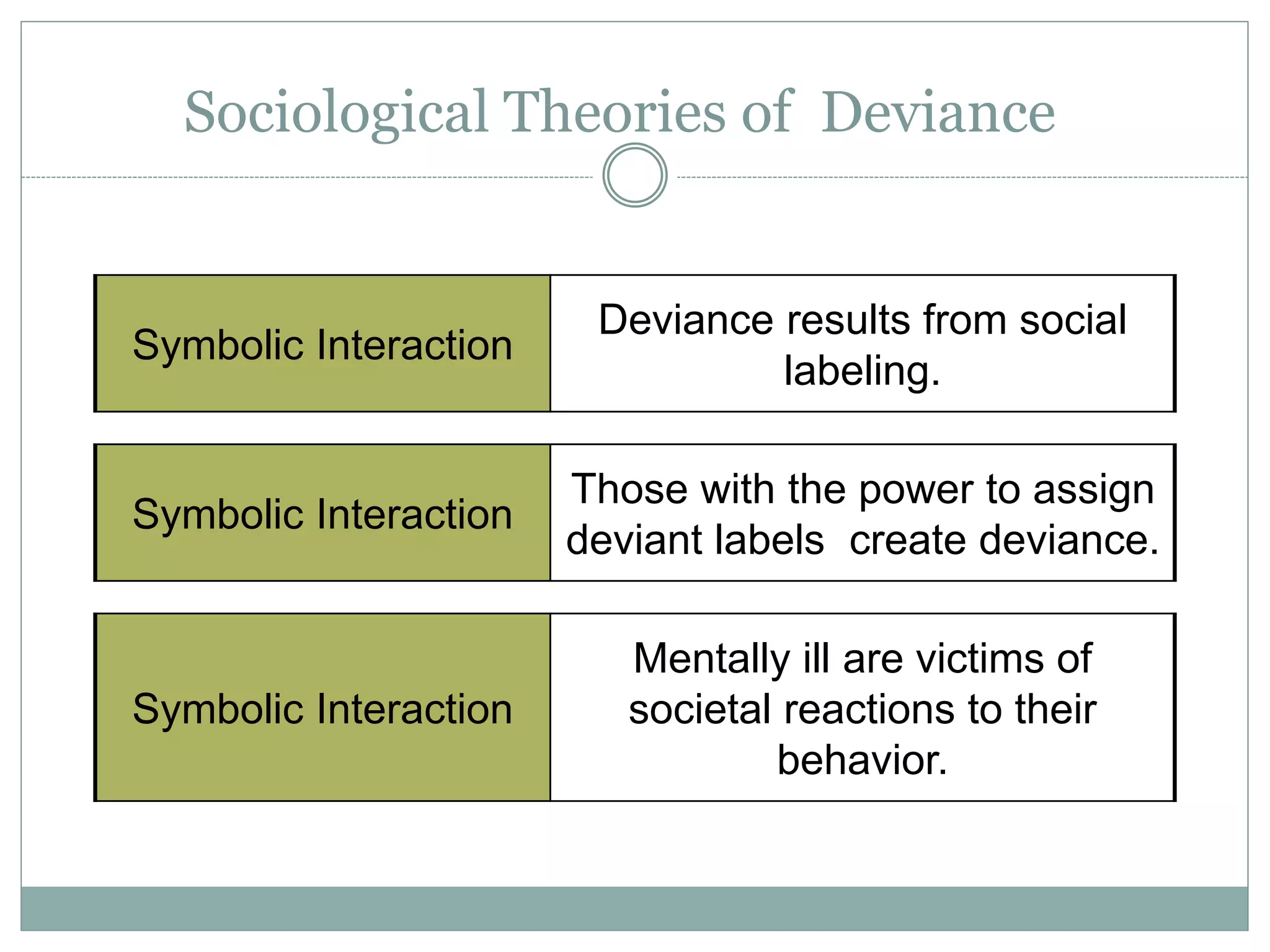
Sociological Theories ofDeviance
Symbolic Interaction
Deviance results from social
labeling.
Symbolic Interaction
Those with the power to assign
deviant labels create deviance.
Symbolic Interaction
Mentally ill are victims of
societal reactions to their
behavior.
8.
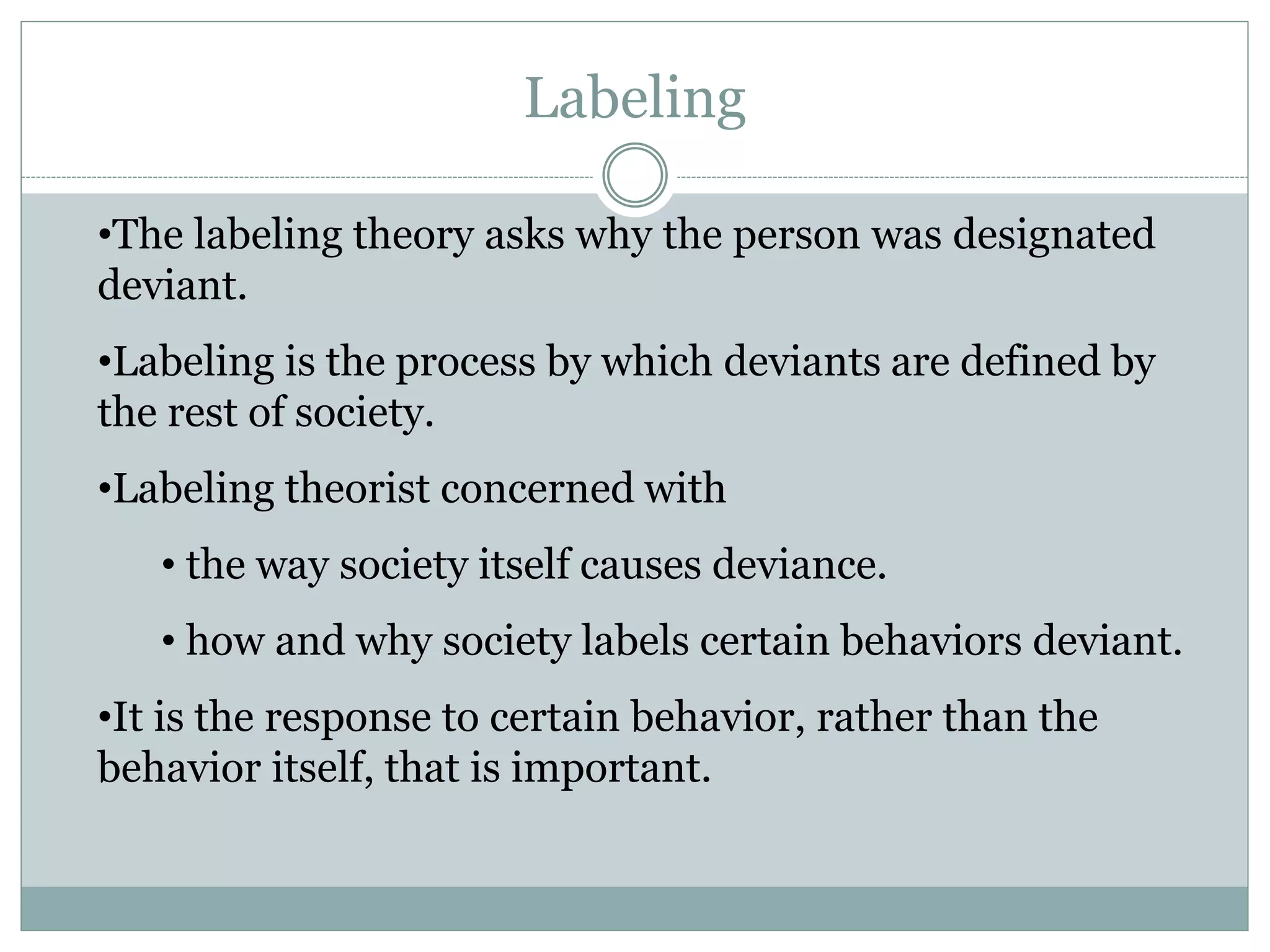
•The labeling theoryasks why the person was designated
deviant.
•Labeling is the process by which deviants are defined by
the rest of society.
•Labeling theorist concerned with
• the way society itself causes deviance.
• how and why society labels certain behaviors deviant.
•It is the response to certain behavior, rather than the
behavior itself, that is important.
Labeling
9.
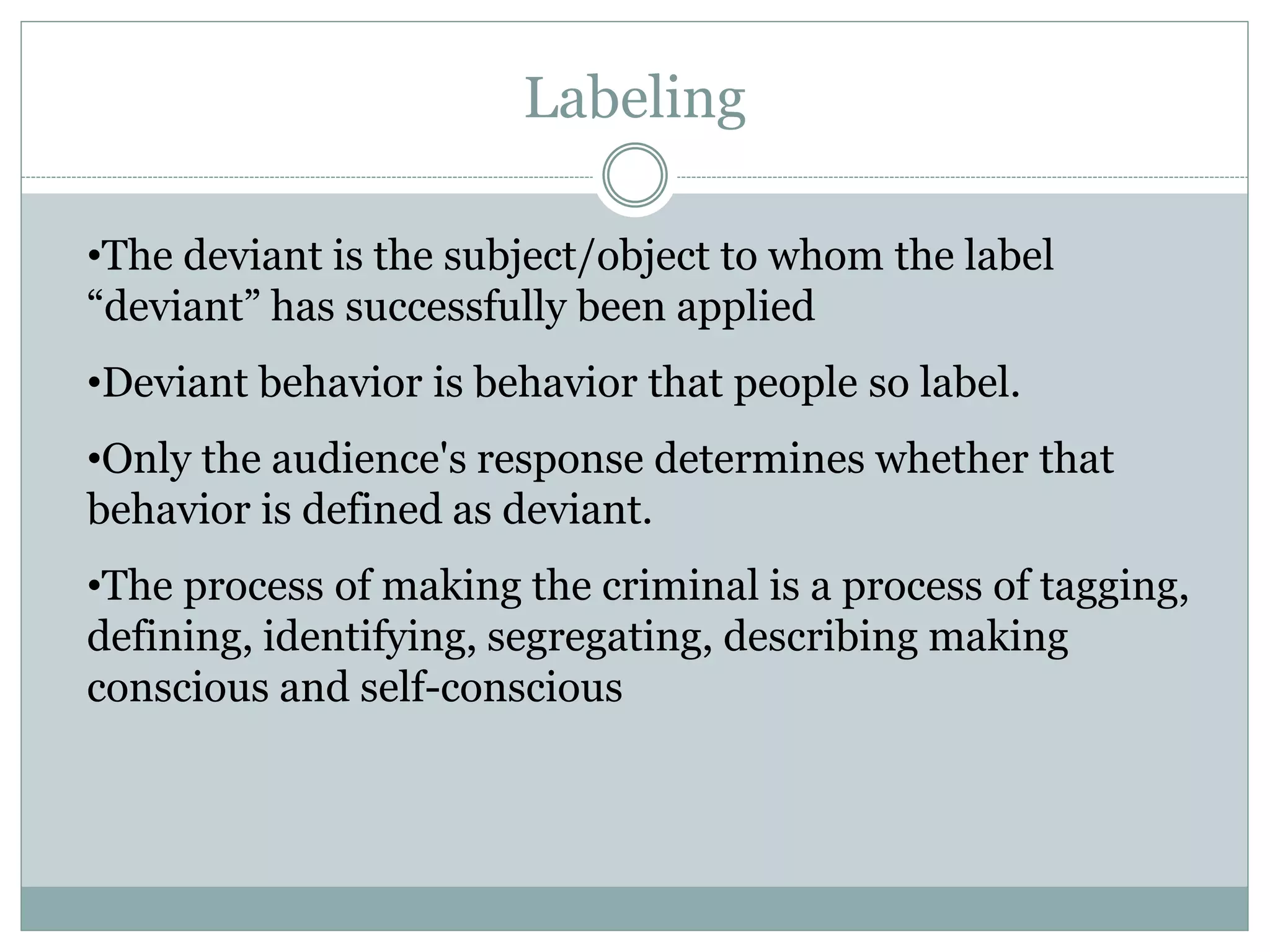
•The deviant isthe subject/object to whom the label
“deviant” has successfully been applied
•Deviant behavior is behavior that people so label.
•Only the audience's response determines whether that
behavior is defined as deviant.
•The process of making the criminal is a process of tagging,
defining, identifying, segregating, describing making
conscious and self-conscious
Labeling
10.
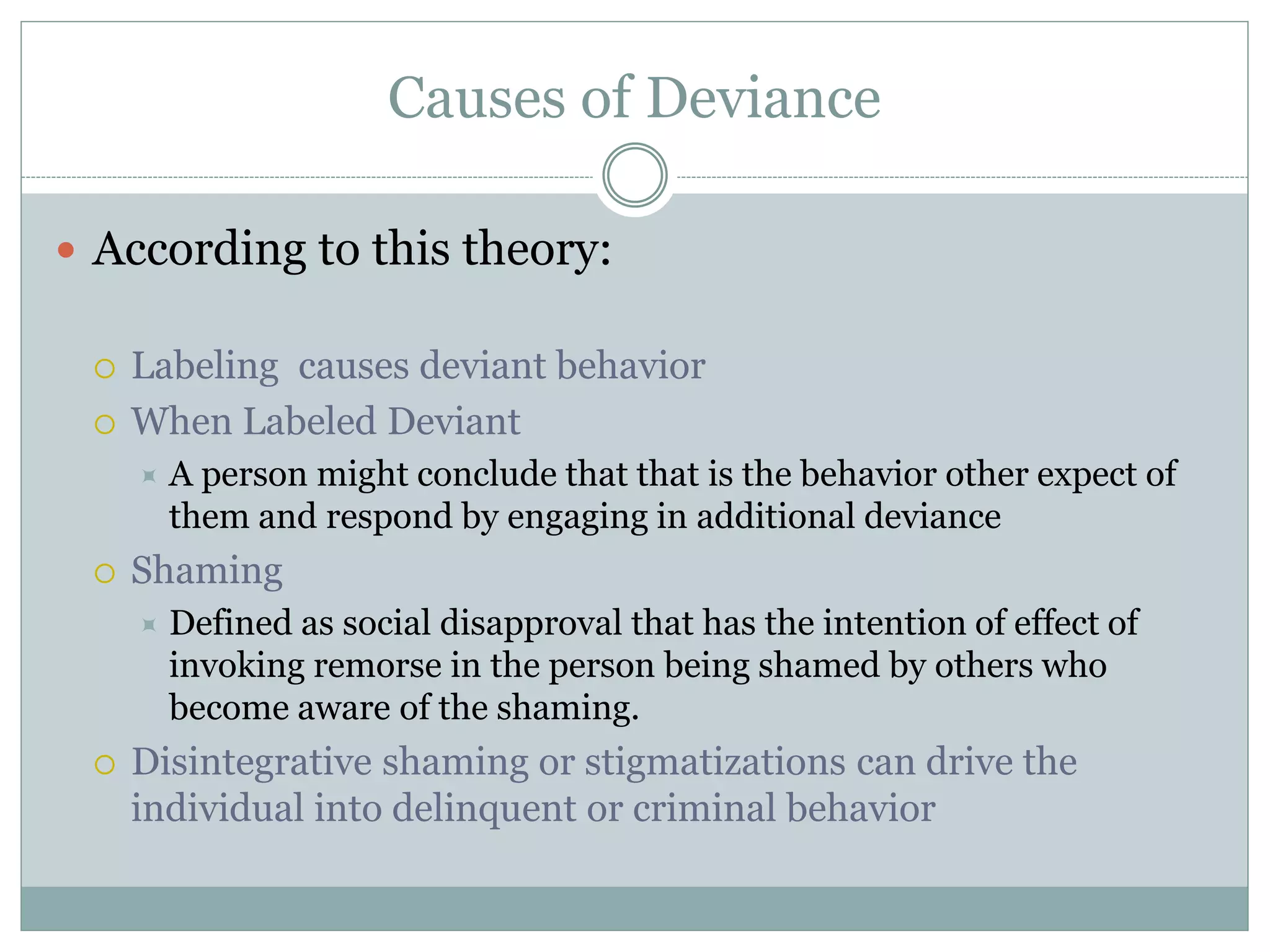
Causes of Deviance
According to this theory:
Labeling causes deviant behavior
When Labeled Deviant
A person might conclude that that is the behavior other expect of
them and respond by engaging in additional deviance
Shaming
Defined as social disapproval that has the intention of effect of
invoking remorse in the person being shamed by others who
become aware of the shaming.
Disintegrative shaming or stigmatizations can drive the
individual into delinquent or criminal behavior
11.
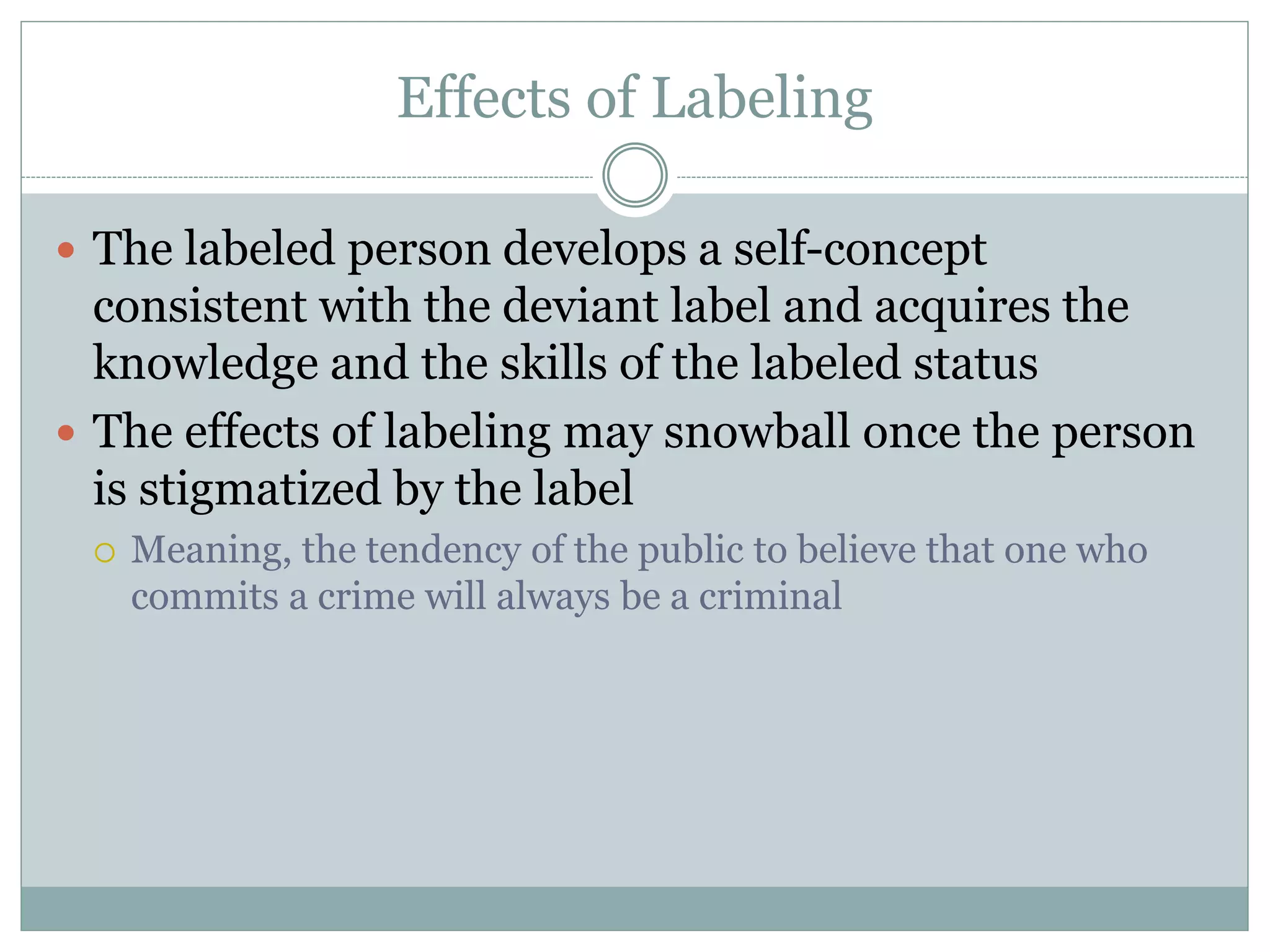
Effects of Labeling
The labeled person develops a self-concept
consistent with the deviant label and acquires the
knowledge and the skills of the labeled status
The effects of labeling may snowball once the person
is stigmatized by the label
Meaning, the tendency of the public to believe that one who
commits a crime will always be a criminal
12.
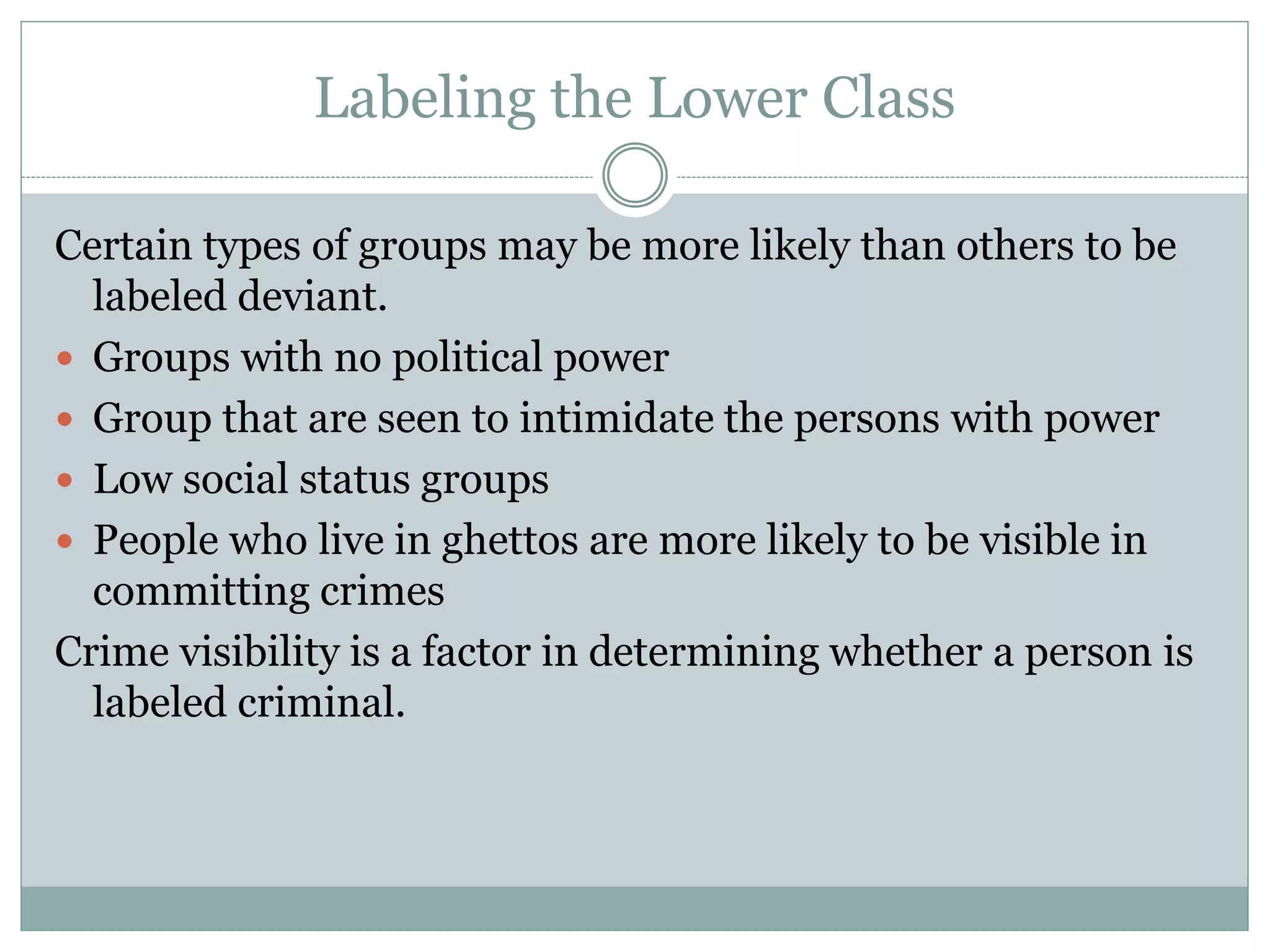
Labeling the LowerClass
Certain types of groups may be more likely than others to be
labeled deviant.
Groups with no political power
Group that are seen to intimidate the persons with power
Low social status groups
People who live in ghettos are more likely to be visible in
committing crimes
Crime visibility is a factor in determining whether a person is
labeled criminal.
13.
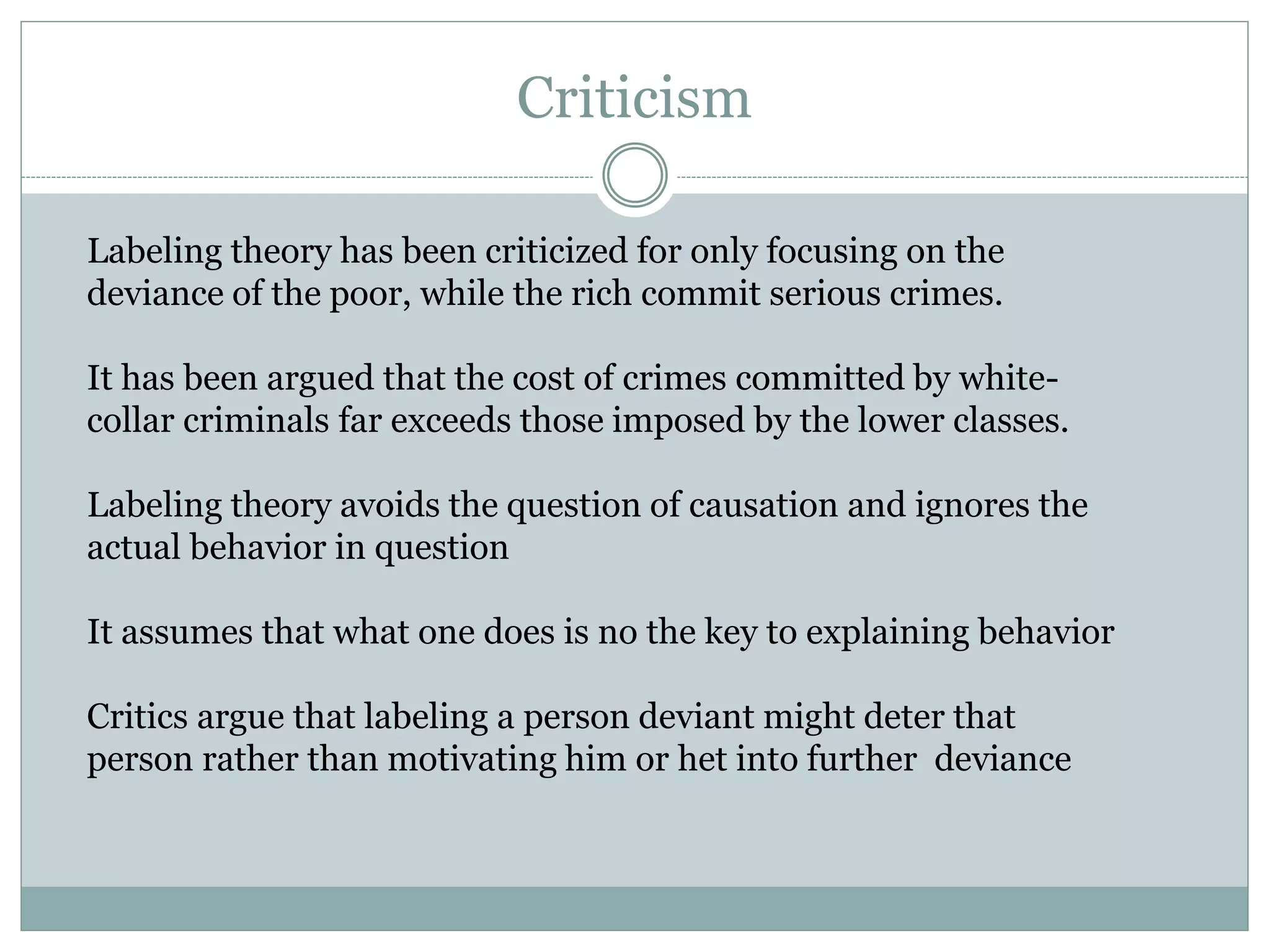
Labeling theory hasbeen criticized for only focusing on the
deviance of the poor, while the rich commit serious crimes.
It has been argued that the cost of crimes committed by white-
collar criminals far exceeds those imposed by the lower classes.
Labeling theory avoids the question of causation and ignores the
actual behavior in question
It assumes that what one does is no the key to explaining behavior
Critics argue that labeling a person deviant might deter that
person rather than motivating him or het into further deviance
Criticism
14.
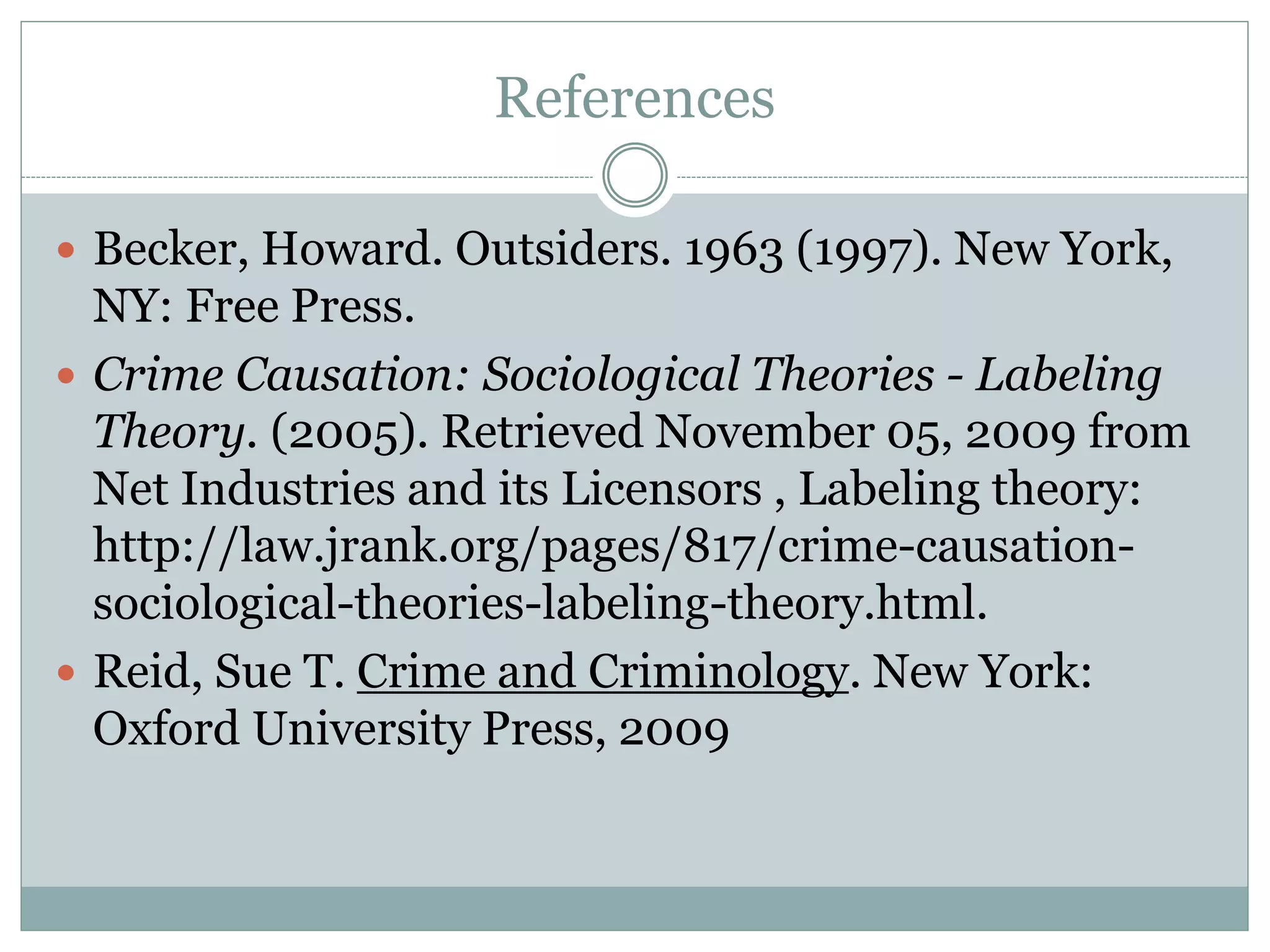
References
Becker, Howard.Outsiders. 1963 (1997). New York,
NY: Free Press.
Crime Causation: Sociological Theories - Labeling
Theory. (2005). Retrieved November 05, 2009 from
Net Industries and its Licensors , Labeling theory:
http://law.jrank.org/pages/817/crime-causation-
sociological-theories-labeling-theory.html.
Reid, Sue T. Crime and Criminology. New York:
Oxford University Press, 2009
Editor's Notes
#9 theory hypothesizes that the labels applied to individuals influence their behavior, particularly the application of negative or stigmatizing labels (such as "criminal" or "felon") promote deviant behavior, becoming a self-fulfilling prophecy,
#10 In other words, you are not a criminal unless someone else calls you a criminal