FEMINISM
Presented By: Musaib
WHAT IS FEMINISM?
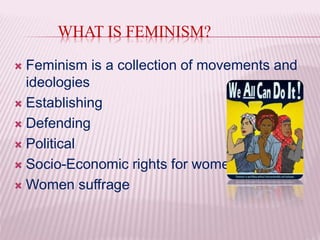
 Feminism is a collection of movements and
ideologies
 Establishing
 Defending
 Political
 Socio-Economic rights for women
 Women suffrage
HISTORY OF FEMINISM
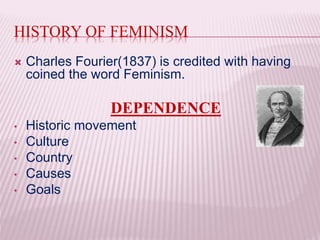
 Charles Fourier(1837) is credited with having
coined the word Feminism.
DEPENDENCE
• Historic movement
• Culture
• Country
• Causes
• Goals
FIRST WAVE OF FEMINISM
 Driven by combination of social, and
economic forces
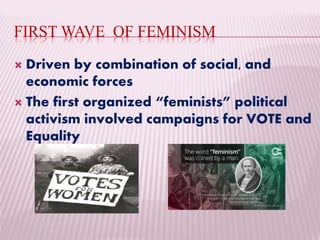
 The first organized “feminists” political
activism involved campaigns for VOTE and
Equality
SECOND WAY OF FEMINISM
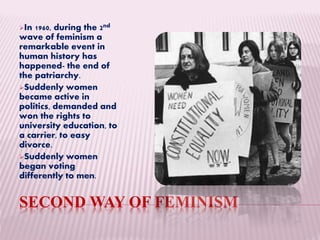
In 1960, during the 2nd
wave of feminism a
remarkable event in
human history has
happened- the end of
the patriarchy.
Suddenly women
became active in
politics, demanded and
won the rights to
university education, to
a carrier, to easy
divorce.
Suddenly women
began voting
differently to men.
THIRD WAVE OF FEMINISM
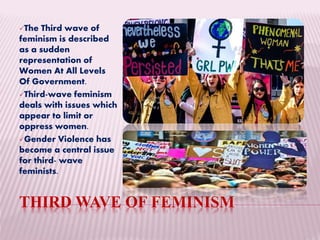
The Third wave of
feminism is described
as a sudden
representation of
Women At All Levels
Of Government.
Third-wave feminism
deals with issues which
appear to limit or
oppress women.
Gender Violence has
become a central issue
for third- wave
feminists.
FEMINIST THEORY
Feminist Theory is the
extension of feminism
into theoretical or
philosophical fields.
It encompasses work in
a variety of disciplines:]
I. Anthropology
II. Sociology
III. Economics and
women’s studies
IV. Literary criticism, art
history and
philosophy
 Feminist theory aims to understand
gender inequality and focuses on
gender politics, power relations. While
providing a critique of these social and
political relations, much of feminist
theory also focuses on women interest
and rights.
FEMINISM MOVEMENT AND IDEOLOGIES
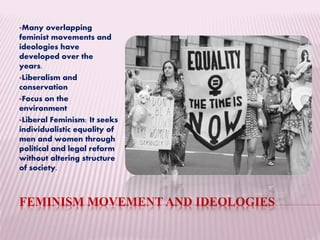
Many overlapping
feminist movements and
ideologies have
developed over the
years.
Liberalism and
conservation
Focus on the
environment
Liberal Feminism: It seeks
individualistic equality of
men and women through
political and legal reform
without altering structure
of society.
PHASES OF INDIAN FEMINISM
 PHASE ONE
 Phase one is marked Britain's colonization of India in around
1850.
 Conversion from Hinduism to Christianity is a complex
matter, with a lot of gender differences.
 Women following men, or women attempting a reprieve strict
gender roles associated with Hinduism.
 Often criticized for being started by British missionaries and converts.
 Worked to Combat Sati, infanticide, property rights and education. Also
strict gender roles of Hindi tradition was addressed.
PHASE TWO
 Phase two is marked by Gandhi's
resistance to the British Reign
i. Gandhi allowed women to participate in
resistance to the British Raj, giving them
the public sphere. Said to be the start of
true “feminism”.
 Creation of AIWC and NFIW
 Education,working,class women, very
anti-colonial
FIVE YEAR PLAN
 A type of welfare system designed to
empower women through means of
education, health care, and other aid.
 Became an “inclusionary” system
meaning of women were included in the
process as participants instead of
recipients.
 Paved way for other women’s
organizations from there on.
PHASE THREE
 Marked by India’s independence from
Britain in 1947 until now.
 Sexual divide in workplace, class
consciousness, patriarchy within religious
laws, female infanticide, violence against
women.
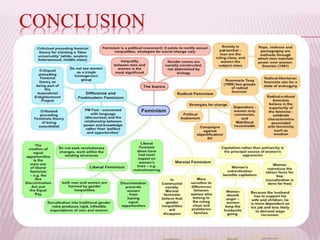
CONCLUSION

Feminism

  • 1.
  • 2.
    WHAT IS FEMINISM? Feminism is a collection of movements and ideologies  Establishing  Defending  Political  Socio-Economic rights for women  Women suffrage
  • 3.
    HISTORY OF FEMINISM Charles Fourier(1837) is credited with having coined the word Feminism. DEPENDENCE • Historic movement • Culture • Country • Causes • Goals
  • 4.
    FIRST WAVE OFFEMINISM  Driven by combination of social, and economic forces  The first organized “feminists” political activism involved campaigns for VOTE and Equality
  • 5.
    SECOND WAY OFFEMINISM In 1960, during the 2nd wave of feminism a remarkable event in human history has happened- the end of the patriarchy. Suddenly women became active in politics, demanded and won the rights to university education, to a carrier, to easy divorce. Suddenly women began voting differently to men.
  • 6.
    THIRD WAVE OFFEMINISM The Third wave of feminism is described as a sudden representation of Women At All Levels Of Government. Third-wave feminism deals with issues which appear to limit or oppress women. Gender Violence has become a central issue for third- wave feminists.
  • 7.
    FEMINIST THEORY Feminist Theoryis the extension of feminism into theoretical or philosophical fields. It encompasses work in a variety of disciplines:] I. Anthropology II. Sociology III. Economics and women’s studies IV. Literary criticism, art history and philosophy  Feminist theory aims to understand gender inequality and focuses on gender politics, power relations. While providing a critique of these social and political relations, much of feminist theory also focuses on women interest and rights.
  • 8.
    FEMINISM MOVEMENT ANDIDEOLOGIES Many overlapping feminist movements and ideologies have developed over the years. Liberalism and conservation Focus on the environment Liberal Feminism: It seeks individualistic equality of men and women through political and legal reform without altering structure of society.
  • 9.
    PHASES OF INDIANFEMINISM  PHASE ONE  Phase one is marked Britain's colonization of India in around 1850.  Conversion from Hinduism to Christianity is a complex matter, with a lot of gender differences.  Women following men, or women attempting a reprieve strict gender roles associated with Hinduism.  Often criticized for being started by British missionaries and converts.  Worked to Combat Sati, infanticide, property rights and education. Also strict gender roles of Hindi tradition was addressed.
  • 10.
    PHASE TWO  Phasetwo is marked by Gandhi's resistance to the British Reign i. Gandhi allowed women to participate in resistance to the British Raj, giving them the public sphere. Said to be the start of true “feminism”.  Creation of AIWC and NFIW  Education,working,class women, very anti-colonial
  • 11.
    FIVE YEAR PLAN A type of welfare system designed to empower women through means of education, health care, and other aid.  Became an “inclusionary” system meaning of women were included in the process as participants instead of recipients.  Paved way for other women’s organizations from there on.
  • 12.
    PHASE THREE  Markedby India’s independence from Britain in 1947 until now.  Sexual divide in workplace, class consciousness, patriarchy within religious laws, female infanticide, violence against women.
  • 13.