DEMOCRACY
learning objectives
• Define democracy and explain the forms it can take.
• Explain the difference between direct democracy and
representative (or indirect) democracy.
• Understand how citizens can participate in politics in
the UK effectively.
• Understand the system of democracy in the UK.
learning objectives
• Explain attempts to enhance democracy and
participation in the UK and analyse their success.
• Understand the role referendums play in the UK
politics.
what is democracy?
Democracy
Democracy is ‘rule by the people’ or ‘people power’. The
term has its origin in the Greek word dēmokratia – a union
of dēmos (meaning ‘people’) and kratos (meaning ‘power’.
Direct democracy
Under a direct model of democracy, citizens are afforded
a direct input into the policy-making process. In western
democracies, a degree of direct democracy is often
achieved through the use of referendums, where citizens
are given the opportunity to vote on whether a specific
proposal is adopted or rejected.
Representative democracy
In a representative (or indirect democracy), citizens elect
representatives who enact laws on their behalf. Under the
representative model there is no obligation on the part of
those elected to seek further approval from citizens before
they introduce new policies. Representatives are held
accountable through the ballot box at the next election.
Is direct democracy compatible with
representative democracy?
yes
Elected representatives often enjoy lengthy terms in
office (up to 5 years in the case of UK MPs). Referendums
and recalls make them more directly accountable
between elections, thereby enhancing representative
democracy.
yes
Many MPs simply toe the party line and do as the whips
tell them, rather than thinking for themselves and/or
representing the interests of their constituents.
Incorporating elements of direct democracy would
remind representatives of who they were elected to
serve.
no
Those elected to office are given a mandate to act on
behalf of voters, along the lines set out in their election
manifestos. Representative democracy should not feel
pressured into going back to the people in order to seek
approval for specific policies.
n0
Elected representatives are often better informed than
the general public. They have access to relevant
research and are able to educate themselves on the
merits and demerits of a particular course of action
before casting their vote in parliament. It is nonsensical
to leave key decisions to the broader public.
no
Representative democracy allows parliament to
implement policies that are necessary but unpopular –
the kinds of things that would not secure support if put
to a public ballot.
yes
Conventional representative democracy limits the
opportunities for meaningful participation between
elections. It is also said to contribute to political apathy.
Wider use of referendums and more ‘direct’ tools may
simulate participation and public debate; thus
reinvigorating representative democracy.
yes
Traditional representative democracy has a tendency
towards elitism. Direct democracy has the potential to
allow people to participate on a level playing field.
no
Representative government allows for ‘joined-up
government’ where individual policies are decided not in
isolation but with full consideration of potential knock-
on effects for other areas of policy. Wider use of
referendums would undermine joined-up government.
referendums
Referendum
A vote on a single issue put to a public ballot by the
government of the day. Referendums offer degree of
direct democracy. They are generally framed in form of 

a simple ‘yes/no’ question.
Do referendums enhance democracy?
yes
Referendums offer a more direct form of democracy. They
encourage participation by allowing citizens to have a
real input into key decisions that matter to them.
no
Referendums are inconsistent with representative
democracy and undermine the doctrine of parliamentary
sovereignty.
yes
They provide a way of focusing or renewing the mandate
on a particular issue or legitimising major constitutional
changes.
no
They can result in a ‘tyranny of the majority’ or even a
tyranny of a very organised minority, when turnout is
low.
yes
they can prevent dangerous decisions within political
parties over controversial issues. This prevents
governments from collapsing and thereby provides
greater continuity in government.xt
no
Excessive use of referendums can result in voter fatigue
and declining turnout.
Most issues are too complicated to be considered into
simple ‘yes/no’ question.
yes
They could be used to provide a clear and final answer
where parliament is deadlocked.
no
Different levels of funding and media access between
‘yes’ and ‘no’ camps might mean that the referendum is not
played out on a level playing field.
yes
They can provide a means by which tricky moral questions
are resolved.
no
Governments can schedule referendums and phrase
questions in a way that makes a favourable result more
likely.
no
Decisions are not always considered final. Governments
sometimes go back again and again until they get the
result they want.
why are referendums controversial in
the uk?
Topic
uk government holds referendums only when they are
relatively certain of securing the outcome they desire –
or where they have direct interest in going to the people.
Wording
the questions are often worded in a way as to encourage a
positive response. the Electoral Commission was granted
the authority to comment on the ineligibility of questions
posed in all future referendums under the Political
Parties, Elections and Referendums Act (2000).
Timing
Even when referendums are offered – and they are
offered rarely in the UK – those scheduling them
routinely delay them until such time they think they are
most likely to secure their desired outcome.
Funding
this has been more of an issue in the past. now Under the
Political Parties, Elections and Referendums Act (2000),
referendums in the UK are state funded, with the ‘yes’ and
‘no’ campaigns each receiving £600,000 public grant
Turnout
turnout at UK referendums is often very low, bringing
into question whether they should be held at all.
participation
Political participation
range of ways in which citizens can involve themselves in
the political process. it can be broadly categorised into
its electoral and non-electoral forms.
Franchise
the right to vote as established by parliamentary
statute. The vast majority of adult UK citizens have the
right to vote.
Electoral participation
Those who are eligible and registered to vote in a given
election are referred to collectively as the electorate.
differential turnout
Where the national turnout figure recorded at a given
election masks differences in turnout by constituency or
region.
What factors might account for variable
turnout?
Type of election
Voters are more likely to turn out to vote when they
value the institutions to which individuals are seeking to
be elected. This may account for the relatively low levels
of turnout witnessed at local elections.
Political apathy or disengagement
Increasing numbers of voters are coming to the
conclusion that elections make little difference,
particularly where the main UK political parties were
seen to be converging ideologically.
‘Hapathy’
A proportion of those who abstain do so because they are
happy with the status quo and do not, therefore, feel the
need to cast a ballot.
The relative value of a vote
those living in safe seats may feel that there is little
point in their voting because the result is already a
forgone conclusion. Those in marginal seats may be more
likely yo turn out and cast a ballot.
The electoral system in operation
Some voters may be more inclined to cast a ballot where
they think that their vote will be counted. Some argue
that turnout would be higher at UK general elections if
they were contested under a proportional electoral
system as opposed to a ‘winner-takes-all’ system such as
first-past-the-post.
The role of the mass media
Intense media coverage can have the effect of simulating
turnout in a particular election or constituency,
particularly where polling published in media appears to
suggest that the contest is close and every vote might
matter.
Non-electoral participation
other forms of political participation than electra
turnout.
Canvassing and leafleting
Large numbers of volunteers are mobilised at grassroots
level in support of the party’s election campaign.
Organising election events and
fundraising activities
Most election campaigns are funded locally, the major
exception being those in marginal constituencies at
general elections.
Staffing campaign offices
during elections a number of staff are employed in the
prospective MPs office and help with the election
campaign.
in what other ways can you get involved
in politics?
Writing to one’s elected representatives or
meeting with them in person
Constituents may write to their MP asking for advice or
support in relation to a particular problem, or seek to
meet the MP in person.
Having an ongoing membership of and/or
involvement in a political party
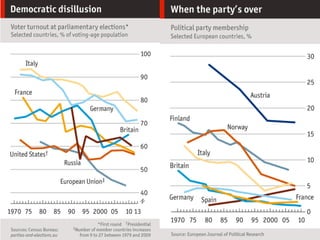
While the memberships of the main UK political parties
have fallen significantly in recent years, such
organisations still provide a significant avenue for
political participation.
Engaging in political protest or organised
pressure group activity
As party membership have fallen, so involvement in
pressure group activity of all shades has risen.
is there a participation crisis in the uk?
Participation crisis
The view that declining levels of political participation in
the UK threaten to undermine its democratic systems.
turnout varies considerably according to
variables such as:
• age
• gender
• social class
• ethnicity
reasons behind the participation
crisis
• a move away from traditional forms of participation
• Declining party membership
• The rise of consumer campaigns
Does political participation matter?
yes
On a simple level participation clearly matters because
low levels of political participation undermine the
legitimacy of political institutions and processes. In the
case of low electoral turnout, it brings the governing
party’s mandate into question.
Tackling the issue of low turnout
government could employ various initiatives to tackle
low turnout at elections.
Compulsory voting
Many countries require eligible voters not only to
register to vote (as in the case in the UK) but also to cast
a ballot on election day.
Reducing the voting age
it could reduce the voting age from 18 to 16. however,
Younger voters are statistically less likely to cast a
ballot than those who are older.
Is the UK democratic?
A critique of UK democracy
• the use of the first-past-the-post system at general elections
• the failure to properly reform parliament
• low levels of voter turnout and widespread disillusionment
with other traditional forms of participation, such as
membership of political parties and mainstream pressure groups
• the rise of (often extreme) single-issue pressure groups, and
groups that seek to destabilise or even overthrow the state
A critique of UK democracy
• the absence of a complete separation of powers and the
tendency towards executive dominance
• the transfer of government power away from elected
bodies, particularly local government, towards unelected
quangos and free-standing agencies
• the absence of a properly drafted bill of rights
incorporated within a codified and entrenched constitution

Week 1: Democracy

  • 1.
  • 2.
    learning objectives • Definedemocracy and explain the forms it can take. • Explain the difference between direct democracy and representative (or indirect) democracy. • Understand how citizens can participate in politics in the UK effectively. • Understand the system of democracy in the UK.
  • 3.
    learning objectives • Explainattempts to enhance democracy and participation in the UK and analyse their success. • Understand the role referendums play in the UK politics.
  • 4.
  • 5.
    Democracy Democracy is ‘ruleby the people’ or ‘people power’. The term has its origin in the Greek word dēmokratia – a union of dēmos (meaning ‘people’) and kratos (meaning ‘power’.
  • 6.
    Direct democracy Under adirect model of democracy, citizens are afforded a direct input into the policy-making process. In western democracies, a degree of direct democracy is often achieved through the use of referendums, where citizens are given the opportunity to vote on whether a specific proposal is adopted or rejected.
  • 7.
    Representative democracy In arepresentative (or indirect democracy), citizens elect representatives who enact laws on their behalf. Under the representative model there is no obligation on the part of those elected to seek further approval from citizens before they introduce new policies. Representatives are held accountable through the ballot box at the next election.
  • 8.
    Is direct democracycompatible with representative democracy?
  • 9.
    yes Elected representatives oftenenjoy lengthy terms in office (up to 5 years in the case of UK MPs). Referendums and recalls make them more directly accountable between elections, thereby enhancing representative democracy.
  • 10.
    yes Many MPs simplytoe the party line and do as the whips tell them, rather than thinking for themselves and/or representing the interests of their constituents. Incorporating elements of direct democracy would remind representatives of who they were elected to serve.
  • 11.
    no Those elected tooffice are given a mandate to act on behalf of voters, along the lines set out in their election manifestos. Representative democracy should not feel pressured into going back to the people in order to seek approval for specific policies.
  • 12.
    n0 Elected representatives areoften better informed than the general public. They have access to relevant research and are able to educate themselves on the merits and demerits of a particular course of action before casting their vote in parliament. It is nonsensical to leave key decisions to the broader public.
  • 13.
    no Representative democracy allowsparliament to implement policies that are necessary but unpopular – the kinds of things that would not secure support if put to a public ballot.
  • 14.
    yes Conventional representative democracylimits the opportunities for meaningful participation between elections. It is also said to contribute to political apathy. Wider use of referendums and more ‘direct’ tools may simulate participation and public debate; thus reinvigorating representative democracy.
  • 15.
    yes Traditional representative democracyhas a tendency towards elitism. Direct democracy has the potential to allow people to participate on a level playing field.
  • 16.
    no Representative government allowsfor ‘joined-up government’ where individual policies are decided not in isolation but with full consideration of potential knock- on effects for other areas of policy. Wider use of referendums would undermine joined-up government.
  • 17.
  • 18.
    Referendum A vote ona single issue put to a public ballot by the government of the day. Referendums offer degree of direct democracy. They are generally framed in form of 
 a simple ‘yes/no’ question.
  • 19.
  • 20.
    yes Referendums offer amore direct form of democracy. They encourage participation by allowing citizens to have a real input into key decisions that matter to them.
  • 21.
    no Referendums are inconsistentwith representative democracy and undermine the doctrine of parliamentary sovereignty.
  • 22.
    yes They provide away of focusing or renewing the mandate on a particular issue or legitimising major constitutional changes.
  • 23.
    no They can resultin a ‘tyranny of the majority’ or even a tyranny of a very organised minority, when turnout is low.
  • 24.
    yes they can preventdangerous decisions within political parties over controversial issues. This prevents governments from collapsing and thereby provides greater continuity in government.xt
  • 25.
    no Excessive use ofreferendums can result in voter fatigue and declining turnout. Most issues are too complicated to be considered into simple ‘yes/no’ question.
  • 26.
    yes They could beused to provide a clear and final answer where parliament is deadlocked.
  • 27.
    no Different levels offunding and media access between ‘yes’ and ‘no’ camps might mean that the referendum is not played out on a level playing field.
  • 28.
    yes They can providea means by which tricky moral questions are resolved.
  • 29.
    no Governments can schedulereferendums and phrase questions in a way that makes a favourable result more likely.
  • 30.
    no Decisions are notalways considered final. Governments sometimes go back again and again until they get the result they want.
  • 31.
    why are referendumscontroversial in the uk?
  • 32.
    Topic uk government holdsreferendums only when they are relatively certain of securing the outcome they desire – or where they have direct interest in going to the people.
  • 33.
    Wording the questions areoften worded in a way as to encourage a positive response. the Electoral Commission was granted the authority to comment on the ineligibility of questions posed in all future referendums under the Political Parties, Elections and Referendums Act (2000).
  • 34.
    Timing Even when referendumsare offered – and they are offered rarely in the UK – those scheduling them routinely delay them until such time they think they are most likely to secure their desired outcome.
  • 35.
    Funding this has beenmore of an issue in the past. now Under the Political Parties, Elections and Referendums Act (2000), referendums in the UK are state funded, with the ‘yes’ and ‘no’ campaigns each receiving £600,000 public grant
  • 36.
    Turnout turnout at UKreferendums is often very low, bringing into question whether they should be held at all.
  • 37.
  • 38.
    Political participation range ofways in which citizens can involve themselves in the political process. it can be broadly categorised into its electoral and non-electoral forms.
  • 39.
    Franchise the right tovote as established by parliamentary statute. The vast majority of adult UK citizens have the right to vote.
  • 40.
    Electoral participation Those whoare eligible and registered to vote in a given election are referred to collectively as the electorate.
  • 41.
    differential turnout Where thenational turnout figure recorded at a given election masks differences in turnout by constituency or region.
  • 42.
    What factors mightaccount for variable turnout?
  • 43.
    Type of election Votersare more likely to turn out to vote when they value the institutions to which individuals are seeking to be elected. This may account for the relatively low levels of turnout witnessed at local elections.
  • 44.
    Political apathy ordisengagement Increasing numbers of voters are coming to the conclusion that elections make little difference, particularly where the main UK political parties were seen to be converging ideologically.
  • 45.
    ‘Hapathy’ A proportion ofthose who abstain do so because they are happy with the status quo and do not, therefore, feel the need to cast a ballot.
  • 46.
    The relative valueof a vote those living in safe seats may feel that there is little point in their voting because the result is already a forgone conclusion. Those in marginal seats may be more likely yo turn out and cast a ballot.
  • 47.
    The electoral systemin operation Some voters may be more inclined to cast a ballot where they think that their vote will be counted. Some argue that turnout would be higher at UK general elections if they were contested under a proportional electoral system as opposed to a ‘winner-takes-all’ system such as first-past-the-post.
  • 48.
    The role ofthe mass media Intense media coverage can have the effect of simulating turnout in a particular election or constituency, particularly where polling published in media appears to suggest that the contest is close and every vote might matter.
  • 49.
    Non-electoral participation other formsof political participation than electra turnout.
  • 50.
    Canvassing and leafleting Largenumbers of volunteers are mobilised at grassroots level in support of the party’s election campaign.
  • 51.
    Organising election eventsand fundraising activities Most election campaigns are funded locally, the major exception being those in marginal constituencies at general elections.
  • 52.
    Staffing campaign offices duringelections a number of staff are employed in the prospective MPs office and help with the election campaign.
  • 53.
    in what otherways can you get involved in politics?
  • 54.
    Writing to one’selected representatives or meeting with them in person Constituents may write to their MP asking for advice or support in relation to a particular problem, or seek to meet the MP in person.
  • 55.
    Having an ongoingmembership of and/or involvement in a political party While the memberships of the main UK political parties have fallen significantly in recent years, such organisations still provide a significant avenue for political participation.
  • 56.
    Engaging in politicalprotest or organised pressure group activity As party membership have fallen, so involvement in pressure group activity of all shades has risen.
  • 57.
    is there aparticipation crisis in the uk?
  • 58.
    Participation crisis The viewthat declining levels of political participation in the UK threaten to undermine its democratic systems.
  • 60.
    turnout varies considerablyaccording to variables such as: • age • gender • social class • ethnicity
  • 61.
    reasons behind theparticipation crisis • a move away from traditional forms of participation • Declining party membership • The rise of consumer campaigns
  • 62.
  • 63.
    yes On a simplelevel participation clearly matters because low levels of political participation undermine the legitimacy of political institutions and processes. In the case of low electoral turnout, it brings the governing party’s mandate into question.
  • 64.
    Tackling the issueof low turnout government could employ various initiatives to tackle low turnout at elections.
  • 65.
    Compulsory voting Many countriesrequire eligible voters not only to register to vote (as in the case in the UK) but also to cast a ballot on election day.
  • 66.
    Reducing the votingage it could reduce the voting age from 18 to 16. however, Younger voters are statistically less likely to cast a ballot than those who are older.
  • 67.
    Is the UKdemocratic?
  • 68.
    A critique ofUK democracy • the use of the first-past-the-post system at general elections • the failure to properly reform parliament • low levels of voter turnout and widespread disillusionment with other traditional forms of participation, such as membership of political parties and mainstream pressure groups • the rise of (often extreme) single-issue pressure groups, and groups that seek to destabilise or even overthrow the state
  • 69.
    A critique ofUK democracy • the absence of a complete separation of powers and the tendency towards executive dominance • the transfer of government power away from elected bodies, particularly local government, towards unelected quangos and free-standing agencies • the absence of a properly drafted bill of rights incorporated within a codified and entrenched constitution