1. Theories of crime and
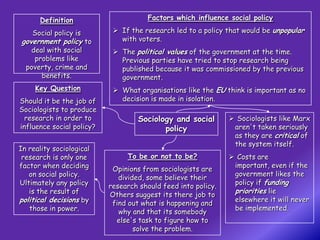
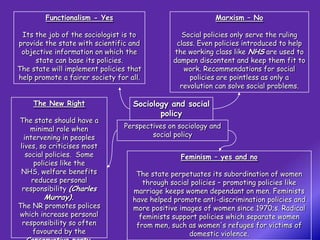
               deviance
        Key questions:
                                          Key information
1.   What is crime and
     deviance?                     Definitions of crime and
                                      deviance, social construction
                                      and biological explanations.
2.   Why do people commit
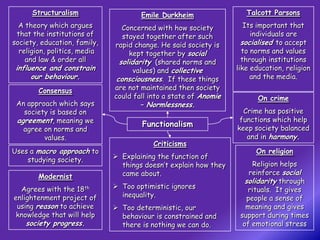
                                     Functionalism – Durkheim &
     crime?
                                      Merton
                                     Subcultural strain theory
3.   What happens if a person        Labelling theory
     is labelled as a criminal?      Marxism and Neo-Marxism
                                      (white collar crime)
4.   Are crime statistics            Left and Right Realism
     valid?
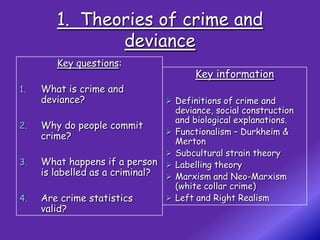
Crime                  Deviance             Deviant not
                                                      criminal
 Any act which breaks        Behaviour which                                  Deviant and
      the laws of            moves away from        Burping, not               criminal
society, such as murder         conventional          queuing
        or rape.             norms and values                                Rape, murder
                              such as burping    Criminal not deviant        , paedophilia
   Social control is
                               and farting in
enforced by agencies                             Speeding, parking on
such as police and the             public.
                                                     yellow lines
       courts.
 Biological explanations            Definitions and
 Early criminologists like           explanations              Crime and deviance as
Cesare Lombroso sort to                                               relative
  find physical criminal
characteristics like long     Crime as socially constructed
                                                                   Crime and deviance is
     arms or sloping
                             If what is consider to be crime       relative (changing) in
foreheads. Sociologists
                              and deviance changes it can’t        relation to time, place
   find such ‘born bad’
                              be inherently wrong but must         and culture. What one
 determinism dangerous
                                  be culturally specific.           society may see as a
 and prefer to normalise
                             This means crime and deviance           crime another may
  crime by reminding us
                               is socially constructed i.e.        not, such as polygamy
that we all commit crime
                               created and defined by the           (many wives). Other
   and there are social
                             people of that society and not             examples are
 factors which influence
                                         universal.                  homosexuality and
      our behaviour.
                                                                           suicide.
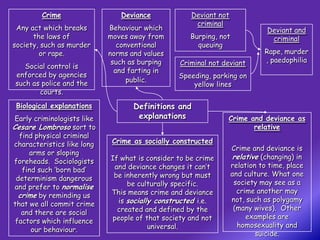
Durkheim – Key ideas                 Crime and society              Positive functions of
                                                                               crime
1. Crime is inevitable and        Society is only healthy when
   necessary to society.           social order is maintained      1. Re-marking social
                                     through the police and           boundaries – affirms
2. Crime has positive
                                    courts. We need a small           social norms and
   functions.
                                   amount of crime to remind          values.
3. The perfect amount               us of what we believe in.
                                                                   2. Media coverage – as
   of crime will keep             Only a small minority will be
                                                                      a warning to others.
   society healthy and            self-interested and commit
   avoid anomie                              crime.                3. Social bonds –
   (Normlessness)                                                     strengthened as we
                                                                      unite in disapproval.
                                          Functionalism
                                            on crime               4. Safety Value – a
          Criticisms                                                  little bit of deviance
                                                                      reduces more serious
 What is the perfect amount             Society of saints            problems –
of crime?                                                             Prostitution – Kingley
                                        Imagine there was no          Davis.
Explaining the functions of           crime or deviance, even
crime doesn’t explain what             the most slight slip like   5. Malfunctioning
caused them in the first place.       coughing without putting        society – theft, drug
                                         your hand over your          use and truancy alert
Murder maybe functional for            mouth would become a          us to other social
society but what about the                      crime.                problems in society.
victim?
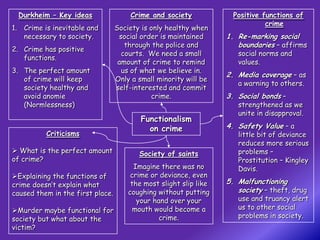
Merton - Key idea
                                                        1. The goals of
 People engage in                                     society – American
deviant behaviour        Deviance is the
                                                            Dream
  when they are           result of the
unable to achieve        strain between
socially approved                                     2. Your legitimate
      goals.                                          means of achieving
                                                            them


   1. Conformity                                     Strain produces
                            Five               frustration which creates a
Most of America not                             pressure to deviate, what
                         adaptations
 criminal or deviant                            Merton calls the strain to
                                                         anomie.
              Deviant adaptations

     Innovation               Retreatism                         Explanation
 Criminal behaviour      Habitual drug users
  as an adaptation         and alcoholics                       lower class and
                                                             ethnic minorities are
                                                                 more likely to
                                                             commit criminal acts
      Ritualism                Rebellion                       because of their
  People in dead end                                         position in the social

                            Karl Marx and                         structure.
         jobs.            Martin Luther King
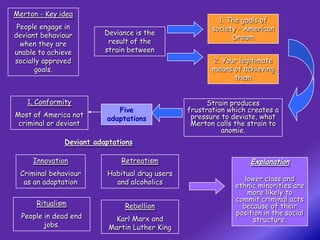
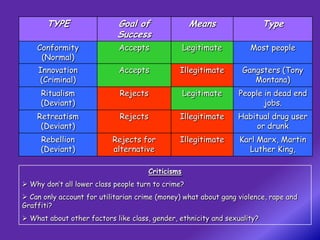
TYPE                 Goal of                 Means                 Type
                            Success
    Conformity               Accepts               Legitimate       Most people
     (Normal)
    Innovation               Accepts           Illegitimate       Gangsters (Tony
    (Criminal)                                                       Montana)
     Ritualism               Rejects               Legitimate    People in dead end
     (Deviant)                                                          jobs.
    Retreatism               Rejects           Illegitimate      Habitual drug user
     (Deviant)                                                       or drunk
     Rebellion             Rejects for         Illegitimate      Karl Marx, Martin
     (Deviant)             alternative                             Luther King,

                                      Criticisms
 Why don’t all lower class people turn to crime?
 Can only account for utilitarian crime (money) what about gang violence, rape and
Graffiti?
 What about other factors like class, gender, ethnicity and sexuality?
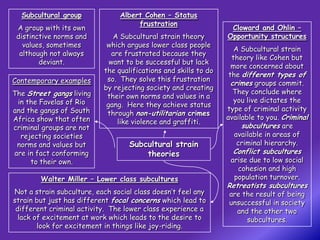
Subcultural group             Albert Cohen – Status
                                     frustration
 A group with its own                                             Cloward and Ohlin –
 distinctive norms and        A Subcultural strain theory        Opportunity structures
   values, sometimes        which argues lower class people
                                                                    A Subcultural strain
  although not always         are frustrated because they
                                                                   theory like Cohen but
        deviant.             want to be successful but lack
                                                                   more concerned about
                           the qualifications and skills to do
                                                                  the different types of
Contemporary examples       so. They solve this frustration
                                                                   crimes groups commit.
                           by rejecting society and creating
The Street gangs living                                             They conclude where
                            their own norms and values in a
 in the Favelas of Rio                                              you live dictates the
                            gang. Here they achieve status
and the gangs of South                                           type of criminal activity
                            through non-utilitarian crimes
Africa show that often                                           available to you. Criminal
                                like violence and graffiti.
criminal groups are not                                               subcultures are
  rejecting societies                                               available in areas of
 norms and values but              Subcultural strain                criminal hierarchy.
are in fact conforming                 theories                    Conflict subcultures
     to their own.                                                arise due to low social
                                                                    cohesion and high
        Walter Miller – Lower class subcultures                    population turnover.
                                                                 Retreatists subcultures
Not a strain subculture, each social class doesn’t feel any      are the result of being
strain but just has different focal concerns which lead to       unsuccessful in society
 different criminal activity. The lower class experience a         and the other two
  lack of excitement at work which leads to the desire to             subcultures.
        look for excitement in things like joy-riding.
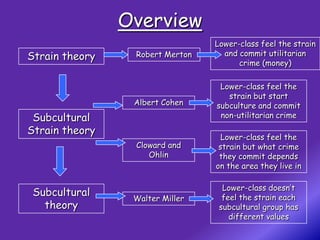
Overview
                                 Lower-class feel the strain
Strain theory    Robert Merton     and commit utilitarian
                                       crime (money)

                                  Lower-class feel the
                                    strain but start
                 Albert Cohen    subculture and commit
 Subcultural                      non-utilitarian crime
Strain theory
                                   Lower-class feel the
                 Cloward and      strain but what crime
                    Ohlin         they commit depends
                                 on the area they live in

                                   Lower-class doesn’t
 Subcultural                       feel the strain each
                 Walter Miller
   theory                         subcultural group has
                                     different values
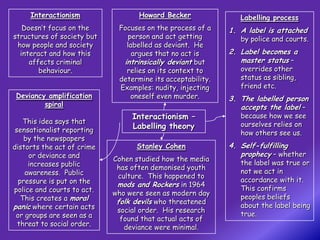
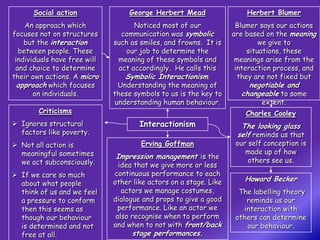
Interactionism                Howard Becker               Labelling process
   Doesn’t focus on the      Focuses on the process of a    1. A label is attached
structures of society but       person and act getting         by police and courts.
 how people and society        labelled as deviant. He
  interact and how this          argues that no act is      2. Label becomes a
     affects criminal         intrinsically deviant but        master status –
        behaviour.             relies on its context to        overrides other
                             determine its acceptability.      status as sibling,
                             Examples: nudity, injecting       friend etc.
 Deviancy amplification          oneself even murder.       3. The labelled person
         spiral                                                accepts the label –
                                 Interactionism –              because how we see
    This idea says that                                        ourselves relies on
 sensationalist reporting
                                 Labelling theory
                                                               how others see us.
    by the newspapers
distorts the act of crime         Stanley Cohen             4. Self-fulfilling
     or deviance and                                           prophecy – whether
                            Cohen studied how the media
     increases public                                          the label was true or
                             has often demonised youth
    awareness. Public                                          not we act in
                             culture. This happened to
  pressure is put on the                                       accordance with it.
                             mods and Rockers in 1964
police and courts to act.                                      This confirms
                            who were seen as modern day
   This creates a moral                                        peoples beliefs
                             folk devils who threatened
panic where certain acts                                       about the label being
                             social order. His research
 or groups are seen as a                                       true.
                              found that actual acts of
  threat to social order.      deviance were minimal.
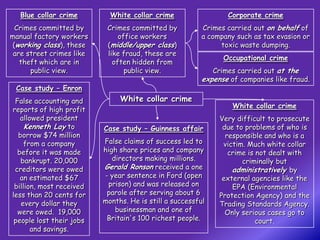
Blue collar crime        White collar crime                  Corporate crime
 Crimes committed by       Crimes committed by           Crimes carried out on behalf of
manual factory workers         office workers            a company such as tax evasion or
(working class), these     (middle/upper class)               toxic waste dumping.
 are street crimes like    like fraud, these are
                                                               Occupational crime
   theft which are in        often hidden from
      public view.               public view.               Crimes carried out at the
                                                         expense of companies like fraud.
 Case study – Enron
 False accounting and          White collar crime
                                                                  White collar crime
reports of high profit
   allowed president                                          Very difficult to prosecute
     Kenneth Lay to       Case study – Guinness affair         due to problems of who is
  borrow $74 million                                            responsible and who is a
    from a company        False claims of success led to       victim. Much white collar
  before it was made      high share prices and company          crime is not dealt with
   bankrupt. 20,000          directors making millions.              criminally but
 creditors were owed      Gerald Ronson received a one            administratively by
   an estimated $67       - year sentence in Ford (open        external agencies like the
 billion, most received    prison) and was released on            EPA (Environmental
less than 20 cents for     parole after serving about 6       Protection Agency) and the
   every dollar they      months. He is still a successful    Trading Standards Agency.
  were owed. 19,000           businessman and one of            Only serious cases go to
 people lost their jobs    Britain's 100 richest people.                  court.
       and savings.
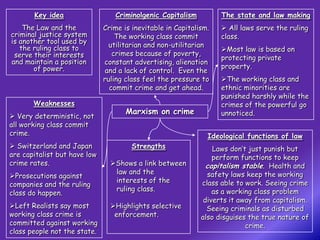
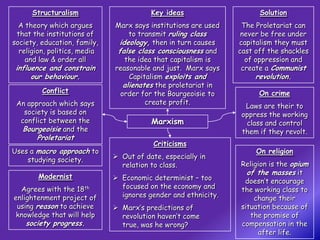
Key idea                  Criminolgenic Capitalism          The state and law making
    The Law and the           Crime is inevitable in Capitalism.    All laws serve the ruling
criminal justice system           The working class commit         class.
is another tool used by
   the ruling class to          utilitarian and non-utilitarian
                                                                   Most law is based on
 serve their interests           crimes because of poverty,
                                                                   protecting private
and maintain a position       constant advertising, alienation
       of power.                                                   property.
                               and a lack of control. Even the
                              ruling class feel the pressure to    The working class and
                                commit crime and get ahead.        ethnic minorities are
                                                                   punished harshly while the
       Weaknesses                                                  crimes of the powerful go
                                     Marxism on crime              unnoticed.
 Very deterministic, not
all working class commit
crime.                                                         Ideological functions of law
 Switzerland and Japan                Strengths                 Laws don’t just punish but
are capitalist but have low                                      perform functions to keep
crime rates.                    Shows a link between          capitalism stable. Health and
                                 law and the                   safety laws keep the working
Prosecutions against
                                 interests of the            class able to work. Seeing crime
companies and the ruling
                                 ruling class.                   as a working class problem
class do happen.
                                                              diverts it away from capitalism.
Left Realists say most         Highlights selective          Seeing criminals as disturbed
working class crime is           enforcement.                also disguises the true nature of
committed against working                                                  crime.
class people not the state.
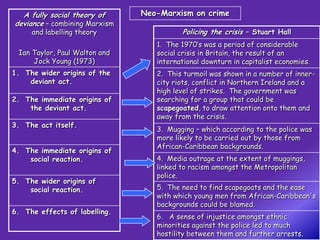
A fully social theory of     Neo-Marxism on crime
deviance – combining Marxism
     and labelling theory                Policing the crisis – Stuart Hall
                                  1. The 1970’s was a period of considerable
 Ian Taylor, Paul Walton and      social crisis in Britain, the result of an
     Jock Young (1973)            international downturn in capitalist economies.
1. The wider origins of the       2. This turmoil was shown in a number of inner-
    deviant act.                  city riots, conflict in Northern Ireland and a
                                  high level of strikes. The government was
2. The immediate origins of       searching for a group that could be
    the deviant act.              scapegoated, to draw attention onto them and
                                  away from the crisis.
3. The act itself.
                                  3. Mugging – which according to the police was
                                  more likely to be carried out by those from
                                  African-Caribbean backgrounds.
4. The immediate origins of
    social reaction.              4. Media outrage at the extent of muggings,
                                  linked to racism amongst the Metropolitan
                                  police.
5. The wider origins of
    social reaction.              5. The need to find scapegoats and the ease
                                  with which young men from African-Caribbean's
                                  backgrounds could be blamed.
6. The effects of labelling.
                                  6. A sense of injustice amongst ethnic
                                  minorities against the police led to much
                                  hostility between them and further arrests.
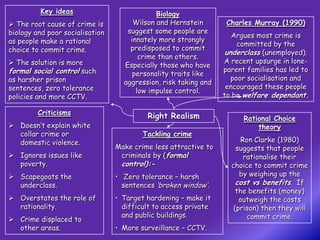
Key ideas                          Biology
 The root cause of crime is          Wilson and Hernstein        Charles Murray (1990)
biology and poor socialisation      suggest some people are
                                                                    Argues most crime is
as people make a rational            innately more strongly
                                                                      committed by the
choice to commit crime.              predisposed to commit
                                                                  underclass (unemployed).
                                        crime than others.
 The solution is more                                           A recent upsurge in lone-
                                   Especially those who have
formal social control such                                       parent families has led to
                                      personality traits like
as harsher prison                                                   poor socialisation and
                                   aggression, risk taking and
sentences, zero tolerance                                         encouraged these people
                                       low impulse control.
policies and more CCTV.                                          to be welfare dependant.

         Criticisms                       Right Realism                Rational Choice
 Doesn’t explain white                                                    theory
  collar crime or                        Tackling crime
  domestic violence.                                                   Ron Clarke (1980)
                                 Make crime less attractive to       suggests that people
 Ignores issues like             criminals by (formal                  rationalise their
  poverty.                        control):-                       choice to commit crime
 Scapegoats the                 • Zero tolerance – harsh             by weighing up the
  underclass.                      sentences ‘broken window’.        cost vs benefits. If
                                                                     the benefits (money)
 Overstates the role of         • Target hardening – make it         outweigh the costs
  rationality.                     difficult to access private      (prison) then they will
                                   and public buildings.                 commit crime.
 Crime displaced to
  other areas.                   • More surveillance – CCTV.
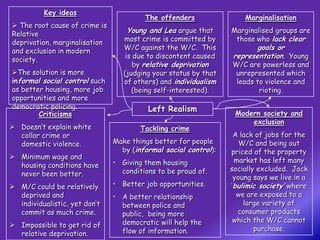
Key ideas
                                        The offenders                Marginalisation
 The root cause of crime is
Relative                          Young and Lea argue that       Marginalised groups are
deprivation, marginalisation      most crime is committed by      those who lack clear
and exclusion in modern           W/C against the W/C. This             goals or
society.                           is due to discontent caused   representation. Young
                                      by relative deprivation    W/C are powerless and
The solution is more             (judging your status by that    unrepresented which
informal social control such      of others) and individualism    leads to violence and
as better housing, more job          (being self-interested).            rioting.
opportunities and more
democratic policing.                     Left Realism
        Criticisms                                                Modern society and
                                                                      exclusion
 Doesn’t explain white                Tackling crime
  collar crime or                                                 A lack of jobs for the
  domestic violence.           Make things better for people        W/C and being out
                                 by (informal social control):   priced of the property
 Minimum wage and
                               • Giving them housing              market has left many
  housing conditions have                                        socially excluded. Jock
  never been better.             conditions to be proud of.
                                                                  young says we live in a
 M/C could be relatively      • Better job opportunities.       ‘bulimic society’ where
  deprived and                 • A better relationship             we are exposed to a
  individualistic, yet don’t     between police and                  large variety of
  commit as much crime.          public, being more                consumer products
                                 democratic will help the         which the W/C cannot
 Impossible to get rid of                                               purchase.
  relative deprivation.          flow of information.
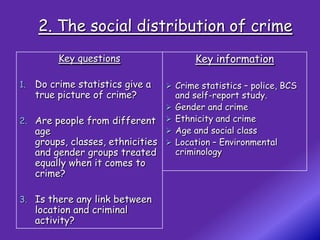
2. The social distribution of crime
          Key questions                     Key information

1.   Do crime statistics give a      Crime statistics – police, BCS
     true picture of crime?             and self-report study.
                                       Gender and crime
2. Are people from different           Ethnicity and crime
     age                               Age and social class
     groups, classes, ethnicities      Location – Environmental
     and gender groups treated          criminology
     equally when it comes to
     crime?

3. Is there any link between
     location and criminal
     activity?
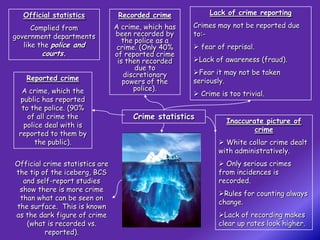
Official statistics            Recorded crime           Lack of crime reporting

      Complied from             A crime, which has   Crimes may not be reported due
government departments          been recorded by     to:-
                                   the police as a
   like the police and           crime. (Only 40%     fear of reprisal.
        courts.                 of reported crime
                                 is then recorded    Lack of awareness (fraud).
                                       due to
                                   discretionary     Fear it may not be taken
   Reported crime                  powers of the     seriously.
  A crime, which the                  police).
                                                      Crime is too trivial.
 public has reported
  to the police. (90%
    of all crime the                 Crime statistics
                                                               Inaccurate picture of
   police deal with is
                                                                       crime
 reported to them by
       the public).                                           White collar crime dealt
                                                             with administratively.
Official crime statistics are                                 Only serious crimes
the tip of the iceberg, BCS                                  from incidences is
  and self-report studies                                    recorded.
 show there is more crime
                                                             Rules for counting always
 than what can be seen on
                                                             change.
the surface. This is known
as the dark figure of crime                                  Lack of recording makes
   (what is recorded vs.                                     clear up rates look higher.
         reported).
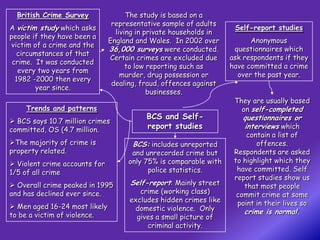
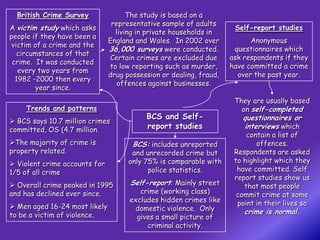
British Crime Survey               The study is based on a
                                representative sample of adults
A victim study which asks                                           Self-report studies
                                 living in private households in
people if they have been a
                               England and Wales. In 2002 over           Anonymous
victim of a crime and the
                               36,000 surveys were conducted.       questionnaires which
  circumstances of that
                               Certain crimes are excluded due     ask respondents if they
 crime. It was conducted
                                     to low reporting such as      have committed a crime
   every two years from
                                   murder, drug possession or        over the past year.
  1982 -2000 then every
                                dealing, fraud, offences against
        year since.
                                            businesses.
                                                                    They are usually based
     Trends and patterns                                              on self-completed
                                          BCS and Self-               questionnaires or
 BCS says 10.7 million crimes
committed, OS (4.7 million.               report studies              interviews which
                                                                        contain a list of
The majority of crime is             BCS: includes unreported             offences.
property related.                     and unrecorded crime but      Respondents are asked
 Violent crime accounts for         only 75% is comparable with    to highlight which they
1/5 of all crime                           police statistics.        have committed. Self
                                                                    report studies show us
 Overall crime peaked in 1995       Self-report: Mainly street        that most people
and has declined ever since.            crime (working class)        commit crime at some
                                     excludes hidden crimes like     point in their lives so
 Men aged 16-24 most likely          domestic violence. Only
to be a victim of violence.                                            crime is normal.
                                       gives a small picture of
                                          criminal activity.
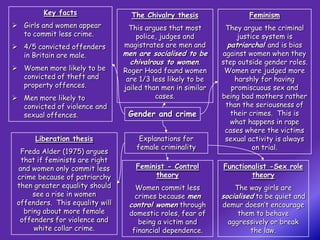
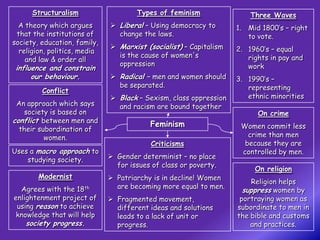
Key facts                 The Chivalry thesis                Feminism
 Girls and women appear          This argues that most        They argue the criminal
  to commit less crime.             police, judges and             justice system is
 4/5 convicted offenders        magistrates are men and        patriarchal and is bias
  in Britain are male.           men are socialised to be     against women when they
                                   chivalrous to women.       step outside gender roles.
 Women more likely to be        Roger Hood found women        Women are judged more
  convicted of theft and          are 1/3 less likely to be       harshly for having
  property offences.             jailed than men in similar      promiscuous sex and
 Men more likely to                       cases.             being bad mothers rather
  convicted of violence and                                    than the seriousness of
  sexual offences.                Gender and crime               their crimes. This is
                                                                 what happens in rape
                                                               cases where the victims
      Liberation thesis               Explanations for         sexual activity is always
                                     female criminality                 on trial.
  Freda Alder (1975) argues
  that if feminists are right
 and women only commit less         Feminist - Control        Functionalist -Sex role
 crime because of patriarchy             theory                       theory
 then greater equality should       Women commit less             The way girls are
      see a rise in women           crimes because men        socialised to be quiet and
 offenders. This equality will    control women through       demur doesn’t encourage
   bring about more female        domestic roles, fear of          them to behave
  offenders for violence and         being a victim and         aggressively or break
      white collar crime.          financial dependence.               the law.
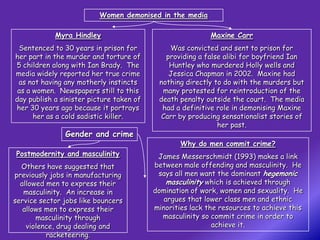
Women demonised in the media

            Myra Hindley                                   Maxine Carr
 Sentenced to 30 years in prison for          Was convicted and sent to prison for
her part in the murder and torture of        providing a false alibi for boyfriend Ian
5 children along with Ian Brady. The          Huntley who murdered Holly wells and
media widely reported her true crime          Jessica Chapman in 2002. Maxine had
 as not having any motherly instincts      nothing directly to do with the murders but
 as a women. Newspapers still to this       many protested for reintroduction of the
day publish a sinister picture taken of    death penalty outside the court. The media
her 30 years ago because it portrays        had a definitive role in demonising Maxine
      her as a cold sadistic killer.       Carr by producing sensationalist stories of
                                                             her past.
               Gender and crime
                                                  Why do men commit crime?
Postmodernity and masculinity              James Messerschmidt (1993) makes a link
  Others have suggested that              between male offending and masculinity. He
previously jobs in manufacturing           says all men want the dominant hegemonic
  allowed men to express their               masculinity which is achieved through
   masculinity. An increase in            domination of work, women and sexuality. He
service sector jobs like bouncers            argues that lower class men and ethnic
   allows men to express their            minorities lack the resources to achieve this
       masculinity through                  masculinity so commit crime in order to
    violence, drug dealing and                              achieve it.
          racketeering.
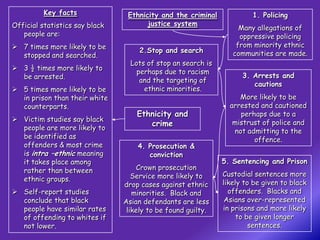
Key facts               Ethnicity and the criminal            1. Policing
Official statistics say black          justice system
                                                                   Many allegations of
   people are:                                                     oppressive policing
 7 times more likely to be                                       from minority ethnic
                                     2.Stop and search           communities are made.
  stopped and searched.
                                  Lots of stop an search is
 3 ½ times more likely to
                                    perhaps due to racism
  be arrested.                                                      3. Arrests and
                                     and the targeting of
                                                                       cautions
 5 times more likely to be           ethnic minorities.
  in prison than their white                                       More likely to be
  counterparts.                                                 arrested and cautioned
                                    Ethnicity and                  perhaps due to a
 Victim studies say black                                       mistrust of police and
                                       crime
  people are more likely to                                      not admitting to the
  be identified as                                                     offence.
  offenders & most crime            4. Prosecution &
  is intra –ethnic meaning             conviction
  it takes place among                                        5. Sentencing and Prison
  rather than between                Crown prosecution
                                   Service more likely to     Custodial sentences more
  ethnic groups.
                                drop cases against ethnic     likely to be given to black
 Self-report studies              minorities. Black and        offenders. Blacks and
  conclude that black           Asian defendants are less      Asians over-represented
  people have similar rates      likely to be found guilty.   in prisons and more likely
  of offending to whites if                                        to be given longer
  not lower.                                                           sentences.
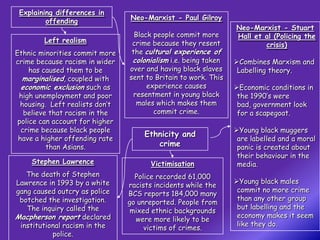
Explaining differences in
         offending               Neo-Marxist - Paul Gilroy
                                                                 Neo-Marxist - Stuart
                                   Black people commit more      Hall et al (Policing the
        Left realism              crime because they resent              crisis)
Ethnic minorities commit more     the cultural experience of
crime because racism in wider     colonialism i.e. being taken   Combines Marxism and
     has caused them to be       over and having black slaves     Labelling theory.
  marginalised, coupled with     sent to Britain to work. This
  economic exclusion such as           experience causes         Economic conditions in
 high unemployment and poor        resentment in young black      the 1990’s were
  housing. Left realists don’t      males which makes them        bad, government look
   believe that racism in the            commit crime.            for a scapegoat.
 police can account for higher
  crime because black people                                     Young black muggers
                                      Ethnicity and
 have a higher offending rate                                     are labelled and a moral
          than Asians.                   crime                    panic is created about
                                                                  their behaviour in the
    Stephen Lawrence                   Victimisation              media.
   The death of Stephen            Police recorded 61,000
Lawrence in 1993 by a white                                      Young black males
                                 racists incidents while the
gang caused outcry as police                                      commit no more crime
                                 BCS reports 184,000 many
 botched the investigation.                                       than any other group
                                 go unreported. People from
   The inquiry called the                                         but labelling and the
                                  mixed ethnic backgrounds
Macpherson report declared                                        economy makes it seem
                                   were more likely to be
 institutional racism in the                                      like they do.
                                      victims of crimes.
           police.
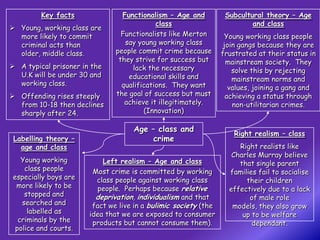
Key facts               Functionalism – Age and          Subcultural theory – Age
                                            class                         and class
 Young, working class are
  more likely to commit          Functionalists like Merton       Young working class people
  criminal acts than              say young working class        join gangs because they are
  older, middle class.         people commit crime because       frustrated at their status in
                                they strive for success but       mainstream society. They
 A typical prisoner in the         lack the necessary              solve this by rejecting
  U.K will be under 30 and         educational skills and           mainstream norms and
  working class.                 qualifications. They want         values, joining a gang and
 Offending rises steeply      the goal of success but must       achieving a status through
  from 10-18 then declines        achieve it illegitimately.        non-utilitarian crimes.
  sharply after 24.                     (Innovation)

                                    Age – class and
                                                                     Right realism – class
 Labelling theory –                     crime
   age and class                                                      Right realists like
                                                                    Charles Murray believe
    Young working          Left realism – Age and class               that single parent
     class people       Most crime is committed by working         families fail to socialise
 especially boys are     class people against working class             their children
  more likely to be       people. Perhaps because relative         effectively due to a lack
     stopped and         deprivation, individualism and that             of male role
    searched and        fact we live in a bulimic society (the      models, they also grow
      labelled as      idea that we are exposed to consumer            up to be welfare
   criminals by the     products but cannot consume them).                dependant.
  police and courts.
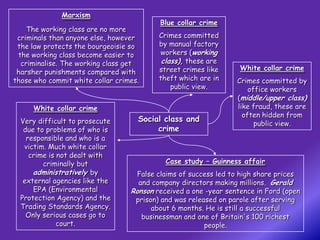
Marxism
                                          Blue collar crime
    The working class are no more
 criminals than anyone else, however      Crimes committed
 the law protects the bourgeoisie so      by manual factory
 the working class become easier to        workers (working
  criminalise. The working class get       class), these are
                                          street crimes like      White collar crime
 harsher punishments compared with
those who commit white collar crimes.     theft which are in     Crimes committed by
                                              public view.           office workers
                                                                 (middle/upper class)
     White collar crime                                          like fraud, these are
                                                                   often hidden from
  Very difficult to prosecute       Social class and
                                                                       public view.
   due to problems of who is             crime
    responsible and who is a
   victim. Much white collar
     crime is not dealt with
         criminally but                     Case study – Guinness affair
      administratively by          False claims of success led to high share prices
   external agencies like the       and company directors making millions. Gerald
      EPA (Environmental          Ronson received a one -year sentence in Ford (open
  Protection Agency) and the       prison) and was released on parole after serving
  Trading Standards Agency.             about 6 months. He is still a successful
    Only serious cases go to         businessman and one of Britain's 100 richest
              court.                                    people.
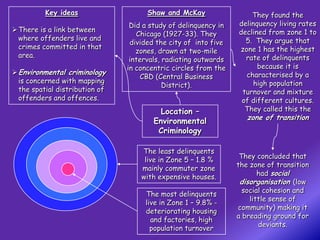
Key ideas                   Shaw and McKay                 They found the
                                 Did a study of delinquency in   delinquency living rates
 There is a link between                                        declined from zone 1 to
                                   Chicago (1927-33). They
  where offenders live and                                         5. They argue that
                                 divided the city of into five
  crimes committed in that                                       zone 1 has the highest
                                   zones, drawn at two-mile
  area.                                                            rate of delinquents
                                 intervals, radiating outwards
                                in concentric circles from the         because it is
 Environmental criminology                                        characterised by a
                                    CBD (Central Business
  is concerned with mapping                                           high population
                                            District).
  the spatial distribution of                                     turnover and mixture
  offenders and offences.                                         of different cultures.
                                          Location –               They called this the
                                                                    zone of transition
                                        Environmental
                                         Criminology

                                    The least delinquents
                                     live in Zone 5 – 1.8 %       They concluded that
                                    mainly commuter zone         the zone of transition
                                    with expensive houses.              had social
                                                                  disorganisation (low
                                                                   social cohesion and
                                     The most delinquents
                                                                     little sense of
                                     live in Zone 1 – 9.8% -
                                                                 community) making it
                                     deteriorating housing
                                                                 a breading ground for
                                       and factories, high
                                                                        deviants.
                                       population turnover
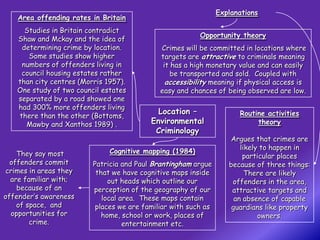
Explanations
    Area offending rates in Britain
      Studies in Britain contradict
                                                          Opportunity theory
    Shaw and Mckay and the idea of
     determining crime by location.           Crimes will be committed in locations where
       Some studies show higher               targets are attractive to criminals meaning
     numbers of offenders living in            it has a high monetary value and can easily
     council housing estates rather               be transported and sold. Coupled with
    than city centres (Morris 1957).            accessibility meaning if physical access is
    One study of two council estates          easy and chances of being observed are low.
    separated by a road showed one
    had 300% more offenders living
                                             Location –                Routine activities
    there than the other (Bottoms,
      Mawby and Xanthos 1989) .            Environmental                    theory
                                            Criminology
                                                                    Argues that crimes are
                                                                        likely to happen in
    They say most              Cognitive mapping (1984)
                                                                         particular places
  offenders commit        Patricia and Paul Brantingham argue       because of three things:
 crimes in areas they      that we have cognitive maps inside             There are likely
  are familiar with;           out heads which outline our           offenders in the area,
    because of an         perception of the geography of our         attractive targets and
offender’s awareness         local area. These maps contain           an absence of capable
    of space, and          places we are familiar with such as       guardians like property
  opportunities for          home, school or work, places of                  owners.
        crime.                      entertainment etc.
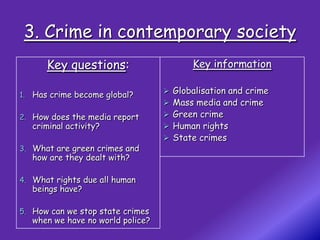
3. Crime in contemporary society
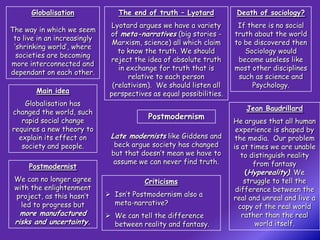
      Key questions:                       Key information

1. Has crime become global?           Globalisation and crime
                                      Mass media and crime
2. How does the media report          Green crime
   criminal activity?                 Human rights
                                      State crimes
3. What are green crimes and
   how are they dealt with?

4. What rights due all human
   beings have?

5. How can we stop state crimes
   when we have no world police?
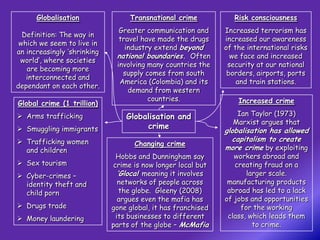
Globalisation               Transnational crime            Risk consciousness
                               Greater communication and      Increased terrorism has
  Definition: The way in
                               travel have made the drugs     increased our awareness
 which we seem to live in
                                 industry extend beyond       of the international risks
an increasingly ‘shrinking
                              national boundaries. Often        we face and increased
 world’, where societies
                              involving many countries the     security at our national
   are becoming more
                                supply comes from south        borders, airports, ports
   interconnected and
                               America (Colombia) and its         and train stations.
dependant on each other.
                                  demand from western
                                        countries.                Increased crime
Global crime (1 trillion)
 Arms trafficking               Globalisation and               Ian Taylor (1973)
                                                                Marxist argues that
 Smuggling immigrants                crime
                                                              globalisation has allowed
 Trafficking women                                             capitalism to create
                                    Changing crime
  and children                                                more crime by exploiting
                              Hobbs and Dunningham say           workers abroad and
 Sex tourism                crime is now longer local but       creating fraud on a
 Cyber-crimes –               ‘Glocal’ meaning it involves          larger scale.
  identity theft and           networks of people across       manufacturing products
  child porn                    the globe. Gleeny (2008)       abroad has led to a lack
                               argues even the mafia has      of jobs and opportunities
 Drugs trade                gone global, it has franchised        for the working
 Money laundering            its businesses to different      class, which leads them
                             parts of the globe – McMafia              to crime.
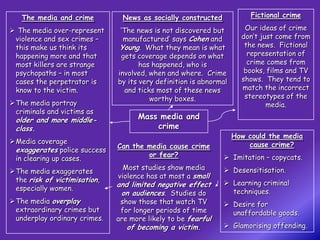
The media and crime         News as socially constructed             Fictional crime

 The media over-represent     ‘The news is not discovered but        Our ideas of crime
 violence and sex crimes –      manufactured’ says Cohen and         don’t just come from
 this make us think its        Young. What they mean is what          the news. Fictional
 happening more and that       gets coverage depends on what           representation of
 most killers are strange            has happened, who is              crime comes from
 psychopaths – in most        involved, when and where. Crime         books, films and TV
 cases the perpetrator is     by its very definition is abnormal     shows. They tend to
 know to the victim.             and ticks most of these news        match the incorrect
                                         worthy boxes.                stereotypes of the
The media portray                                                           media.
 criminals and victims as
 older and more middle-             Mass media and
 class.                                 crime
                                                                   How could the media
Media coverage                                                        cause crime?
                              Can the media cause crime
 exaggerates police success
                                      or fear?                 Imitation – copycats.
 in clearing up cases.
                                Most studies show media        Desensitisation.
The media exaggerates
                              violence has at most a small
 the risk of victimisation,                                    Learning criminal
                              and limited negative effect
 especially women.                                              techniques.
                               on audiences. Studies do
The media overplay            show those that watch TV        Desire for
 extraordinary crimes but      for longer periods of time       unaffordable goods.
 underplay ordinary crimes.   are more likely to be fearful
                                 of becoming a victim.         Glamorising offending.
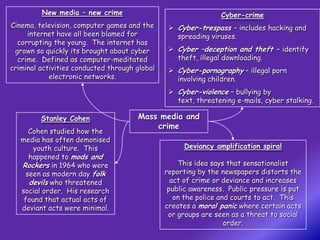
New media – new crime                                  Cyber-crime
Cinema, television, computer games and the       Cyber-trespass – includes hacking and
     internet have all been blamed for            spreading viruses.
  corrupting the young. The internet has
 grown so quickly its brought about cyber        Cyber –deception and theft – identify
  crime. Defined as computer-meditated            theft, illegal downloading.
criminal activities conducted through global     Cyber-pornography – illegal porn
            electronic networks.                  involving children.
                                                 Cyber-violence – bullying by
                                                  text, threatening e-mails, cyber stalking.

         Stanley Cohen                Mass media and
                                          crime
      Cohen studied how the
   media has often demonised
       youth culture. This                          Deviancy amplification spiral
      happened to mods and
   Rockers in 1964 who were                        This idea says that sensationalist
     seen as modern day folk                   reporting by the newspapers distorts the
      devils who threatened                      act of crime or deviance and increases
   social order. His research                   public awareness. Public pressure is put
    found that actual acts of                     on the police and courts to act. This
   deviant acts were minimal.                  creates a moral panic where certain acts
                                                or groups are seen as a threat to social
                                                                  order.
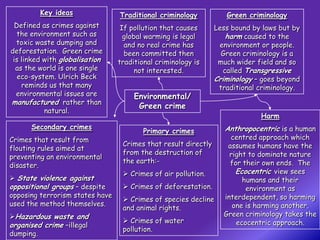
Key ideas               Traditional criminology           Green criminology
  Defined as crimes against       If pollution that causes      Less bound by laws but by
   the environment such as         global warming is legal          harm caused to the
  toxic waste dumping and          and no real crime has         environment or people.
deforestation. Green crime         been committed then            Green criminology is a
 is linked with globalisation    traditional criminology is      much wider field and so
  as the world is one single           not interested.             called Transgressive
   eco-system. Ulrich Beck                                      Criminology – goes beyond
    reminds us that many                                         traditional criminology.
  environmental issues are            Environmental/
manufactured rather than
                                       Green crime
           natural.
                                                                             Harm
      Secondary crimes                                             Anthropocentric is a human
                                         Primary crimes
Crimes that result from                                             centred approach which
                                  Crimes that result directly      assumes humans have the
flouting rules aimed at
                                  from the destruction of           right to dominate nature
preventing an environmental
                                  the earth:-                       for their own ends. The
disaster.
                                   Crimes of air pollution.          Ecocentric view sees
 State violence against                                                humans and their
oppositional groups – despite      Crimes of deforestation.             environment as
opposing terrorism states have                                    interdependent, so harming
                                   Crimes of species decline
used the method themselves.                                          one is harming another.
                                  and animal rights.
Hazardous waste and                                              Green criminology takes the
                                   Crimes of water                   ecocentric approach.
organised crime –illegal
                                  pollution.
dumping.
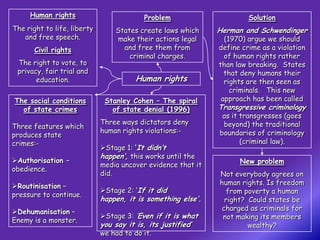
Human rights                         Problem                      Solution
The right to life, liberty       States create laws which     Herman and Schwendinger
   and free speech.              make their actions legal      (1970) argue we should
       Civil rights                and free them from         define crime as a violation
                                     criminal charges.          of human rights rather
 The right to vote, to                                        than law breaking. States
 privacy, fair trial and                                        that deny humans their
       education.                       Human rights            rights are then seen as
                                                                  criminals. This new
The social conditions         Stanley Cohen – The spiral       approach has been called
  of state crimes               of state denial (1996)        Transgressive criminology
                                                               as it transgresses (goes
                             Three ways dictators deny         beyond) the traditional
Three features which
                             human rights violations:-        boundaries of criminology
produces state
crimes:-                                                             (criminal law).
                             Stage 1: ‘It didn’t
                             happen’, this works until the
Authorisation –                                                    New problem
                             media uncover evidence that it
obedience.
                             did.                             Not everybody agrees on
Routinisation –                                              human rights. Is freedom
                             Stage 2: ‘If it did                from poverty a human
pressure to continue.
                             happen, it is something else’.     right? Could states be
Dehumanisation –                                              charged as criminals for
                             Stage 3: ‘Even if it is what     not making its members
Enemy is a monster.
                             you say it is, its justified’             wealthy?
                             we had to do it.
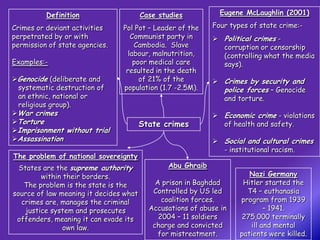
Definition                    Case studies           Eugene McLaughlin (2001)

Crimes or deviant activities    Pol Pot – Leader of the      Four types of state crime:-
perpetrated by or with             Communist party in         Political crimes -
permission of state agencies.       Cambodia. Slave            corruption or censorship
                                  labour, malnutrition,        (controlling what the media
Examples:-                          poor medical care          says).
                                 resulted in the death
Genocide (deliberate and             of 21% of the           Crimes by security and
 systematic destruction of      population (1.7 -2.5M).        police forces – Genocide
 an ethnic, national or                                        and torture.
 religious group).
War crimes                                                   Economic crime - violations
Torture                                State crimes           of health and safety.
Imprisonment without trial
Assassination                                                Social and cultural crimes
                                                               - institutional racism.
The problem of national sovereignty
  States are the supreme authority              Abu Ghraib
         within their borders.                                          Nazi Germany
    The problem is the state is the         A prison in Baghdad       Hitler started the
source of law meaning it decides what      Controlled by US led        T4 – euthanasia
   crimes are, manages the criminal           coalition forces.      program from 1939
    justice system and prosecutes         Accusations of abuse in            – 1941.
 offenders, meaning it can evade its         2004 – 11 soldiers       275,000 terminally
                own law.                   charge and convicted         ill and mental
                                             for mistreatment.       patients were killed.
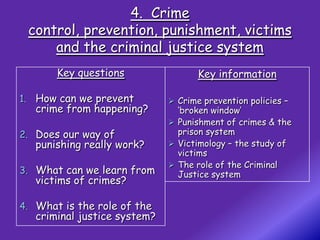
4. Crime
 control, prevention, punishment, victims
     and the criminal justice system
       Key questions                 Key information

1. How can we prevent          Crime prevention policies –
   crime from happening?        ‘broken window’
                               Punishment of crimes & the
2. Does our way of              prison system
   punishing really work?      Victimology – the study of
                                victims
                               The role of the Criminal
3. What can we learn from       Justice system
   victims of crimes?

4. What is the role of the
   criminal justice system?
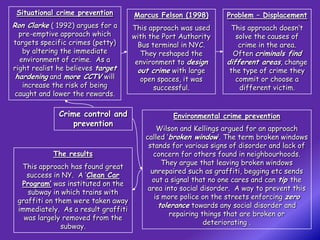
Situational crime prevention        Marcus Felson (1998)       Problem – Displacement
Ron Clarke ( 1992) argues for a      This approach was used      This approach doesn’t
  pre-emptive approach which         with the Port Authority       solve the causes of
targets specific crimes (petty)        Bus terminal in NYC.         crime in the area.
   by altering the immediate            They reshaped the         Often criminals find
  environment of crime. As a          environment to design     different areas, change
right realist he believes target       out crime with large      the type of crime they
 hardening and more CCTV will           open spaces, it was        commit or choose a
   increase the risk of being               successful.             different victim.
caught and lower the rewards.

              Crime control and                  Environmental crime prevention
                  prevention
                                            Wilson and Kellings argued for an approach
                                        called ‘broken window’. The term broken windows
                                         stands for various signs of disorder and lack of
            The results                    concern for others found in neighbourhoods.
                                              They argue that leaving broken windows
  This approach has found great
                                          unrepaired such as graffiti, begging etc sends
    success in NY. A ‘Clean Car
                                          out a signal that no one cares and can tip the
  Program’ was instituted on the
                                         area into social disorder. A way to prevent this
    subway in which trains with
                                           is more police on the streets enforcing zero
 graffiti on them were taken away
                                             tolerance towards any social disorder and
 immediately. As a result graffiti
                                                 repairing things that are broken or
   was largely removed from the
                                                            deteriorating .
               subway.
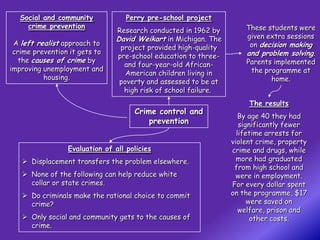
Social and community            Perry pre-school project
     crime prevention                                                These students were
                                Research conducted in 1962 by
                                David Weikart in Michigan. The       given extra sessions
 A left realist approach to                                           on decision making
                                 project provided high-quality
 crime prevention it gets to                                         and problem solving.
                                pre-school education to three-
   the causes of crime by                                            Parents implemented
                                  and four-year-old African-
improving unemployment and                                            the programme at
                                   American children living in
          housing.                                                          home.
                                 poverty and assessed to be at
                                  high risk of school failure.
                                                                      The results
                                     Crime control and
                                                                    By age 40 they had
                                         prevention                 significantly fewer
                                                                   lifetime arrests for
                                                                 violent crime, property
                 Evaluation of all policies                      crime and drugs, while
    Displacement transfers the problem elsewhere.                 more had graduated
                                                                  from high school and
    None of the following can help reduce white                   were in employment.
     collar or state crimes.                                     For every dollar spent
    Do criminals make the rational choice to commit             on the programme, $17
     crime?                                                            were saved on
                                                                    welfare, prison and
    Only social and community gets to the causes of                    other costs.
     crime.
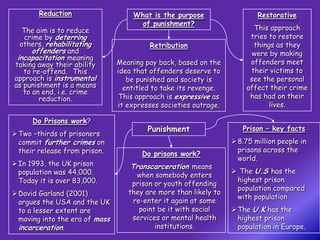
Reduction                   What is the purpose                   Restorative
                                      of punishment?
   The aim is to reduce                                                 This approach
    crime by deterring                                                 tries to restore
  others, rehabilitating                 Retribution                    things as they
      offenders and                                                     were by making
 incapacitation meaning
taking away their ability       Meaning pay back, based on the         offenders meet
   to re-offend. This           idea that offenders deserve to         their victims to
approach is instrumental           be punished and society is          see the personal
as punishment is a means          entitled to take its revenge.       affect their crime
   to an end, i.e. crime
        reduction.               This approach is expressive as        has had on their
                                it expresses societies outrage.              lives.

      Do Prisons work?
                                         Punishment                  Prison – key facts
 Two –thirds of prisoners
  commit further crimes on                                         8.75 million people in
  their release from prison.                                        prisons across the
                                       Do prisons work?
                                                                    world.
 In 1993, the UK prison            Transcarceration means
  population was 44,000.                                           The U.S has the
                                     when somebody enters
  Today it is over 83,000.                                         highest prison
                                    prison or youth offending
                                                                   population compared
 David Garland (2001)             they are more than likely to
                                                                   with population
  argues the USA and the UK         re-enter it again at some
  to a lesser extent are              point be it with social      The U.K has the
  moving into the era of mass       services or mental health       highest prison
  incarceration.                           institutions.            population in Europe.
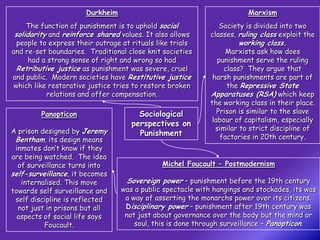
Durkheim                                         Marxism
     The function of punishment is to uphold social             Society is divided into two
 solidarity and reinforce shared values. It also allows      classes, ruling class exploit the
  people to express their outrage at rituals like trials             working class.
and re-set boundaries. Traditional close knit societies            Marxists ask how does
      had a strong sense of right and wrong so had              punishment serve the ruling
  Retributive justice as punishment was severe, cruel             class? They argue that
and public. Modern societies have Restitutive justice         harsh punishments are part of
which like restorative justice tries to restore broken             the Repressive State
           relations and offer compensation.                 Apparatuses (RSA) which keep
                                                             the working class in their place.
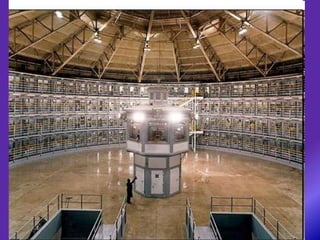
         Panopticon                    Sociological             Prison is similar to the slave
                                                              labour of capitalism, especially
                                     perspectives on
A prison designed by Jeremy                                    similar to strict discipline of
                                       Punishment                factories in 20th century.
 Bentham, its design means
 inmates don’t know if they
are being watched. The idea
  of surveillance turns into                  Michel Foucault – Postmodernism
self-surveillance, it becomes
   internalised. This move         Sovereign power – punishment before the 19th century
towards self surveillance and     was a public spectacle with hangings and stockades, its was
 self discipline is reflected      a way of asserting the monarchs power over its citizens.
  not just in prisons but all      Disciplinary power – punishment after 19th century was
  aspects of social life says      not just about governance over the body but the mind or
          Foucault.                   soul, this is done through surveillance – Panopticon.
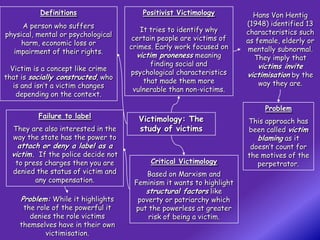
Definitions                    Positivist Victimology          Hans Von Hentig
                                                                                .
     A person who suffers                                              (1948) identified 13
                                        It tries to identify why       characteristics such
physical, mental or psychological
                                      certain people are victims of    as female, elderly or
     harm, economic loss or
                                     crimes. Early work focused on     mentally subnormal.
  impairment of their rights.
                                       victim proneness meaning          They imply that
                                            finding social and            victims invite
  Victim is a concept like crime
                                     psychological characteristics     victimisation by the
that is socially constructed, who
                                         that made them more              way they are.
   is and isn’t a victim changes
                                      vulnerable than non-victims.
    depending on the context.
                                                                            Problem
          Failure to label             Victimology: The                This approach has
  They are also interested in the      study of victims                been called victim
  way the state has the power to                                          blaming as it
    attach or deny a label as a                                         doesn’t count for
  victim. If the police decide not                                     the motives of the
   to press charges then you are           Critical Victimology           perpetrator.
  denied the status of victim and         Based on Marxism and
         any compensation.            Feminism it wants to highlight
                                         structural factors like
     Problem: While it highlights      poverty or patriarchy which
     the role of the powerful it      put the powerless at greater
       denies the role victims            risk of being a victim.
    themselves have in their own
            victimisation.
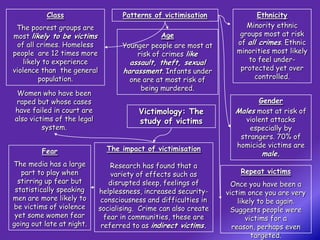
Class                   Patterns of victimisation              Ethnicity
 The poorest groups are                                                Minority ethnic
most likely to be victims                      Age                   groups most at risk
 of all crimes. Homeless           Younger people are most at       of all crimes. Ethnic
people are 12 times more               risk of crimes like          minorities most likely
   likely to experience              assault, theft, sexual            to feel under-
violence than the general          harassment. Infants under         protected yet over
        population.                  one are at most risk of             controlled.
                                        being murdered.
 Women who have been
 raped but whose cases                                                    Gender
have failed in court are                Victimology: The           Males most at risk of
also victims of the legal               study of victims              violent attacks
         system.                                                       especially by
                                                                    strangers. 70% of
                              The impact of victimisation          homicide victims are
         Fear                                                              male.
The media has a large           Research has found that a
   part to play when            variety of effects such as           Repeat victims
  stirring up fear but         disrupted sleep, feelings of        Once you have been a
 statistically speaking     helplessness, increased security-    victim once you are very
men are more likely to       consciousness and difficulties in       likely to be again.
be victims of violence      socialising. Crime can also create    Suggests people were
 yet some women fear          fear in communities, these are            victims for a
going out late at night.     referred to as indirect victims.      reason, perhaps even
                                                                          targeted.
Common law                    Murder isn’t written        Structure of the courts
British law not originally          in law anywhere but         1. European courts of
decided upon and written            based on precedents            Justice
  down but based on a                 made years ago.
                                                                2. House of Lords
  series of judgements
made by judges based on           Oldest statute law in         3. Royal Courts of
 a series of facts. The          England and Wales goes            Justice
 courts must follow the        back to 1297 originally part     4. Crown Court
     decisions of the          of the Magna Carta and its
   precedent (previous           about seeking damages.         5. Magistrates courts
          case).
       Courtroom
                                     The role of the                    Criminal
 Judges seats – often 3
                                     criminal justice             These are cases that
 Clerk & stenograph                     system                  have broken the law of
  (typist).                                                       the land and brought
 Witness stand                                                  about by the state such
                                      Types of law                 as murder or rape.
 The bar – behind which      Criminal – murder, rape.
  the prosecution and                                                     Civil
  defence solicitors and      Tort –                             These are cases that
  barristers sit               negligence, nuisance, defamati    have broken the law but
                               on, trespass.                      are brought about by
 The dock – The
  accused                     Contract – sales & purchasing.         people such as
                                                                  compensation against
 Public viewing area         Trusts – Property and             injury or land disputes.
                               inheritance.
1. Reporting             2. Investigation            3. Crown Prosecution
                                                                Service
 A crime is committed           The police will
 and reported to the        investigate the scene        The CPS must decide
        police.            and question witnesses.     whether a case is likely to
                            The will either charge      get a conviction in court.
   8. Mental health          the suspect, release
                            them or given them a
  Those deemed to be               warning.               4. Magistrates court
  without their mental                                 Over 95% of cases are dealt
faculty when committing                                    with by the magistrates
 a crime are often sent          Stages of the            court. Because its usually
   for assessment and           criminal justice       less serious crimes there is a
     incarceration at               system              limit to the punishment that
hospitals like Broadmoor                                can be imposed (6 months in
 or Ashworth, many will                                            prison).
   never be released.              6. Prison
                            With shorter sentences
                                                             5. Crown court
                            prisoners remain in the
  7. Probation service
                             local area while longer      More serious cases are
    Works to monitor          sentences, prisoners      passed to the crown court
  prisoners after their     could be sent anywhere.     which is served by a judge
release. They help with      They must be treated         and jury. The jury will
employment and housing          with fairness and      decide if the accused is guilt
and advise the courts of      humility and be given    at which point the judge will
 a risk of re-offending.      productive activities.    decide upon the sentence.
5. The study of suicide

          Key questions              Key information

1.   Is suicide just a          Positivism – Emile Durkheim
     psychological issue?
                                Interpretivism – Maxwell
                                 Atkinson
2. What social factors may
                                Realism – Steve Taylor
     cause suicide?

3. How do we define suicide?

4. Should we include people
     who have attempted
     suicide?
Emile Durkheim (1897)                                       Findings
                 3


  Objective: To look beyond the          Suicide rates were higher in Protestant countries
  individual act and towards the         than Catholic ones.
     social factors which cause          Suicide rates for any given country remained more or
    suicide. He took a positivist
                                          less constant over time.
  methodology, as he wanted to
      establish Sociology as a           Rates were higher for childless and unmarried people.
   science. He collected suicide
       statistics from across            Rates rose during times of economic depression and
               Europe.                    prosperity and fell during times of war and political
                                          uncertainty.

     Social Facts
                                      The study of suicide                  Explaining findings
 For Durkheim social
  facts exist in the                                                   Durkheim concluded that
 world. Integration                  Types of suicide                 suicide must be the result
  and regulation are        Altruistic – Too much integration        of the extent to which we
social facts i.e. forces     (Japan, Seppuka).                            are integrated and
   in the world that                                                    regulated into a group.
     constrain our          Egoistic – too little integration        Integration is the extent
     behaviour. If           (individualistic).                      to which a person is bound
    Durkheim could          Fatalistic – Too much                    by a society by norms and
 discover these facts        regulation, you cant change things      values (Japan). Regulation
  he would establish         (China).                                  is the extent to which a
sociology as a science.                                              society has control over its
                            Anomic – Too little                           members (China)
                             regulation, norms and values
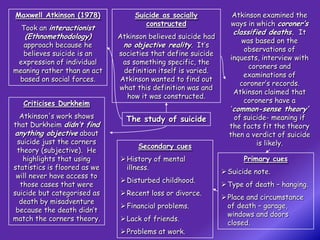
Maxwell Atkinson (1978)            Suicide as socially            Atkinson examined the
                                      constructed                ways in which coroner’s
  Took an interactionist
                                                                  classified deaths. It
   (Ethnomethodology)         Atkinson believed suicide had
                                                                     was based on the
  approach because he          no objective reality. It’s
                                                                      observations of
  believes suicide is an      societies that define suicide
                                                                inquests, interview with
 expression of individual      as something specific, the
                                                                       coroners and
meaning rather than an act     definition itself is varied.
                                                                     examinations of
 based on social forces.      Atkinson wanted to find out
                                                                    coroner’s records.
                              what this definition was and
                                                                  Atkinson claimed that
                                how it was constructed.
   Criticises Durkheim                                               coroners have a
                                                                 ‘common-sense theory’
  Atkinson's work shows         The study of suicide              of suicide- meaning if
that Durkheim didn’t find                                       the facts fit the theory
anything objective about                                        then a verdict of suicide
 suicide just the corners                                                 is likely.
                                    Secondary cues
 theory (subjective). He
   highlights that using       History of mental                   Primary cues
statistics is floored as we     illness.
                                                               Suicide note.
 will never have access to
                               Disturbed childhood.
  those cases that were                                        Type of death – hanging.
suicide but categorised as     Recent loss or divorce.
                                                               Place and circumstance
  death by misadventure
                               Financial problems.             of death – garage,
 because the death didn’t
                                                                windows and doors
match the corners theory.      Lack of friends.
                                                                closed.
                               Problems at work.
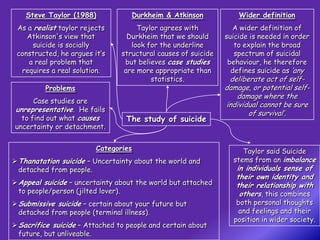
Steve Taylor (1988)            Durkheim & Atkinson             Wider definition
 As a realist taylor rejects         Taylor agrees with          A wider definition of
    Atkinson's view that          Durkheim that we should      suicide is needed in order
     suicide is socially           look for the underline         to explain the broad
 constructed, he argues it’s    structural causes of suicide      spectrum of suicidal
    a real problem that          but believes case studies      behaviour, he therefore
  requires a real solution.      are more appropriate than       defines suicide as ‘any
                                         statistics.            deliberate act of self-
         Problems                                              damage, or potential self-
                                                                  damage where the
      Case studies are
                                                               individual cannot be sure
unrepresentative. He fails                                            of survival’.
  to find out what causes         The study of suicide
uncertainty or detachment.


                         Categories                                 Taylor said Suicide
 Thanatation suicide – Uncertainty about the world and          stems from an imbalance
  detached from people.                                           in individuals sense of
                                                                  their own identity and
 Appeal suicide – uncertainty about the world but attached       their relationship with
  to people/person (jilted lover).                                 others, this combines
 Submissive suicide – certain about your future but              both personal thoughts
  detached from people (terminal illness).                         and feelings and their
                                                                 position in wider society.
 Sacrifice suicide – Attached to people and certain about
  future, but unliveable.
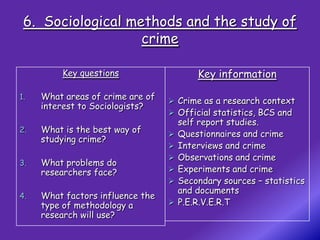
6. Sociological methods and the study of
                   crime

         Key questions                    Key information

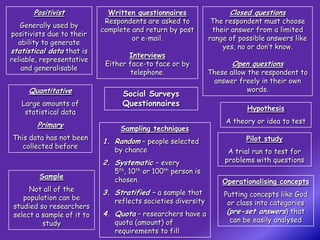
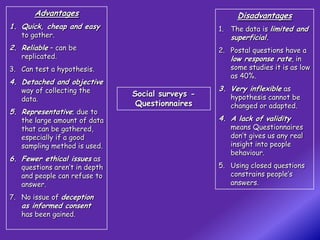
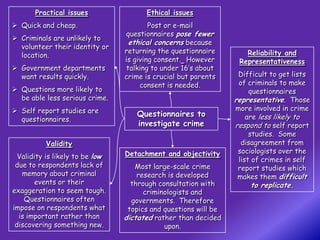
1.   What areas of crime are of    Crime as a research context
     interest to Sociologists?
                                   Official statistics, BCS and
                                      self report studies.
2.   What is the best way of         Questionnaires and crime
     studying crime?
                                     Interviews and crime
                                     Observations and crime
3.   What problems do
     researchers face?               Experiments and crime
                                     Secondary sources – statistics
                                      and documents
4.   What factors influence the
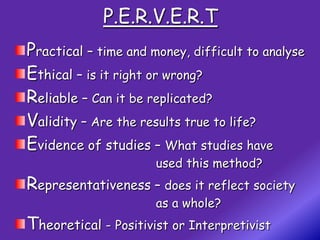
     type of methodology a           P.E.R.V.E.R.T
     research will use?
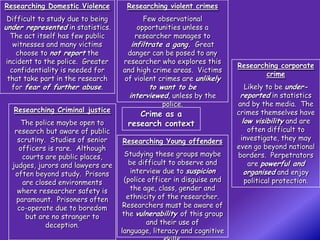
Researching Domestic Violence       Researching violent crimes
 Difficult to study due to being         Few observational
under represented in statistics.       opportunities unless a
   The act itself has few public      researcher manages to
    witnesses and many victims       infiltrate a gang. Great
     choose to not report the       danger can be posed to any
 incident to the police. Greater   researcher who explores this
                                                                      Researching corporate
   confidentiality is needed for   and high crime areas. Victims
                                                                              crime
  that take part in the research   of violent crimes are unlikely
   for fear of further abuse.              to want to be                Likely to be under-
                                     interviewed, unless by the        reported in statistics
                                               police.                and by the media. The
   Researching Criminal justice                                       crimes themselves have
                                        Crime as a
      The police maybe open to       research context                  low visibility and are
   research but aware of public                                          often difficult to
    scrutiny. Studies of senior    Researching Young offenders         investigate, they may
     officers is rare. Although                                       even go beyond national
      courts are public places,      Studying these groups maybe      borders. Perpetrators
  judges, jurors and lawyers are      be difficult to observe and        are powerful and
   often beyond study. Prisons        interview due to suspicion        organised and enjoy
      are closed environments       (police officer in disguise and     political protection.
    where researcher safety is        the age, class, gender and
    paramount. Prisoners often       ethnicity of the researcher.
    co-operate due to boredom       Researchers must be aware of
       but are no stranger to       the vulnerability of this group
             deception.                    and their use of
                                   language, literacy and cognitive
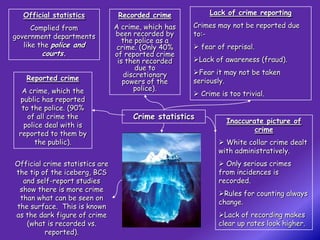
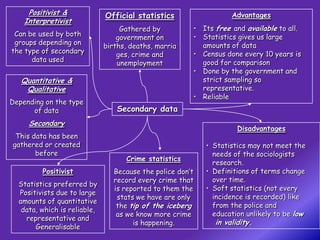
Official statistics            Recorded crime           Lack of crime reporting

      Complied from             A crime, which has   Crimes may not be reported due
government departments          been recorded by     to:-
                                   the police as a
   like the police and           crime. (Only 40%     fear of reprisal.
        courts.                 of reported crime
                                 is then recorded    Lack of awareness (fraud).
                                       due to
                                   discretionary     Fear it may not be taken
   Reported crime                  powers of the     seriously.
  A crime, which the                  police).
                                                      Crime is too trivial.
 public has reported
  to the police. (90%
    of all crime the                 Crime statistics
                                                               Inaccurate picture of
   police deal with is
                                                                       crime
 reported to them by
       the public).                                           White collar crime dealt
                                                             with administratively.
Official crime statistics are                                 Only serious crimes
the tip of the iceberg, BCS                                  from incidences is
  and self-report studies                                    recorded.
 show there is more crime
                                                             Rules for counting always
 than what can be seen on
                                                             change.
the surface. This is known
as the dark figure of crime                                  Lack of recording makes
   (what is recorded vs.                                     clear up rates look higher.
         reported).
British Crime Survey               The study is based on a
                                representative sample of adults
A victim study which asks                                            Self-report studies
                                 living in private households in
people if they have been a
                               England and Wales. In 2002 over            Anonymous
victim of a crime and the
                               36,000 surveys were conducted.        questionnaires which
  circumstances of that
                               Certain crimes are excluded due      ask respondents if they
 crime. It was conducted
                               to low reporting such as murder,     have committed a crime
   every two years from
                               drug possession or dealing, fraud,     over the past year.
  1982 -2000 then every
                                  offences against businesses.
        year since.
                                                                     They are usually based
     Trends and patterns                                               on self-completed
                                          BCS and Self-                questionnaires or
 BCS says 10.7 million crimes
committed, OS (4.7 million.               report studies               interviews which
                                                                         contain a list of
The majority of crime is             BCS: includes unreported              offences.
property related.                     and unrecorded crime but       Respondents are asked
 Violent crime accounts for         only 75% is comparable with     to highlight which they
1/5 of all crime                           police statistics.         have committed. Self
                                                                     report studies show us
 Overall crime peaked in 1995       Self-report: Mainly street         that most people
and has declined ever since.            crime (working class)         commit crime at some
                                     excludes hidden crimes like      point in their lives so
 Men aged 16-24 most likely          domestic violence. Only
to be a victim of violence.                                             crime is normal.
                                       gives a small picture of
                                          criminal activity.
Positivist             Written questionnaires                 Closed questions
                             Respondents are asked to           The respondent must choose
   Generally used by
                            complete and return by post         their answer from a limited
positivists due to their
                                     or e-mail.                range of possible answers like
   ability to generate
                                                                   yes, no or don’t know.
statistical data that is
                                    Interviews
reliable, representative
                             Either face-to face or by                Open questions
    and generalisable
                                     telephone.                These allow the respondent to
                                                                answer freely in their own
     Quantitative                                                          words.
                                  Social Surveys
   Large amounts of               Questionnaires
                                                                          Hypothesis
    statistical data
                                                                    A theory or idea to test
        Primary                  Sampling techniques
This data has not been                                                    Pilot study
                            1. Random – people selected
   collected before
                                by chance                            A trial run to test for
                            2. Systematic – every                   problems with questions
                               5th, 10th or 100th person is
         Sample                 chosen.                            Operationalising concepts
      Not all of the        3. Stratified – a sample that
    population can be                                              Putting concepts like God
                                reflects societies diversity        or class into categories
 studied so researchers
 select a sample of it to   4. Quota – researchers have a           (pre-set answers) that
          study                quota (amount) of                     can be easily analysed
                                requirements to fill
Advantages                                      Disadvantages
1. Quick, cheap and easy                          1. The data is limited and
   to gather.                                        superficial.
2. Reliable – can be                              2. Postal questions have a
   replicated.                                       low response rate, in
3. Can test a hypothesis.                            some studies it is as low
                                                     as 40%.
4. Detached and objective
   way of collecting the                          3. Very inflexible as
                               Social surveys -      hypothesis cannot be
   data.
                                Questionnaires       changed or adapted.
5. Representative; due to
   the large amount of data                       4. A lack of validity
   that can be gathered,                             means Questionnaires
   especially if a good                              don’t gives us any real
   sampling method is used.                          insight into people
                                                     behaviour.
6. Fewer ethical issues as
   questions aren’t in depth                      5. Using closed questions
   and people can refuse to                          constrains people’s
   answer.                                           answers.

7. No issue of deception
   as informed consent
   has been gained.
Practical issues                Ethical issues
 Quick and cheap.                       Post or e-mail
                                 questionnaires pose fewer
 Criminals are unlikely to
                                  ethical concerns because
  volunteer their identity or
                                 returning the questionnaire        Reliability and
  location.
                                 is giving consent. However       Representativeness
 Government departments         talking to under 16’s about
  want results quickly.          crime is crucial but parents     Difficult to get lists
                                      consent is needed.          of criminals to make
 Questions more likely to                                            questionnaires
  be able less serious crime.                                    representative. Those
 Self report studies are                                        more involved in crime
                                    Questionnaires to                are less likely to
  questionnaires.
                                    investigate crime            respond to self report
                                                                      studies. Some
          Validity                                                 disagreement from
                                 Detachment and objectivity       sociologists over the
  Validity is likely to be low                                    list of crimes in self
 due to respondents lack of         Most large-scale crime        report studies which
   memory about criminal             research is developed        makes them difficult
        events or their            through consultation with         to replicate.
exaggeration to seem tough.            criminologists and
    Questionnaires often           governments. Therefore
impose on respondents what        topics and questions will be
  is important rather than       dictated rather than decided
 discovering something new.                  upon.
Positivist             Laboratory experiments              Stanley Milgram
                                                                 Experiment (1961)
   Generally used by          Conducted in a controlled
positivists due to their           environment.                   A lab experiment
   ability to generate          (Milgram, Stanford)             conducted to test our
statistical data that is                                       obedience to authority.
                                  Field experiments
reliable, representative                                      Volunteers were asked to
    and generalisable      Conducted out in the field where   administer electric shocks
                             variables can’t be controlled.   while being encouraged to
      Quantitative             (Sissons – Hawthorne)             do so by a scientist.
                                                                Results showed people
   Large amounts of
                                    Experiments               were highly influenced by
    statistical data
                                                                 an authority figure.
        Primary
                              Philip Zimbardo – Stanford
 This data has not been        prison experiment (1971)
    collected before
                             A lab experiment designed to             Problems
                              show behaviour of inmates        Highly unethical due to
                               and the role of authority       the amount of emotional
        Problems
                               figures. Volunteers were            harm caused and
 Highly unethical due to     given roles as either prisoner     deception. Study not
 the amount of emotional     or guard. The experiment got         representative or
     harm caused and            out of hand as prisoners            generalisable
  deception. Study not           suffered sadistic and
    representative or        humiliating treatment at the
      generalisable               hands of the guards
Sissons               Hawthorne Electrical plant          Hawthorne effect
   A field experiment          A field experiment to test
conducted at Paddington                                           People who know they
                               the adjustment of light and          are being studied
 station to see whether              heat on workers
   people behaviour in                                                change their
                                productivity. In all cases         ordinary behaviour
 relation to social class.      workers output increased.
    It involved a man
  dressed as a labourer
     and then later a        Experiments                     Lab experiments
      businessman.                               Advantages:
                                                  Can test a hypothesis.
              Field experiments
                                                  Can be replicated due to controllable
Advantages:                                        variables.
 Higher validity than lab experiments.           Can study cause and effect
 Less artificial as respondents are in their      relationships.
  natural setting.                               Disadvantages:
Disadvantages:                                    Due to small scale it isn’t
                                                   representative or generalisable.
 Variables more difficult to control –
 lack of reliability.                             Low validity due to artificial
                                                   situation.
 Low in validity due to Hawthorne effect.
                                                  Lots of ethical issues.
 Lots of ethical issues.
Laboratory experiments                  Ethics              Bandura et al (1977)
This method doesn’t lend itself      Many crime related       Did an experiment on young
   to the study of crime and           research involves         nursery children about
deviance. Although Zimbardo’s        danger, victimisation     imitative aggression. The
    study of the behaviour           and the exercise of     children watched an adult be
   prisoners and guards has           power which can if      aggressive towards the doll
produced some useful insights        recreated can cause     then were told they couldn't
into the dehumanising effects         harmful effects.       play with some toys to see if
of prisons on both inmates and                                they would act as the adults
             staff.                                          did. This caused the children
                                   Experiments to               psychological harm. This
   We must remember               investigate crime          study like others showed low
  that youth offenders                                       validity as often experiments
                                    and deviance
   are more vulnerable                                          are artificial and bear no
   than other criminal                                             relation to reality.
groups. Its difficult to
                              Tougher regime project
      replicate field
experiments because of     Field experiments were used to          Field experiments
    the complexity of        study the effect of tougher         More effect in crime
crime and deviance. If        regimes in youth offending        research as they can be
   prisoners know they       institutions such as physical        used to study crime
 are being studied they      exercise, reduced education       prevention policies to see
   are likely to change       and more inspections. The         how effect they are on
    their behaviour –         results showed it had little        criminal groups like
  Hawthorne effect.         effect on re-offending rates.              prisoners.
Interpretivist           Structured interview                Semi-Structured
                            Set questions asked to all      Set themes to cover but has
   Generally used by
                                  respondents.              some freedom to explore and
 Interpretivists due to
    their ability to                                              probe answers.
                             Unstructured interview
  generate valid data
                           Interviewers have freedom               Group interview
about what people think
                            to ask any questions and        The discussion of topics with
 and feel and how they
                               probe answers for            small groups of 10-12 people.
          act.
                                   explanation.
     Qualitative
                                       Interviews                Interviewer bias
 Small in-depth data
giving us a real insight                                   Interviewer could ask leading
                              Structured interviews
                                                                questions or use body
       Primary                       (Disad)
                                                             language to subconsciously
  This data has not        No depth so low in validity.       influence respondents
been collected before                                                 answers.
                           Lacks flexibility.
     Unstructured          Risk of interviewer bias.       Structured interviews (Ad)
    interviews (Ad)                                         Easy to quantify.
                             Unstructured interviews
 High validity.                      (Disad)               Reliable less risk of
Can develop a rapport.     Costly, lack                    interviewer bias.
Real insights.             reliability, Representative     Higher response rate if
                            ness, & Generalisability.        face to face.
People feel at ease.
                            Comparison is difficult.       Can test a hypothesis.
Practical issues                  Reliability
 Convicted criminals have      The nature of some groups              Validity
  lower literacy levels.        makes it very difficult to
                                 replicate and interview.           Unstructured
 Recording answers may                                            interviews allow
                              Maguire (2007) studied street
  make respondents feel                                         researcher to decode
                                 criminals and said some
  uncomfortable that their                                       language and slang.
                              interviews took minutes while
  answer may have legal                                           Lengthy interviews
                              others took hours, in a pub or
  implications.                                                  allow researchers to
                                      persons home.
 Safety of interviewers is                                      build a rapport and
  important.                                                    trust. The appearance
                                    Interviews to               of the interviewer may
 Getting access to               investigate crime             make respondents feel
  interviewing criminals or                                      they are an authority
  victims is difficult.                                             figure. There are
                                            Ethics                hierarchy and status
    Representativeness                                                 issues when
                                 Respondents may become at       interviewing members
    These interviews with           ease and give up ‘guilty    of courts and police. A
  victims and criminals are       knowledge’ of crimes they     clerk of a magistrates
 time-consuming due to the       committed. This leaves the       is more likely to give
   sensitive nature of the       researcher with the ethical    honest response than a
discussion which means they         dilemma of whether to           high court judge.
   are unlikely to produce          break the respondents
large enough samples to be            trust and pass the
      representative.            information onto the police.
Interpretivist                Non-Participant obs
                              Where the researcher observes
   Generally used by                                                      Participant obs
                                  without interfering.
 Interpretivists due to                                                     Where the
    their ability to                                                        researcher
  generate valid data         Structured                                  becomes a part
                                                    Unstructured
about what people think                                                    of what they
                           a set of criteria in   Nothing set just
 and feel and how they                            record as much             observe.
                             categories that
          act.                 need to be             important
                                recorded.          information as
     Qualitative                                       possible.

 Small in-depth data
giving us a real insight           Observations                  Covert observation -
                                                                 the sociologist is open
       Primary                                                 about what they are doing
                                                                by making their identity
  This data has not                   Keywords
                                                                  and purpose known.
been collected before
                            Getting in: gaining access
                            to a group.                        Covert observation - the
     Observers role                                           study is done undercover as
  take a position which     Going native: no longer
                                                               the researchers identity
   will not allow you to    being a research and being a
                                                              and purpose are concealed.
   disrupt the groups       part of the group.
  normal behaviour and                                        Semi-covert observation –
                            Getting out: leaving the
    yet offer a good
    vantage to make         group without putting                Telling one person in a
       observations.        yourself in danger.                   group but no others.
Positivism            John Howard Griffin            Laud Humphries (1970)
 Structured observations        Used medication and         Broke the law by being a look
      could be used by          sun lamps to conduct       out at a toilet to find out more
 positivists as they create    covert research among         about sex in public places.
    data that is easy to        black people in 1959.
    quantify and can be         He knew he wouldn’t            James Patrick (1973)
        replicated.            be accepted as a white
                                        male.               Acted as a gang member in
                                                          Glasgow but had to leave due to
        Advantages                                         the violence he experienced.

                                        Observations
1. High Validity as you see
   people in their natural
                                                    Disadvantages
   setting.
2.A real insight into why      1. Time, money and personal cost through stress and
   people do the things they      danger.
   do.                         2. Personal involvement can reduce objectivity.
3. The only chance to walk     3. Very difficult to replicate as its so unpredictable.
  in other persons shoes and   4. Not possible to generalise due to small sample sizes.
  get their view of the        5. Maybe unethical to members of group if deception is
  world.                          used.
4. More flexible method        6. Researcher may be asked to commit illegal acts.
5. A way to gain access to     7. The observer is likely to affect the groups especially
  deviant groups                  if they are aware of them (participant observation).
Practical issues                  Going native             Covert observation
 Covert observation                  Whyte (1955)
 maybe the only way to                                             Many criminal groups
                                   recognised he turned              won’t allow overt
 study criminal gangs.               from being a non-           participation or at very
 Gaining access to groups        participating observe to       least will only let them
 is going to be difficult.            a non-observing          see what they want them
                                     participator when        to see. However if access
 Police stations and prisons        observing Italian
  may restrict access to                                        is granted this will allow
                                  American street gangs.       the researcher to ask all
  observe.
                                                                    sorts of naive but
 Observations can take a           Observations to               interesting questions.
  long time without any
                                   investigate crime
  incidence of crime or
  deviance.                                                       Overt observation
                                         Ethics
 Ken Pryce was murdered                                         It reduces the risk of
  observing organised            More ethical dilemmas       changing people’s behaviour,
  crime.                         than any other method       Laud Humphreys found this
                                in studying crime due to      in his observation of causal
                                 risk to research, illegal   sex in public places. The risk
          Validity
                                   activity and lack of      of one’s cover being blown is
   A rare method that            consent. How to leave         very dangerous, along with
 reveals real insights into         the gang without           concerns that you may be
   criminal and deviant              reprisal is also a         asked to engage in illegal
        behaviour.                      challenge.              activity in order to fit in.
Positivist &             Official statistics                  Advantages
    Interpretivist
                                   Gathered by          • Its free and available to all.
 Can be used by both                                    • Statistics gives us large
                                  government on
 groups depending on                                      amounts of data
                              births, deaths, marria
the type of secondary                                   • Census done every 10 years is
                                  ges, crime and
      data used                                           good for comparison
                                  unemployment
                                                        • Done by the government and
   Quantitative &                                         strict sampling so
    Qualitative                                           representative.
                                                        • Reliable
Depending on the type
      of data                     Secondary data
     Secondary
                                                                     Disadvantages
 This data has been
gathered or created                                         • Statistics may not meet the
       before                                                 needs of the sociologists
                                    Crime statistics
                                                              research.
         Positivist              Because the police don’t   • Definitions of terms change
                                 record every crime that      over time.
  Statistics preferred by
                                 is reported to them the    • Soft statistics (not every
  Positivists due to large
                                  stats we have are only      incidence is recorded) like
  amounts of quantitative
                                  the tip of the iceberg      from the police and
   data, which is reliable,
                                  as we know more crime       education unlikely to be low
    representative and
                                       is happening.           in validity.
       Generalisable
Documents                    Public documents                Personal documents
  Refers to diaries,           Produced by organisations      First person accounts and
letters, photographs,           like schools and includes      experiences, these include
 newspapers, novels,                things like Ofsted           letters, diaries, photo
   and things from            reports, council notes from     albums and autobiographies.
 television and radio.        meetings, published company
                                accounts, and records of
                                 parliamentary debates.
                                                                 Historical documents

     Interpretivists                                              A personal or public
                                                                document created in the
       Preferred by                  Secondary data            past. These documents will
 Interpretivists because                                      allow you the opportunity to
the data is qualitative and                                   see how people experienced
allows them a real insight                                         the social world.
into peoples meanings and
         motives
                                                    John Scott – assessing documents

          Content analysis                            Scott says we must consider if
                                                    documents are authentic (not fakes)
A method for systematically studying                 and if it is credible (believable). We
     content of documents and                           must find out if the document
  producing quantitive data. Sue                   represents the past fairly and that the
Sharpe did this in her study of girls               meaning of words, ideas and beliefs
            aspirations.                                         hasn’t changed.
Official statistics                    Validity                   Representativeness

Practically there is always        About 90% of crime is          At first sight they seem
     large amounts of            reported to the police by         to be representative as
       statistical data         the public, whether they do         they are collected by
  available to researchers       so depends on the nature         government agencies but
   on a variety of issues        of the crime. Crimes like        we know they are only the
       from different            domestic violence and sex           tip of the iceberg.
          agencies.               crimes are less likely to
                                  be reported which puts                  Reliability
                                the validity of statistics in         Although the same
          Validity
                                          question.                    research can be
  Biographies of criminals                                          replicated what crimes
maybe be exaggerated but                                             are included and how
can still offer real insight.
                                    Secondary data to
                                                                      changes making it
 Many official documents             investigate crime
                                                                    difficult to compare.
 tilt towards enforcement
agenicies like the police or               Ethics
           courts.                                                     Documents
                                      These pose few
                                      ethical issues if         Practically there is always
         Reliability and              they are part pf          large amounts of documents
       Representativeness              public record.           from courts, police etc that
 If documents about crimes are                                        are part of public
 found they are varied and few                                    record, however there is
  and far between making them                                         also a lot that is
unreliable and unrepresentative.                                 restricted. Suicide notes
                                                                  along with graffiti can be
Practical issues                                   Ethical issues
 Time and money.                     the British Sociological Society guidelines.

 If you can get research funded       Informed consent – participants should be offered
  they may require a certain type       the right to refuse to be researched.
  of data.                             Participants identity should be kept confidential
                                       Researchers should be aware of the social or
 Skills of the Sociologist to          psychological harm of research.
  build trust and rapport or social    Special care should be give to research in vulnerable
  skills. Skills of the Sociologist     groups like young offenders and victims.
  to build trust and rapport or        Covert research can take place but must be aware of
  social skills.                       problems of deception.

 A research opportunity may
                                                Factors influencing a
  come out of the blue leaving no
  time for Questionnaires.
                                             researchers choice of topic


                                      Theoretical issues


  Validity – Getting results that are true to life, qualitative methods are seen to do this
   the best.
  Reliability – getting results that be replicated, quantitative methods allow for this.
  Representativeness – getting results that reflects all of society, large scale
   quantitative questionnaires allow researchers to make generalisations.
  Whether the researcher is a Positivist or Interpretivist
P.E.R.V.E.R.T
Practical – time and money, difficult to analyse
Ethical – is it right or wrong?
Reliable – Can it be replicated?
Validity – Are the results true to life?
Evidence of studies – What studies have
                      used this method?
Representativeness – does it reflect society
                      as a whole?
Theoretical - Positivist or Interpretivist
Positivists                        Interpretivism
             Main aim:                               Main aim:
  Reliability, Representativeness                     Validity
        and Generalisability

   Structuralists: Sees society            Interactionism: Sees society
  has a set of institutions which         as created by our interactions
       shape our behaviour.                     with other people.


      Functionalists, Marxist                 Labelling theory, Charles
          and Feminists                        Cooley, Erving Goffman


A bird’s eye view of society, looking     Walking in other peoples shoes,
for cause and effect relationships       subjective, small but quality data
and turning behaviour into numbers        looking at how people interact


       Quantitative methods:             Qualitative methods: gathering
    gathering lots of data that be            small but in-depth data
     turned into statistical data


          Research methods:              Research methods: Unstructured
      Questionnaires, structured         interviews, participant observation
  interviews, experiments and official         and personal documents
               statistics
Aim of sociology: To find out why people behave as they do.


                     Structuralism                          Social Action
Theories    Sees behaviour as the result of us     See behaviour as the result of
            being constrained by institutions.     people interacting and creating
                                                  their own meanings and motives.

                                                           Interactionism
Theories    Functionalism - Consensus               Labelling theory
            Marxism - Conflict                      Mead – Symbolic
            Feminism - Conflict                    Interactionism
                                                    Goffman – Impression
                                                   management
                         Positivist                         Interpretivist
Methods 1.Scientific                              1.Walking in others shoes
           2.Birds eye view                       2.Subjective
           3.Quantitative                         3.Interaction
           4.Cause and effect                     4.Qualitative
           Questionnaires, structured              Unstructured interviews,
           interviews, experiments and Official    observations and personal
           statistics                              documents
7. Sociological theory only

           Key questions                     Key information
1.   Does society control us or do
     we control society?              Functionalism
                                      Marxism and feminism
2.   Do we need new theories to       Social action approaches -
     explain recent changes in           Interactionism
     society?
                                        Structuration theory –
                                         Giddens
3.   Is sociology a science?
                                        Globalisation, modernity and
                                         Postmodernity
                                        Late modernity – Giddens
4.   Should sociology be objective
     and value free?                    Sociology as a science
                                        Objectivity and values in
5.   Should sociological research        Sociology
     influence social policy?           Sociology and social policy
Structuralism                   Emile Durkheim                 Talcott Parsons
  A theory which argues          Concerned with how society          Its important that
 that the institutions of        stayed together after such            individuals are
society, education, family,   rapid change. He said society is      socialised to accept
  religion, politics, media        kept together by social          to norms and values
    and law & order all         solidarity (shared norms and        through institutions
 influence and constrain             values) and collective       like education, religion
      our behaviour.           consciousness. If these things          and the media.
        Consensus             are not maintained then society
                              could fall into a state of Anomie          On crime
 An approach which says              – Normlessness.
   society is based on                                              Crime has positive
 agreement, meaning we                                             functions which help
                                      Functionalism               keep society balanced
   agree on norms and
         values.                                                     and in harmony.
                                          Criticisms
Uses a macro approach to                                                On religion
    studying society.          Explaining the function of
                                things doesn’t explain how they         Religion helps
                                came about.                            reinforce social
        Modernist
                                                                     solidarity through
  Agrees with the 18th         Too optimistic ignores                rituals. It gives
enlightenment project of        inequality.                           people a sense of
 using reason to achieve       Too deterministic, our               meaning and gives
 knowledge that will help       behaviour is constrained and       support during times
    society progress.           there is nothing we can do.         of emotional stress
Structuralism                      Key ideas                    Solution
  A theory which argues       Marx says institutions are used    The Proletariat can
 that the institutions of          to transmit ruling class      never be free under
society, education, family,    ideology, then in turn causes    capitalism they must
  religion, politics, media    false class consciousness and    cast off the shackles
    and law & order all          the idea that capitalism is      of oppression and
 influence and constrain      reasonable and just. Marx says     create a Communist
      our behaviour.               Capitalism exploits and           revolution.
                                 alienates the proletariat in
         Conflict               order for the Bourgeoisie to          On crime
 An approach which says                 create profit.
                                                                  Laws are their to
   society is based on                                           oppress the working
  conflict between the                   Marxism                  class and control
  Bourgeoisie and the                                            them if they revolt.
       Proletariat
                                          Criticisms
Uses a macro approach to                                             On religion
    studying society.          Out of date, especially in
                                relation to class.              Religion is the opium
                                                                  of the masses it
        Modernist              Economic determinist – too       doesn’t encourage
  Agrees with the 18th          focused on the economy and      the working class to
enlightenment project of        ignores gender and ethnicity.       change their
 using reason to achieve       Marx’s predictions of           situation because of
 knowledge that will help       revolution haven’t come            the promise of
    society progress.           true, was he wrong?             compensation in the
                                                                     after life.
Structuralism                   Types of feminism                Three Waves
  A theory which argues        Liberal – Using democracy to       1. Mid 1800’s – right
 that the institutions of       change the laws.                      to vote.
society, education, family,
                               Marxist (socialist) – Capitalism   2. 1960’s – equal
  religion, politics, media
                                is the cause of women's               rights in pay and
    and law & order all
                                oppression                            work
 influence and constrain
      our behaviour.           Radical – men and women should     3. 1990’s –
                                be separated.                         representing
         Conflict
                               Black – Sexism, class oppression      ethnic minorities
 An approach which says         and racism are bound together
   society is based on                                                   On crime
conflict between men and                  Feminism
  their subordination of                                            Women commit less
          women.                                                      crime than men
                                           Criticisms                because they are
Uses a macro approach to                                            controlled by men.
    studying society.          Gender determinist – no place
                                for issues of class or poverty.
                                                                        On religion
        Modernist              Patriarchy is in decline! Women
                                                                       Religion helps
  Agrees with the   18th        are becoming more equal to men.
                                                                     suppress women by
enlightenment project of       Fragmented movement,                portraying women as
 using reason to achieve        different ideas and solutions      subordinate to men in
 knowledge that will help       leads to a lack of unit or         the bible and customs
    society progress.           progress.                              and practices.
Social action                George Herbert Mead                 Herbert Blumer
    An approach which                Noticed most of our            Blumer says our actions
focuses not on structures        communication was symbolic        are based on the meaning
    but the interaction       such as smiles, and frowns. It is             we give to
  between people. These           our job to determine the              situations, these
 individuals have free will    meaning of these symbols and         meanings arise from the
 and choice to determine        act accordingly. He calls this      interaction process, and
their own actions. A micro        Symbolic Interactionism.           they are not fixed but
  approach which focuses       Understanding the meaning of            negotiable and
       on individuals.        these symbols to us is the key to      changeable to some
                              understanding human behaviour.                extent.
        Criticisms                                                     Charles Cooley
 Ignores structural                  Interactionism                 The looking glass
  factors like poverty.                                             self reminds us that
 Not all action is                   Erving Goffman                our self conception is
  meaningful sometimes                                                 made up of how
                              Impression management is the
  we act subconsciously.                                                others see us.
                                idea that we give more or less
 If we care so much          continuous performance to each
                              other like actors on a stage. Like      Howard Becker
  about what people
  think of us and we feel        actors we manage costumes,          The labelling theory
  a pressure to conform       dialogue and props to give a good        reminds us our
  then this seems as           performance. Like an actor we          interaction with
  though our behaviour         also recognise when to perform       others can determine
  is determined and not       and when to not with front/back          our behaviour.
  free at all.                     stage performances.
Structure                                                    Action
                                         Whilst its easy to
 Structuralist theories are those        see society as an      Social action theories are
  that focus on the institutions of       external force            those that focus on
 society because these dictate our        which constrains     individuals and the way they
      norms and values and thus          our behaviour, its      interact with each other.
   determine our behaviour. While            difficult to       The reason for this is that
people can choose to act otherwise       believe we have no    they believe our behaviour is
    most of the time this ends in          free will as we        the result of the way we
  prison or social exclusion. These       seem to express      interpret and negotiate with
include Functionalism, Marxism and         this everyday.          others over norms and
              Feminism                                                     values.


      Criticisms                                               Whilst its easy to see how we
                                      Structuration           freely choose our actions, its
 Can people just                        theory                  difficult to see how such
  choose to change                                             freedom is possible without
  the structures of                                             structures like democracy.
  society – slaves.
 Craib says this                                Structure and action
  isn’t a theory at all
  because it doesn’t        Giddens says that structure and action are two sides of the
  explain what             same coin; neither can exist without the other, he calls this the
  happens in                duality of structure. He says through our actions we produce
  society, just            and reproduce structures over time, while these structures are
  structure and                 also what make our actions possible in the first place.
  action.
Globalisation              The end of truth – Lyotard            Death of sociology?
                                Lyotard argues we have a variety       If there is no social
The way in which we seem
                               of meta-narratives (big stories -      truth about the world
 to live in an increasingly
                                Marxism, science) all which claim     to be discovered then
 ‘shrinking world’, where
                                  to know the truth. We should           Sociology would
  societies are becoming
                               reject the idea of absolute truth       become useless like
more interconnected and
                                  in exchange for truth that is       most other disciplines
dependant on each other.
                                     relative to each person           such as science and
                                (relativism). We should listen all         Psychology.
        Main idea              perspectives as equal possibilities.
    Globalisation has
                                                                          Jean Baudrillard
changed the world, such
   rapid social change
                                           Postmodernism
                                                                      He argues that all human
requires a new theory to                                               experience is shaped by
  explain its effect on        Late modernists like Giddens and        the media. Our problem
   society and people.          beck argue society has changed        is at times we are unable
                               but that doesn’t mean we have to          to distinguish reality
                               assume we can never find truth.               from fantasy
     Postmodernist
                                                                          (Hypereality). We
 We can no longer agree                   Criticisms                      struggle to tell the
 with the enlightenment                                                difference between the
 project, as this hasn’t       Isn’t Postmodernism also a
                                                                      real and unreal and live a
   led to progress but          meta-narrative?
                                                                        copy of the real world
   more manufactured           We can tell the difference               rather than the real
 risks and uncertainty.         between reality and fantasy.                  world itself.
Positivism                                                 Sociology is a science!
  This methodological       It’s the job of science to          It’s the jobs of sociologists
approach takes bird's-       study the natural world             to discover the laws that
eye view of society and       and discover objective                order our behaviour.
    seeks to create            facts that will tell us         Durkheim took this approach
quantitative data which         about its behaviour.               in his study of suicide
 can help to find cause     Society should be studied              statistics. Sociologists
      and effect            in the same way to reveal          should use objective methods
     relationships.               social facts.                              like
                                                                experiments, questionnaires
                                                                 and statistics as these are
Understanding society is
                             Sociology as a science             mathematically precise and
  about understanding
                                                                 not based on thoughts and
 people’s meanings and
                                                                           feelings
 motives, to do this you
 must use methods that
                              Sociology isn’t a science!                Interpretivism
   allow you to see the
world from their point of     Interpretivists argues that             This methodological
   view – unstructured      people are more complex than              approach focuses on
 interviews, participant    things in the natural world like          individuals and their
     observations and        plants. People’s behaviour is          interaction with others.
   personal documents.      less predictable because they           It seeks to generate in-
 Becker and Goffman              have the choice to act              depth qualitative data
have used these methods      differently and frequently do          that can reveal people’s
   in their research.                      so.                       meaning and motives.
Thomas Kuhn
        Karl popper
                                                           1. Science is a paradigm
1. No theory can ever be         Popper says sociology        meaning a shared set of
   said to be 100% true.        isn’t a science because       assumptions, principles and
                                 theories like Marxism        methods.
2. Science works by                  and false class
   Falsification meaning a          consciousness are      2. Science studies the world
   theory can only be           unfalsifiable. Sociology      until it finds conclusions
   scientific if it can be      could be a science if it      that it cannot explain
   proved to be false or          produced hypothesis         (anomalies).
   true.                           that can be tested.
                                                           3. These anomalies cause us to
3. If it can’t be proven or                                   consider other paradigms
   disproven it isn’t          Sociology as a science
                                                              in order to find answers
   scientific!                                                (flat earth vs. round).
                               Kuhn says sociology isn’t a
4. A good theory isn’t
                                science because there is 4. Two paradigms cannot exist
   necessarily true but one                                   together, at some point one
                               no shared assumptions and
   that has withstood                                         wins favour amongst the
                                        principles.
   attempts to falsify it so                                  scientific community, this
                                 Functionalism, Marxism
   far.                                                       causes a scientific
                                  and Feminism all have
                                differing ideas. If these     revolution, a shift from one
5. Science is an open belief                                  to the other.
                                   could be resolved to
   system, it can and should
                               create one paradigm then
   be constantly criticised                                5. This process starts all over
                                  sociology could be a
   and this will allow us to                                  again as this new paradigm
                                   science, but this is
   get closer to the truth.                                   highlights new anomalies.
                                         unlikely.
Key Question            Comte, Durkheim and Marx                  Max Weber

   Can sociologists        All agree that Sociology can be         Its impossible for
 research be value-       studied like the natural sciences,     sociology to be value
  free meaning free        objectively without subjective      free, as these values guide
from contamination or       values. This can help society      the type of research to be
  distortion by their            improve and progress           studied and the way to go
        values?            (enlightenment project). Comte           about studying it.
                            and Durkheim were Positivist,       Sociologists have a moral
                            while Marx was in a scientist.       responsibility for their
                                                                work and the harm it may
  Howard Becker
                                                                   cause. Despite this
                                  Objectivity and
Says we should ask                                                 although values are
whose side are you               values in Sociology           important we should try to
 on? Sociologists                                              be objective and unbiased
always take the side                                            in the data collection.
  of the powerful          Committed sociology
(police, courts) what     They argue its not only                 Other issues
about the powerless      possible but desirable to           Sociologists research is
 such as labelled or    use values in their research.     constrained by other factors
 mentally ill? Taking   Sociologists should not only         like the values of their
   the side of the      make their values clear but         paymasters. Whether a
underdog will reveal    actually take the side of a         sociologist is positivist or
   another side to       particular group. Gunnar         Interpretivist will also affect
       reality.         Myrdal and Alvin Gouldner         the methods they use and the
                          advocate this approach.          type of data they generate.
Definition                       Factors which influence social policy

    Social policy is         If the research led to a policy that would be unpopular
government policy to          with voters.
   deal with social          The political values of the government at the time.
    problems like             Previous parties have tried to stop research being
  poverty, crime and          published because it was commissioned by the previous
      benefits.               government.
     Key Question            What organisations like the EU think is important as no
Should it be the job of       decision is made in isolation.
Sociologists to produce
  research in order to              Sociology and social        Sociologists like Marx
influence social policy?                   policy               aren't taken seriously
                                                                as they are critical of
                                                                the system itself.
In reality sociological
 research is only one           To be or not to be?             Costs are
factor when deciding                                            important, even if the
                            Opinions from sociologists are
   on social policy.                                            government likes the
                              divided, some believe their
Ultimately any policy                                           policy if funding
                           research should feed into policy.
   is the result of        Others suggest its there job to
                                                                priorities lie
political decisions by      find out what is happening and
                                                                elsewhere it will never
   those in power.                                              be implemented.
                              why and that its somebody
                             else's task to figure how to
                                   solve the problem.
Functionalism - Yes                                Marxism – No

 Its the job of the sociologist is to            Social policies only serve the ruling
provide the state with scientific and           class. Even policies introduced to help
 objective information on which the            the working class like NHS are used to
     state can base its policies.              dampen discontent and keep them fit to
The state will implement policies that            work. Recommendations for social
help promote a fairer society for all.              policies are pointless as only a
                                                 revolution can solve social problems.

    The New Right                  Sociology and social
                                          policy
The state should have a
    minimal role when           Perspectives on sociology and
 intervening in peoples                 social policy
lives, so criticises most
  social policies. Some                          Feminism – yes and no
     policies like the
NHS, welfare benefits               The state perpetuates its subordination of women
    reduces personal                  through social policies – promoting policies like
 responsibility (Charles           marriage keeps women dependant on men. Feminists
        Murray).                   have helped promote anti-discrimination policies and
The NR promotes polices            more positive images of women since 1970;s. Radical
which increase personal              feminists support policies which separate women
 responsibility so often            from men, such as women's refuges for victims of
    favoured by the                                 domestic violence.