IFY Social Sciences
Crime and Deviance
By the end of this week, you will be
able to:
Describe crime and deviance and
the difference between them
Compare theoretical approaches
crime and deviance, using key
terminology
Assess the link between inequality
and crime
Debate approaches to reducing
crime
Learning outcomes
Warm up activity
Spot the deviant:
Compare the two images –
Which of the two is socially unconventional?
Why?
What are the consequences of being deviant?
Defining Crime and Deviance
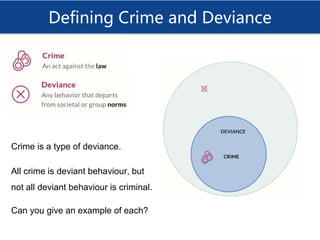
Crime is a type of deviance.
All crime is deviant behaviour, but
not all deviant behaviour is criminal.
Can you give an example of each?
Defining Crime and Deviance
Deviance, according to Giddens
(2013), is defined as non-
conformity to a given set of norms
or rules that are accepted by a
significant number of people in a
community or society.
Most people follow social norms or
rules because of ‘socialisation’, the
behaviours society teaches its
members to follow.
Deviance is where someone
deviates (moves away) from social
norms.
Image source: Microsoft 365 stock
Defining Crime and Deviance
Deviance usually refers to behaviour that is
disapproved of, and therefore results in
punishment (sanction):
Image source:
BBC
Legal: going to jail or paying a financial
penalty
Social: losing friends, being excluded from
a club, being judged
As Durkheim notes, all social rules are
accompanied by sanctions or consequences for
breaking these rules.
However, most of us may on occasion break
these rules: for example, we may take office
notepaper or pens for personal use.
Defining Crime and Deviance
No action or behaviour is naturally criminal or deviant, it
is society that defines actions (explicitly or implicitly) as
deviant or criminal.
This is a social convention, a construction (imaginary concept that
becomes true because everybody behaves accordingly), and this can
change over time, as well as between cultures and subcultures.
Can you think of an example where behaviour has been considered
deviant or criminal in the past, but is not anymore?
Image source: Aftermath
Quick revision
Crime and Deviance: Theoretical
Approaches
Different approaches have
developed over the last 150
years to explain criminal and
deviant behaviour.
Today we will look at two of
these that relate to the theoretical
approaches that you have
studied in this module already:
Functionalism and Conflict
theory.
Image Source:
FSN
Crime and Functionalism
Functionalism argues that:
• Crime and deviance are
universal, they exist in all
known societies.
• It is normal for them to take
place (even though considered
socially unacceptable).
• Crime and deviance perform
necessary functions in society,
helping to maintain social
stability.
Image Source: NBC
Logo
Crime and Functionalism: An
Example
When someone commits a
crime, people feel a sense
of collective outrage.
This brings people closer
together, contributing to
social cohesion.
This then reinforces social
values and the line
between acceptable and
unacceptable behaviour.
Image Source: Wikimedia
Commons
Functionalism: Anomie
But crime and deviance are not only
‘positive.’ There is a tension between
consensus, cohesion and stability
on the one hand, and a state of
anomie on the other.
Anomie is a weakening of the
agreement over social norms, due to
rapid changes in society and/or
where there is social pressure for
achieving cultural goals (e.g. getting
married, educated, earning) but for
many these are unachievable within
legitimate means.
As the rules of what is normal and
legitimate lose legitimacy and
influence, they are being ignored
more.
Image Source: Pediaa
Durkheim and Crime
Image source: Revise Sociology
Conflict Theory: Recap
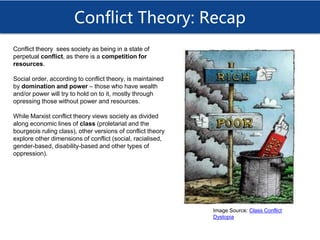
Conflict theory sees society as being in a state of
perpetual conflict, as there is a competition for
resources.
Social order, according to conflict theory, is maintained
by domination and power – those who have wealth
and/or power will try to hold on to it, mostly through
opressing those without power and resources.
While Marxist conflict theory views society as divided
along economic lines of class (proletariat and the
bourgeois ruling class), other versions of conflict theory
explore other dimensions of conflict (social, racialised,
gender-based, disability-based and other types of
oppression).
Image Source: Class Conflict
Dystopia
Conflict Theory and Crime
Conflict theory explores how
social and economic factors
cause crime and deviance.
Unlike functionalists,they don’t
see these factors as positive
functions of society or natural.
Instead, they see them as
proof of inequality in the social
system.
Conflict theorists are also
interested in how gender and
race correlate with wealth and
crime.
Image Source: Class In Justice
Conflict Theory and Crime
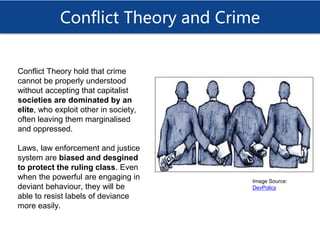
Conflict Theory hold that crime
cannot be properly understood
without accepting that capitalist
societies are dominated by an
elite, who exploit other in society,
often leaving them marginalised
and oppressed.
Laws, law enforcement and justice
system are biased and desgined
to protect the ruling class. Even
when the powerful are engaging in
deviant behaviour, they will be
able to resist labels of deviance
more easily.
Image Source:
DevPolicy
Conflict Theory and Crime
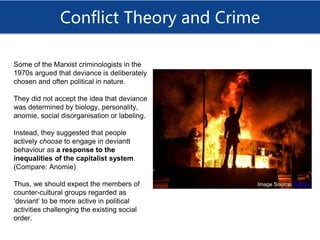
Some of the Marxist criminologists in the
1970s argued that deviance is deliberately
chosen and often political in nature.
They did not accept the idea that deviance
was determined by biology, personality,
anomie, social disorganisation or labeling.
Instead, they suggested that people
actively choose to engage in deviantt
behaviour as a response to the
inequalities of the capitalist system.
(Compare: Anomie)
Thus, we should expect the members of
counter-cultural groups regarded as
‘deviant’ to be more active in political
activities challenging the existing social
order.
Image Source: WBUR
Conflict Theory and Crime
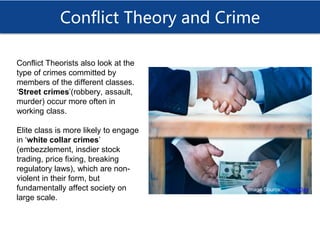
Conflict Theorists also look at the
type of crimes committed by
members of the different classes.
‘Street crimes’(robbery, assault,
murder) occur more often in
working class.
Elite class is more likely to engage
in ‘white collar crimes’
(embezzlement, insdier stock
trading, price fixing, breaking
regulatory laws), which are non-
violent in their form, but
fundamentally affect society on
large scale.
Image Source: Jones Day
Understanding Crime Sociologically
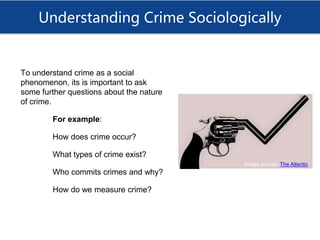
To understand crime as a social
phenomenon, its is important to ask
some further questions about the nature
of crime.
For example:
How does crime occur?
What types of crime exist?
Who commits crimes and why?
How do we measure crime?
Image source: The Atlantic
Crime and Inequality
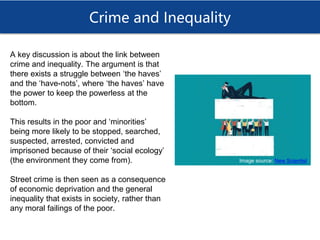
A key discussion is about the link between
crime and inequality. The argument is that
there exists a struggle between ‘the haves’
and the ‘have-nots’, where ‘the haves’ have
the power to keep the powerless at the
bottom.
This results in the poor and ‘minorities’
being more likely to be stopped, searched,
suspected, arrested, convicted and
imprisoned because of their ‘social ecology’
(the environment they come from).
Street crime is then seen as a consequence
of economic deprivation and the general
inequality that exists in society, rather than
any moral failings of the poor.
Image source: New Scientist
Crime and Inequality
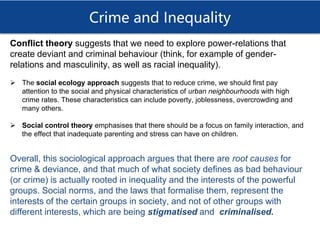
Conflict theory suggests that we need to explore power-relations that
create deviant and criminal behaviour (think, for example of gender-
relations and masculinity, as well as racial inequality).
 The social ecology approach suggests that to reduce crime, we should first pay
attention to the social and physical characteristics of urban neighbourhoods with high
crime rates. These characteristics can include poverty, joblessness, overcrowding and
many others.
 Social control theory emphasises that there should be a focus on family interaction, and
the effect that inadequate parenting and stress can have on children.
Overall, this sociological approach argues that there are root causes for
crime & deviance, and that much of what society defines as bad behaviour
(or crime) is actually rooted in inequality and the interests of the powerful
groups. Social norms, and the laws that formalise them, represent the
interests of the certain groups in society, and not of other groups with
different interests, which are being stigmatised and criminalised.
Crime and Inequality: How to reduce
crime?
If inequality causes crime, then to reduce crime we
need to reduce inequality.
Common suggestions include:
1. Establishing good-paying jobs for the poor in
urban areas.
2. Establishing youth recreation programs and
strengthening social interaction in urban
neighborhoods.
3. Improving living conditions in urban neighborhoods.
4. Changing male socialization practices.
5. Establishing early childhood intervention programs to help high-risk families raise
their children.
6. Improving the nation’s schools by establishing small classes and taking other
measures.
7. Providing alternative corrections for non-dangerous prisoners in order to reduce
prison crowding and costs and to lessen the chances of repeat offending.
8. Providing better educational and vocational services and better services for treating
and preventing drug and alcohol abuse for ex-offenders.
Image credit: Bart Everson
Researching Crime
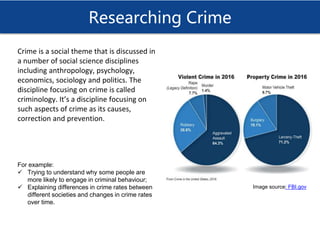
Crime is a social theme that is discussed in
a number of social science disciplines
including anthropology, psychology,
economics, sociology and politics. The
discipline focusing on crime is called
criminology. It’s a discipline focusing on
such aspects of crime as its causes,
correction and prevention.
For example:
 Trying to understand why some people are
more likely to engage in criminal behaviour;
 Explaining differences in crime rates between
different societies and changes in crime rates
over time.
Image source: FBI.gov
Measuring Crime
Most common data used
in criminological research
are official statistics,
which is typically
collected by different
statal criminal justice
institutions and agencies,
such as police, courts and
prisons.
What are the benefits and
shortcomings of this measurement?
What isn’t included? Can it answer
qualitative questions (like how, and
why people commit crimes)?
Image source: CPSS
Crime Research: Examples of
topics/questions
Is there a link between crime and immigrant status?
Does crime rate depend on the neighbourhood?
Does street lighting reduce crime?
Is there a relation between social class and crime?
What causes crime?
How can crime be prevented?
How effective are prisons?
How do criminals give meaning to their crime?
How do convicts perceive the justice system?
Is criminality a product of culture?
Conclusion
• Not all deviant behvaiour is criminal, but all crime is a type
of deviance.
• Explaining why disobeying norms and laws is a key
interest of the social sciences.
• Both crime and deviance are socially constructed,
changing and depend on the understanding of good and
bad in a specific time and place.
• Functionalists explain crime as helping to maintain
cohesion and consensus, but also as linked with anomie.
• Conflict theorists emphasise that the root causes for
breaking from social norms is inequality of power and fair
opportunities.

L6 Crime and dev.pptx

  • 1.
  • 2.
    By the endof this week, you will be able to: Describe crime and deviance and the difference between them Compare theoretical approaches crime and deviance, using key terminology Assess the link between inequality and crime Debate approaches to reducing crime Learning outcomes
  • 3.
    Warm up activity Spotthe deviant: Compare the two images – Which of the two is socially unconventional? Why? What are the consequences of being deviant?
  • 4.
    Defining Crime andDeviance Crime is a type of deviance. All crime is deviant behaviour, but not all deviant behaviour is criminal. Can you give an example of each?
  • 5.
    Defining Crime andDeviance Deviance, according to Giddens (2013), is defined as non- conformity to a given set of norms or rules that are accepted by a significant number of people in a community or society. Most people follow social norms or rules because of ‘socialisation’, the behaviours society teaches its members to follow. Deviance is where someone deviates (moves away) from social norms. Image source: Microsoft 365 stock
  • 6.
    Defining Crime andDeviance Deviance usually refers to behaviour that is disapproved of, and therefore results in punishment (sanction): Image source: BBC Legal: going to jail or paying a financial penalty Social: losing friends, being excluded from a club, being judged As Durkheim notes, all social rules are accompanied by sanctions or consequences for breaking these rules. However, most of us may on occasion break these rules: for example, we may take office notepaper or pens for personal use.
  • 7.
    Defining Crime andDeviance No action or behaviour is naturally criminal or deviant, it is society that defines actions (explicitly or implicitly) as deviant or criminal. This is a social convention, a construction (imaginary concept that becomes true because everybody behaves accordingly), and this can change over time, as well as between cultures and subcultures. Can you think of an example where behaviour has been considered deviant or criminal in the past, but is not anymore? Image source: Aftermath
  • 8.
  • 9.
    Crime and Deviance:Theoretical Approaches Different approaches have developed over the last 150 years to explain criminal and deviant behaviour. Today we will look at two of these that relate to the theoretical approaches that you have studied in this module already: Functionalism and Conflict theory. Image Source: FSN
  • 10.
    Crime and Functionalism Functionalismargues that: • Crime and deviance are universal, they exist in all known societies. • It is normal for them to take place (even though considered socially unacceptable). • Crime and deviance perform necessary functions in society, helping to maintain social stability. Image Source: NBC Logo
  • 11.
    Crime and Functionalism:An Example When someone commits a crime, people feel a sense of collective outrage. This brings people closer together, contributing to social cohesion. This then reinforces social values and the line between acceptable and unacceptable behaviour. Image Source: Wikimedia Commons
  • 12.
    Functionalism: Anomie But crimeand deviance are not only ‘positive.’ There is a tension between consensus, cohesion and stability on the one hand, and a state of anomie on the other. Anomie is a weakening of the agreement over social norms, due to rapid changes in society and/or where there is social pressure for achieving cultural goals (e.g. getting married, educated, earning) but for many these are unachievable within legitimate means. As the rules of what is normal and legitimate lose legitimacy and influence, they are being ignored more. Image Source: Pediaa
  • 13.
    Durkheim and Crime Imagesource: Revise Sociology
  • 14.
    Conflict Theory: Recap Conflicttheory sees society as being in a state of perpetual conflict, as there is a competition for resources. Social order, according to conflict theory, is maintained by domination and power – those who have wealth and/or power will try to hold on to it, mostly through opressing those without power and resources. While Marxist conflict theory views society as divided along economic lines of class (proletariat and the bourgeois ruling class), other versions of conflict theory explore other dimensions of conflict (social, racialised, gender-based, disability-based and other types of oppression). Image Source: Class Conflict Dystopia
  • 15.
    Conflict Theory andCrime Conflict theory explores how social and economic factors cause crime and deviance. Unlike functionalists,they don’t see these factors as positive functions of society or natural. Instead, they see them as proof of inequality in the social system. Conflict theorists are also interested in how gender and race correlate with wealth and crime. Image Source: Class In Justice
  • 16.
    Conflict Theory andCrime Conflict Theory hold that crime cannot be properly understood without accepting that capitalist societies are dominated by an elite, who exploit other in society, often leaving them marginalised and oppressed. Laws, law enforcement and justice system are biased and desgined to protect the ruling class. Even when the powerful are engaging in deviant behaviour, they will be able to resist labels of deviance more easily. Image Source: DevPolicy
  • 17.
    Conflict Theory andCrime Some of the Marxist criminologists in the 1970s argued that deviance is deliberately chosen and often political in nature. They did not accept the idea that deviance was determined by biology, personality, anomie, social disorganisation or labeling. Instead, they suggested that people actively choose to engage in deviantt behaviour as a response to the inequalities of the capitalist system. (Compare: Anomie) Thus, we should expect the members of counter-cultural groups regarded as ‘deviant’ to be more active in political activities challenging the existing social order. Image Source: WBUR
  • 18.
    Conflict Theory andCrime Conflict Theorists also look at the type of crimes committed by members of the different classes. ‘Street crimes’(robbery, assault, murder) occur more often in working class. Elite class is more likely to engage in ‘white collar crimes’ (embezzlement, insdier stock trading, price fixing, breaking regulatory laws), which are non- violent in their form, but fundamentally affect society on large scale. Image Source: Jones Day
  • 19.
    Understanding Crime Sociologically Tounderstand crime as a social phenomenon, its is important to ask some further questions about the nature of crime. For example: How does crime occur? What types of crime exist? Who commits crimes and why? How do we measure crime? Image source: The Atlantic
  • 20.
    Crime and Inequality Akey discussion is about the link between crime and inequality. The argument is that there exists a struggle between ‘the haves’ and the ‘have-nots’, where ‘the haves’ have the power to keep the powerless at the bottom. This results in the poor and ‘minorities’ being more likely to be stopped, searched, suspected, arrested, convicted and imprisoned because of their ‘social ecology’ (the environment they come from). Street crime is then seen as a consequence of economic deprivation and the general inequality that exists in society, rather than any moral failings of the poor. Image source: New Scientist
  • 21.
    Crime and Inequality Conflicttheory suggests that we need to explore power-relations that create deviant and criminal behaviour (think, for example of gender- relations and masculinity, as well as racial inequality).  The social ecology approach suggests that to reduce crime, we should first pay attention to the social and physical characteristics of urban neighbourhoods with high crime rates. These characteristics can include poverty, joblessness, overcrowding and many others.  Social control theory emphasises that there should be a focus on family interaction, and the effect that inadequate parenting and stress can have on children. Overall, this sociological approach argues that there are root causes for crime & deviance, and that much of what society defines as bad behaviour (or crime) is actually rooted in inequality and the interests of the powerful groups. Social norms, and the laws that formalise them, represent the interests of the certain groups in society, and not of other groups with different interests, which are being stigmatised and criminalised.
  • 22.
    Crime and Inequality:How to reduce crime? If inequality causes crime, then to reduce crime we need to reduce inequality. Common suggestions include: 1. Establishing good-paying jobs for the poor in urban areas. 2. Establishing youth recreation programs and strengthening social interaction in urban neighborhoods. 3. Improving living conditions in urban neighborhoods. 4. Changing male socialization practices. 5. Establishing early childhood intervention programs to help high-risk families raise their children. 6. Improving the nation’s schools by establishing small classes and taking other measures. 7. Providing alternative corrections for non-dangerous prisoners in order to reduce prison crowding and costs and to lessen the chances of repeat offending. 8. Providing better educational and vocational services and better services for treating and preventing drug and alcohol abuse for ex-offenders. Image credit: Bart Everson
  • 23.
    Researching Crime Crime isa social theme that is discussed in a number of social science disciplines including anthropology, psychology, economics, sociology and politics. The discipline focusing on crime is called criminology. It’s a discipline focusing on such aspects of crime as its causes, correction and prevention. For example:  Trying to understand why some people are more likely to engage in criminal behaviour;  Explaining differences in crime rates between different societies and changes in crime rates over time. Image source: FBI.gov
  • 24.
    Measuring Crime Most commondata used in criminological research are official statistics, which is typically collected by different statal criminal justice institutions and agencies, such as police, courts and prisons. What are the benefits and shortcomings of this measurement? What isn’t included? Can it answer qualitative questions (like how, and why people commit crimes)? Image source: CPSS
  • 25.
    Crime Research: Examplesof topics/questions Is there a link between crime and immigrant status? Does crime rate depend on the neighbourhood? Does street lighting reduce crime? Is there a relation between social class and crime? What causes crime? How can crime be prevented? How effective are prisons? How do criminals give meaning to their crime? How do convicts perceive the justice system? Is criminality a product of culture?
  • 26.
    Conclusion • Not alldeviant behvaiour is criminal, but all crime is a type of deviance. • Explaining why disobeying norms and laws is a key interest of the social sciences. • Both crime and deviance are socially constructed, changing and depend on the understanding of good and bad in a specific time and place. • Functionalists explain crime as helping to maintain cohesion and consensus, but also as linked with anomie. • Conflict theorists emphasise that the root causes for breaking from social norms is inequality of power and fair opportunities.