Subcultural Strain Theories 2
Lesson Objectives
• Recap Cohen’s Status Frustration and
  Alternative Status Hierarchy explanations of
  crime
• Introduce Cloward and Ohlin’s theory of crime
  committed by young people
• Evaluate this subcultural theory
Last Lesson Recap
• What reasons are there for young men
  committing more crimes than any other group?
• What is Status Frustration and why does it
  occur?
• How does Alternative Status Hierarchy explain
  delinquency?
• What are some of the evaluation points of
  Cohen’s theory?
Cloward and Ohlin: 3 subcultures
• Agree with Merton that WC youths are
  denied legitimate opportunities to achieve
  and that deviance stems from the response
  to this.
• However not everyone adapts to lack of
  legitimate opportunities by turning to
  innovation (utilitarian crime). Some resort
  to violence, others to drugs
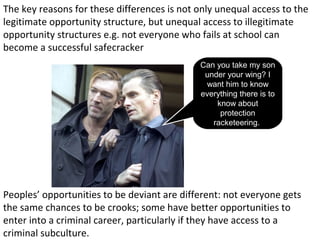
The key reasons for these differences is not only unequal access to the
legitimate opportunity structure, but unequal access to illegitimate
opportunity structures e.g. not everyone who fails at school can
become a successful safecracker
                                             Can you take my son
                                              under your wing? I
                                              want him to know
                                             everything there is to
                                                 know about
                                                  protection
                                                racketeering.


Peoples’ opportunities to be deviant are different: not everyone gets
the same chances to be crooks; some have better opportunities to
enter into a criminal career, particularly if they have access to a
criminal subculture.
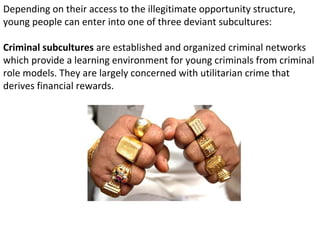
Depending on their access to the illegitimate opportunity structure,
young people can enter into one of three deviant subcultures:

Criminal subcultures are established and organized criminal networks
which provide a learning environment for young criminals from criminal
role models. They are largely concerned with utilitarian crime that
derives financial rewards.
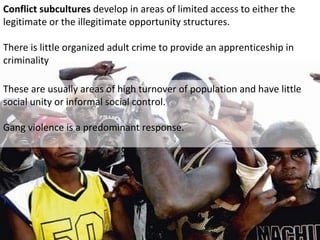
Conflict subcultures develop in areas of limited access to either the
legitimate or the illegitimate opportunity structures.

There is little organized adult crime to provide an apprenticeship in
criminality

These are usually areas of high turnover of population and have little
social unity or informal social control.

Gang violence is a predominant response.
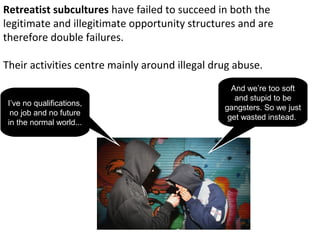
Retreatist subcultures have failed to succeed in both the
legitimate and illegitimate opportunity structures and are
therefore double failures.

Their activities centre mainly around illegal drug abuse.
                                                  And we’re too soft
                                                   and stupid to be
 I’ve no qualifications,
                                                gangsters. So we just
  no job and no future
                                                 get wasted instead.
 in the normal world...
What similarities and differences are
there between Cloward’s and Ohlin’s
 retreatist subculture and Merton’s
   idea of a retreatist adaptation
• Members of different types of deviant subculture might engage in
  different acts of deviant behaviour.
• In small groups, discuss which of the following offences you think
  would be most likely to be committed by members of ‘criminal’,
  ‘conflict’ or ‘retreatist’ subcultures.
• Are there some offences that might be committed by members of
  all three subcultures?


 Vandalism                           hooliganism
 illegal possession of knives        street fighting
 using ‘crack’ cocaine               theft from shops
 car theft                           burglary
 illegal possession of guns          dealing in stolen goods
 robbery with violence               murder
 taking ecstasy                      joy riding
                                     dealing in drugs
Evaluation
 Like Merton and Cohen, Cloward and Ohlin ignore
  crimes of the wealthy and the wider power structure
  and over predict the amount of W/C crime.

 Unlike Cohen they try to explain different types of
  W/C deviance in terms of different subcultures.
  However they draw the boundaries too sharply
  between the different types. Actual subcultures
  often show characteristics of more than one ‘type’
  (can you think of any examples?)
Like Cohen’s theory, Cloward and Ohlin’s is a reactive
one- they explain deviant subcultures as forming in
reaction to the failure to achieve mainstream success
goals. This wrongly assumes that everyone starts off
sharing these same goals

Walter Miller- lower class has its own independent
subculture separate from mainstream culture with its
own values. This culture does not value success in the
first place so its members are not frustrated by failure. He
agrees that deviance is widespread in lower class but
argues this arises out of an attempt to achieve their own
goals not mainstream ones (focal concerns)
among middle class people
Burke identifies criticisms of their work also:

1) the idea of the criminal subculture is based on
  gangs in Chicago in the 1920s and 30s so isn’t
  particularly applicable to modern British society;

2) the idea of retreatist subcultures is a ‘grossly
  simplistic’ explanation of drug abuse which is
  actually really common
What have Recent Strain
 Theorists suggested?
        Page 78
Overview of Key Sociologists
• Create a glossary of what the key sub
  cultural sociologists have said.

• Summaries each of them in no more than
  25 words.
Use subcultural explanations to
           explain
• http://www.bbc.co.uk/radio4/womanshour/
  02/2007_26_wed.shtml
MIC: Gang Leader for A Day
1. Summarise using the key words below:
    KEY CONCEPT: legitimate opportunity
structure; illegitimate opportunity structure;
  criminal subcultures; conflict subcultures;
   retreatist subcultures; utilitarian crime;
             non-utilitarian crime.

                2. Revision Sheet
Quick Check Q’s Page 79

Subcultural strain theories l2

  • 1.
  • 2.
    Lesson Objectives • RecapCohen’s Status Frustration and Alternative Status Hierarchy explanations of crime • Introduce Cloward and Ohlin’s theory of crime committed by young people • Evaluate this subcultural theory
  • 3.
    Last Lesson Recap •What reasons are there for young men committing more crimes than any other group? • What is Status Frustration and why does it occur? • How does Alternative Status Hierarchy explain delinquency? • What are some of the evaluation points of Cohen’s theory?
  • 4.
    Cloward and Ohlin:3 subcultures • Agree with Merton that WC youths are denied legitimate opportunities to achieve and that deviance stems from the response to this. • However not everyone adapts to lack of legitimate opportunities by turning to innovation (utilitarian crime). Some resort to violence, others to drugs
  • 5.
    The key reasonsfor these differences is not only unequal access to the legitimate opportunity structure, but unequal access to illegitimate opportunity structures e.g. not everyone who fails at school can become a successful safecracker Can you take my son under your wing? I want him to know everything there is to know about protection racketeering. Peoples’ opportunities to be deviant are different: not everyone gets the same chances to be crooks; some have better opportunities to enter into a criminal career, particularly if they have access to a criminal subculture.
  • 6.
    Depending on theiraccess to the illegitimate opportunity structure, young people can enter into one of three deviant subcultures: Criminal subcultures are established and organized criminal networks which provide a learning environment for young criminals from criminal role models. They are largely concerned with utilitarian crime that derives financial rewards.
  • 7.
    Conflict subcultures developin areas of limited access to either the legitimate or the illegitimate opportunity structures. There is little organized adult crime to provide an apprenticeship in criminality These are usually areas of high turnover of population and have little social unity or informal social control. Gang violence is a predominant response.
  • 8.
    Retreatist subcultures havefailed to succeed in both the legitimate and illegitimate opportunity structures and are therefore double failures. Their activities centre mainly around illegal drug abuse. And we’re too soft and stupid to be I’ve no qualifications, gangsters. So we just no job and no future get wasted instead. in the normal world...
  • 9.
    What similarities anddifferences are there between Cloward’s and Ohlin’s retreatist subculture and Merton’s idea of a retreatist adaptation
  • 10.
    • Members ofdifferent types of deviant subculture might engage in different acts of deviant behaviour. • In small groups, discuss which of the following offences you think would be most likely to be committed by members of ‘criminal’, ‘conflict’ or ‘retreatist’ subcultures. • Are there some offences that might be committed by members of all three subcultures? Vandalism hooliganism illegal possession of knives street fighting using ‘crack’ cocaine theft from shops car theft burglary illegal possession of guns dealing in stolen goods robbery with violence murder taking ecstasy joy riding dealing in drugs
  • 11.
    Evaluation  Like Mertonand Cohen, Cloward and Ohlin ignore crimes of the wealthy and the wider power structure and over predict the amount of W/C crime.  Unlike Cohen they try to explain different types of W/C deviance in terms of different subcultures. However they draw the boundaries too sharply between the different types. Actual subcultures often show characteristics of more than one ‘type’ (can you think of any examples?)
  • 12.
    Like Cohen’s theory,Cloward and Ohlin’s is a reactive one- they explain deviant subcultures as forming in reaction to the failure to achieve mainstream success goals. This wrongly assumes that everyone starts off sharing these same goals Walter Miller- lower class has its own independent subculture separate from mainstream culture with its own values. This culture does not value success in the first place so its members are not frustrated by failure. He agrees that deviance is widespread in lower class but argues this arises out of an attempt to achieve their own goals not mainstream ones (focal concerns) among middle class people
  • 13.
    Burke identifies criticismsof their work also: 1) the idea of the criminal subculture is based on gangs in Chicago in the 1920s and 30s so isn’t particularly applicable to modern British society; 2) the idea of retreatist subcultures is a ‘grossly simplistic’ explanation of drug abuse which is actually really common
  • 14.
    What have RecentStrain Theorists suggested? Page 78
  • 15.
    Overview of KeySociologists • Create a glossary of what the key sub cultural sociologists have said. • Summaries each of them in no more than 25 words.
  • 16.
    Use subcultural explanationsto explain • http://www.bbc.co.uk/radio4/womanshour/ 02/2007_26_wed.shtml
  • 17.
  • 18.
    1. Summarise usingthe key words below: KEY CONCEPT: legitimate opportunity structure; illegitimate opportunity structure; criminal subcultures; conflict subcultures; retreatist subcultures; utilitarian crime; non-utilitarian crime. 2. Revision Sheet
  • 19.

Editor's Notes

  • #6 Different neighbourhoods provide different illegitimate opportunities to learn criminal skills and develop criminal careers. They identify 3 types of subcultures that result
  • #7 Adult criminal select and train youths with the right abilities and provide youths with opportunities on the criminal career ladder
  • #11 Drug Trade is a mixture of disorganised crime like conflict subculture and professional mafia style criminal subculture. Also some supposedly retreatist users are professional dealers making a living from this utilitarian crime
  • #13 Like Cohen’s theory, Cloward and Ohlin’s is a reactive one- they explain deviant subcultures as forming in reaction to the failure to achieve mainstream success goals. This wrongly assumes that everyone starts off sharing these same goals Walter Miller- lower class has its own independent subculture separate from mainstream culture with its own values. This culture does not value success in the first place so its members are not frustrated by failure. He agrees that deviance is widespread in lower class but argues this arises out of an attempt to achieve their own goals not mainstream ones (focal concerns)
  • #18 MIC worksheet from spiral ringbound book
  • #20 1. Boundary maintenance – reinforcing norms and values for the majority; adaptation – facilitating social change; safety-valve, warning of a societal malfunction. 2. The feeling created when individuals find their access to legitimate means of achieving status is blocked+-. 3. Ritualists have lost sight of society’s goals, but still follow the legitimate means or rules; retreatists have rejected both society’s goals and the legitimate means to achieve them. 4. It assumes that all those who experience a strain to anomie will deviate, but many who experience strain do not deviate. 5. Crime that has no economic motive, such as vandalism. 6. Because some people are not effectively socialised and because in complex societies there are subcultural differences in norms and values. 7. Goals are the things we are expected to want and strive for, such as success, money, fast cars; means are the ways in which a person may obtain or achieve these goals. 8. Because not everyone who fails in mainstream society has equal access to an illegitimate opportunity structure; e.g. some areas have an organised professional criminal structure but others do not. 9. The emphasis on money and economic success; the lack of a supportive welfare system; the lack of clear norms about how wealth should be pursued legitimately.