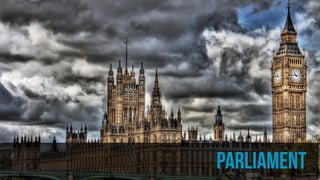
PARLIAMENT
learning objectives
• Explain the main features of parliamentary government
• Understand the powers and composition of the House of
Commons and the House of Lords
• Understand the function of parliament and how well does it
perform them
• Understand the role of an MP both in parliament and their
constituency
parliament
Bicameralism
A political system, in which there are two chambers in the
legislature.
The lower house is usually elected in a general election
and tends to be the dominant chamber.
The upper house may be directly elected or indirectly
elected (e.g. appointed by ministers), or a hybrid of both.
HOUSE OF COMMONS
house of commons
• 650 Members of Parliament (MPs)
• Each MP is elected is a single-member constituency by the
first-past-the-post electoral system
• the governing party (or parties) sit on the benches to the
right of the speaker’s chair
• members of opposition parties on the benches to its left
house of commons
• The main opposition party appoints 'shadow ministers' to
confront their rivals
• Ministers and shadow ministers are known as frontbenchers
because they occupy the benches closest to the floor of the
chamber
• The majority of MPs have no ministerial or shadow
ministerial posts and are known as backbenchers
Whips
Each party appoints a number of MPs to act as whips:
• Ensuring that MPs attend parliamentary divisions
(votes)
• Issuing instructions on how MPs should vote
• Enforcing discipline within the parliamentary party
The speaker
• The speaker of the House of Commons proceeds over
debates in the chamber, selecting speakers and
maintaining order
• The speaker is elected by MPs in a secret ballot
• the speaker must give up his or her party affiliation and
is non-partisan
House of commons in numbers
• there are 650 mps elected to the house of commons
• five Sinn Féin MPs refused to take their seats
• mPs salary is £74,000 - they had a 10% pay rise in July
• the highest paid mp is … John Bercow who gets paid
£75,766 for being the Speaker, on top of his salary for
being MP for Buckingham, in total £142,826
HOUSE OF LORDS
house of lords
• The upper house of the UK Parliament
• it can delay most bills passed by the House of Commons
for up to 1 year
• it is a revising chamber in the parliament
• should not reject or wreck bills that seek to enact a
manifesto commitment of the governing party
Hereditary peers
The House of Lords Act (1999) ended the right of all but 92
hereditary peers to sit and vote in the Lords. Before the
Act came into force, the House of Lords contained more
than 750 hereditary peers who had inherited their title
and a place in the upper house.
Life peers
The Life Peerages Act (1958) gave the prime minister the
right to appoint members of the upper house for life. Their
title and right to sit in the Lords cannot be inherited. With
the removal of most hereditary peers, life peers now form
the largest category of members of the upper house.
Lords Spiritual
Two archbishops and 24 senior bishops of the Church of
England sit in the House of Lords.
House of lords in numbers
• The new appointments take the total number of eligible
members to 826
• In 2014/15 the average daily attendance was 483 peers
• Members can claim a tax-free daily allowance of £300
• net operating costs for the chamber totalled £94.4m for
2014/15
• Of this £20.7m was spent on members' allowances and expenses
THE MONARCHY
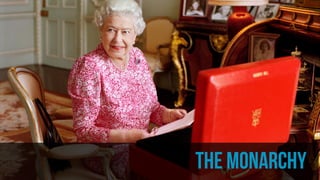
The monarchy
The monarchy retains a formal and ceremonial role in
parliament. The monarch is head of state, but many of the
powers associated with the Crown, such as the power to
declare war, are exercised by ministers.
The royal assent
Approval by the monarch is the final stage in the
legislative process. Only when a bill has been signed by the
monarch can it become law. Constitutional convention
dictates that the monarch must always grant they royal
assent.
Appointing the prime minister
The monarch appoints the prime minister. This is usually a
formality, with the leader of the largest party in the
House of Commons invited to form a government. If no party
has a majority, the monarch awaits the outcome of
discussions between parties, avoiding personal
involvement in the process of forming a government.
Dissolving parliament
The monarch’s prerogative power to dissolve parliament
was ended by the Fixed-term Parliaments Act (2011). The
monarch retains a formal role in bringing a parliamentary
session to an end.
The Queens’s Speech
At the State Opening of Parliament, the monarch opens the
new parliamentary session and delivers the Queen’s
Speech. It sets out the main bills that the government
intends to introduce that year. The speech is drawn up by
the government not the monarch.
functions of parliament
• legislation
• scrutiny and accountability
• representation
• recruitment of ministers
• legitimacy
Legislation
Parliament is the legislative branch (the ‘legislature’) of a
political system. The term reflects parliament’s primary
function – making law.
Green Paper
sets out various options for legislation.
White Paper
explains the objectives of government policy
bill
draft legislative proposal that is debated in parliament.
act
When a bill has completed the legislative process and
enters into law, it is known as an Act of Parliament.
public bills
The most significant bills are public bills. The most
important public bills are promoted by a government
minister and concern general issues of public policy. 

Public bills are also the most common because the
executive exercises significant control over the
parliamentary timetable.
private members’ bills
Legislative proposals initiated by backbench MPs rather
than by the government. Only a small number of private
members’ bills become law. Time constraints and the
difficulty of persuading other MPs to back a proposal mean
that most fall at an early stage.
The passage of a bill
effectiveness of legislation
parliament’s effectiveness is making ad scrutinising law is
limited by the dominance of the executive:
• Government bills. Most bills that come before
parliament originate from the government. Private
members’ bills have little chance of success unless
they have government backing.
effectiveness of legislation
• Parliamentary timetable. The executive controls much of the
legislative timetable.
• Party discipline. The whip system ensures that government
proposals are rarely defeated and that most amendments are
acceptable to it.
• House of Lords. The upper house scrutinises and revises
legislation, but does not alter they key features of most bills.
scrutiny and accountability
In addition to scrutinising a government’s legislative
proposals, parliament also exercises a general scrutiny and
oversight role. the parliament scrutinises the actions of the
executive and ensures government accountability by requiring
ministers to explain and justify their actions. The convention of
individual ministerial responsibility states that ministers are
accountable to parliament.
Question time
Government ministers face questions from MPs on the floor
of the house. The parliamentary timetable includes
question sessions for ministers from each government
department. The most high-profile event is Prime Minister’s
Questions, which takes place each Wednesday at noon for
half an hour.
The opposition
The latest party not included in the government is the
official opposition. The very architecture of the House of
Commons is confrontational, with the government and
opposition facing each other across the chamber.
the opposition
the opposition will opposes many of the government’s
legislative proposals, and hurries the government
throughout the legislative process by tabling amendments
and forcing votes. The leader of the opposition also
confronts the prime minister at Question Time.
the opposition
the opposition will also try to appear as an alternative
government-in-waiting. It will need to develop its own
policies and might consider supporting government
measures that it agrees with. When government has a
comfortable majority, a period in opposition can prove
frustrating and fruitless.
Debates
MPs can also express their views and try to influence policy in
debates on current events and government actions. Their half-
hour adjournment debates at the end of each day give MPs a
chance to raise a particular issue. Ministers also take
statements to parliament on major issues, and these are
followed by debate. However, many debates are poorly
attended.
Select committees
In addition to general committees that examine legislation,
there are a number of other committees which scrutinise
government, the most important of which are select
committees. They have proved to be far more effective than
debates in holding the government to account.
Select committees
Select committees decide the issues that they are going to
examine. They have wide powers to summon witnesses and
to examine restricted documents. The committees spend
much time of their time questioning ministers, officials and
outside experts.
Select committees
The select committee system has deepened the
accountability of government to parliament. The remit of
select committees has been widened in recent years. Select
committees are beginning to scrutinise legislation that has
come into force, and hold hearings on some public
appointments.
Representation
The House of Commons consists of 650 MPs, elected from
single-member constituencies. The geographical nature of
representation is supposed to ensure that individual MPs can
be identified as the exclusive representatives of their
constituents, as opposed to the multi-member
constituencies used in proportional representation systems.
Representation
Constituency work takes up a greater proportion of an MP's
time than in the recent past – almost half of it, according
to a 2005 Hansard Society study. MPs hold regular
surgeries in which constituents can discuss problems.
Recruitment of ministers
Government ministers must be members of either the House of
Commons or the House of Lords. Parliament is, therefore, a
recruiting ground for government. The number of government
posts – the 'payroll vote' – has increased over the last 20
years with 95 MPs holding paid posts in 2012 and a further 43
unpaid positions as parliamentary private secretaries.
Legitimacy
Parliament helps to maintain the legitimacy of the
political system. Government policies are scrutinised and
discussed by MPs who represent the people. MPs also hold
the executive accountable and represent the interests of
their constituents.

Week 5: Parliament

  • 1.
  • 2.
    learning objectives • Explainthe main features of parliamentary government • Understand the powers and composition of the House of Commons and the House of Lords • Understand the function of parliament and how well does it perform them • Understand the role of an MP both in parliament and their constituency
  • 3.
  • 4.
    Bicameralism A political system,in which there are two chambers in the legislature. The lower house is usually elected in a general election and tends to be the dominant chamber. The upper house may be directly elected or indirectly elected (e.g. appointed by ministers), or a hybrid of both.
  • 5.
  • 6.
    house of commons •650 Members of Parliament (MPs) • Each MP is elected is a single-member constituency by the first-past-the-post electoral system • the governing party (or parties) sit on the benches to the right of the speaker’s chair • members of opposition parties on the benches to its left
  • 7.
    house of commons •The main opposition party appoints 'shadow ministers' to confront their rivals • Ministers and shadow ministers are known as frontbenchers because they occupy the benches closest to the floor of the chamber • The majority of MPs have no ministerial or shadow ministerial posts and are known as backbenchers
  • 8.
    Whips Each party appointsa number of MPs to act as whips: • Ensuring that MPs attend parliamentary divisions (votes) • Issuing instructions on how MPs should vote • Enforcing discipline within the parliamentary party
  • 9.
    The speaker • Thespeaker of the House of Commons proceeds over debates in the chamber, selecting speakers and maintaining order • The speaker is elected by MPs in a secret ballot • the speaker must give up his or her party affiliation and is non-partisan
  • 10.
    House of commonsin numbers • there are 650 mps elected to the house of commons • five Sinn Féin MPs refused to take their seats • mPs salary is £74,000 - they had a 10% pay rise in July • the highest paid mp is … John Bercow who gets paid £75,766 for being the Speaker, on top of his salary for being MP for Buckingham, in total £142,826
  • 11.
  • 12.
    house of lords •The upper house of the UK Parliament • it can delay most bills passed by the House of Commons for up to 1 year • it is a revising chamber in the parliament • should not reject or wreck bills that seek to enact a manifesto commitment of the governing party
  • 13.
    Hereditary peers The Houseof Lords Act (1999) ended the right of all but 92 hereditary peers to sit and vote in the Lords. Before the Act came into force, the House of Lords contained more than 750 hereditary peers who had inherited their title and a place in the upper house.
  • 14.
    Life peers The LifePeerages Act (1958) gave the prime minister the right to appoint members of the upper house for life. Their title and right to sit in the Lords cannot be inherited. With the removal of most hereditary peers, life peers now form the largest category of members of the upper house.
  • 15.
    Lords Spiritual Two archbishopsand 24 senior bishops of the Church of England sit in the House of Lords.
  • 16.
    House of lordsin numbers • The new appointments take the total number of eligible members to 826 • In 2014/15 the average daily attendance was 483 peers • Members can claim a tax-free daily allowance of £300 • net operating costs for the chamber totalled £94.4m for 2014/15 • Of this £20.7m was spent on members' allowances and expenses
  • 17.
  • 18.
    The monarchy The monarchyretains a formal and ceremonial role in parliament. The monarch is head of state, but many of the powers associated with the Crown, such as the power to declare war, are exercised by ministers.
  • 19.
    The royal assent Approvalby the monarch is the final stage in the legislative process. Only when a bill has been signed by the monarch can it become law. Constitutional convention dictates that the monarch must always grant they royal assent.
  • 20.
    Appointing the primeminister The monarch appoints the prime minister. This is usually a formality, with the leader of the largest party in the House of Commons invited to form a government. If no party has a majority, the monarch awaits the outcome of discussions between parties, avoiding personal involvement in the process of forming a government.
  • 21.
    Dissolving parliament The monarch’sprerogative power to dissolve parliament was ended by the Fixed-term Parliaments Act (2011). The monarch retains a formal role in bringing a parliamentary session to an end.
  • 22.
    The Queens’s Speech Atthe State Opening of Parliament, the monarch opens the new parliamentary session and delivers the Queen’s Speech. It sets out the main bills that the government intends to introduce that year. The speech is drawn up by the government not the monarch.
  • 23.
  • 24.
    functions of parliament •legislation • scrutiny and accountability • representation • recruitment of ministers • legitimacy
  • 25.
    Legislation Parliament is thelegislative branch (the ‘legislature’) of a political system. The term reflects parliament’s primary function – making law.
  • 26.
    Green Paper sets outvarious options for legislation. White Paper explains the objectives of government policy
  • 27.
    bill draft legislative proposalthat is debated in parliament. act When a bill has completed the legislative process and enters into law, it is known as an Act of Parliament.
  • 28.
    public bills The mostsignificant bills are public bills. The most important public bills are promoted by a government minister and concern general issues of public policy. 
 Public bills are also the most common because the executive exercises significant control over the parliamentary timetable.
  • 29.
    private members’ bills Legislativeproposals initiated by backbench MPs rather than by the government. Only a small number of private members’ bills become law. Time constraints and the difficulty of persuading other MPs to back a proposal mean that most fall at an early stage.
  • 30.
  • 31.
    effectiveness of legislation parliament’seffectiveness is making ad scrutinising law is limited by the dominance of the executive: • Government bills. Most bills that come before parliament originate from the government. Private members’ bills have little chance of success unless they have government backing.
  • 32.
    effectiveness of legislation •Parliamentary timetable. The executive controls much of the legislative timetable. • Party discipline. The whip system ensures that government proposals are rarely defeated and that most amendments are acceptable to it. • House of Lords. The upper house scrutinises and revises legislation, but does not alter they key features of most bills.
  • 33.
    scrutiny and accountability Inaddition to scrutinising a government’s legislative proposals, parliament also exercises a general scrutiny and oversight role. the parliament scrutinises the actions of the executive and ensures government accountability by requiring ministers to explain and justify their actions. The convention of individual ministerial responsibility states that ministers are accountable to parliament.
  • 34.
    Question time Government ministersface questions from MPs on the floor of the house. The parliamentary timetable includes question sessions for ministers from each government department. The most high-profile event is Prime Minister’s Questions, which takes place each Wednesday at noon for half an hour.
  • 35.
    The opposition The latestparty not included in the government is the official opposition. The very architecture of the House of Commons is confrontational, with the government and opposition facing each other across the chamber.
  • 36.
    the opposition the oppositionwill opposes many of the government’s legislative proposals, and hurries the government throughout the legislative process by tabling amendments and forcing votes. The leader of the opposition also confronts the prime minister at Question Time.
  • 37.
    the opposition the oppositionwill also try to appear as an alternative government-in-waiting. It will need to develop its own policies and might consider supporting government measures that it agrees with. When government has a comfortable majority, a period in opposition can prove frustrating and fruitless.
  • 38.
    Debates MPs can alsoexpress their views and try to influence policy in debates on current events and government actions. Their half- hour adjournment debates at the end of each day give MPs a chance to raise a particular issue. Ministers also take statements to parliament on major issues, and these are followed by debate. However, many debates are poorly attended.
  • 39.
    Select committees In additionto general committees that examine legislation, there are a number of other committees which scrutinise government, the most important of which are select committees. They have proved to be far more effective than debates in holding the government to account.
  • 40.
    Select committees Select committeesdecide the issues that they are going to examine. They have wide powers to summon witnesses and to examine restricted documents. The committees spend much time of their time questioning ministers, officials and outside experts.
  • 41.
    Select committees The selectcommittee system has deepened the accountability of government to parliament. The remit of select committees has been widened in recent years. Select committees are beginning to scrutinise legislation that has come into force, and hold hearings on some public appointments.
  • 42.
    Representation The House ofCommons consists of 650 MPs, elected from single-member constituencies. The geographical nature of representation is supposed to ensure that individual MPs can be identified as the exclusive representatives of their constituents, as opposed to the multi-member constituencies used in proportional representation systems.
  • 43.
    Representation Constituency work takesup a greater proportion of an MP's time than in the recent past – almost half of it, according to a 2005 Hansard Society study. MPs hold regular surgeries in which constituents can discuss problems.
  • 44.
    Recruitment of ministers Governmentministers must be members of either the House of Commons or the House of Lords. Parliament is, therefore, a recruiting ground for government. The number of government posts – the 'payroll vote' – has increased over the last 20 years with 95 MPs holding paid posts in 2012 and a further 43 unpaid positions as parliamentary private secretaries.
  • 45.
    Legitimacy Parliament helps tomaintain the legitimacy of the political system. Government policies are scrutinised and discussed by MPs who represent the people. MPs also hold the executive accountable and represent the interests of their constituents.