CRANIAL FOSSA
The internal surface of the cranial
base
Mojee Tuapati
Internal Surface of Skull:
• Has 3 large depressions:
▫ Anterior cranial fossa
▫ Middle cranial fossa
▫ Posterior cranial fossa
• All lie at different levels within cavity
• Anterior cranial fossa lies at highest level
• Posterior cranial fossa lies at lowest level
Anterior Cranial Fossa:
• Occupied by inferior & anterior parts of frontal lobes
of brain-cerebrum.
• Bounded anteriorly by frontal bone, the ethmoid
bone in the middle and the body & lesser wing of
sphenoid posteriorly.
• Most of fossa formed by orbital part of frontal bone.

• Frontal crest is a median body extension of frontal
bone.
• At its base, present is Foraman cecum of frontal
bone-important in natal life.
(cont’d):
• Crista galli-a thick median ridge posterior to
foramen cecum.
▫ Projects superiorly from the ethmoid.
• On each side of ridge is the sieve-like cribiform
plate of ethmoid.
• This transmits the olfactory nerves (CN I) from
olfactory areas of nasal cavities to the olfactory
bulbs of the brain which lie on this plate.
Middle Cranial Fossa:
• Butterfly-shaped
• Lies posteroinferior to anterior cranial fossa.
• Bounded anteriorly by sphenoidal crests-made
up mostly of lesser wing of sphenoid bone.
• Laterally, bounded by greater wing of sphenoid
bone and squamous part of temporal bone.
• Posteriorly by superior border of petrous part of
temporal bone.
(cont’d):
• The central part of middle cranial fossa
composed of Sella-turcica (Turkish saddle).
• Sella-turcica is a saddle-like bony formation on
the upper surface of body of sphenoid.
• Surrounded by anterior(2) & posterior(2) clinoid
processes. “Clinoid”-bed post
• The 4 processes surround the hypophysial fossa,
the bed of the pituitary glands.
Parts of Sella-Turcica
1. The tuberculum sellae: A median elevation
forming posterior boundary of prechiasmatic
sulcus & anterior boundary of hypophysial
fossa
2. The hypophysial fossa: Median depression
that accommodates the pituitary gland.
3. The dorsum sellae: a square plate projecting
superiorly from body of sphenoid.
▫ Forms posterior border of sella turcica
▫ Its superolateral angles make up the posterior
clinoid processes.
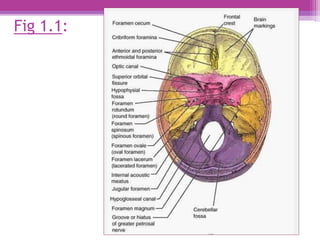
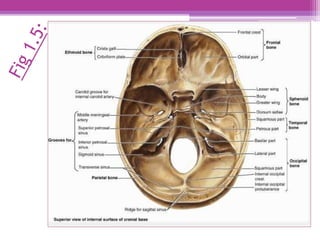
Posterior Cranial Fossa:
• Largest & deepest of the 3 cranial fossae.
• Lodges the cerebellum, pons & medulla oblongata.
• Formed mostly by occipital bone
• Dorsum sellae forms anterior border centrally &
petrous and mastoid parts of temporal bone forms
its anterolateral boundaries.
• Posterior to Foramen magnum, fossa is partially
divided into bilateral concave impressions, the
cerebellar fossae.
• Broad grooves show horizontal course of transverse
sinus & the S-shaped sigmoid sinus.
Fig 1.1:
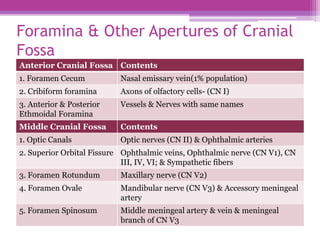
Foramina & Other Apertures of Cranial
Fossa
Anterior Cranial Fossa Contents
1. Foramen Cecum Nasal emissary vein(1% population)
2. Cribiform foramina Axons of olfactory cells- (CN I)
3. Anterior & Posterior
Ethmoidal Foramina
Vessels & Nerves with same names
Middle Cranial Fossa Contents
1. Optic Canals Optic nerves (CN II) & Ophthalmic arteries
2. Superior Orbital Fissure Ophthalmic veins, Ophthalmic nerve (CN V1), CN
III, IV, VI; & Sympathetic fibers
3. Foramen Rotundum Maxillary nerve (CN V2)
4. Foramen Ovale Mandibular nerve (CN V3) & Accessory meningeal
artery
5. Foramen Spinosum Middle meningeal artery & vein & meningeal
branch of CN V3
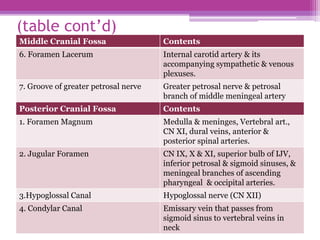
(table cont’d)
Middle Cranial Fossa Contents
6. Foramen Lacerum Internal carotid artery & its
accompanying sympathetic & venous
plexuses.
7. Groove of greater petrosal nerve Greater petrosal nerve & petrosal
branch of middle meningeal artery
Posterior Cranial Fossa Contents
1. Foramen Magnum Medulla & meninges, Vertebral art.,
CN XI, dural veins, anterior &
posterior spinal arteries.
2. Jugular Foramen CN IX, X & XI, superior bulb of IJV,
inferior petrosal & sigmoid sinuses, &
meningeal branches of ascending
pharyngeal & occipital arteries.
3.Hypoglossal Canal Hypoglossal nerve (CN XII)
4. Condylar Canal Emissary vein that passes from
sigmoid sinus to vertebral veins in
neck
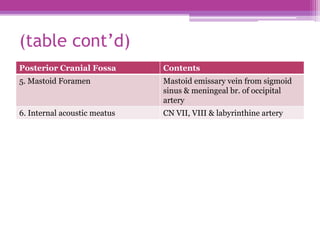
(table cont’d)
Posterior Cranial Fossa Contents
5. Mastoid Foramen Mastoid emissary vein from sigmoid
sinus & meningeal br. of occipital
artery
6. Internal acoustic meatus CN VII, VIII & labyrinthine artery
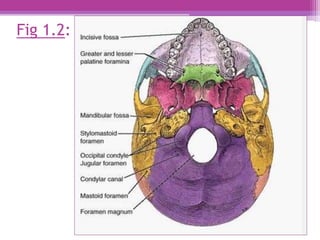
Fig 1.2:
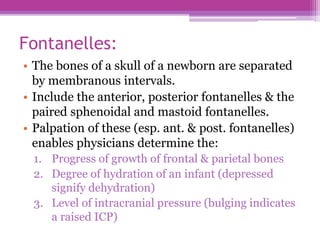
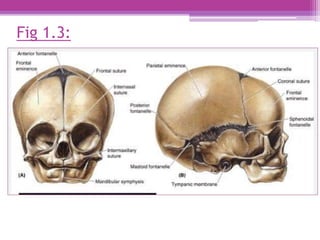
Fontanelles:
• The bones of a skull of a newborn are separated
by membranous intervals.
• Include the anterior, posterior fontanelles & the
paired sphenoidal and mastoid fontanelles.
• Palpation of these (esp. ant. & post. fontanelles)
enables physicians determine the:
1. Progress of growth of frontal & parietal bones
2. Degree of hydration of an infant (depressed
signify dehydration)
3. Level of intracranial pressure (bulging indicates
a raised ICP)
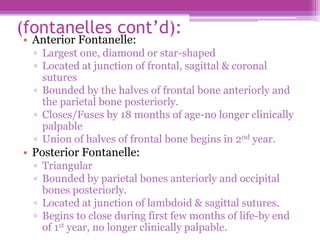
(fontanelles cont’d):
• Anterior Fontanelle:
▫ Largest one, diamond or star-shaped
▫ Located at junction of frontal, sagittal & coronal
sutures
▫ Bounded by the halves of frontal bone anteriorly and
the parietal bone posteriorly.
▫ Closes/Fuses by 18 months of age-no longer clinically
palpable
▫ Union of halves of frontal bone begins in 2nd year.
• Posterior Fontanelle:
▫ Triangular
▫ Bounded by parietal bones anteriorly and occipital
bones posteriorly.
▫ Located at junction of lambdoid & sagittal sutures.
▫ Begins to close during first few months of life-by end
of 1st year, no longer clinically palpable.
(fontanelles cont’d):
• The sphenoidal & mastoid fontanelles:
▫ Fuse during infancy
▫ Less important clinically than midline fontanelles.
Fig 1.3:
• MENINGES WILL NOT BE DISCUSSED HERE;
REASON-BEING, A SLIDE ON IT ALREADY
CIRCULATED!!!
• Ons..Move on
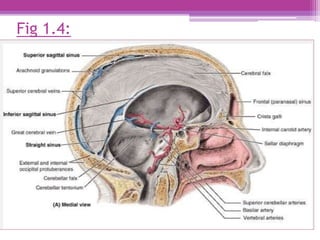
Dural Reflections:
• The dural infoldings divide the cranial cavity
into compartments.
• Include the following:
▫ Falx cerebri
▫ Falx cerebelli
▫ Sellar diaphragm
▫ Tentorium cerebelli
Fig 1.4:
(dural reflections cont’d):
• Falx cerebral:
▫ Largest dural infolding
▫ Lies in the longitudinal cerebral fissure that
separate the right & left cerebral hemispheres.
▫ Attached anteriorly to frontal crest of frontal bone
& crista galli of ethmoid bone.
▫ Posteriorly attached to internal occipital
protuberance of occipital bone.
▫ Ends by becoming continuous with cerebellar
tentorium.
(cont’d):
• Falx cerebelli:
▫ Is a vertical dural infolding
▫ Lies inferior to tentorium cerebelli in posterior
part of posterior cranial fossa.
▫ Attached to internal occipital crest.
▫ Partially separates cerebellar hemispheres.
• Sellar diaphragm:
▫ Smallest dural infolding
▫ A circular dural sheet suspended between clinoid
processes forming a partial roof over hypophysial
fossa of sphenoid bone.
(cont’d):
• Tentorium cerebelli:
▫ 2nd largest dural infolding
▫ Is crescent-shaped and separates occipital lobe of
cerebrum from cerebellum.
▫ Attached anteriorly to clinoid processes of sphenoid,
anterolaterally to petrous part of temporal bone and
posterolaterally to internal surface of occipital bone &
part of parietal bone.
▫ Falx cerebri attaches to it and holds it up, giving it a
tent-like appearance.
▫ Divides cranial cavity into supratentorial &
infratentorial compartments
▫ Free anteromedial border produces a gap called
tentorial notch through which brainstem passes.
Dural Venous Sinuses:
• Are endothelium-lined spaces between the
endosteal & meningeal layer of dura mater,
• Large veins from surface of brain drains into
these sinuses & most of blood from brain drains
through them into the IJVs.
1. Superior sagittal sinus
 Lies in the convex attached border of the falx
cerebri.
 Begins at crista galli & ends at internal occipital
protuberance at confluence of sinuses-meeting
place of superior sagittal, straight, occipital, &
transverse sinuses.
(cont’d):
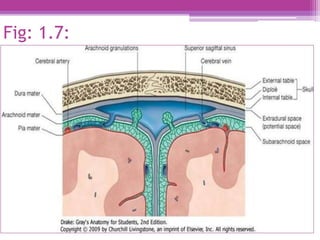
▫ Arachnoid granulations:
 Collections of arachnoid villi
 Protrusions of arachnoid that penetrates the
meningeal layer of dura mater into the dural venous
sinuses.
 Are structurally adapted for transport of CSF from
subarachnoid space to the venous system
▫ Inferior sagittal sinus:
 Much smaller than superior sagittal sinus
 Runs in the inferior concave free border of the falx
cerebri & ends in the straight sinus.
(cont’d):
▫ Straight sinus:
 Formed by union of inferior sagittal sinus & great
cerebral vein.
 Runs inferoposteriorly along attachment of falx
cerebri to tentorium cerebelli, where it joins the
confluence of sinuses.
▫ Transverse sinus:
 Pass laterally from confluence of sinuses, forming a
groove in occipital bones & posteroinferior angles of
parietal bones.
 Become sigmoid sinuses as they approach posterior
aspect of petrous temporal bones.
 Blood received by the confluence of sinuses is
drained by the transverse sinuses, but rarely equal
since left sinus is dominant.
(cont’d):
▫ Sigmoid sinus:
 Follow S-shaped courses in the posterior cranial
fossa, forming deep grooves in temporal & occipital
bones.
 Turns anteriorly & continues inferiorly as IJV after
transversing jugular foramen.
▫ Occipital sinus:
 Lies in the attached border of falx cerebelli.
 Ends superiorly at confluence of sinuses.
 Communicates inferiorly with the internal vertebral
venous plexus.
(cont’d):
▫ Cavernous sinus:
 Located on each side of sella turcica
 Consists of a plexus of extremely thin-walled veins.
 Receives blood from superior & inferior ophthalmic
veins, superficial middle cerebral vein, and
sphenoparietal sinus.
 Channels within communicate with each other via
intercavernous sinuses.
 Drains posteroinferiorly through superior & inferior
petrosal sinuses.
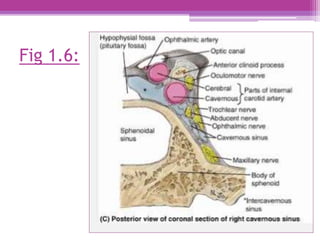
Fig 1.6:
(cavernous sinus cont’d)
▫ Within each cavernous sinus are certain structures
 Internal carotid artery with its small branches
 Carotid plexus of sympathetic nerve(s)
 CN III, IV and VI
 Plus 2 out of the 3 divisions of CN V.
▫ The artery carrying warm blood from body's core,
transverses the sinus filled with cooler blood
returning from capillaries of body’s periphery.
 This allows heat exchange to conserve energy.
(cont’d)
▫ Superior petrosal sinuses:
 Run from posterior end of cavernous sinus to the
transverse sinuses where ‘ey curve inferiorly to form
the sigmoid sinuses.
 Each lies in the anterolateral attached margin of
tentorium cerebelli.
▫ Inferior petrosal sinuses:
 Also commence at posterior end of cavernous sinus
inferiorly
 Drain the veins of the lateral cavernous sinus
directly into the origin of the IJVs.
Fig: 1.7:
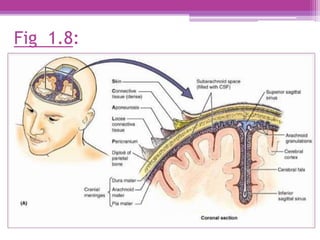
SCALP: (scalp)
• Is composed of 5 layers. The first 3 of which are
connected intimately & move as a unit.
▫ 1. Skin:
 Thin, except in occipital region
 Contains many sweat & sebaceous glands & hair
follicles.
 Abundant arterial supply and good venous &
lymphatic drainage
▫ 2. Connective tissue:
 Forms the thick, richly vascularized, subcutaneous
layer that is well supplied by cutaneous nerves.
(cont’d):
▫ 3. Aponeurosis:
 The strong tendinous sheet that covers the skull and
serves as an attachment for muscle(s).
 All parts are innervated by CN VII
▫ 4. Loose-areolar tissue:
 A sponge-like layer including potential spaces that
may distend with fluid as a result of injury or
infection.
 Allows free movement of scalp proper-first 3 layers
▫ 5. Pericranium:
 A dense layer of CT that forms periosteum of
external neurocranium.
Fig 1.8:
Sources:
• Grays Anatomy
• Moore’s Clinically Oriented Anatomy (7th Ed)
THE END!
#BWA #WinnerzKlub
#StaySafeFam

Cranial fossa-SCALP

  • 1.
    CRANIAL FOSSA The internalsurface of the cranial base Mojee Tuapati
  • 2.
    Internal Surface ofSkull: • Has 3 large depressions: ▫ Anterior cranial fossa ▫ Middle cranial fossa ▫ Posterior cranial fossa • All lie at different levels within cavity • Anterior cranial fossa lies at highest level • Posterior cranial fossa lies at lowest level
  • 3.
    Anterior Cranial Fossa: •Occupied by inferior & anterior parts of frontal lobes of brain-cerebrum. • Bounded anteriorly by frontal bone, the ethmoid bone in the middle and the body & lesser wing of sphenoid posteriorly. • Most of fossa formed by orbital part of frontal bone. • Frontal crest is a median body extension of frontal bone. • At its base, present is Foraman cecum of frontal bone-important in natal life.
  • 4.
    (cont’d): • Crista galli-athick median ridge posterior to foramen cecum. ▫ Projects superiorly from the ethmoid. • On each side of ridge is the sieve-like cribiform plate of ethmoid. • This transmits the olfactory nerves (CN I) from olfactory areas of nasal cavities to the olfactory bulbs of the brain which lie on this plate.
  • 5.
    Middle Cranial Fossa: •Butterfly-shaped • Lies posteroinferior to anterior cranial fossa. • Bounded anteriorly by sphenoidal crests-made up mostly of lesser wing of sphenoid bone. • Laterally, bounded by greater wing of sphenoid bone and squamous part of temporal bone. • Posteriorly by superior border of petrous part of temporal bone.
  • 6.
    (cont’d): • The centralpart of middle cranial fossa composed of Sella-turcica (Turkish saddle). • Sella-turcica is a saddle-like bony formation on the upper surface of body of sphenoid. • Surrounded by anterior(2) & posterior(2) clinoid processes. “Clinoid”-bed post • The 4 processes surround the hypophysial fossa, the bed of the pituitary glands.
  • 7.
    Parts of Sella-Turcica 1.The tuberculum sellae: A median elevation forming posterior boundary of prechiasmatic sulcus & anterior boundary of hypophysial fossa 2. The hypophysial fossa: Median depression that accommodates the pituitary gland. 3. The dorsum sellae: a square plate projecting superiorly from body of sphenoid. ▫ Forms posterior border of sella turcica ▫ Its superolateral angles make up the posterior clinoid processes.
  • 8.
    Posterior Cranial Fossa: •Largest & deepest of the 3 cranial fossae. • Lodges the cerebellum, pons & medulla oblongata. • Formed mostly by occipital bone • Dorsum sellae forms anterior border centrally & petrous and mastoid parts of temporal bone forms its anterolateral boundaries. • Posterior to Foramen magnum, fossa is partially divided into bilateral concave impressions, the cerebellar fossae. • Broad grooves show horizontal course of transverse sinus & the S-shaped sigmoid sinus.
  • 9.
  • 10.
    Foramina & OtherApertures of Cranial Fossa Anterior Cranial Fossa Contents 1. Foramen Cecum Nasal emissary vein(1% population) 2. Cribiform foramina Axons of olfactory cells- (CN I) 3. Anterior & Posterior Ethmoidal Foramina Vessels & Nerves with same names Middle Cranial Fossa Contents 1. Optic Canals Optic nerves (CN II) & Ophthalmic arteries 2. Superior Orbital Fissure Ophthalmic veins, Ophthalmic nerve (CN V1), CN III, IV, VI; & Sympathetic fibers 3. Foramen Rotundum Maxillary nerve (CN V2) 4. Foramen Ovale Mandibular nerve (CN V3) & Accessory meningeal artery 5. Foramen Spinosum Middle meningeal artery & vein & meningeal branch of CN V3
  • 11.
    (table cont’d) Middle CranialFossa Contents 6. Foramen Lacerum Internal carotid artery & its accompanying sympathetic & venous plexuses. 7. Groove of greater petrosal nerve Greater petrosal nerve & petrosal branch of middle meningeal artery Posterior Cranial Fossa Contents 1. Foramen Magnum Medulla & meninges, Vertebral art., CN XI, dural veins, anterior & posterior spinal arteries. 2. Jugular Foramen CN IX, X & XI, superior bulb of IJV, inferior petrosal & sigmoid sinuses, & meningeal branches of ascending pharyngeal & occipital arteries. 3.Hypoglossal Canal Hypoglossal nerve (CN XII) 4. Condylar Canal Emissary vein that passes from sigmoid sinus to vertebral veins in neck
  • 12.
    (table cont’d) Posterior CranialFossa Contents 5. Mastoid Foramen Mastoid emissary vein from sigmoid sinus & meningeal br. of occipital artery 6. Internal acoustic meatus CN VII, VIII & labyrinthine artery
  • 13.
  • 14.
    Fontanelles: • The bonesof a skull of a newborn are separated by membranous intervals. • Include the anterior, posterior fontanelles & the paired sphenoidal and mastoid fontanelles. • Palpation of these (esp. ant. & post. fontanelles) enables physicians determine the: 1. Progress of growth of frontal & parietal bones 2. Degree of hydration of an infant (depressed signify dehydration) 3. Level of intracranial pressure (bulging indicates a raised ICP)
  • 15.
    (fontanelles cont’d): • AnteriorFontanelle: ▫ Largest one, diamond or star-shaped ▫ Located at junction of frontal, sagittal & coronal sutures ▫ Bounded by the halves of frontal bone anteriorly and the parietal bone posteriorly. ▫ Closes/Fuses by 18 months of age-no longer clinically palpable ▫ Union of halves of frontal bone begins in 2nd year. • Posterior Fontanelle: ▫ Triangular ▫ Bounded by parietal bones anteriorly and occipital bones posteriorly. ▫ Located at junction of lambdoid & sagittal sutures. ▫ Begins to close during first few months of life-by end of 1st year, no longer clinically palpable.
  • 16.
    (fontanelles cont’d): • Thesphenoidal & mastoid fontanelles: ▫ Fuse during infancy ▫ Less important clinically than midline fontanelles.
  • 17.
  • 18.
    • MENINGES WILLNOT BE DISCUSSED HERE; REASON-BEING, A SLIDE ON IT ALREADY CIRCULATED!!! • Ons..Move on
  • 19.
    Dural Reflections: • Thedural infoldings divide the cranial cavity into compartments. • Include the following: ▫ Falx cerebri ▫ Falx cerebelli ▫ Sellar diaphragm ▫ Tentorium cerebelli
  • 20.
  • 21.
    (dural reflections cont’d): •Falx cerebral: ▫ Largest dural infolding ▫ Lies in the longitudinal cerebral fissure that separate the right & left cerebral hemispheres. ▫ Attached anteriorly to frontal crest of frontal bone & crista galli of ethmoid bone. ▫ Posteriorly attached to internal occipital protuberance of occipital bone. ▫ Ends by becoming continuous with cerebellar tentorium.
  • 22.
    (cont’d): • Falx cerebelli: ▫Is a vertical dural infolding ▫ Lies inferior to tentorium cerebelli in posterior part of posterior cranial fossa. ▫ Attached to internal occipital crest. ▫ Partially separates cerebellar hemispheres. • Sellar diaphragm: ▫ Smallest dural infolding ▫ A circular dural sheet suspended between clinoid processes forming a partial roof over hypophysial fossa of sphenoid bone.
  • 23.
    (cont’d): • Tentorium cerebelli: ▫2nd largest dural infolding ▫ Is crescent-shaped and separates occipital lobe of cerebrum from cerebellum. ▫ Attached anteriorly to clinoid processes of sphenoid, anterolaterally to petrous part of temporal bone and posterolaterally to internal surface of occipital bone & part of parietal bone. ▫ Falx cerebri attaches to it and holds it up, giving it a tent-like appearance. ▫ Divides cranial cavity into supratentorial & infratentorial compartments ▫ Free anteromedial border produces a gap called tentorial notch through which brainstem passes.
  • 25.
    Dural Venous Sinuses: •Are endothelium-lined spaces between the endosteal & meningeal layer of dura mater, • Large veins from surface of brain drains into these sinuses & most of blood from brain drains through them into the IJVs. 1. Superior sagittal sinus  Lies in the convex attached border of the falx cerebri.  Begins at crista galli & ends at internal occipital protuberance at confluence of sinuses-meeting place of superior sagittal, straight, occipital, & transverse sinuses.
  • 26.
    (cont’d): ▫ Arachnoid granulations: Collections of arachnoid villi  Protrusions of arachnoid that penetrates the meningeal layer of dura mater into the dural venous sinuses.  Are structurally adapted for transport of CSF from subarachnoid space to the venous system ▫ Inferior sagittal sinus:  Much smaller than superior sagittal sinus  Runs in the inferior concave free border of the falx cerebri & ends in the straight sinus.
  • 27.
    (cont’d): ▫ Straight sinus: Formed by union of inferior sagittal sinus & great cerebral vein.  Runs inferoposteriorly along attachment of falx cerebri to tentorium cerebelli, where it joins the confluence of sinuses. ▫ Transverse sinus:  Pass laterally from confluence of sinuses, forming a groove in occipital bones & posteroinferior angles of parietal bones.  Become sigmoid sinuses as they approach posterior aspect of petrous temporal bones.  Blood received by the confluence of sinuses is drained by the transverse sinuses, but rarely equal since left sinus is dominant.
  • 28.
    (cont’d): ▫ Sigmoid sinus: Follow S-shaped courses in the posterior cranial fossa, forming deep grooves in temporal & occipital bones.  Turns anteriorly & continues inferiorly as IJV after transversing jugular foramen. ▫ Occipital sinus:  Lies in the attached border of falx cerebelli.  Ends superiorly at confluence of sinuses.  Communicates inferiorly with the internal vertebral venous plexus.
  • 29.
    (cont’d): ▫ Cavernous sinus: Located on each side of sella turcica  Consists of a plexus of extremely thin-walled veins.  Receives blood from superior & inferior ophthalmic veins, superficial middle cerebral vein, and sphenoparietal sinus.  Channels within communicate with each other via intercavernous sinuses.  Drains posteroinferiorly through superior & inferior petrosal sinuses.
  • 30.
  • 31.
    (cavernous sinus cont’d) ▫Within each cavernous sinus are certain structures  Internal carotid artery with its small branches  Carotid plexus of sympathetic nerve(s)  CN III, IV and VI  Plus 2 out of the 3 divisions of CN V. ▫ The artery carrying warm blood from body's core, transverses the sinus filled with cooler blood returning from capillaries of body’s periphery.  This allows heat exchange to conserve energy.
  • 32.
    (cont’d) ▫ Superior petrosalsinuses:  Run from posterior end of cavernous sinus to the transverse sinuses where ‘ey curve inferiorly to form the sigmoid sinuses.  Each lies in the anterolateral attached margin of tentorium cerebelli. ▫ Inferior petrosal sinuses:  Also commence at posterior end of cavernous sinus inferiorly  Drain the veins of the lateral cavernous sinus directly into the origin of the IJVs.
  • 33.
  • 34.
    SCALP: (scalp) • Iscomposed of 5 layers. The first 3 of which are connected intimately & move as a unit. ▫ 1. Skin:  Thin, except in occipital region  Contains many sweat & sebaceous glands & hair follicles.  Abundant arterial supply and good venous & lymphatic drainage ▫ 2. Connective tissue:  Forms the thick, richly vascularized, subcutaneous layer that is well supplied by cutaneous nerves.
  • 35.
    (cont’d): ▫ 3. Aponeurosis: The strong tendinous sheet that covers the skull and serves as an attachment for muscle(s).  All parts are innervated by CN VII ▫ 4. Loose-areolar tissue:  A sponge-like layer including potential spaces that may distend with fluid as a result of injury or infection.  Allows free movement of scalp proper-first 3 layers ▫ 5. Pericranium:  A dense layer of CT that forms periosteum of external neurocranium.
  • 36.
  • 37.
    Sources: • Grays Anatomy •Moore’s Clinically Oriented Anatomy (7th Ed)
  • 38.