ADHD
Attention-Deficit / Hyperactivity
Disorder
ADHD:
 Attention deficit/hyperactivity disorder is a neurobehavioral disorder
defined by symptoms of :
 Inattention
 Hyperactivity
 And impulsivity.
Etiology:
 It is multifactorial in origin.
 Has genetic, environmental and neural contributions.
 Candidate genes include those involving the dopaminergic & noradrenergic
neurotransmitter systems.
 Prenatal exposure to substances (e.g., nicotine, alcohol) and damage to the central
nervous system from trauma or infection, increase the risk of ADHD.
Epidemiology:
 The male to female ratio is 2 to 6:1,
 with greater male predominance for the hyperactive/impulsive & combined types.
 Girls often present with inattentive symptoms.
 More likely to be underdiagnosed or to receive later diagnoses.
Diagnosis:
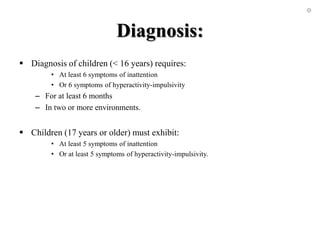
 Diagnosis of children (< 16 years) requires:
• At least 6 symptoms of inattention
• Or 6 symptoms of hyperactivity-impulsivity
– For at least 6 months
– In two or more environments.
 Children (17 years or older) must exhibit:
• At least 5 symptoms of inattention
• Or at least 5 symptoms of hyperactivity-impulsivity.
Diagnosis:
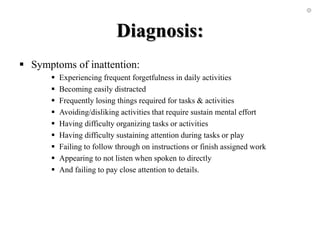
 Symptoms of inattention:
 Experiencing frequent forgetfulness in daily activities
 Becoming easily distracted
 Frequently losing things required for tasks & activities
 Avoiding/disliking activities that require sustain mental effort
 Having difficulty organizing tasks or activities
 Having difficulty sustaining attention during tasks or play
 Failing to follow through on instructions or finish assigned work
 Appearing to not listen when spoken to directly
 And failing to pay close attention to details.
Diagnosis:
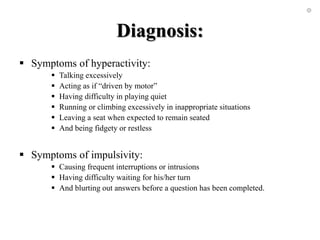
 Symptoms of hyperactivity:
 Talking excessively
 Acting as if “driven by motor”
 Having difficulty in playing quiet
 Running or climbing excessively in inappropriate situations
 Leaving a seat when expected to remain seated
 And being fidgety or restless
 Symptoms of impulsivity:
 Causing frequent interruptions or intrusions
 Having difficulty waiting for his/her turn
 And blurting out answers before a question has been completed.
Diagnosis:
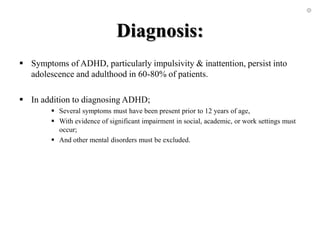
 Symptoms of ADHD, particularly impulsivity & inattention, persist into
adolescence and adulthood in 60-80% of patients.
 In addition to diagnosing ADHD;
 Several symptoms must have been present prior to 12 years of age,
 With evidence of significant impairment in social, academic, or work settings must
occur;
 And other mental disorders must be excluded.
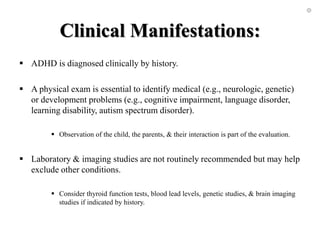
Clinical Manifestations:
 ADHD is diagnosed clinically by history.
 A physical exam is essential to identify medical (e.g., neurologic, genetic)
or development problems (e.g., cognitive impairment, language disorder,
learning disability, autism spectrum disorder).
 Observation of the child, the parents, & their interaction is part of the evaluation.
 Laboratory & imaging studies are not routinely recommended but may help
exclude other conditions.
 Consider thyroid function tests, blood lead levels, genetic studies, & brain imaging
studies if indicated by history.
Differential Diagnosis:
 Psychiatric conditions
 Oppositional defiant disorder
 Conduct disorder
 Anxiety disorder
 Depression
 Learning disabilities
 Language disorders
 And tic disorders
 *coexisting conditions are present in up to 60% of children with ADHD.
 Physician should first determine child’s development level to determine whether
behaviors are within normal range.
 Medical conditions, such as seizure disorders, sleep disordered breathing,
hyperthyroidism, lead intoxication, substance use & sensory deficits, should be
considered as possible causes for a child’s hyperactivity & distractibility.
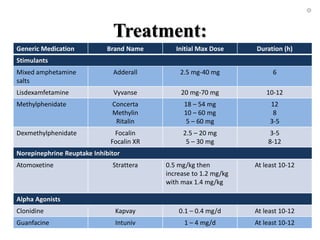
Treatment:
Generic Medication Brand Name Initial Max Dose Duration (h)
Stimulants
Mixed amphetamine
salts
Adderall 2.5 mg-40 mg 6
Lisdexamfetamine Vyvanse 20 mg-70 mg 10-12
Methylphenidate Concerta
Methylin
Ritalin
18 – 54 mg
10 – 60 mg
5 – 60 mg
12
8
3-5
Dexmethylphenidate Focalin
Focalin XR
2.5 – 20 mg
5 – 30 mg
3-5
8-12
Norepinephrine Reuptake Inhibitor
Atomoxetine Strattera 0.5 mg/kg then
increase to 1.2 mg/kg
with max 1.4 mg/kg
At least 10-12
Alpha Agonists
Clonidine Kapvay 0.1 – 0.4 mg/d At least 10-12
Guanfacine Intuniv 1 – 4 mg/d At least 10-12
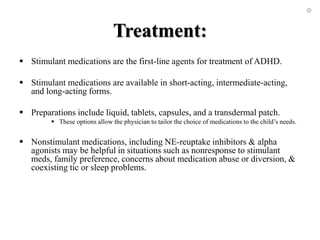
Treatment:
 Stimulant medications are the first-line agents for treatment of ADHD.
 Stimulant medications are available in short-acting, intermediate-acting,
and long-acting forms.
 Preparations include liquid, tablets, capsules, and a transdermal patch.
 These options allow the physician to tailor the choice of medications to the child’s needs.
 Nonstimulant medications, including NE-reuptake inhibitors & alpha
agonists may be helpful in situations such as nonresponse to stimulant
meds, family preference, concerns about medication abuse or diversion, &
coexisting tic or sleep problems.
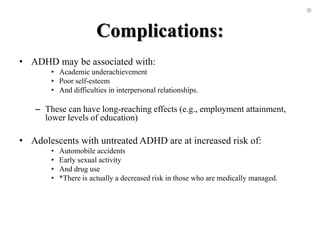
Complications:
• ADHD may be associated with:
• Academic underachievement
• Poor self-esteem
• And difficulties in interpersonal relationships.
– These can have long-reaching effects (e.g., employment attainment,
lower levels of education)
• Adolescents with untreated ADHD are at increased risk of:
• Automobile accidents
• Early sexual activity
• And drug use
• *There is actually a decreased risk in those who are medically managed.
Prevention:
 Limit television & video game times as these activities reinforce
short attention span.
 Child-rearing practices including promoting calm environment &
opportunities for age-appropriate activities that require increasing
levels of focus may be helpful.
 Secondary disabilities can be prevented by educating medical
professionals & teachers about signs & symptoms of ADHD.
 Collaboration between health care providers, educational
professionals, & mental health physicians will enhance early
identification of and provision of services to children at risk of
ADHD.
The End

ADHD - Attention Deficit Hyperactivity Disorder

  • 1.
  • 2.
    ADHD:  Attention deficit/hyperactivitydisorder is a neurobehavioral disorder defined by symptoms of :  Inattention  Hyperactivity  And impulsivity.
  • 3.
    Etiology:  It ismultifactorial in origin.  Has genetic, environmental and neural contributions.  Candidate genes include those involving the dopaminergic & noradrenergic neurotransmitter systems.  Prenatal exposure to substances (e.g., nicotine, alcohol) and damage to the central nervous system from trauma or infection, increase the risk of ADHD.
  • 4.
    Epidemiology:  The maleto female ratio is 2 to 6:1,  with greater male predominance for the hyperactive/impulsive & combined types.  Girls often present with inattentive symptoms.  More likely to be underdiagnosed or to receive later diagnoses.
  • 5.
    Diagnosis:  Diagnosis ofchildren (< 16 years) requires: • At least 6 symptoms of inattention • Or 6 symptoms of hyperactivity-impulsivity – For at least 6 months – In two or more environments.  Children (17 years or older) must exhibit: • At least 5 symptoms of inattention • Or at least 5 symptoms of hyperactivity-impulsivity.
  • 6.
    Diagnosis:  Symptoms ofinattention:  Experiencing frequent forgetfulness in daily activities  Becoming easily distracted  Frequently losing things required for tasks & activities  Avoiding/disliking activities that require sustain mental effort  Having difficulty organizing tasks or activities  Having difficulty sustaining attention during tasks or play  Failing to follow through on instructions or finish assigned work  Appearing to not listen when spoken to directly  And failing to pay close attention to details.
  • 7.
    Diagnosis:  Symptoms ofhyperactivity:  Talking excessively  Acting as if “driven by motor”  Having difficulty in playing quiet  Running or climbing excessively in inappropriate situations  Leaving a seat when expected to remain seated  And being fidgety or restless  Symptoms of impulsivity:  Causing frequent interruptions or intrusions  Having difficulty waiting for his/her turn  And blurting out answers before a question has been completed.
  • 8.
    Diagnosis:  Symptoms ofADHD, particularly impulsivity & inattention, persist into adolescence and adulthood in 60-80% of patients.  In addition to diagnosing ADHD;  Several symptoms must have been present prior to 12 years of age,  With evidence of significant impairment in social, academic, or work settings must occur;  And other mental disorders must be excluded.
  • 9.
    Clinical Manifestations:  ADHDis diagnosed clinically by history.  A physical exam is essential to identify medical (e.g., neurologic, genetic) or development problems (e.g., cognitive impairment, language disorder, learning disability, autism spectrum disorder).  Observation of the child, the parents, & their interaction is part of the evaluation.  Laboratory & imaging studies are not routinely recommended but may help exclude other conditions.  Consider thyroid function tests, blood lead levels, genetic studies, & brain imaging studies if indicated by history.
  • 10.
    Differential Diagnosis:  Psychiatricconditions  Oppositional defiant disorder  Conduct disorder  Anxiety disorder  Depression  Learning disabilities  Language disorders  And tic disorders  *coexisting conditions are present in up to 60% of children with ADHD.  Physician should first determine child’s development level to determine whether behaviors are within normal range.  Medical conditions, such as seizure disorders, sleep disordered breathing, hyperthyroidism, lead intoxication, substance use & sensory deficits, should be considered as possible causes for a child’s hyperactivity & distractibility.
  • 11.
    Treatment: Generic Medication BrandName Initial Max Dose Duration (h) Stimulants Mixed amphetamine salts Adderall 2.5 mg-40 mg 6 Lisdexamfetamine Vyvanse 20 mg-70 mg 10-12 Methylphenidate Concerta Methylin Ritalin 18 – 54 mg 10 – 60 mg 5 – 60 mg 12 8 3-5 Dexmethylphenidate Focalin Focalin XR 2.5 – 20 mg 5 – 30 mg 3-5 8-12 Norepinephrine Reuptake Inhibitor Atomoxetine Strattera 0.5 mg/kg then increase to 1.2 mg/kg with max 1.4 mg/kg At least 10-12 Alpha Agonists Clonidine Kapvay 0.1 – 0.4 mg/d At least 10-12 Guanfacine Intuniv 1 – 4 mg/d At least 10-12
  • 12.
    Treatment:  Stimulant medicationsare the first-line agents for treatment of ADHD.  Stimulant medications are available in short-acting, intermediate-acting, and long-acting forms.  Preparations include liquid, tablets, capsules, and a transdermal patch.  These options allow the physician to tailor the choice of medications to the child’s needs.  Nonstimulant medications, including NE-reuptake inhibitors & alpha agonists may be helpful in situations such as nonresponse to stimulant meds, family preference, concerns about medication abuse or diversion, & coexisting tic or sleep problems.
  • 13.
    Complications: • ADHD maybe associated with: • Academic underachievement • Poor self-esteem • And difficulties in interpersonal relationships. – These can have long-reaching effects (e.g., employment attainment, lower levels of education) • Adolescents with untreated ADHD are at increased risk of: • Automobile accidents • Early sexual activity • And drug use • *There is actually a decreased risk in those who are medically managed.
  • 14.
    Prevention:  Limit television& video game times as these activities reinforce short attention span.  Child-rearing practices including promoting calm environment & opportunities for age-appropriate activities that require increasing levels of focus may be helpful.  Secondary disabilities can be prevented by educating medical professionals & teachers about signs & symptoms of ADHD.  Collaboration between health care providers, educational professionals, & mental health physicians will enhance early identification of and provision of services to children at risk of ADHD.
  • 15.