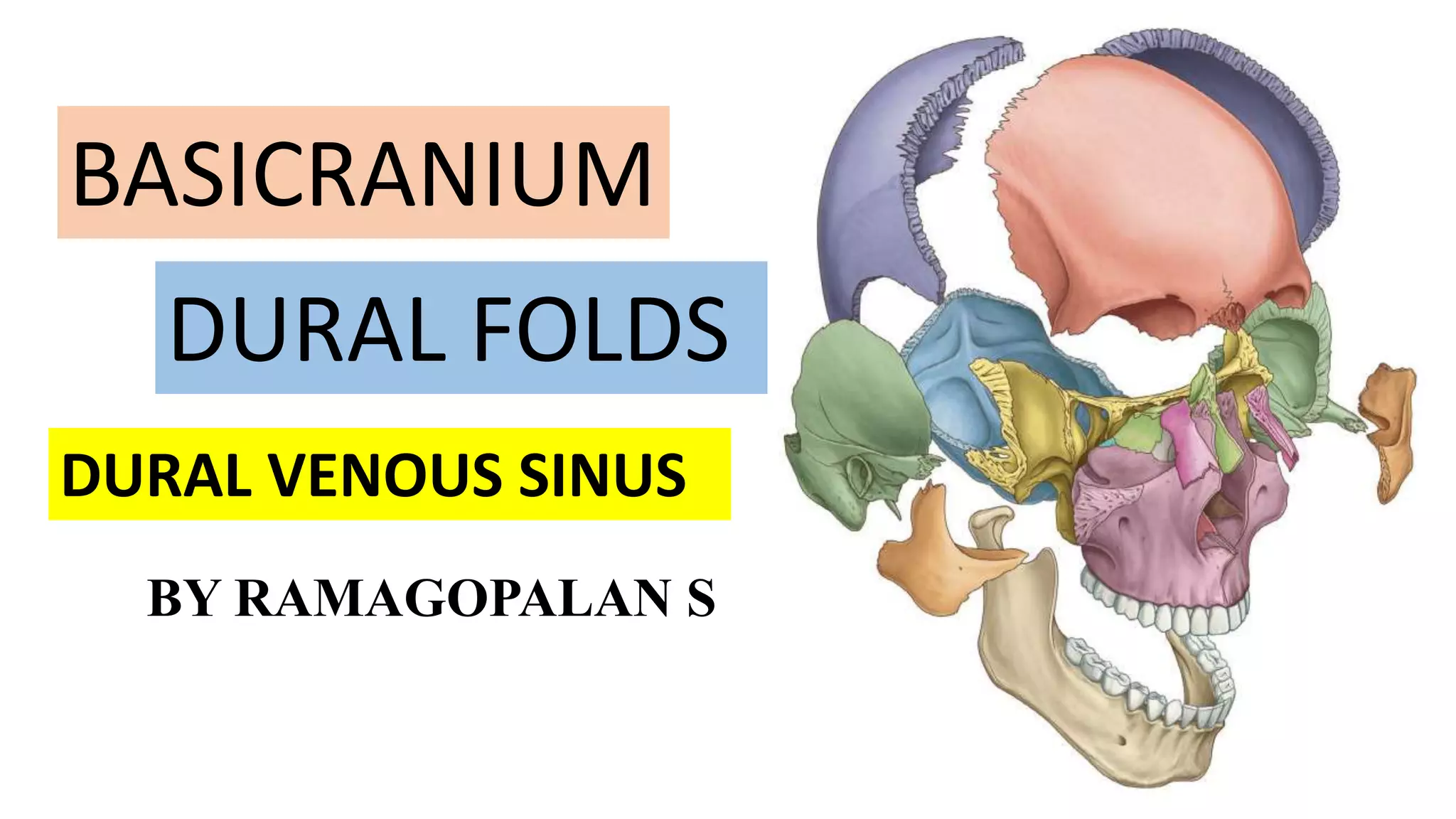
BASICRANIUM
DURAL FOLDS
DURAL VENOUS SINUS
BY RAMAGOPALAN S
CRANIAL CAVITY:
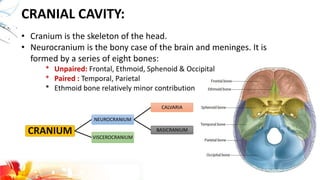
• Cranium is the skeleton of the head.
• Neurocranium is the bony case of the brain and meninges. It is
formed by a series of eight bones:
* Unpaired: Frontal, Ethmoid, Sphenoid & Occipital
* Paired : Temporal, Parietal
* Ethmoid bone relatively minor contribution
CRANIUM
NEUROCRANIUM
CALVARIA
BASICRANIUM
VISCEROCRANIUM
CRANIAL CAVITY:
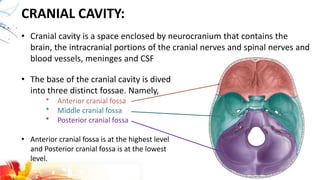
• Cranial cavity is a space enclosed by neurocranium that contains the
brain, the intracranial portions of the cranial nerves and spinal nerves and
blood vessels, meninges and CSF
• The base of the cranial cavity is dived
into three distinct fossae. Namely,
* Anterior cranial fossa
* Middle cranial fossa
* Posterior cranial fossa
• Anterior cranial fossa is at the highest level
and Posterior cranial fossa is at the lowest
level.
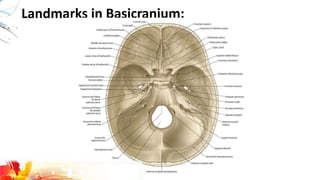
Landmarks in Basicranium:
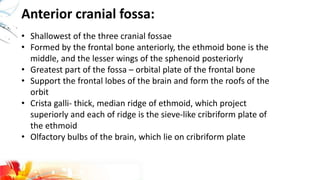
Anterior cranial fossa:
• Shallowest of the three cranial fossae
• Formed by the frontal bone anteriorly, the ethmoid bone is the
middle, and the lesser wings of the sphenoid posteriorly
• Greatest part of the fossa – orbital plate of the frontal bone
• Support the frontal lobes of the brain and form the roofs of the
orbit
• Crista galli- thick, median ridge of ethmoid, which project
superiorly and each of ridge is the sieve-like cribriform plate of
the ethmoid
• Olfactory bulbs of the brain, which lie on cribriform plate
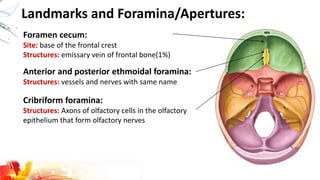
Landmarks and Foramina/Apertures:
Foramen cecum:
Site: base of the frontal crest
Structures: emissary vein of frontal bone(1%)
Anterior and posterior ethmoidal foramina:
Structures: vessels and nerves with same name
Cribriform foramina:
Structures: Axons of olfactory cells in the olfactory
epithelium that form olfactory nerves
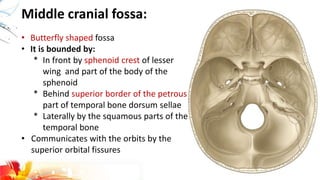
Middle cranial fossa:
• Butterfly shaped fossa
• It is bounded by:
* In front by sphenoid crest of lesser
wing and part of the body of the
sphenoid
* Behind superior border of the petrous
part of temporal bone dorsum sellae
* Laterally by the squamous parts of the
temporal bone
• Communicates with the orbits by the
superior orbital fissures
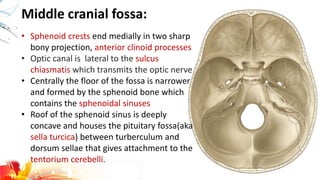
Middle cranial fossa:
• Sphenoid crests end medially in two sharp
bony projection, anterior clinoid processes
• Optic canal is lateral to the sulcus
chiasmatis which transmits the optic nerve
• Centrally the floor of the fossa is narrower
and formed by the sphenoid bone which
contains the sphenoidal sinuses
• Roof of the sphenoid sinus is deeply
concave and houses the pituitary fossa(aka
sella turcica) between turberculum and
dorsum sellae that gives attachment to the
tentorium cerebelli.
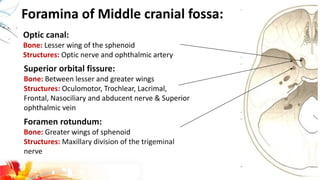
Foramina of Middle cranial fossa:
Optic canal:
Bone: Lesser wing of the sphenoid
Structures: Optic nerve and ophthalmic artery
Superior orbital fissure:
Bone: Between lesser and greater wings
Structures: Oculomotor, Trochlear, Lacrimal,
Frontal, Nasociliary and abducent nerve & Superior
ophthalmic vein
Foramen rotundum:
Bone: Greater wings of sphenoid
Structures: Maxillary division of the trigeminal
nerve
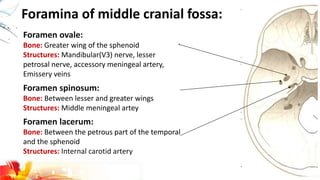
Foramina of middle cranial fossa:
Foramen ovale:
Bone: Greater wing of the sphenoid
Structures: Mandibular(V3) nerve, lesser
petrosal nerve, accessory meningeal artery,
Emissery veins
Foramen spinosum:
Bone: Between lesser and greater wings
Structures: Middle meningeal artey
Foramen lacerum:
Bone: Between the petrous part of the temporal
and the sphenoid
Structures: Internal carotid artery
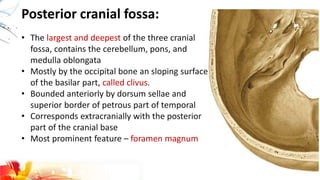
Posterior cranial fossa:
• The largest and deepest of the three cranial
fossa, contains the cerebellum, pons, and
medulla oblongata
• Mostly by the occipital bone an sloping surface
of the basilar part, called clivus.
• Bounded anteriorly by dorsum sellae and
superior border of petrous part of temporal
• Corresponds extracranially with the posterior
part of the cranial base
• Most prominent feature – foramen magnum
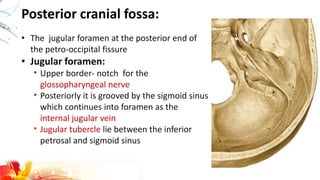
Posterior cranial fossa:
• The jugular foramen at the posterior end of
the petro-occipital fissure
• Jugular foramen:
* Upper border- notch for the
glossopharyngeal nerve
* Posteriorly it is grooved by the sigmoid sinus
which continues into foramen as the
internal jugular vein
* Jugular tubercle lie between the inferior
petrosal and sigmoid sinus
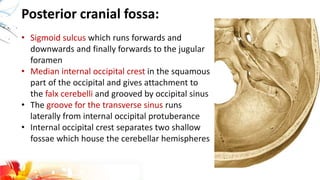
Posterior cranial fossa:
• Sigmoid sulcus which runs forwards and
downwards and finally forwards to the jugular
foramen
• Median internal occipital crest in the squamous
part of the occipital and gives attachment to
the falx cerebelli and grooved by occipital sinus
• The groove for the transverse sinus runs
laterally from internal occipital protuberance
• Internal occipital crest separates two shallow
fossae which house the cerebellar hemispheres
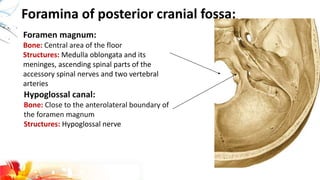
Foramina of posterior cranial fossa:
Foramen magnum:
Bone: Central area of the floor
Structures: Medulla oblongata and its
meninges, ascending spinal parts of the
accessory spinal nerves and two vertebral
arteries
Hypoglossal canal:
Bone: Close to the anterolateral boundary of
the foramen magnum
Structures: Hypoglossal nerve
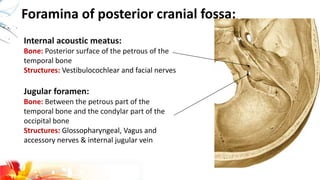
Foramina of posterior cranial fossa:
Jugular foramen:
Bone: Between the petrous part of the
temporal bone and the condylar part of the
occipital bone
Structures: Glossopharyngeal, Vagus and
accessory nerves & internal jugular vein
Internal acoustic meatus:
Bone: Posterior surface of the petrous of the
temporal bone
Structures: Vestibulocochlear and facial nerves
• Fracture of the anterior cranial fossa causes anosmia,
periorbital bruising, and CSF leakage from the nose
• Fracture of the anterior cranial fossa causes anosmia,
periorbital bruising, and CSF leakage from the nose
• A blow to the chin with the mouth closed, causing fracture
of the middle cranial fossa
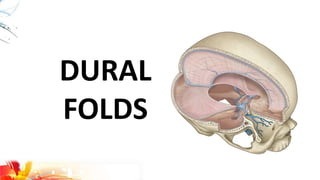
DURAL
FOLDS
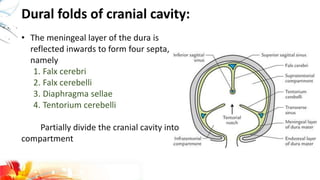
Dural folds of cranial cavity:
• The meningeal layer of the dura is
reflected inwards to form four septa,
namely
1. Falx cerebri
2. Falx cerebelli
3. Diaphragma sellae
4. Tentorium cerebelli
Partially divide the cranial cavity into
compartment
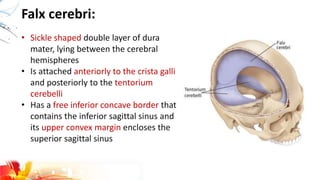
Falx cerebri:
• Sickle shaped double layer of dura
mater, lying between the cerebral
hemispheres
• Is attached anteriorly to the crista galli
and posteriorly to the tentorium
cerebelli
• Has a free inferior concave border that
contains the inferior sagittal sinus and
its upper convex margin encloses the
superior sagittal sinus
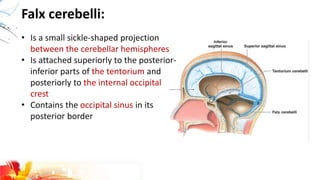
Falx cerebelli:
• Is a small sickle-shaped projection
between the cerebellar hemispheres
• Is attached superiorly to the posterior-
inferior parts of the tentorium and
posteriorly to the internal occipital
crest
• Contains the occipital sinus in its
posterior border
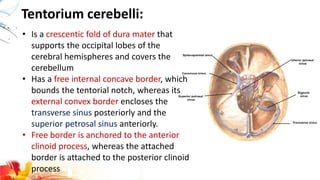
Tentorium cerebelli:
• Is a crescentic fold of dura mater that
supports the occipital lobes of the
cerebral hemispheres and covers the
cerebellum
• Has a free internal concave border, which
bounds the tentorial notch, whereas its
external convex border encloses the
transverse sinus posteriorly and the
superior petrosal sinus anteriorly.
• Free border is anchored to the anterior
clinoid process, whereas the attached
border is attached to the posterior clinoid
process
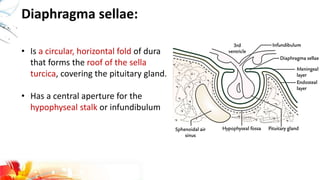
Diaphragma sellae:
• Is a circular, horizontal fold of dura
that forms the roof of the sella
turcica, covering the pituitary gland.
• Has a central aperture for the
hypophyseal stalk or infundibulum
• Pain sensitive intracranial structures are:
 Large cranial venous sinuses
 Dural arteries
 Dural floor of anterior and posterior cranial fossae
 Arteries at the base of the brain
DURAL
VENOUS
SINUSES
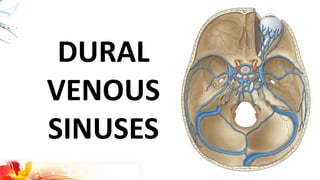
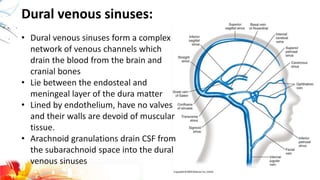
• Dural venous sinuses form a complex
network of venous channels which
drain the blood from the brain and
cranial bones
• Lie between the endosteal and
meningeal layer of the dura matter
• Lined by endothelium, have no valves
and their walls are devoid of muscular
tissue.
• Arachnoid granulations drain CSF from
the subarachnoid space into the dural
venous sinuses
Dural venous sinuses:
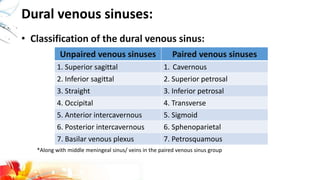
• Classification of the dural venous sinus:
Dural venous sinuses:
Unpaired venous sinuses Paired venous sinuses
1. Superior sagittal 1. Cavernous
2. Inferior sagittal 2. Superior petrosal
3. Straight 3. Inferior petrosal
4. Occipital 4. Transverse
5. Anterior intercavernous 5. Sigmoid
6. Posterior intercavernous 6. Sphenoparietal
7. Basilar venous plexus 7. Petrosquamous
*Along with middle meningeal sinus/ veins in the paired venous sinus group
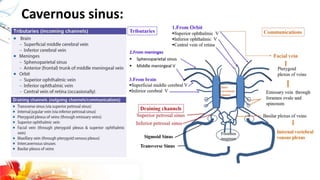
Cavernous sinus:
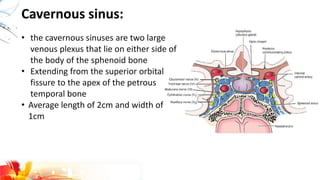
• the cavernous sinuses are two large
venous plexus that lie on either side of
the body of the sphenoid bone
• Extending from the superior orbital
fissure to the apex of the petrous
temporal bone
• Average length of 2cm and width of
1cm
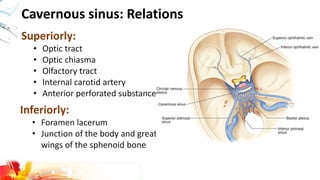
Cavernous sinus: Relations
Superiorly:
• Optic tract
• Optic chiasma
• Olfactory tract
• Internal carotid artery
• Anterior perforated substance
Inferiorly:
• Foramen lacerum
• Junction of the body and greater
wings of the sphenoid bone
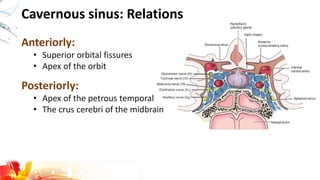
Cavernous sinus: Relations
Anteriorly:
• Superior orbital fissures
• Apex of the orbit
Posteriorly:
• Apex of the petrous temporal
• The crus cerebri of the midbrain
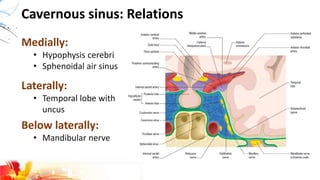
Cavernous sinus: Relations
Medially:
• Hypophysis cerebri
• Sphenoidal air sinus
Laterally:
• Temporal lobe with
uncus
Below laterally:
• Mandibular nerve
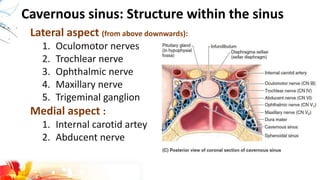
Cavernous sinus: Structure within the sinus
Lateral aspect (from above downwards):
1. Oculomotor nerves
2. Trochlear nerve
3. Ophthalmic nerve
4. Maxillary nerve
5. Trigeminal ganglion
Medial aspect :
1. Internal carotid artey
2. Abducent nerve
Cavernous sinus:
Cavernous sinus thrombosis:
• Caused by bacterial infections
• Usually from a spreading infection in the nose, sinuses, ears
or teeth
• Produce: headache, papilledema, exophthalmos, diplopia,
vision loss, meningitis, ophthalmoplegia
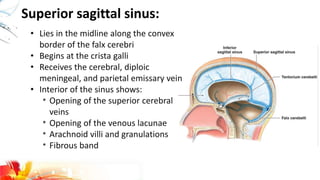
Superior sagittal sinus:
• Lies in the midline along the convex
border of the falx cerebri
• Begins at the crista galli
• Receives the cerebral, diploic
meningeal, and parietal emissary vein
• Interior of the sinus shows:
* Opening of the superior cerebral
veins
* Opening of the venous lacunae
* Arachnoid villi and granulations
* Fibrous band
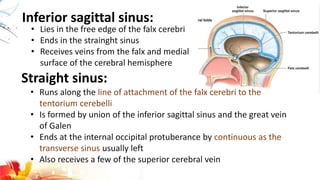
Inferior sagittal sinus:
• Lies in the free edge of the falx cerebri
• Ends in the strainght sinus
• Receives veins from the falx and medial
surface of the cerebral hemisphere
Straight sinus:
• Runs along the line of attachment of the falx cerebri to the
tentorium cerebelli
• Is formed by union of the inferior sagittal sinus and the great vein
of Galen
• Ends at the internal occipital protuberance by continuous as the
transverse sinus usually left
• Also receives a few of the superior cerebral vein
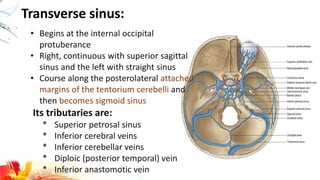
Transverse sinus:
• Begins at the internal occipital
protuberance
• Right, continuous with superior sagittal
sinus and the left with straight sinus
• Course along the posterolateral attached
margins of the tentorium cerebelli and
then becomes sigmoid sinus
Its tributaries are:
* Superior petrosal sinus
* Inferior cerebral veins
* Inferior cerebellar veins
* Diploic (posterior temporal) vein
* Inferior anastomotic vein
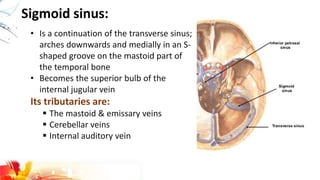
Sigmoid sinus:
• Is a continuation of the transverse sinus;
arches downwards and medially in an S-
shaped groove on the mastoid part of
the temporal bone
• Becomes the superior bulb of the
internal jugular vein
Its tributaries are:
 The mastoid & emissary veins
 Cerebellar veins
 Internal auditory vein
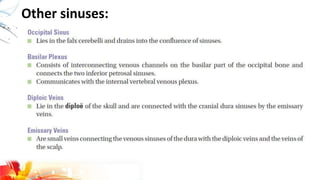
Other sinuses:
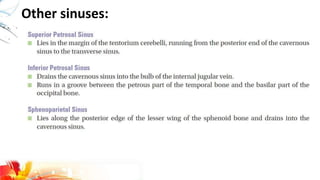
Other sinuses:
Cranium- anatomy of basi-cranium, dural venous sinus

Cranium- anatomy of basi-cranium, dural venous sinus

  • 1.
  • 2.
    CRANIAL CAVITY: • Craniumis the skeleton of the head. • Neurocranium is the bony case of the brain and meninges. It is formed by a series of eight bones: * Unpaired: Frontal, Ethmoid, Sphenoid & Occipital * Paired : Temporal, Parietal * Ethmoid bone relatively minor contribution CRANIUM NEUROCRANIUM CALVARIA BASICRANIUM VISCEROCRANIUM
  • 3.
    CRANIAL CAVITY: • Cranialcavity is a space enclosed by neurocranium that contains the brain, the intracranial portions of the cranial nerves and spinal nerves and blood vessels, meninges and CSF • The base of the cranial cavity is dived into three distinct fossae. Namely, * Anterior cranial fossa * Middle cranial fossa * Posterior cranial fossa • Anterior cranial fossa is at the highest level and Posterior cranial fossa is at the lowest level.
  • 4.
  • 5.
    Anterior cranial fossa: •Shallowest of the three cranial fossae • Formed by the frontal bone anteriorly, the ethmoid bone is the middle, and the lesser wings of the sphenoid posteriorly • Greatest part of the fossa – orbital plate of the frontal bone • Support the frontal lobes of the brain and form the roofs of the orbit • Crista galli- thick, median ridge of ethmoid, which project superiorly and each of ridge is the sieve-like cribriform plate of the ethmoid • Olfactory bulbs of the brain, which lie on cribriform plate
  • 6.
    Landmarks and Foramina/Apertures: Foramencecum: Site: base of the frontal crest Structures: emissary vein of frontal bone(1%) Anterior and posterior ethmoidal foramina: Structures: vessels and nerves with same name Cribriform foramina: Structures: Axons of olfactory cells in the olfactory epithelium that form olfactory nerves
  • 7.
    Middle cranial fossa: •Butterfly shaped fossa • It is bounded by: * In front by sphenoid crest of lesser wing and part of the body of the sphenoid * Behind superior border of the petrous part of temporal bone dorsum sellae * Laterally by the squamous parts of the temporal bone • Communicates with the orbits by the superior orbital fissures
  • 8.
    Middle cranial fossa: •Sphenoid crests end medially in two sharp bony projection, anterior clinoid processes • Optic canal is lateral to the sulcus chiasmatis which transmits the optic nerve • Centrally the floor of the fossa is narrower and formed by the sphenoid bone which contains the sphenoidal sinuses • Roof of the sphenoid sinus is deeply concave and houses the pituitary fossa(aka sella turcica) between turberculum and dorsum sellae that gives attachment to the tentorium cerebelli.
  • 9.
    Foramina of Middlecranial fossa: Optic canal: Bone: Lesser wing of the sphenoid Structures: Optic nerve and ophthalmic artery Superior orbital fissure: Bone: Between lesser and greater wings Structures: Oculomotor, Trochlear, Lacrimal, Frontal, Nasociliary and abducent nerve & Superior ophthalmic vein Foramen rotundum: Bone: Greater wings of sphenoid Structures: Maxillary division of the trigeminal nerve
  • 10.
    Foramina of middlecranial fossa: Foramen ovale: Bone: Greater wing of the sphenoid Structures: Mandibular(V3) nerve, lesser petrosal nerve, accessory meningeal artery, Emissery veins Foramen spinosum: Bone: Between lesser and greater wings Structures: Middle meningeal artey Foramen lacerum: Bone: Between the petrous part of the temporal and the sphenoid Structures: Internal carotid artery
  • 11.
    Posterior cranial fossa: •The largest and deepest of the three cranial fossa, contains the cerebellum, pons, and medulla oblongata • Mostly by the occipital bone an sloping surface of the basilar part, called clivus. • Bounded anteriorly by dorsum sellae and superior border of petrous part of temporal • Corresponds extracranially with the posterior part of the cranial base • Most prominent feature – foramen magnum
  • 12.
    Posterior cranial fossa: •The jugular foramen at the posterior end of the petro-occipital fissure • Jugular foramen: * Upper border- notch for the glossopharyngeal nerve * Posteriorly it is grooved by the sigmoid sinus which continues into foramen as the internal jugular vein * Jugular tubercle lie between the inferior petrosal and sigmoid sinus
  • 13.
    Posterior cranial fossa: •Sigmoid sulcus which runs forwards and downwards and finally forwards to the jugular foramen • Median internal occipital crest in the squamous part of the occipital and gives attachment to the falx cerebelli and grooved by occipital sinus • The groove for the transverse sinus runs laterally from internal occipital protuberance • Internal occipital crest separates two shallow fossae which house the cerebellar hemispheres
  • 14.
    Foramina of posteriorcranial fossa: Foramen magnum: Bone: Central area of the floor Structures: Medulla oblongata and its meninges, ascending spinal parts of the accessory spinal nerves and two vertebral arteries Hypoglossal canal: Bone: Close to the anterolateral boundary of the foramen magnum Structures: Hypoglossal nerve
  • 15.
    Foramina of posteriorcranial fossa: Jugular foramen: Bone: Between the petrous part of the temporal bone and the condylar part of the occipital bone Structures: Glossopharyngeal, Vagus and accessory nerves & internal jugular vein Internal acoustic meatus: Bone: Posterior surface of the petrous of the temporal bone Structures: Vestibulocochlear and facial nerves
  • 16.
    • Fracture ofthe anterior cranial fossa causes anosmia, periorbital bruising, and CSF leakage from the nose • Fracture of the anterior cranial fossa causes anosmia, periorbital bruising, and CSF leakage from the nose • A blow to the chin with the mouth closed, causing fracture of the middle cranial fossa
  • 17.
  • 18.
    Dural folds ofcranial cavity: • The meningeal layer of the dura is reflected inwards to form four septa, namely 1. Falx cerebri 2. Falx cerebelli 3. Diaphragma sellae 4. Tentorium cerebelli Partially divide the cranial cavity into compartment
  • 19.
    Falx cerebri: • Sickleshaped double layer of dura mater, lying between the cerebral hemispheres • Is attached anteriorly to the crista galli and posteriorly to the tentorium cerebelli • Has a free inferior concave border that contains the inferior sagittal sinus and its upper convex margin encloses the superior sagittal sinus
  • 20.
    Falx cerebelli: • Isa small sickle-shaped projection between the cerebellar hemispheres • Is attached superiorly to the posterior- inferior parts of the tentorium and posteriorly to the internal occipital crest • Contains the occipital sinus in its posterior border
  • 21.
    Tentorium cerebelli: • Isa crescentic fold of dura mater that supports the occipital lobes of the cerebral hemispheres and covers the cerebellum • Has a free internal concave border, which bounds the tentorial notch, whereas its external convex border encloses the transverse sinus posteriorly and the superior petrosal sinus anteriorly. • Free border is anchored to the anterior clinoid process, whereas the attached border is attached to the posterior clinoid process
  • 22.
    Diaphragma sellae: • Isa circular, horizontal fold of dura that forms the roof of the sella turcica, covering the pituitary gland. • Has a central aperture for the hypophyseal stalk or infundibulum
  • 23.
    • Pain sensitiveintracranial structures are:  Large cranial venous sinuses  Dural arteries  Dural floor of anterior and posterior cranial fossae  Arteries at the base of the brain
  • 24.
  • 25.
    • Dural venoussinuses form a complex network of venous channels which drain the blood from the brain and cranial bones • Lie between the endosteal and meningeal layer of the dura matter • Lined by endothelium, have no valves and their walls are devoid of muscular tissue. • Arachnoid granulations drain CSF from the subarachnoid space into the dural venous sinuses Dural venous sinuses:
  • 26.
    • Classification ofthe dural venous sinus: Dural venous sinuses: Unpaired venous sinuses Paired venous sinuses 1. Superior sagittal 1. Cavernous 2. Inferior sagittal 2. Superior petrosal 3. Straight 3. Inferior petrosal 4. Occipital 4. Transverse 5. Anterior intercavernous 5. Sigmoid 6. Posterior intercavernous 6. Sphenoparietal 7. Basilar venous plexus 7. Petrosquamous *Along with middle meningeal sinus/ veins in the paired venous sinus group
  • 27.
    Cavernous sinus: • thecavernous sinuses are two large venous plexus that lie on either side of the body of the sphenoid bone • Extending from the superior orbital fissure to the apex of the petrous temporal bone • Average length of 2cm and width of 1cm
  • 28.
    Cavernous sinus: Relations Superiorly: •Optic tract • Optic chiasma • Olfactory tract • Internal carotid artery • Anterior perforated substance Inferiorly: • Foramen lacerum • Junction of the body and greater wings of the sphenoid bone
  • 29.
    Cavernous sinus: Relations Anteriorly: •Superior orbital fissures • Apex of the orbit Posteriorly: • Apex of the petrous temporal • The crus cerebri of the midbrain
  • 30.
    Cavernous sinus: Relations Medially: •Hypophysis cerebri • Sphenoidal air sinus Laterally: • Temporal lobe with uncus Below laterally: • Mandibular nerve
  • 31.
    Cavernous sinus: Structurewithin the sinus Lateral aspect (from above downwards): 1. Oculomotor nerves 2. Trochlear nerve 3. Ophthalmic nerve 4. Maxillary nerve 5. Trigeminal ganglion Medial aspect : 1. Internal carotid artey 2. Abducent nerve
  • 32.
  • 33.
    Cavernous sinus thrombosis: •Caused by bacterial infections • Usually from a spreading infection in the nose, sinuses, ears or teeth • Produce: headache, papilledema, exophthalmos, diplopia, vision loss, meningitis, ophthalmoplegia
  • 34.
    Superior sagittal sinus: •Lies in the midline along the convex border of the falx cerebri • Begins at the crista galli • Receives the cerebral, diploic meningeal, and parietal emissary vein • Interior of the sinus shows: * Opening of the superior cerebral veins * Opening of the venous lacunae * Arachnoid villi and granulations * Fibrous band
  • 35.
    Inferior sagittal sinus: •Lies in the free edge of the falx cerebri • Ends in the strainght sinus • Receives veins from the falx and medial surface of the cerebral hemisphere Straight sinus: • Runs along the line of attachment of the falx cerebri to the tentorium cerebelli • Is formed by union of the inferior sagittal sinus and the great vein of Galen • Ends at the internal occipital protuberance by continuous as the transverse sinus usually left • Also receives a few of the superior cerebral vein
  • 36.
    Transverse sinus: • Beginsat the internal occipital protuberance • Right, continuous with superior sagittal sinus and the left with straight sinus • Course along the posterolateral attached margins of the tentorium cerebelli and then becomes sigmoid sinus Its tributaries are: * Superior petrosal sinus * Inferior cerebral veins * Inferior cerebellar veins * Diploic (posterior temporal) vein * Inferior anastomotic vein
  • 37.
    Sigmoid sinus: • Isa continuation of the transverse sinus; arches downwards and medially in an S- shaped groove on the mastoid part of the temporal bone • Becomes the superior bulb of the internal jugular vein Its tributaries are:  The mastoid & emissary veins  Cerebellar veins  Internal auditory vein
  • 38.
  • 39.