Dural venous sinuses
Lecture by
Dr.N.Mugunthan.MBBS.,M.S.,DNB.,MNAMS.,PhD.,
Associate Professor
MGMC&RI.
Learning objectives
• Dural venous sinuses – characteristics &
functions
• Classification
• Cavernous sinus in detail
• Applied anatomy
©Dr.N.Mugunthan
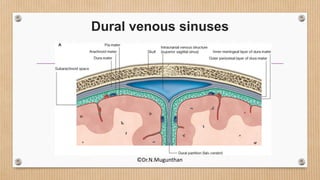
Dural venous sinuses
©Dr.N.Mugunthan
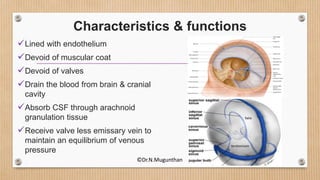
Characteristics & functions
Lined with endothelium
Devoid of muscular coat
Devoid of valves
Drain the blood from brain & cranial
cavity
Absorb CSF through arachnoid
granulation tissue
Receive valve less emissary vein to
maintain an equilibrium of venous
pressure
©Dr.N.Mugunthan
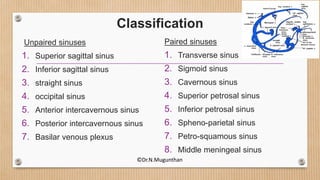
Classification
Unpaired sinuses
1. Superior sagittal sinus
2. Inferior sagittal sinus
3. straight sinus
4. occipital sinus
5. Anterior intercavernous sinus
6. Posterior intercavernous sinus
7. Basilar venous plexus
Paired sinuses
1. Transverse sinus
2. Sigmoid sinus
3. Cavernous sinus
4. Superior petrosal sinus
5. Inferior petrosal sinus
6. Spheno-parietal sinus
7. Petro-squamous sinus
8. Middle meningeal sinus
©Dr.N.Mugunthan
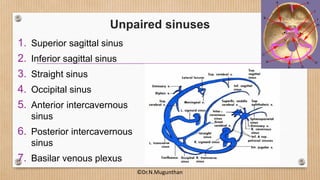
Unpaired sinuses
1. Superior sagittal sinus
2. Inferior sagittal sinus
3. Straight sinus
4. Occipital sinus
5. Anterior intercavernous
sinus
6. Posterior intercavernous
sinus
7. Basilar venous plexus
©Dr.N.Mugunthan
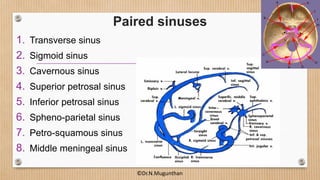
Paired sinuses
1. Transverse sinus
2. Sigmoid sinus
3. Cavernous sinus
4. Superior petrosal sinus
5. Inferior petrosal sinus
6. Spheno-parietal sinus
7. Petro-squamous sinus
8. Middle meningeal sinus
©Dr.N.Mugunthan
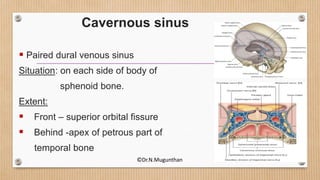
Cavernous sinus
 Paired dural venous sinus
Situation: on each side of body of
sphenoid bone.
Extent:
 Front – superior orbital fissure
 Behind -apex of petrous part of
temporal bone
©Dr.N.Mugunthan
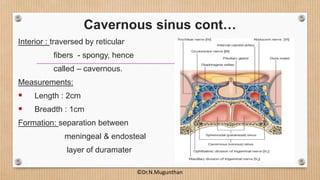
Interior : traversed by reticular
fibers - spongy, hence
called – cavernous.
Measurements:
 Length : 2cm
 Breadth : 1cm
Formation: separation between
meningeal & endosteal
layer of duramater
Cavernous sinus cont…
©Dr.N.Mugunthan
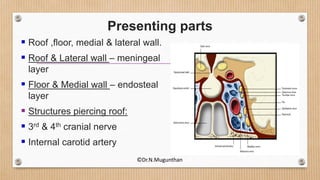
Presenting parts
 Roof ,floor, medial & lateral wall.
 Roof & Lateral wall – meningeal
layer
 Floor & Medial wall – endosteal
layer
 Structures piercing roof:
 3rd & 4th cranial nerve
 Internal carotid artery
©Dr.N.Mugunthan
RELATIONS
Superiorly:
• Optic chiasma
• ICA [after piercing roof -
backward & upward(Carotid siphon)]
Inferiorly:
• Sphenoidal air sinus
Medially:
• Pituitary gland
Laterally:
• Cavum trigeminale
• Temporal lobe (uncus)
©Dr.N.Mugunthan
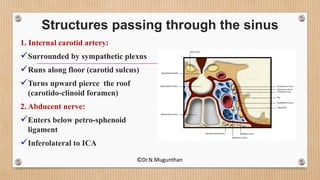
Structures passing through the sinus
1. Internal carotid artery:
Surrounded by sympathetic plexus
Runs along floor (carotid sulcus)
Turns upward pierce the roof
(carotido-clinoid foramen)
2. Abducent nerve:
Enters below petro-sphenoid
ligament
Inferolateral to ICA
©Dr.N.Mugunthan
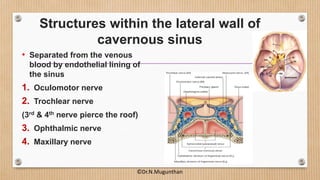
Structures within the lateral wall of
cavernous sinus
• Separated from the venous
blood by endothelial lining of
the sinus
1. Oculomotor nerve
2. Trochlear nerve
(3rd & 4th nerve pierce the roof)
3. Ophthalmic nerve
4. Maxillary nerve
©Dr.N.Mugunthan
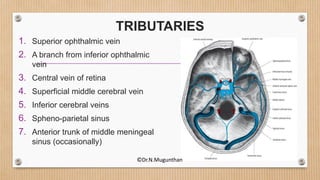
TRIBUTARIES
1. Superior ophthalmic vein
2. A branch from inferior ophthalmic
vein
3. Central vein of retina
4. Superficial middle cerebral vein
5. Inferior cerebral veins
6. Spheno-parietal sinus
7. Anterior trunk of middle meningeal
sinus (occasionally)
©Dr.N.Mugunthan
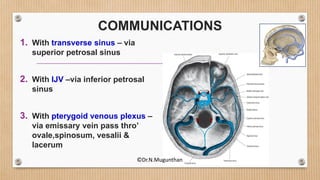
COMMUNICATIONS
1. With transverse sinus – via
superior petrosal sinus
2. With IJV –via inferior petrosal
sinus
3. With pterygoid venous plexus –
via emissary vein pass thro’
ovale,spinosum, vesalii &
lacerum
©Dr.N.Mugunthan
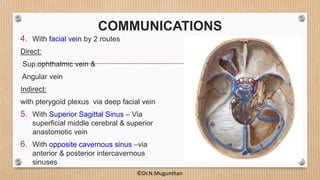
COMMUNICATIONS
4. With facial vein by 2 routes
Direct:
Sup.ophthalmic vein &
Angular vein
Indirect:
with pterygoid plexus via deep facial vein
5. With Superior Sagittal Sinus – Via
superficial middle cerebral & superior
anastomotic vein
6. With opposite cavernous sinus –via
anterior & posterior intercavernous
sinuses
©Dr.N.Mugunthan
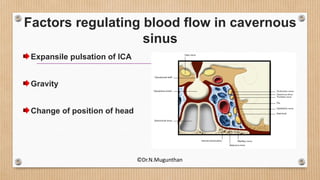
Factors regulating blood flow in cavernous
sinus
Expansile pulsation of ICA
Gravity
Change of position of head
©Dr.N.Mugunthan
Applied anatomy
1.Thrombosis of cavernous sinus
Causes: communications from dangerous area
of face,orbit & pharynx
Symptoms:
• Pain in eye
• Oedema of eyelids
Signs:
• Ophthalmoplegia (3rd,4th & 6th nerves)
• Exophthalmos (congestion of orbital veins)
• Unilateral becomes bilateral due to
ant.&post.intercavernous sinuses
©Dr.N.Mugunthan
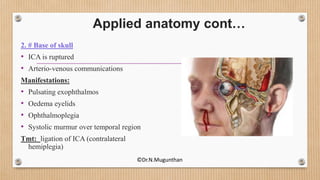
2. # Base of skull
• ICA is ruptured
• Arterio-venous communications
Manifestations:
• Pulsating exophthalmos
• Oedema eyelids
• Ophthalmoplegia
• Systolic murmur over temporal region
Tmt: ligation of ICA (contralateral
hemiplegia)
Applied anatomy cont…
©Dr.N.Mugunthan
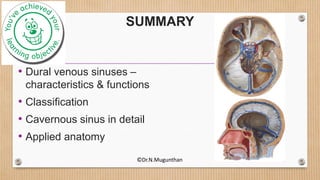
SUMMARY
• Dural venous sinuses –
characteristics & functions
• Classification
• Cavernous sinus in detail
• Applied anatomy
©Dr.N.Mugunthan
Dural venous sinuses & cavernous sinus - Dr.N.Mugunthan.

Dural venous sinuses & cavernous sinus - Dr.N.Mugunthan.

  • 1.
    Dural venous sinuses Lectureby Dr.N.Mugunthan.MBBS.,M.S.,DNB.,MNAMS.,PhD., Associate Professor MGMC&RI.
  • 2.
    Learning objectives • Duralvenous sinuses – characteristics & functions • Classification • Cavernous sinus in detail • Applied anatomy ©Dr.N.Mugunthan
  • 3.
  • 4.
    Characteristics & functions Linedwith endothelium Devoid of muscular coat Devoid of valves Drain the blood from brain & cranial cavity Absorb CSF through arachnoid granulation tissue Receive valve less emissary vein to maintain an equilibrium of venous pressure ©Dr.N.Mugunthan
  • 5.
    Classification Unpaired sinuses 1. Superiorsagittal sinus 2. Inferior sagittal sinus 3. straight sinus 4. occipital sinus 5. Anterior intercavernous sinus 6. Posterior intercavernous sinus 7. Basilar venous plexus Paired sinuses 1. Transverse sinus 2. Sigmoid sinus 3. Cavernous sinus 4. Superior petrosal sinus 5. Inferior petrosal sinus 6. Spheno-parietal sinus 7. Petro-squamous sinus 8. Middle meningeal sinus ©Dr.N.Mugunthan
  • 6.
    Unpaired sinuses 1. Superiorsagittal sinus 2. Inferior sagittal sinus 3. Straight sinus 4. Occipital sinus 5. Anterior intercavernous sinus 6. Posterior intercavernous sinus 7. Basilar venous plexus ©Dr.N.Mugunthan
  • 7.
    Paired sinuses 1. Transversesinus 2. Sigmoid sinus 3. Cavernous sinus 4. Superior petrosal sinus 5. Inferior petrosal sinus 6. Spheno-parietal sinus 7. Petro-squamous sinus 8. Middle meningeal sinus ©Dr.N.Mugunthan
  • 8.
    Cavernous sinus  Paireddural venous sinus Situation: on each side of body of sphenoid bone. Extent:  Front – superior orbital fissure  Behind -apex of petrous part of temporal bone ©Dr.N.Mugunthan
  • 9.
    Interior : traversedby reticular fibers - spongy, hence called – cavernous. Measurements:  Length : 2cm  Breadth : 1cm Formation: separation between meningeal & endosteal layer of duramater Cavernous sinus cont… ©Dr.N.Mugunthan
  • 10.
    Presenting parts  Roof,floor, medial & lateral wall.  Roof & Lateral wall – meningeal layer  Floor & Medial wall – endosteal layer  Structures piercing roof:  3rd & 4th cranial nerve  Internal carotid artery ©Dr.N.Mugunthan
  • 11.
    RELATIONS Superiorly: • Optic chiasma •ICA [after piercing roof - backward & upward(Carotid siphon)] Inferiorly: • Sphenoidal air sinus Medially: • Pituitary gland Laterally: • Cavum trigeminale • Temporal lobe (uncus) ©Dr.N.Mugunthan
  • 12.
    Structures passing throughthe sinus 1. Internal carotid artery: Surrounded by sympathetic plexus Runs along floor (carotid sulcus) Turns upward pierce the roof (carotido-clinoid foramen) 2. Abducent nerve: Enters below petro-sphenoid ligament Inferolateral to ICA ©Dr.N.Mugunthan
  • 13.
    Structures within thelateral wall of cavernous sinus • Separated from the venous blood by endothelial lining of the sinus 1. Oculomotor nerve 2. Trochlear nerve (3rd & 4th nerve pierce the roof) 3. Ophthalmic nerve 4. Maxillary nerve ©Dr.N.Mugunthan
  • 14.
    TRIBUTARIES 1. Superior ophthalmicvein 2. A branch from inferior ophthalmic vein 3. Central vein of retina 4. Superficial middle cerebral vein 5. Inferior cerebral veins 6. Spheno-parietal sinus 7. Anterior trunk of middle meningeal sinus (occasionally) ©Dr.N.Mugunthan
  • 15.
    COMMUNICATIONS 1. With transversesinus – via superior petrosal sinus 2. With IJV –via inferior petrosal sinus 3. With pterygoid venous plexus – via emissary vein pass thro’ ovale,spinosum, vesalii & lacerum ©Dr.N.Mugunthan
  • 16.
    COMMUNICATIONS 4. With facialvein by 2 routes Direct: Sup.ophthalmic vein & Angular vein Indirect: with pterygoid plexus via deep facial vein 5. With Superior Sagittal Sinus – Via superficial middle cerebral & superior anastomotic vein 6. With opposite cavernous sinus –via anterior & posterior intercavernous sinuses ©Dr.N.Mugunthan
  • 17.
    Factors regulating bloodflow in cavernous sinus Expansile pulsation of ICA Gravity Change of position of head ©Dr.N.Mugunthan
  • 18.
    Applied anatomy 1.Thrombosis ofcavernous sinus Causes: communications from dangerous area of face,orbit & pharynx Symptoms: • Pain in eye • Oedema of eyelids Signs: • Ophthalmoplegia (3rd,4th & 6th nerves) • Exophthalmos (congestion of orbital veins) • Unilateral becomes bilateral due to ant.&post.intercavernous sinuses ©Dr.N.Mugunthan
  • 19.
    2. # Baseof skull • ICA is ruptured • Arterio-venous communications Manifestations: • Pulsating exophthalmos • Oedema eyelids • Ophthalmoplegia • Systolic murmur over temporal region Tmt: ligation of ICA (contralateral hemiplegia) Applied anatomy cont… ©Dr.N.Mugunthan
  • 20.
    SUMMARY • Dural venoussinuses – characteristics & functions • Classification • Cavernous sinus in detail • Applied anatomy ©Dr.N.Mugunthan