ANATOMY OF CAVERNOUS
SINUS
 Earliest description of CS by Ridley in 1695.
 Winslow in 1732 gave name CS due to presence of
fibrous trabeculae.
 Controversy still persists regarding whether CS is a
venous channel or a true venous plexus.
 Taptas in 1982 argued in favour of CS an irregular
network of veins- a part of ED venous network at skull
base.
 However good venous injection techniques not supported
this.
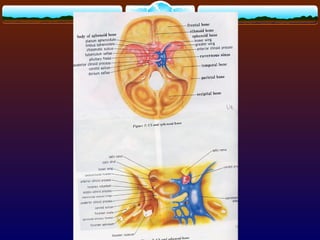
 2 CS on either side of Sella tursica irregular form
larger behind than front.
 Extends from sphenoid fissure to petrous apex.
 First surgical excursion to CS credited to Krogius
in 1895.
 In 1965 Parkinson showed this space can be
approached safely followed by-DOLNEC
Osseous Relationships
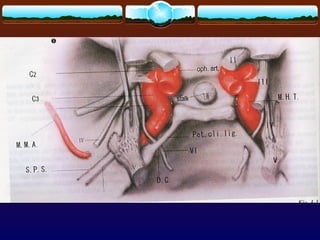
 Related to sphenoid bone and sella tursica.
 Postr border of sella is a square plate of bone
terminates sprly in postr clinoids.
 On each side of fossa is S shaped groove lodges
ICA.
 Distal extremity of lesser wing terminates in antr
clinoids which form the lateral wall of IC end of
optic canal.
Osseus Relationships
 Controlled removal of AC is the mile stone in surgical
treatment of CS lesions.
 Complete clinoidectomy exposes clinoid segment of ICA
and Antr extn of lateral venous space of CS.
 Fibrous or osseus bridge exist between AC,MC or PC
makes the removal of AC difficult.
 Connection between AC and MC makes distal end of
carotid sulcus to carotico-clinoid foramen.
Osseus Relationships
 Although not involved in the formation of CS
structures within the middle cranial fossa like
carotid canal, FO,FR,FS,arcuate eminence and
cochlea are important land marks.
CAROTID CANAL
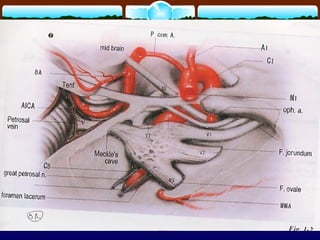
 Located at anterolateral aspect of petrous bone.
Part of the canal wall is formed by the postr
part of grtr wing of sphenoid
.
 Canal contains hori segment of ICA and symp
fibres.
 ICA courses antrly and medially within petrous
bone to emerge near petrous apex.
 At postr and medial wall canal is separated from
cochlea by a thin plate of bone.
CAROTID CANAL
 At the most distal end under V3 ICA is covered only by
dura or thin layer of cartilage.
 Removal of spr wall at this region exposes 20 mm of ICA.
 FR situated most antr and intr part of grtr wing of
sphenoid bone.
 FO and FS situated posterolateral to this.
 Eustachian tube and Tensor tympani are located antr and
parallel to hori segment of ICA below floor of MCF.
CAROTID CANAL
 Geniculate ganglion of 7th
nerve located in the floor
of MCF is usually covered by a layer of bone.
 Vulnerable to traction damage when dura mater of
MCF is elevated.
ARTERIAL COMPARTMENT
 ICA enters the skull thru carotid canal located
medial to styloid anteromedial to jugular foramen.
 ICA ascends a short distance curves antrly and
medially, ascends and leaves the carotid canal to
enter CS between lingula of sphenoid bone and
petrous temporal bone.
ARTERIAL COMPARTMENT
 Inside the vertical portion of carotid canal ICA is
adherent to bone by a strong layer of CT making
mobilisation of ICA difficult.
 Vertical segment of ICA
*jugular fossa postrly
*eustachian tube antrly
*tympanic bone anterolaterally
*length is 6-15mm
ARTERIAL COMPARTMENT
 Hori segment of ICA is related to otic apparatus
and 7th
N.
 Dense CT is absent in this segment.
 Length is 15-25mm
 Branches are
* Caroticotympanic artery
* Vidian or Pterygoid artery( usually from Int:
Maxillary Artery)
ARTERIAL COMPARTMENT
 ICA enters intracranial cavity passing between
lingula of sphenoid and petrous apex crossing FL
 As it enters IC cavity it is surrounded by venous
plexus and symp fibres.
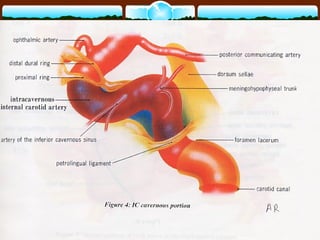
INTRACAVERNOUS ICA(5 Parts)
 Postr Vertical Segment
 Ascends under Gasserion Ganglion.
 A fibrous ring holds the beginning o fpostr vertical
segment and holds between lingula and petrous
apex.
INTRACAVERNOUS ICA(5 Parts)
Postr bend
ICA in this portion curves antrly to reach the hori
segment.
 Devptly last segment. This seg usually gives
meningo hypophyseal trunk.
MENINGO HYPOPHYSEAL
TRUNK
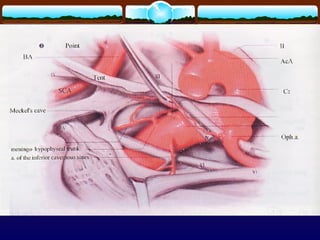
 Largest and most constant branch of Postr bend.
 Present in 88-100% cases.
 Arises from middle of outer wall of postr bend.
 Gives 3 branches.
1) Tentorial Artery- Courses posterolaterally
exiting the CS between 2 layers beneath the 4th
N
to supply tentorium
MENINGO HYPOPHYSEAL
TRUNK
 2) Infr Hypophyseal Artery- Traverses medially
and slightly antrly towards the pituitary gland.
 Anastomoses directly with opp artery.
 3) Dorsal Meningeal Artery- Courses in a
postero infero medial direction. Supplies dura
along the upper clivus.
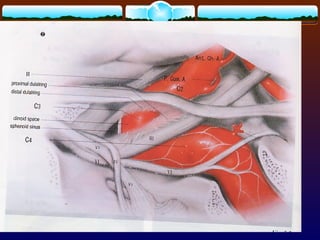
IC-ICA Horizontal Segment.
 Longest. Avg 20mm
 Courses forwards and located close to medial wall of CS.
 At the antr end hori seg curves upwards forming the antr
bend.
 Antr vertical seg begins distal to antr bend and passes
upwards medial to antr clinoid process to perforate roof of
CS.
 Vertical seg is obscured by ACP and limited proximally
and distally by dural rings.
IC-ICA Horizontal Segment.
 Arteruy of Inf CS arises from central third of hori
seg courses laterally with 6th
N
 Mc Connel`s Capsular Artery -arises from medial
aspect of hori seg
 Courses towards the pituitary gland
 Ophthalmic Artery arises from CS in 8 % cases
 Persistent Trigeminal Artery present in 2% cases
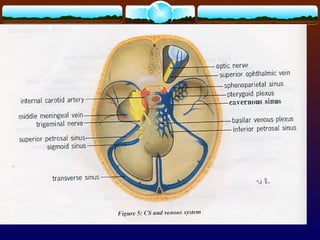
VENOUS COMPARTMENT
 Recent surgical explorations of CS show it to be
more consistent with venous channel than plexus.
 Divided into medial, lateral anteroinf and
posterosup compartments.
 As afferents each CS receives spheno parietal
sinus, spr ophthalmic vein, sfl sylvian vein, middle
meningeal vein and spr petrosal sinus.
 On efferent side, CS drains into Inf Petrosal sinus.
NEURAL COMPARTMENT
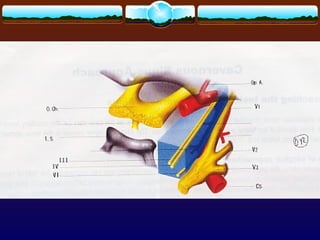
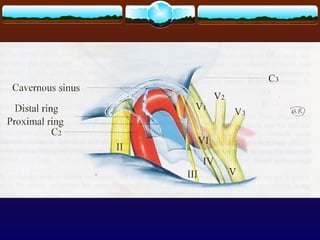
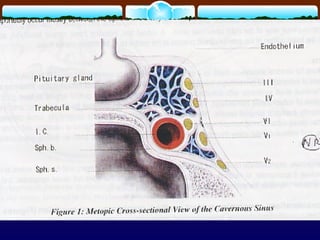
III,IV,V1,V2 lie between 2 dural layers that form
lateral wall of CS.
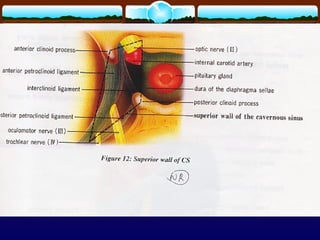
Sfl layer of lateral wall is a thick layer formed by the
duramater.
This layer continues antrly over the spr surface of
ACP enveloping ICA to form distal dural ring.
The inner layer has a reticular consistency and
incomplete in 40% of cases.
NEURAL COMPARTMENT
 Thru the inner layer run III,IV and V1.
 The inner layer extents antrly and infrly to ACP
surrounds antr loop of ICA and forms the proximl
ring and also antr loop of CS.
 III N pierces CS in the middle of occulomotor
trigone in the upper part of lateral wall of CS.
 Courses antrly and leaves the CS on nhe
inferolateral surface of ACP
NEURAL COMPARTMENT
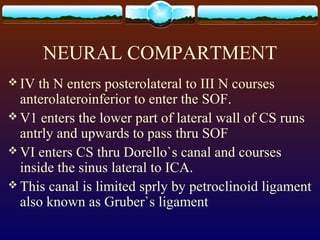
 IV th N enters posterolateral to III N courses
anterolateroinferior to enter the SOF.
 V1 enters the lower part of lateral wall of CS runs
antrly and upwards to pass thru SOF
 VI enters CS thru Dorello`s canal and courses
inside the sinus lateral to ICA.
 This canal is limited sprly by petroclinoid ligament
also known as Gruber`s ligament
Thank
you

Anatomy of cavernous sinus

  • 1.
    ANATOMY OF CAVERNOUS SINUS Earliest description of CS by Ridley in 1695.  Winslow in 1732 gave name CS due to presence of fibrous trabeculae.  Controversy still persists regarding whether CS is a venous channel or a true venous plexus.  Taptas in 1982 argued in favour of CS an irregular network of veins- a part of ED venous network at skull base.  However good venous injection techniques not supported this.
  • 2.
     2 CSon either side of Sella tursica irregular form larger behind than front.  Extends from sphenoid fissure to petrous apex.  First surgical excursion to CS credited to Krogius in 1895.  In 1965 Parkinson showed this space can be approached safely followed by-DOLNEC
  • 3.
    Osseous Relationships  Relatedto sphenoid bone and sella tursica.  Postr border of sella is a square plate of bone terminates sprly in postr clinoids.  On each side of fossa is S shaped groove lodges ICA.  Distal extremity of lesser wing terminates in antr clinoids which form the lateral wall of IC end of optic canal.
  • 5.
    Osseus Relationships  Controlledremoval of AC is the mile stone in surgical treatment of CS lesions.  Complete clinoidectomy exposes clinoid segment of ICA and Antr extn of lateral venous space of CS.  Fibrous or osseus bridge exist between AC,MC or PC makes the removal of AC difficult.  Connection between AC and MC makes distal end of carotid sulcus to carotico-clinoid foramen.
  • 7.
    Osseus Relationships  Althoughnot involved in the formation of CS structures within the middle cranial fossa like carotid canal, FO,FR,FS,arcuate eminence and cochlea are important land marks.
  • 9.
    CAROTID CANAL  Locatedat anterolateral aspect of petrous bone. Part of the canal wall is formed by the postr part of grtr wing of sphenoid
  • 10.
    .  Canal containshori segment of ICA and symp fibres.  ICA courses antrly and medially within petrous bone to emerge near petrous apex.  At postr and medial wall canal is separated from cochlea by a thin plate of bone.
  • 11.
    CAROTID CANAL  Atthe most distal end under V3 ICA is covered only by dura or thin layer of cartilage.  Removal of spr wall at this region exposes 20 mm of ICA.  FR situated most antr and intr part of grtr wing of sphenoid bone.  FO and FS situated posterolateral to this.  Eustachian tube and Tensor tympani are located antr and parallel to hori segment of ICA below floor of MCF.
  • 12.
    CAROTID CANAL  Geniculateganglion of 7th nerve located in the floor of MCF is usually covered by a layer of bone.  Vulnerable to traction damage when dura mater of MCF is elevated.
  • 13.
    ARTERIAL COMPARTMENT  ICAenters the skull thru carotid canal located medial to styloid anteromedial to jugular foramen.  ICA ascends a short distance curves antrly and medially, ascends and leaves the carotid canal to enter CS between lingula of sphenoid bone and petrous temporal bone.
  • 14.
    ARTERIAL COMPARTMENT  Insidethe vertical portion of carotid canal ICA is adherent to bone by a strong layer of CT making mobilisation of ICA difficult.  Vertical segment of ICA *jugular fossa postrly *eustachian tube antrly *tympanic bone anterolaterally *length is 6-15mm
  • 15.
    ARTERIAL COMPARTMENT  Horisegment of ICA is related to otic apparatus and 7th N.  Dense CT is absent in this segment.  Length is 15-25mm  Branches are * Caroticotympanic artery * Vidian or Pterygoid artery( usually from Int: Maxillary Artery)
  • 16.
    ARTERIAL COMPARTMENT  ICAenters intracranial cavity passing between lingula of sphenoid and petrous apex crossing FL  As it enters IC cavity it is surrounded by venous plexus and symp fibres.
  • 19.
    INTRACAVERNOUS ICA(5 Parts) Postr Vertical Segment  Ascends under Gasserion Ganglion.  A fibrous ring holds the beginning o fpostr vertical segment and holds between lingula and petrous apex.
  • 20.
    INTRACAVERNOUS ICA(5 Parts) Postrbend ICA in this portion curves antrly to reach the hori segment.  Devptly last segment. This seg usually gives meningo hypophyseal trunk.
  • 21.
    MENINGO HYPOPHYSEAL TRUNK  Largestand most constant branch of Postr bend.  Present in 88-100% cases.  Arises from middle of outer wall of postr bend.  Gives 3 branches. 1) Tentorial Artery- Courses posterolaterally exiting the CS between 2 layers beneath the 4th N to supply tentorium
  • 22.
    MENINGO HYPOPHYSEAL TRUNK  2)Infr Hypophyseal Artery- Traverses medially and slightly antrly towards the pituitary gland.  Anastomoses directly with opp artery.  3) Dorsal Meningeal Artery- Courses in a postero infero medial direction. Supplies dura along the upper clivus.
  • 25.
    IC-ICA Horizontal Segment. Longest. Avg 20mm  Courses forwards and located close to medial wall of CS.  At the antr end hori seg curves upwards forming the antr bend.  Antr vertical seg begins distal to antr bend and passes upwards medial to antr clinoid process to perforate roof of CS.  Vertical seg is obscured by ACP and limited proximally and distally by dural rings.
  • 26.
    IC-ICA Horizontal Segment. Arteruy of Inf CS arises from central third of hori seg courses laterally with 6th N  Mc Connel`s Capsular Artery -arises from medial aspect of hori seg  Courses towards the pituitary gland  Ophthalmic Artery arises from CS in 8 % cases  Persistent Trigeminal Artery present in 2% cases
  • 27.
    VENOUS COMPARTMENT  Recentsurgical explorations of CS show it to be more consistent with venous channel than plexus.  Divided into medial, lateral anteroinf and posterosup compartments.  As afferents each CS receives spheno parietal sinus, spr ophthalmic vein, sfl sylvian vein, middle meningeal vein and spr petrosal sinus.  On efferent side, CS drains into Inf Petrosal sinus.
  • 30.
    NEURAL COMPARTMENT III,IV,V1,V2 liebetween 2 dural layers that form lateral wall of CS. Sfl layer of lateral wall is a thick layer formed by the duramater. This layer continues antrly over the spr surface of ACP enveloping ICA to form distal dural ring. The inner layer has a reticular consistency and incomplete in 40% of cases.
  • 31.
    NEURAL COMPARTMENT  Thruthe inner layer run III,IV and V1.  The inner layer extents antrly and infrly to ACP surrounds antr loop of ICA and forms the proximl ring and also antr loop of CS.  III N pierces CS in the middle of occulomotor trigone in the upper part of lateral wall of CS.  Courses antrly and leaves the CS on nhe inferolateral surface of ACP
  • 32.
    NEURAL COMPARTMENT  IVth N enters posterolateral to III N courses anterolateroinferior to enter the SOF.  V1 enters the lower part of lateral wall of CS runs antrly and upwards to pass thru SOF  VI enters CS thru Dorello`s canal and courses inside the sinus lateral to ICA.  This canal is limited sprly by petroclinoid ligament also known as Gruber`s ligament
  • 35.