P H Y S I O L O G Y
P A T H O L O G Y
M A N A G E M E N T
Pleural Effusion
Pleural Fluid:
 Pleural space normally contains 5-10 ml of pleural fluid.
 This lubricates the apposing surfaces of the visceral & parietal pleurae during
respiratory movements.
 It is formed by presence of hydrostatic & osmotic pressures.
 Excreted via parietal pleura capillaries (higher hydrostatic pressure) and
absorbed into the capillaries of visceral pleura (lower hydrostatic pressure).
 Any condition that increases production or impairs drainage of fluid results in
abnormal accumulation in pleural space between lining of the lungs & thoracic
cavity, known as pleural – effusion.
Pleural Effusion:
 Pleural effusion is a common manifestation of both primary & secondary
pleural diseases, which may be inflammatory or non-inflammatory.
 Accumulation of pleural fluid is not a specific disease, but rather a reflection of
underlying pathology.
 Source of the fluid is usually blood vessels or lymphatic vessels lying beneath
either pleura, but occasionally an abscess or other lesion may drain into pleural
space.
 Can occur in the following setting:
i. Increased hydrostatic pressure: as in congestive heart failure.
ii. Increased vascular permeability: as in pneumonia.
iii. Decreased osmotic pressure: as in nephrotic syndrome.
iv. Increased intrapleural negative pressure: as in atelectasis.
v. Decreased lymphatic drainage: as in mediastinal carcinomatosis.
Pleural Effusion:
 Transudate is a filtrate, hence, it is a clear fluid with a low protein & cell
count.
 Exudate, on the other hand, is a cloudy fluid with a high protein & cell
count;
 as lesions responsible for the outflow of exudate allow larger molecules &
even solid matter to pass into the pleural space.
 The effusion follows gravity & usually collects in the lower margins of
the pleural space.
Pleural Fluid:
 Generally, fluid accumulates as a result of:
A. Increased hydrostatic pressure or decreased osmotic pressure
(“transudative” effusion).
B. Increased microvascular pressure due to disease of the pleural surface
itself or injury in the adjacent lung (“exudative” effusion).
Etiology:
 Common causes:
 Pneumonia
 Cardiac failure
 Subdiaphragmatic disorders
(subphrenic abscess, pancreatitis,
etc.)
 Tuberculosis
 Pulmonary infarction
 Malignant disease
 Uncommon causes:
 Hypoproteinaemia (nephrotic
syndrome, liver failure,
malnutrition).
 Connective tissue disorder (SLE,
rheumatoid arthritis)
 Acute rheumatic fever
 Post-myocardial infarction
syndrome.
 Myxoedema
 Uraemia
 Meigs’ syndrome (ovarian tumor +
plural effusion)
 Asbestos-related.
Clinical Features:
 Pain on inspiration + coughing/sneezing.
 Pleuritic chest pain.
 May be localized or referred.
 Non-productive cough.
 Breathlessness (dyspnea) is the only
symptom related to the effusion itself, & its
severity depends on the size & rate of
accumulation.
 Inspection:
 Tachypnoea
 Palpation:
 Decreased chest expansion on affected side.
 Trachea & apex may be shifted towards
unaffected side.
 Reduced tactile vocal fremitus.
 Percussion:
 Stony dull tone.
 Usually the R mid- and lower- zones.
 Auscultation:
 Absent breath sounds
 Diminished or absent vocal resonance at
affected side.
 Crackles above effusion.
Diagnosis:
 The diagnostic evaluation of pleural effusion includes:
 chemical
 microbiological studies
 as well as cytological analysis, which can provide further information about the
etiology of the disease process.
 Immunohistochemistry provides increased diagnostic accuracy.
Imaging:
 Chest x-ray & ultrasound are usually performed as first-line tests to
diagnose pleural effusion.
 Standard PA & lateral views remain the most important technique for
initial diagnosis of pleural effusion.
 But thorax CT is sometimes required (e.g. for very small effusions).
Imaging:
 CXR:
 Around 200 mL of fluid is required to be detectable on a PA chest x-ray.
 Smaller effusions can be identified by ultrasound or CT.
 Classical appearance of pleural fluid on the erect PA chest film is of a curved
shadow at the lung base, blunting the costophrenic angle & ascending
towards the axilla.
 Previous scarring or adhesions in the pleural space can cause localized
effusions.
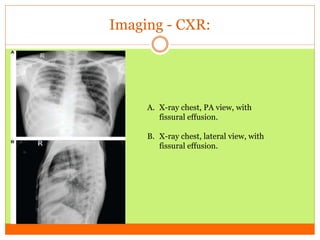
 Fluid localized within an oblique fissure may produce a rounded opacity,
simulating a tumour.
Imaging - CXR:
A. X-ray chest, PA view, with
fissural effusion.
B. X-ray chest, lateral view, with
fissural effusion.
Imaging:
 Ultrasonography:
 Is more accurate than plain CXR for determining the volume of
pleural fluid & frequently provides additional helpful information.
 Visualisation of fluid facilitates skin marking to indicate a site for
safe needle aspiration & guides pleural biopsy, increasing diagnostic
yield.
 Technique may also distinguish pleural fluid from pleural thickening.
 CT:
 Displays pleural abnormalities more readily than either plain
radiography or ultrasound, & may distinguish benign from
malignant pleural disease.
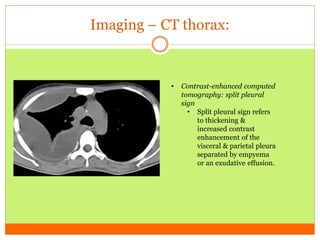
Imaging – CT thorax:
• Contrast-enhanced computed
tomography: split pleural
sign
• Split pleural sign refers
to thickening &
increased contrast
enhancement of the
visceral & parietal pleura
separated by empyema
or an exudative effusion.
Pleural aspiration & biopsy:
 In most cases, sampling is necessary to establish a diagnosis.
 Is the PREFERRED investigation (pleural tap).
 Simple aspiration provides information on the color & texture of fluid & on
appearance alone may immediately suggest an empyema or chylothorax.
 Presence of blood consistent with pulmonary infarction or malignancy, but may
also represent a traumatic tap.
 Gram stain of pleural fluid may indicate para-pneumonic effusion.
 Cytological examination is essential.
 A low pH suggests infection, but also seen in rheumatoid arthritis, ruptured
oesophagus or advanced malignancy.
Pleural aspiration & biopsy:
 Aspiration should not be performed for bilateral effusions in a clinical setting
strongly suggestive of a pleural transudate.
 Differentiation between transudate & exudate is crucial before further tests are
undertaken.
 Hemorrhagic effusions can be differentiated from traumatic pleural taps by
observing serial samples of pleural tap which clear up in the case of a traumatic
pleural tap.
 The routine pleural fluid evaluation usually includes determination of:
 Protein
 pH
 Lactate dehydrogenase (LDH).
 Glucose & albumin levels, with adenosine deaminase levels
 Cell count for differential & cytological examination.
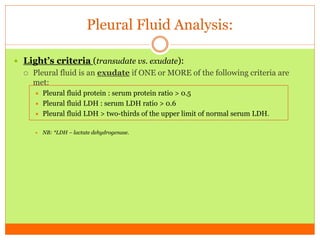
Pleural Fluid Analysis:
 Light’s criteria (transudate vs. exudate):
 Pleural fluid is an exudate if ONE or MORE of the following criteria are
met:
 Pleural fluid protein : serum protein ratio > 0.5
 Pleural fluid LDH : serum LDH ratio > 0.6
 Pleural fluid LDH > two-thirds of the upper limit of normal serum LDH.
 NB: *LDH – lactate dehydrogenase.
Malignant Pleural Effusion:
 Is a common complication of cancer.
 40% of all pleural effusions are due to malignancy.
 Most common causes are lung & breast cancers, & presence of effusion
indicates advanced & incurable disease.
 Pleural aspirate is the key investigation & may show malignant cells.
 In fact, the most common diagnosis with a massive effusion is malignancy,
other causes being complicated parapneumonic effusions & tuberculosis.
Differential Diagnoses:
 Bacterial pneumonia.
 Pulmonary thromboembolism (pulmonary infarct).
 Carcinoma.
 Connective tissue disorder.
 TB.
Management:
 To treat pleural effusion appropriately, it is important to determine its etiology.
 However, the etiology of pleural effusion remains unclear in nearly 20% of cases.
 First of; stabilize patients with respiratory distress.
 Therapeutic aspiration may be required to palliate breathlessness.
 An effusion should never be drained to dryness before establishing a diagnosis.
 Treatment of underlying cause – for example, heart failure, pneumonia,
pulmonary embolism or subphrenic abscess – will often be followed by
resolution of the effusion.
Treat Underlying Cause:
 Acute congestive heart failure – loop diuretics.
 Collagen vascular diseases – steroids.
 Pancreatitis.
 Pancreaticopleural fistula – endoscopic or surgical intervention is
recommended.
 Meigs syndrome – removal of ovarian tumor is recommended.
 Other malignancy: targeted cancer immunotherapy, chemotherapy,
radiotherapy, or surgical resection.

Pleural effusion ppt

  • 1.
    P H YS I O L O G Y P A T H O L O G Y M A N A G E M E N T Pleural Effusion
  • 2.
    Pleural Fluid:  Pleuralspace normally contains 5-10 ml of pleural fluid.  This lubricates the apposing surfaces of the visceral & parietal pleurae during respiratory movements.  It is formed by presence of hydrostatic & osmotic pressures.  Excreted via parietal pleura capillaries (higher hydrostatic pressure) and absorbed into the capillaries of visceral pleura (lower hydrostatic pressure).  Any condition that increases production or impairs drainage of fluid results in abnormal accumulation in pleural space between lining of the lungs & thoracic cavity, known as pleural – effusion.
  • 3.
    Pleural Effusion:  Pleuraleffusion is a common manifestation of both primary & secondary pleural diseases, which may be inflammatory or non-inflammatory.  Accumulation of pleural fluid is not a specific disease, but rather a reflection of underlying pathology.  Source of the fluid is usually blood vessels or lymphatic vessels lying beneath either pleura, but occasionally an abscess or other lesion may drain into pleural space.  Can occur in the following setting: i. Increased hydrostatic pressure: as in congestive heart failure. ii. Increased vascular permeability: as in pneumonia. iii. Decreased osmotic pressure: as in nephrotic syndrome. iv. Increased intrapleural negative pressure: as in atelectasis. v. Decreased lymphatic drainage: as in mediastinal carcinomatosis.
  • 4.
    Pleural Effusion:  Transudateis a filtrate, hence, it is a clear fluid with a low protein & cell count.  Exudate, on the other hand, is a cloudy fluid with a high protein & cell count;  as lesions responsible for the outflow of exudate allow larger molecules & even solid matter to pass into the pleural space.  The effusion follows gravity & usually collects in the lower margins of the pleural space.
  • 5.
    Pleural Fluid:  Generally,fluid accumulates as a result of: A. Increased hydrostatic pressure or decreased osmotic pressure (“transudative” effusion). B. Increased microvascular pressure due to disease of the pleural surface itself or injury in the adjacent lung (“exudative” effusion).
  • 6.
    Etiology:  Common causes: Pneumonia  Cardiac failure  Subdiaphragmatic disorders (subphrenic abscess, pancreatitis, etc.)  Tuberculosis  Pulmonary infarction  Malignant disease  Uncommon causes:  Hypoproteinaemia (nephrotic syndrome, liver failure, malnutrition).  Connective tissue disorder (SLE, rheumatoid arthritis)  Acute rheumatic fever  Post-myocardial infarction syndrome.  Myxoedema  Uraemia  Meigs’ syndrome (ovarian tumor + plural effusion)  Asbestos-related.
  • 7.
    Clinical Features:  Painon inspiration + coughing/sneezing.  Pleuritic chest pain.  May be localized or referred.  Non-productive cough.  Breathlessness (dyspnea) is the only symptom related to the effusion itself, & its severity depends on the size & rate of accumulation.  Inspection:  Tachypnoea  Palpation:  Decreased chest expansion on affected side.  Trachea & apex may be shifted towards unaffected side.  Reduced tactile vocal fremitus.  Percussion:  Stony dull tone.  Usually the R mid- and lower- zones.  Auscultation:  Absent breath sounds  Diminished or absent vocal resonance at affected side.  Crackles above effusion.
  • 8.
    Diagnosis:  The diagnosticevaluation of pleural effusion includes:  chemical  microbiological studies  as well as cytological analysis, which can provide further information about the etiology of the disease process.  Immunohistochemistry provides increased diagnostic accuracy.
  • 9.
    Imaging:  Chest x-ray& ultrasound are usually performed as first-line tests to diagnose pleural effusion.  Standard PA & lateral views remain the most important technique for initial diagnosis of pleural effusion.  But thorax CT is sometimes required (e.g. for very small effusions).
  • 10.
    Imaging:  CXR:  Around200 mL of fluid is required to be detectable on a PA chest x-ray.  Smaller effusions can be identified by ultrasound or CT.  Classical appearance of pleural fluid on the erect PA chest film is of a curved shadow at the lung base, blunting the costophrenic angle & ascending towards the axilla.  Previous scarring or adhesions in the pleural space can cause localized effusions.  Fluid localized within an oblique fissure may produce a rounded opacity, simulating a tumour.
  • 11.
    Imaging - CXR: A.X-ray chest, PA view, with fissural effusion. B. X-ray chest, lateral view, with fissural effusion.
  • 12.
    Imaging:  Ultrasonography:  Ismore accurate than plain CXR for determining the volume of pleural fluid & frequently provides additional helpful information.  Visualisation of fluid facilitates skin marking to indicate a site for safe needle aspiration & guides pleural biopsy, increasing diagnostic yield.  Technique may also distinguish pleural fluid from pleural thickening.  CT:  Displays pleural abnormalities more readily than either plain radiography or ultrasound, & may distinguish benign from malignant pleural disease.
  • 13.
    Imaging – CTthorax: • Contrast-enhanced computed tomography: split pleural sign • Split pleural sign refers to thickening & increased contrast enhancement of the visceral & parietal pleura separated by empyema or an exudative effusion.
  • 14.
    Pleural aspiration &biopsy:  In most cases, sampling is necessary to establish a diagnosis.  Is the PREFERRED investigation (pleural tap).  Simple aspiration provides information on the color & texture of fluid & on appearance alone may immediately suggest an empyema or chylothorax.  Presence of blood consistent with pulmonary infarction or malignancy, but may also represent a traumatic tap.  Gram stain of pleural fluid may indicate para-pneumonic effusion.  Cytological examination is essential.  A low pH suggests infection, but also seen in rheumatoid arthritis, ruptured oesophagus or advanced malignancy.
  • 15.
    Pleural aspiration &biopsy:  Aspiration should not be performed for bilateral effusions in a clinical setting strongly suggestive of a pleural transudate.  Differentiation between transudate & exudate is crucial before further tests are undertaken.  Hemorrhagic effusions can be differentiated from traumatic pleural taps by observing serial samples of pleural tap which clear up in the case of a traumatic pleural tap.  The routine pleural fluid evaluation usually includes determination of:  Protein  pH  Lactate dehydrogenase (LDH).  Glucose & albumin levels, with adenosine deaminase levels  Cell count for differential & cytological examination.
  • 16.
    Pleural Fluid Analysis: Light’s criteria (transudate vs. exudate):  Pleural fluid is an exudate if ONE or MORE of the following criteria are met:  Pleural fluid protein : serum protein ratio > 0.5  Pleural fluid LDH : serum LDH ratio > 0.6  Pleural fluid LDH > two-thirds of the upper limit of normal serum LDH.  NB: *LDH – lactate dehydrogenase.
  • 17.
    Malignant Pleural Effusion: Is a common complication of cancer.  40% of all pleural effusions are due to malignancy.  Most common causes are lung & breast cancers, & presence of effusion indicates advanced & incurable disease.  Pleural aspirate is the key investigation & may show malignant cells.  In fact, the most common diagnosis with a massive effusion is malignancy, other causes being complicated parapneumonic effusions & tuberculosis.
  • 18.
    Differential Diagnoses:  Bacterialpneumonia.  Pulmonary thromboembolism (pulmonary infarct).  Carcinoma.  Connective tissue disorder.  TB.
  • 19.
    Management:  To treatpleural effusion appropriately, it is important to determine its etiology.  However, the etiology of pleural effusion remains unclear in nearly 20% of cases.  First of; stabilize patients with respiratory distress.  Therapeutic aspiration may be required to palliate breathlessness.  An effusion should never be drained to dryness before establishing a diagnosis.  Treatment of underlying cause – for example, heart failure, pneumonia, pulmonary embolism or subphrenic abscess – will often be followed by resolution of the effusion.
  • 20.
    Treat Underlying Cause: Acute congestive heart failure – loop diuretics.  Collagen vascular diseases – steroids.  Pancreatitis.  Pancreaticopleural fistula – endoscopic or surgical intervention is recommended.  Meigs syndrome – removal of ovarian tumor is recommended.  Other malignancy: targeted cancer immunotherapy, chemotherapy, radiotherapy, or surgical resection.