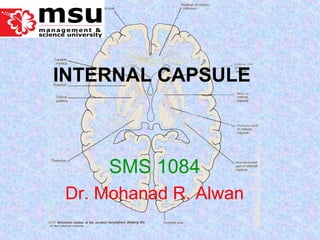
INTERNAL CAPSULE
SMS 1084
Dr. Mohanad R. Alwan
• Define internal capsule and enumerate the
parts
• Illustrate the internal capsule and describe
the components of each part
• Describe the blood supply and its clinical
importance
OBJECTIVES
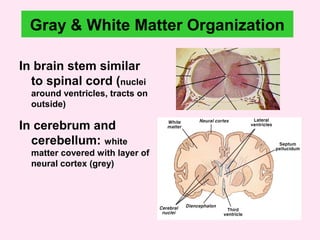
Gray & White Matter Organization
In brain stem similar
to spinal cord (nuclei
around ventricles, tracts on
outside)
In cerebrum and
cerebellum: white
matter covered with layer of
neural cortex (grey)
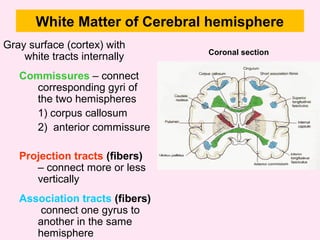
White Matter of Cerebral hemisphere
Gray surface (cortex) with
white tracts internally
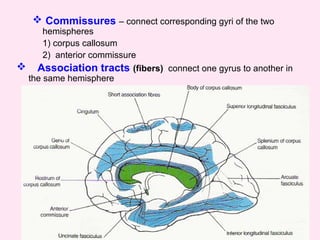
Commissures – connect
corresponding gyri of
the two hemispheres
1) corpus callosum
2) anterior commissure
Projection tracts (fibers)
– connect more or less
vertically
Association tracts (fibers)
connect one gyrus to
another in the same
hemisphere
Coronal section
 Commissures – connect corresponding gyri of the two
hemispheres
1) corpus callosum
2) anterior commissure
 Association tracts (fibers) connect one gyrus to another in
the same hemisphere
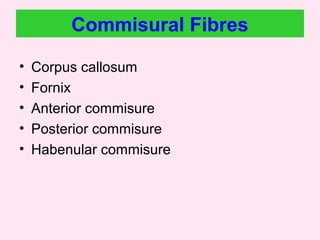
Commisural Fibres
• Corpus callosum
• Fornix
• Anterior commisure
• Posterior commisure
• Habenular commisure
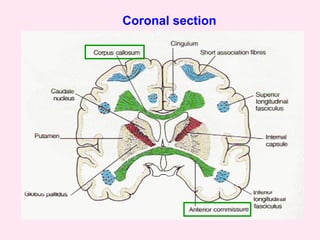
Coronal section
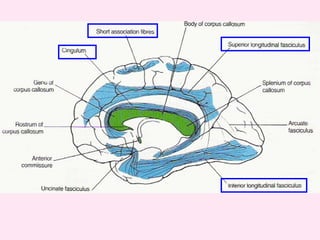
Association Fibres
• Short association fibres
• Long association fibres
– Superior longitudinal fibres
– Inferior longitudinal fibres
– Cingulum
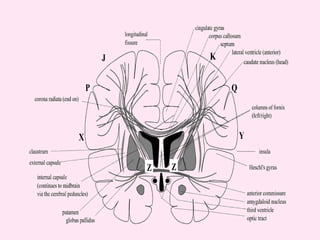
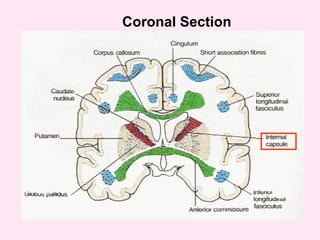
Coronal Section
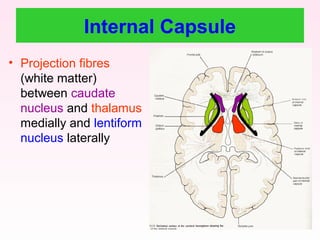
• Projection fibres
(white matter)
between caudate
nucleus and thalamus
medially and lentiform
nucleus laterally
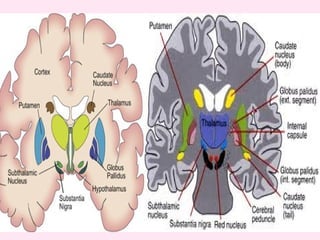
Internal Capsule
• The fibres projection from the cerebral cortex to the
various nuclei of the extrapyramidal system (a neural
network located in the brain that is part of the motor system
involved in the coordination of movement e.g., the putamen
and caudate nucleus).
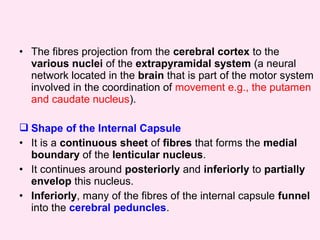
 Shape of the Internal Capsule
• It is a continuous sheet of fibres that forms the medial
boundary of the lenticular nucleus.
• It continues around posteriorly and inferiorly to partially
envelop this nucleus.
• Inferiorly, many of the fibres of the internal capsule funnel
into the cerebral peduncles.
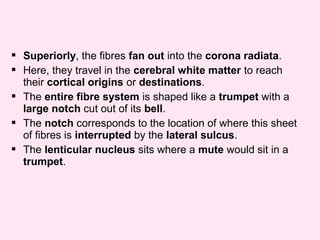
 Superiorly, the fibres fan out into the corona radiata.
 Here, they travel in the cerebral white matter to reach
their cortical origins or destinations.
 The entire fibre system is shaped like a trumpet with a
large notch cut out of its bell.
 The notch corresponds to the location of where this sheet
of fibres is interrupted by the lateral sulcus.
 The lenticular nucleus sits where a mute would sit in a
trumpet.
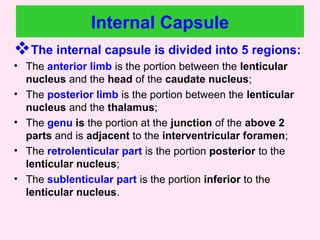
Internal Capsule
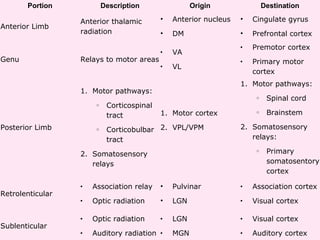
The internal capsule is divided into 5 regions:
• The anterior limb is the portion between the lenticular
nucleus and the head of the caudate nucleus;
• The posterior limb is the portion between the lenticular
nucleus and the thalamus;
• The genu is the portion at the junction of the above 2
parts and is adjacent to the interventricular foramen;
• The retrolenticular part is the portion posterior to the
lenticular nucleus;
• The sublenticular part is the portion inferior to the
lenticular nucleus.
Portion Description Origin Destination
Anterior Limb
Anterior thalamic
radiation
• Anterior nucleus
• DM
• Cingulate gyrus
• Prefrontal cortex
Genu Relays to motor areas
• VA
• VL
• Premotor cortex
• Primary motor
cortex
Posterior Limb
1. Motor pathways:
o Corticospinal
tract
o Corticobulbar
tract
2. Somatosensory
relays
1. Motor cortex
2. VPL/VPM
1. Motor pathways:
o Spinal cord
o Brainstem
2. Somatosensory
relays:
o Primary
somatosentory
cortex
Retrolenticular
• Association relay
• Optic radiation
• Pulvinar
• LGN
• Association cortex
• Visual cortex
Sublenticular
• Optic radiation
• Auditory radiation
• LGN
• MGN
• Visual cortex
• Auditory cortex
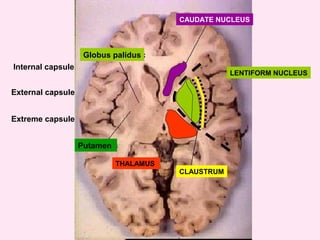
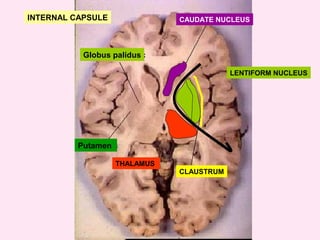
CAUDATE NUCLEUS
LENTIFORM NUCLEUS
THALAMUS
Globus palidus
Putamen
CLAUSTRUM
Internal capsule
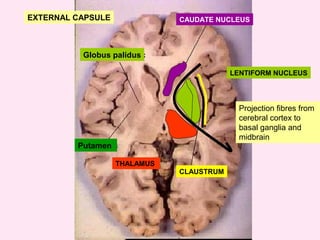
External capsule
Extreme capsule
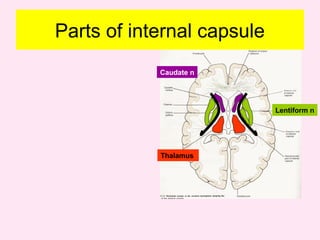
Parts of internal capsule
Caudate n
Lentiform n
Thalamus
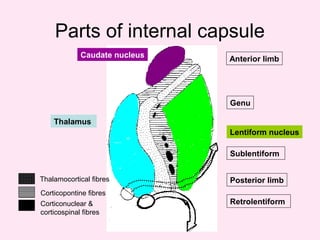
Parts of internal capsule
Caudate nucleus
Lentiform nucleus
Thalamus
Anterior limb
Posterior limb
Genu
Thalamocortical fibres
Corticopontine fibres
Corticonuclear &
corticospinal fibres
Sublentiform
Retrolentiform
Superior
Inferior
Anterior
Posterior
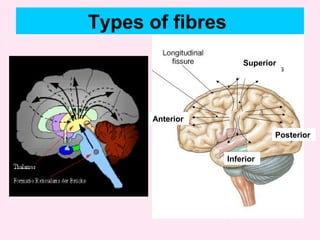
Types of fibres
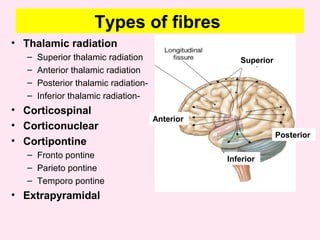
Types of fibres
• Thalamic radiation
– Superior thalamic radiation
– Anterior thalamic radiation
– Posterior thalamic radiation-
– Inferior thalamic radiation-
• Corticospinal
• Corticonuclear
• Cortipontine
– Fronto pontine
– Parieto pontine
– Temporo pontine
• Extrapyramidal
Superior
Inferior
Anterior
Posterior
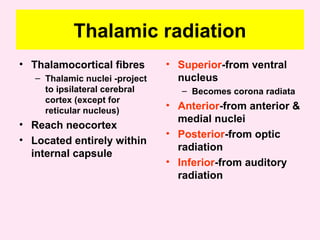
Thalamic radiation
• Thalamocortical fibres
– Thalamic nuclei -project
to ipsilateral cerebral
cortex (except for
reticular nucleus)
• Reach neocortex
• Located entirely within
internal capsule
• Superior-from ventral
nucleus
– Becomes corona radiata
• Anterior-from anterior &
medial nuclei
• Posterior-from optic
radiation
• Inferior-from auditory
radiation
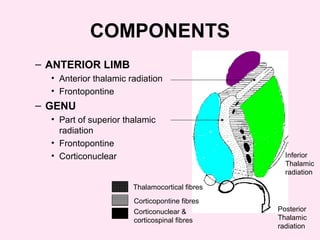
COMPONENTS
– ANTERIOR LIMB
• Anterior thalamic radiation
• Frontopontine
– GENU
• Part of superior thalamic
radiation
• Frontopontine
• Corticonuclear
Thalamocortical fibres
Corticopontine fibres
Corticonuclear &
corticospinal fibres
Inferior
Thalamic
radiation
Posterior
Thalamic
radiation
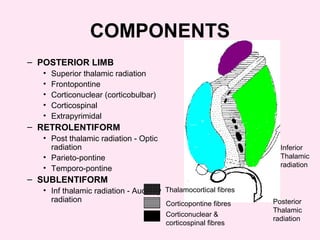
COMPONENTS
– POSTERIOR LIMB
• Superior thalamic radiation
• Frontopontine
• Corticonuclear (corticobulbar)
• Corticospinal
• Extrapyrimidal
– RETROLENTIFORM
• Post thalamic radiation - Optic
radiation
• Parieto-pontine
• Temporo-pontine
– SUBLENTIFORM
• Inf thalamic radiation - Auditory
radiation
Thalamocortical fibres
Corticopontine fibres
Corticonuclear &
corticospinal fibres
Inferior
Thalamic
radiation
Posterior
Thalamic
radiation
Thalamocortical fibres
Corticopontine fibres
Corticonuclear &
corticospinal fibres
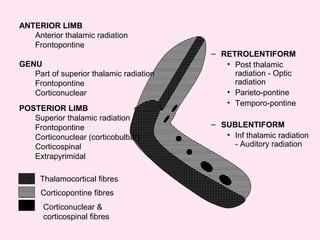
ANTERIOR LIMB
Anterior thalamic radiation
Frontopontine
GENU
Part of superior thalamic radiation
Frontopontine
Corticonuclear
– RETROLENTIFORM
• Post thalamic
radiation - Optic
radiation
• Parieto-pontine
• Temporo-pontine
– SUBLENTIFORM
• Inf thalamic radiation
- Auditory radiation
POSTERIOR LIMB
Superior thalamic radiation
Frontopontine
Corticonuclear (corticobulbar)
Corticospinal
Extrapyrimidal
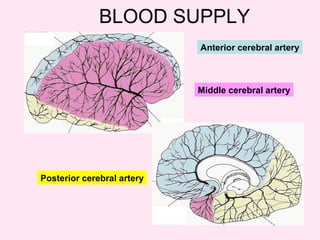
Middle cerebral artery
Anterior cerebral artery
Posterior cerebral artery
BLOOD SUPPLY
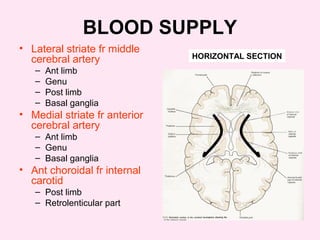
BLOOD SUPPLY
HORIZONTAL SECTION
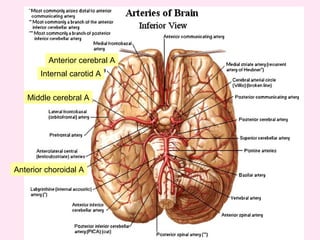
• Lateral striate fr middle
cerebral artery
– Ant limb
– Genu
– Post limb
– Basal ganglia
• Medial striate fr anterior
cerebral artery
– Ant limb
– Genu
– Basal ganglia
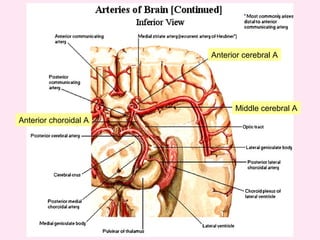
• Ant choroidal fr internal
carotid
– Post limb
– Retrolenticular part
Anterior choroidal A
Middle cerebral A
Anterior cerebral A
Internal carotid A
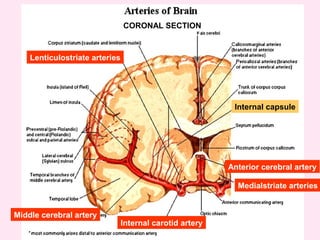
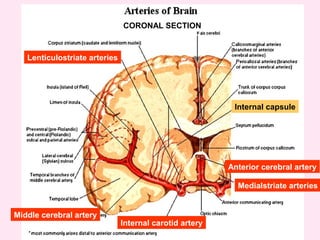
Internal capsule
Lenticulostriate arteries
Middle cerebral artery
Internal carotid artery
Anterior cerebral artery
Medialstriate arteries
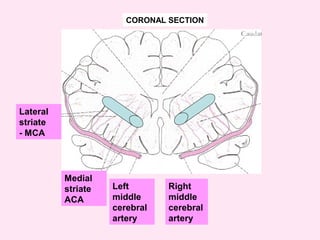
CORONAL SECTION
Left
middle
cerebral
artery
Right
middle
cerebral
artery
Medial
striate
ACA
Lateral
striate
- MCA
CORONAL SECTION
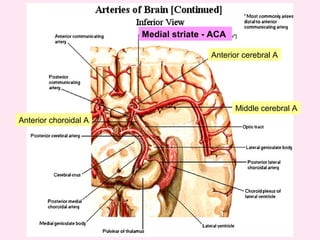
*Anterior choroidal A
Middle cerebral A
Anterior cerebral A
Medial striate - ACA
ANTERIOR LIMB
• Ant cerebral artery through medial striate
br.
• Middle cerebral artery through lateral
striate and lenticulostriate br.
- pass through the lentiform N to supply the striate
GENU
• Ant cerebral artery through medial striate
br.
• Middle cerebral artery through lateral
striate and lenticulostriate br.
• Branches of internal carotid artery
Internal capsule
Lenticulostriate arteries
Middle cerebral artery
Internal carotid artery
Anterior cerebral artery
Medialstriate arteries
CORONAL SECTION
POSTERIOR LIMB
• Middle cerebral artery through lateral
striate and lenticulostriate br.
– Charcot’s artery of cerebral haemorrhage
• Anterior choroidal artery, direct branch of
internal carotid artery
– Long and slender, thus has tendency to get
thrombosis
CAUDATE NUCLEUS
LENTIFORM NUCLEUS
THALAMUS
Globus palidus
Putamen
CLAUSTRUM
INTERNAL CAPSULE
CAUDATE NUCLEUS
LENTIFORM NUCLEUS
THALAMUS
Globus palidus
Putamen
CLAUSTRUM
EXTERNAL CAPSULE
Projection fibres from
cerebral cortex to
basal ganglia and
midbrain
*Anterior choroidal A
Middle cerebral A
Anterior cerebral A
Internal capsule
Internal capsule

Internal capsule

  • 1.
  • 2.
    • Define internalcapsule and enumerate the parts • Illustrate the internal capsule and describe the components of each part • Describe the blood supply and its clinical importance OBJECTIVES
  • 3.
    Gray & WhiteMatter Organization In brain stem similar to spinal cord (nuclei around ventricles, tracts on outside) In cerebrum and cerebellum: white matter covered with layer of neural cortex (grey)
  • 4.
    White Matter ofCerebral hemisphere Gray surface (cortex) with white tracts internally Commissures – connect corresponding gyri of the two hemispheres 1) corpus callosum 2) anterior commissure Projection tracts (fibers) – connect more or less vertically Association tracts (fibers) connect one gyrus to another in the same hemisphere Coronal section
  • 5.
     Commissures –connect corresponding gyri of the two hemispheres 1) corpus callosum 2) anterior commissure  Association tracts (fibers) connect one gyrus to another in the same hemisphere
  • 6.
    Commisural Fibres • Corpuscallosum • Fornix • Anterior commisure • Posterior commisure • Habenular commisure
  • 7.
  • 9.
    Association Fibres • Shortassociation fibres • Long association fibres – Superior longitudinal fibres – Inferior longitudinal fibres – Cingulum
  • 11.
  • 12.
    • Projection fibres (whitematter) between caudate nucleus and thalamus medially and lentiform nucleus laterally Internal Capsule
  • 14.
    • The fibresprojection from the cerebral cortex to the various nuclei of the extrapyramidal system (a neural network located in the brain that is part of the motor system involved in the coordination of movement e.g., the putamen and caudate nucleus).  Shape of the Internal Capsule • It is a continuous sheet of fibres that forms the medial boundary of the lenticular nucleus. • It continues around posteriorly and inferiorly to partially envelop this nucleus. • Inferiorly, many of the fibres of the internal capsule funnel into the cerebral peduncles.
  • 15.
     Superiorly, thefibres fan out into the corona radiata.  Here, they travel in the cerebral white matter to reach their cortical origins or destinations.  The entire fibre system is shaped like a trumpet with a large notch cut out of its bell.  The notch corresponds to the location of where this sheet of fibres is interrupted by the lateral sulcus.  The lenticular nucleus sits where a mute would sit in a trumpet.
  • 16.
    Internal Capsule The internalcapsule is divided into 5 regions: • The anterior limb is the portion between the lenticular nucleus and the head of the caudate nucleus; • The posterior limb is the portion between the lenticular nucleus and the thalamus; • The genu is the portion at the junction of the above 2 parts and is adjacent to the interventricular foramen; • The retrolenticular part is the portion posterior to the lenticular nucleus; • The sublenticular part is the portion inferior to the lenticular nucleus.
  • 17.
    Portion Description OriginDestination Anterior Limb Anterior thalamic radiation • Anterior nucleus • DM • Cingulate gyrus • Prefrontal cortex Genu Relays to motor areas • VA • VL • Premotor cortex • Primary motor cortex Posterior Limb 1. Motor pathways: o Corticospinal tract o Corticobulbar tract 2. Somatosensory relays 1. Motor cortex 2. VPL/VPM 1. Motor pathways: o Spinal cord o Brainstem 2. Somatosensory relays: o Primary somatosentory cortex Retrolenticular • Association relay • Optic radiation • Pulvinar • LGN • Association cortex • Visual cortex Sublenticular • Optic radiation • Auditory radiation • LGN • MGN • Visual cortex • Auditory cortex
  • 18.
    CAUDATE NUCLEUS LENTIFORM NUCLEUS THALAMUS Globuspalidus Putamen CLAUSTRUM Internal capsule External capsule Extreme capsule
  • 19.
    Parts of internalcapsule Caudate n Lentiform n Thalamus
  • 20.
    Parts of internalcapsule Caudate nucleus Lentiform nucleus Thalamus Anterior limb Posterior limb Genu Thalamocortical fibres Corticopontine fibres Corticonuclear & corticospinal fibres Sublentiform Retrolentiform
  • 21.
  • 22.
    Types of fibres •Thalamic radiation – Superior thalamic radiation – Anterior thalamic radiation – Posterior thalamic radiation- – Inferior thalamic radiation- • Corticospinal • Corticonuclear • Cortipontine – Fronto pontine – Parieto pontine – Temporo pontine • Extrapyramidal Superior Inferior Anterior Posterior
  • 23.
    Thalamic radiation • Thalamocorticalfibres – Thalamic nuclei -project to ipsilateral cerebral cortex (except for reticular nucleus) • Reach neocortex • Located entirely within internal capsule • Superior-from ventral nucleus – Becomes corona radiata • Anterior-from anterior & medial nuclei • Posterior-from optic radiation • Inferior-from auditory radiation
  • 24.
    COMPONENTS – ANTERIOR LIMB •Anterior thalamic radiation • Frontopontine – GENU • Part of superior thalamic radiation • Frontopontine • Corticonuclear Thalamocortical fibres Corticopontine fibres Corticonuclear & corticospinal fibres Inferior Thalamic radiation Posterior Thalamic radiation
  • 25.
    COMPONENTS – POSTERIOR LIMB •Superior thalamic radiation • Frontopontine • Corticonuclear (corticobulbar) • Corticospinal • Extrapyrimidal – RETROLENTIFORM • Post thalamic radiation - Optic radiation • Parieto-pontine • Temporo-pontine – SUBLENTIFORM • Inf thalamic radiation - Auditory radiation Thalamocortical fibres Corticopontine fibres Corticonuclear & corticospinal fibres Inferior Thalamic radiation Posterior Thalamic radiation
  • 26.
    Thalamocortical fibres Corticopontine fibres Corticonuclear& corticospinal fibres ANTERIOR LIMB Anterior thalamic radiation Frontopontine GENU Part of superior thalamic radiation Frontopontine Corticonuclear – RETROLENTIFORM • Post thalamic radiation - Optic radiation • Parieto-pontine • Temporo-pontine – SUBLENTIFORM • Inf thalamic radiation - Auditory radiation POSTERIOR LIMB Superior thalamic radiation Frontopontine Corticonuclear (corticobulbar) Corticospinal Extrapyrimidal
  • 27.
    Middle cerebral artery Anteriorcerebral artery Posterior cerebral artery BLOOD SUPPLY
  • 28.
    BLOOD SUPPLY HORIZONTAL SECTION •Lateral striate fr middle cerebral artery – Ant limb – Genu – Post limb – Basal ganglia • Medial striate fr anterior cerebral artery – Ant limb – Genu – Basal ganglia • Ant choroidal fr internal carotid – Post limb – Retrolenticular part
  • 29.
    Anterior choroidal A Middlecerebral A Anterior cerebral A Internal carotid A
  • 30.
    Internal capsule Lenticulostriate arteries Middlecerebral artery Internal carotid artery Anterior cerebral artery Medialstriate arteries CORONAL SECTION
  • 31.
  • 32.
    *Anterior choroidal A Middlecerebral A Anterior cerebral A Medial striate - ACA
  • 33.
    ANTERIOR LIMB • Antcerebral artery through medial striate br. • Middle cerebral artery through lateral striate and lenticulostriate br. - pass through the lentiform N to supply the striate
  • 34.
    GENU • Ant cerebralartery through medial striate br. • Middle cerebral artery through lateral striate and lenticulostriate br. • Branches of internal carotid artery
  • 35.
    Internal capsule Lenticulostriate arteries Middlecerebral artery Internal carotid artery Anterior cerebral artery Medialstriate arteries CORONAL SECTION
  • 36.
    POSTERIOR LIMB • Middlecerebral artery through lateral striate and lenticulostriate br. – Charcot’s artery of cerebral haemorrhage • Anterior choroidal artery, direct branch of internal carotid artery – Long and slender, thus has tendency to get thrombosis
  • 37.
    CAUDATE NUCLEUS LENTIFORM NUCLEUS THALAMUS Globuspalidus Putamen CLAUSTRUM INTERNAL CAPSULE
  • 38.
    CAUDATE NUCLEUS LENTIFORM NUCLEUS THALAMUS Globuspalidus Putamen CLAUSTRUM EXTERNAL CAPSULE Projection fibres from cerebral cortex to basal ganglia and midbrain
  • 39.
    *Anterior choroidal A Middlecerebral A Anterior cerebral A