Head and Neck
The Cranial cavity I
Meninges & Dural Folds
Dr. Mohamed Elfiky
Professor of anatomy and embryology
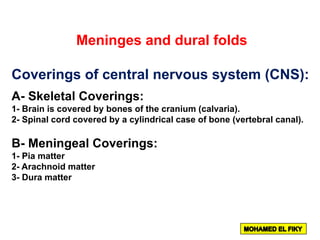
Meninges and dural folds
Coverings of central nervous system (CNS):
A- Skeletal Coverings:
1- Brain is covered by bones of the cranium (calvaria).
2- Spinal cord covered by a cylindrical case of bone (vertebral canal).
B- Meningeal Coverings:
1- Pia matter
2- Arachnoid matter
3- Dura matter
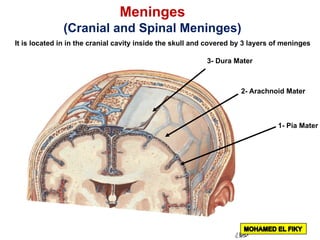
It is located in in the cranial cavity inside the skull and covered by 3 layers of meninges
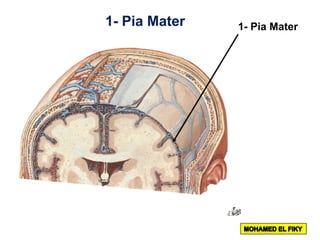
1- Pia Mater
2- Arachnoid Mater
3- Dura Mater
Meninges
(Cranial and Spinal Meninges)
1- Pia Mater1- Pia Mater
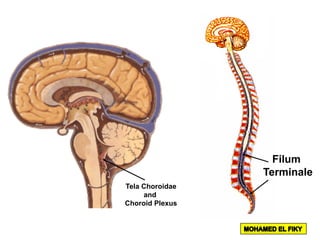
Tela Choroidae
and
Choroid Plexus
Filum
Terminale
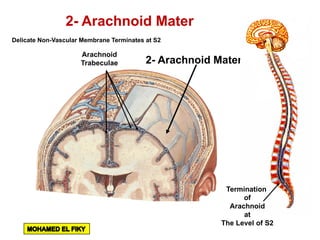
2- Arachnoid Mater
Delicate Non-Vascular Membrane Terminates at S2
Arachnoid
Trabeculae
2- Arachnoid Mater
Termination
of
Arachnoid
at
The Level of S2
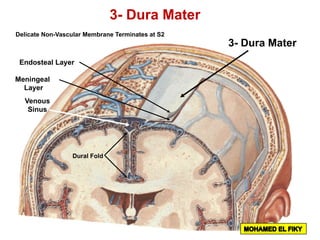
3- Dura Mater
Delicate Non-Vascular Membrane Terminates at S2
Endosteal Layer
Meningeal
Layer
Venous
Sinus
Dural Fold
3- Dura Mater
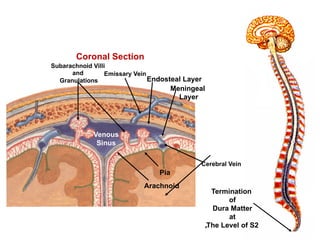
Coronal Section
Endosteal Layer
Meningeal
Layer
Venous
Sinus
Pia
Arachnoid
Subarachnoid Villi
and
Granulations
Emissary Vein
Cerebral Vein
Termination
of
Dura Matter
at
The Level of S2
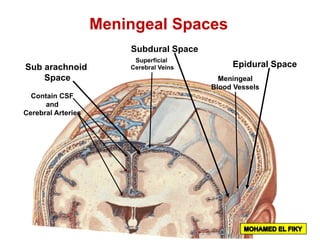
Epidural Space
Subdural Space
Superficial
Cerebral VeinsSub arachnoid
Space Meningeal
Blood Vessels
Contain CSF
and
Cerebral Arteries
Meningeal Spaces
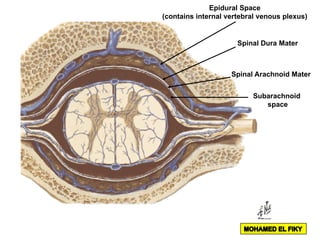
Epidural Space
(contains internal vertebral venous plexus)
Spinal Dura Mater
Spinal Arachnoid Mater
Subarachnoid
space
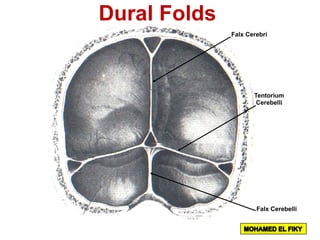
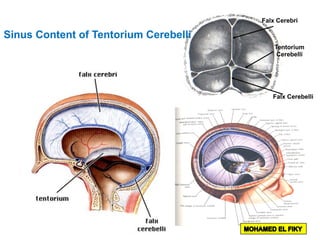
Falx Cerebri
Falx Cerebelli
Tentorium
Cerebelli
Dural Folds
1- Falx Cerebri
Definition: It is a large sickle-shaped reduplication of the inner layer of dura mater Site: Occupies
the median longitudinal fissure between the two cerebral hemispheres.
Features:
(a) Apex: is narrow and is attached to the crista galli.
(b) Base: is broad and is attached to, the tentorium cerebelli in the median plane.
(c) Upper margin: is convex and is attached to the lips of the sagittal sulcus on the inner surface of
the vault of the skull.
(d) Lower margin: is concave and free. It encloses the inferior sagittal sinus in its posterior two-thirds.
(e) Right and left surfaces: are related to the medial surface of the corresponding cerebral
hemispheres.
Sinuses enclosed in it:
(1) Superior sagittal sinus: in its upper convex margin.
(2) Inferior sagittal sinus: in the posterior 2/3 of its lower margin.
(3) Straight sinus: within the junction of the falx cerebri with the tentorium cerebelli in the median
plane.
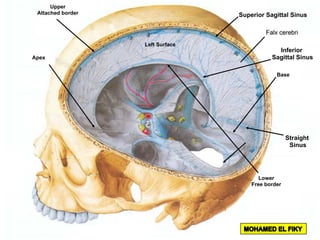
Apex
Base
Lower
Free border
Upper
Attached border
Left Surface
Superior Sagittal Sinus
Inferior
Sagittal Sinus
Straight
Sinus
2- Tentorium Cerebelli
Definition: It is a tent-shaped reduplication of the inner layer of the dura. Site: between the
cerebellum and the cerebrum.
Features: It has:
(1) Two surfaces, Superior and inferior.
Superior surface: gives attachment to the falx cerebri in the median plane.
Inferior surface: concave to fit the superior convex surface of the cerebellum
(2) Two border , attached and free
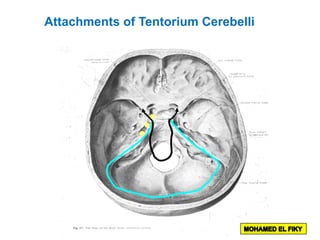
(Attached border: is attached on either sides to:
(a) Posterior clinoid process.
(b) Lips of superior petrosal sulcus along the upper border of petrous temporal bone.
(c) Lips of transverse sulcus of the occipital bone.
Free border: U-shaped
(a) tentorial notch which transmits the midbrain.
(b) it crosses the attached border at the apex of petrous temporal to be attached to the anterior
clinoid process.
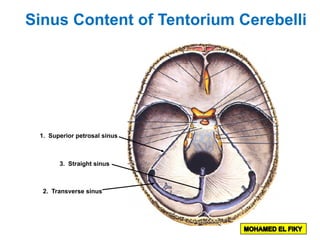
Sinuses enclosed in it:
(1) Transverse sinus: in the attached border along the transverse sulcus.
(2) Superior petrosal sinus: in the attached border along the superior petrosal
sulcus.
(3) Straight sinus: In the midline along of its attachment with the falx cerebri.
Cranial nerves piercing it:
(1) Oculomotor: in front of the point of crossing of the free and attached borders.
(2) Trochlear: at the point of crossing.
(3) Trigeminal nerve: behind the point of crossing
Attachments of Tentorium Cerebelli
Falx Cerebri
Falx Cerebelli
Tentorium
Cerebelli
Sinus Content of Tentorium Cerebelli
1. Superior petrosal sinus
2. Transverse sinus
3. Straight sinus
Sinus Content of Tentorium Cerebelli
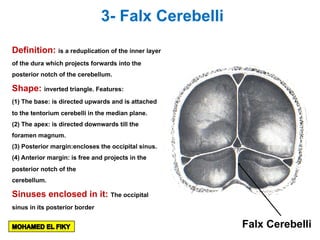
3- Falx Cerebelli
Definition: is a reduplication of the inner layer
of the dura which projects forwards into the
posterior notch of the cerebellum.
Shape: inverted triangle. Features:
(1) The base: is directed upwards and is attached
to the tentorium cerebelli in the median plane.
(2) The apex: is directed downwards till the
foramen magnum.
(3) Posterior margin:encloses the occipital sinus.
(4) Anterior margin: is free and projects in the
posterior notch of the
cerebellum.
Sinuses enclosed in it: The occipital
sinus in its posterior border
Falx Cerebelli
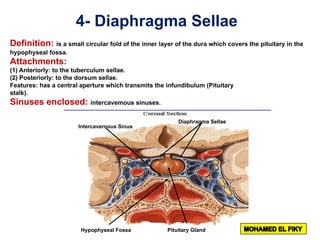
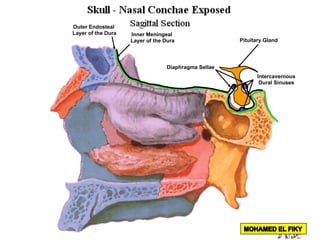
4- Diaphragma Sellae
Definition: is a small circular fold of the inner layer of the dura which covers the pituitary in the
hypophyseal fossa.
Attachments:
(1) Anteriorly: to the tuberculum sellae.
(2) Posteriorly: to the dorsum sellae.
Features: has a central aperture which transmits the infundibulum (Pituitary
stalk).
Sinuses enclosed: intercavemous sinuses.
Diaphragma Sellae
Pituitary GlandHypophyseal Fossa
Intercavernous Sinus
Pituitary Gland
Outer Endosteal
Layer of the Dura Inner Meningeal
Layer of the Dura
Diaphragma Sellae
Intercavernous
Dural Sinuses
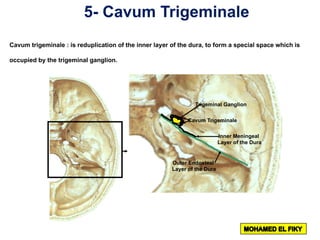
5- Cavum Trigeminale
Cavum trigeminale : is reduplication of the inner layer of the dura, to form a special space which is
occupied by the trigeminal ganglion.
Trigeminal Ganglion
Cavum Trigeminale
Outer Endosteal
Layer of the Dura
Inner Meningeal
Layer of the Dura
Nerve supply of the dura
1- The dura of anterior cranial fossa : supplied by the anterior and posterior ethmoidal
nerve.
2- The dura of the middle cranial fossa : supplied by nervous spinosus (br. of
mandibular ) and meningeal branch of maxillary nerve.
3- The dura of posterior cranial fossa : supplied by the meningeal branches of the 9th ,
10th &12th cranial nerves .
4- The dura around foramen magnum : supplied by 1st, 2nd &3rd cervical nerves .
Arterial supply of the dura
1- The dura in the anterior cranial fossa : is supplied by anterior and posterior ethmoidal arteries
(branches of ophthalmic artery)
2- The dura in the middle cranial fossa : is supplied by :
a. Accessory and middle meningeal arteries (branches of maxillary a.) b. Recurrent branch of
lacrimal artery (br. of ophthalmic a.)
3- The dura of posterior cranial fossa : is supplied by vertebral , occipital and ascending
pharyngeal arteries

Cranial cavity part 1

  • 1.
    Head and Neck TheCranial cavity I Meninges & Dural Folds Dr. Mohamed Elfiky Professor of anatomy and embryology
  • 2.
    Meninges and duralfolds Coverings of central nervous system (CNS): A- Skeletal Coverings: 1- Brain is covered by bones of the cranium (calvaria). 2- Spinal cord covered by a cylindrical case of bone (vertebral canal). B- Meningeal Coverings: 1- Pia matter 2- Arachnoid matter 3- Dura matter
  • 3.
    It is locatedin in the cranial cavity inside the skull and covered by 3 layers of meninges 1- Pia Mater 2- Arachnoid Mater 3- Dura Mater Meninges (Cranial and Spinal Meninges)
  • 4.
    1- Pia Mater1-Pia Mater
  • 5.
  • 6.
    2- Arachnoid Mater DelicateNon-Vascular Membrane Terminates at S2 Arachnoid Trabeculae 2- Arachnoid Mater Termination of Arachnoid at The Level of S2
  • 7.
    3- Dura Mater DelicateNon-Vascular Membrane Terminates at S2 Endosteal Layer Meningeal Layer Venous Sinus Dural Fold 3- Dura Mater
  • 8.
    Coronal Section Endosteal Layer Meningeal Layer Venous Sinus Pia Arachnoid SubarachnoidVilli and Granulations Emissary Vein Cerebral Vein Termination of Dura Matter at The Level of S2
  • 9.
    Epidural Space Subdural Space Superficial CerebralVeinsSub arachnoid Space Meningeal Blood Vessels Contain CSF and Cerebral Arteries Meningeal Spaces
  • 10.
    Epidural Space (contains internalvertebral venous plexus) Spinal Dura Mater Spinal Arachnoid Mater Subarachnoid space
  • 11.
  • 12.
    1- Falx Cerebri Definition:It is a large sickle-shaped reduplication of the inner layer of dura mater Site: Occupies the median longitudinal fissure between the two cerebral hemispheres. Features: (a) Apex: is narrow and is attached to the crista galli. (b) Base: is broad and is attached to, the tentorium cerebelli in the median plane. (c) Upper margin: is convex and is attached to the lips of the sagittal sulcus on the inner surface of the vault of the skull. (d) Lower margin: is concave and free. It encloses the inferior sagittal sinus in its posterior two-thirds. (e) Right and left surfaces: are related to the medial surface of the corresponding cerebral hemispheres. Sinuses enclosed in it: (1) Superior sagittal sinus: in its upper convex margin. (2) Inferior sagittal sinus: in the posterior 2/3 of its lower margin. (3) Straight sinus: within the junction of the falx cerebri with the tentorium cerebelli in the median plane.
  • 13.
    Apex Base Lower Free border Upper Attached border LeftSurface Superior Sagittal Sinus Inferior Sagittal Sinus Straight Sinus
  • 14.
    2- Tentorium Cerebelli Definition:It is a tent-shaped reduplication of the inner layer of the dura. Site: between the cerebellum and the cerebrum. Features: It has: (1) Two surfaces, Superior and inferior. Superior surface: gives attachment to the falx cerebri in the median plane. Inferior surface: concave to fit the superior convex surface of the cerebellum (2) Two border , attached and free (Attached border: is attached on either sides to: (a) Posterior clinoid process. (b) Lips of superior petrosal sulcus along the upper border of petrous temporal bone. (c) Lips of transverse sulcus of the occipital bone. Free border: U-shaped (a) tentorial notch which transmits the midbrain. (b) it crosses the attached border at the apex of petrous temporal to be attached to the anterior clinoid process. Sinuses enclosed in it: (1) Transverse sinus: in the attached border along the transverse sulcus. (2) Superior petrosal sinus: in the attached border along the superior petrosal sulcus. (3) Straight sinus: In the midline along of its attachment with the falx cerebri. Cranial nerves piercing it: (1) Oculomotor: in front of the point of crossing of the free and attached borders. (2) Trochlear: at the point of crossing. (3) Trigeminal nerve: behind the point of crossing
  • 15.
  • 16.
  • 17.
    1. Superior petrosalsinus 2. Transverse sinus 3. Straight sinus Sinus Content of Tentorium Cerebelli
  • 18.
    3- Falx Cerebelli Definition:is a reduplication of the inner layer of the dura which projects forwards into the posterior notch of the cerebellum. Shape: inverted triangle. Features: (1) The base: is directed upwards and is attached to the tentorium cerebelli in the median plane. (2) The apex: is directed downwards till the foramen magnum. (3) Posterior margin:encloses the occipital sinus. (4) Anterior margin: is free and projects in the posterior notch of the cerebellum. Sinuses enclosed in it: The occipital sinus in its posterior border Falx Cerebelli
  • 19.
    4- Diaphragma Sellae Definition:is a small circular fold of the inner layer of the dura which covers the pituitary in the hypophyseal fossa. Attachments: (1) Anteriorly: to the tuberculum sellae. (2) Posteriorly: to the dorsum sellae. Features: has a central aperture which transmits the infundibulum (Pituitary stalk). Sinuses enclosed: intercavemous sinuses. Diaphragma Sellae Pituitary GlandHypophyseal Fossa Intercavernous Sinus
  • 20.
    Pituitary Gland Outer Endosteal Layerof the Dura Inner Meningeal Layer of the Dura Diaphragma Sellae Intercavernous Dural Sinuses
  • 21.
    5- Cavum Trigeminale Cavumtrigeminale : is reduplication of the inner layer of the dura, to form a special space which is occupied by the trigeminal ganglion. Trigeminal Ganglion Cavum Trigeminale Outer Endosteal Layer of the Dura Inner Meningeal Layer of the Dura
  • 22.
    Nerve supply ofthe dura 1- The dura of anterior cranial fossa : supplied by the anterior and posterior ethmoidal nerve. 2- The dura of the middle cranial fossa : supplied by nervous spinosus (br. of mandibular ) and meningeal branch of maxillary nerve. 3- The dura of posterior cranial fossa : supplied by the meningeal branches of the 9th , 10th &12th cranial nerves . 4- The dura around foramen magnum : supplied by 1st, 2nd &3rd cervical nerves .
  • 23.
    Arterial supply ofthe dura 1- The dura in the anterior cranial fossa : is supplied by anterior and posterior ethmoidal arteries (branches of ophthalmic artery) 2- The dura in the middle cranial fossa : is supplied by : a. Accessory and middle meningeal arteries (branches of maxillary a.) b. Recurrent branch of lacrimal artery (br. of ophthalmic a.) 3- The dura of posterior cranial fossa : is supplied by vertebral , occipital and ascending pharyngeal arteries