Physiology Seminar
24/06/2013
©Dr. Anwar Siddiqui
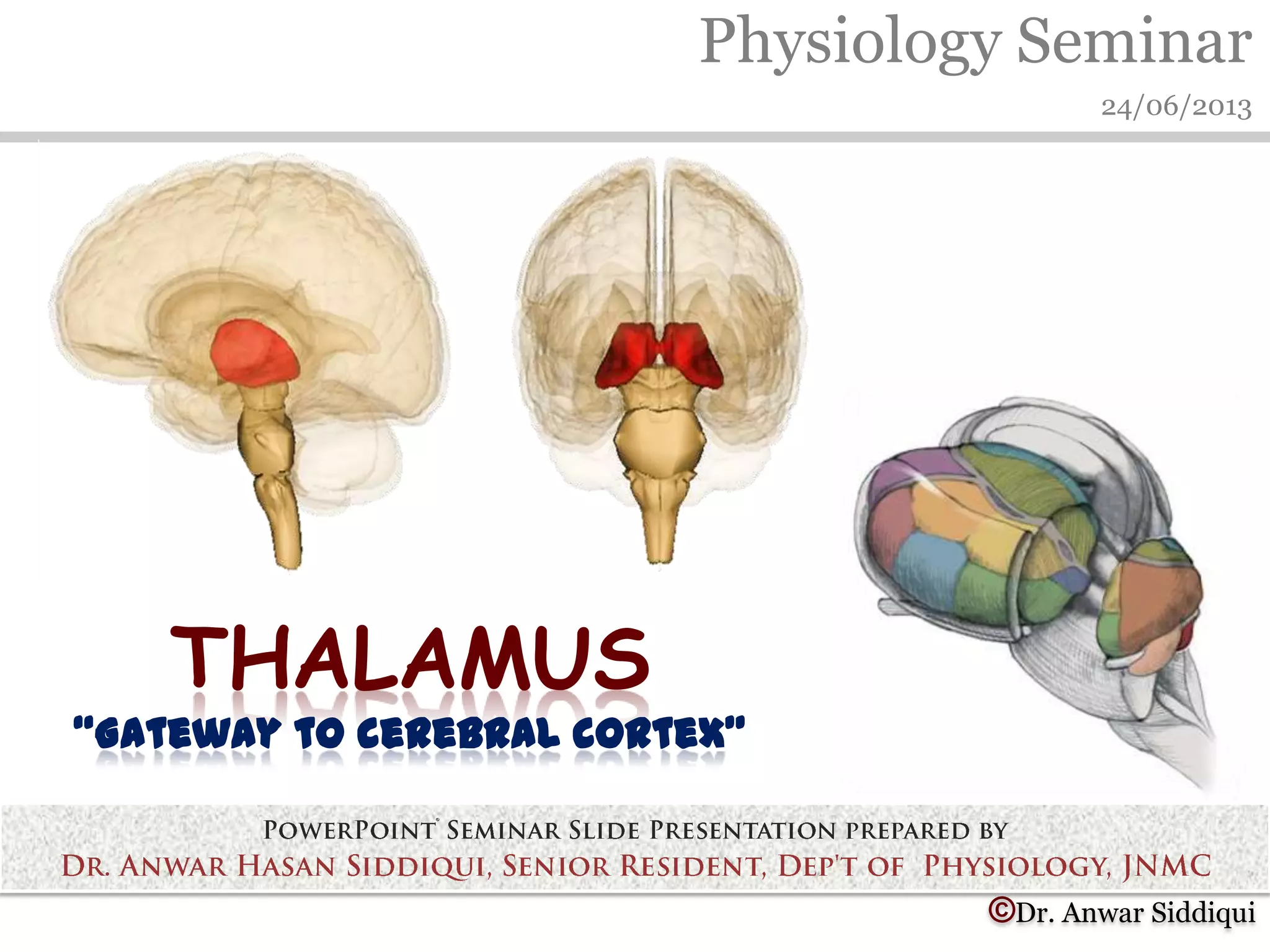
THALAMUS
“Gateway to cerebral cortex”
Introduction
 The term thalamus derives from a Greek word

that means “inner chamber” or “meeting place”.
 Paired, oval, nuclear mass of ~ 30 × 20 × 20
mm
 The largest component (80%) of the
diencephalon
 The term diencephalon includes the following
structures:
• epithalamus,
• thalamus (including the metathalamus),
• hypothalamus, and
• subthalamus.
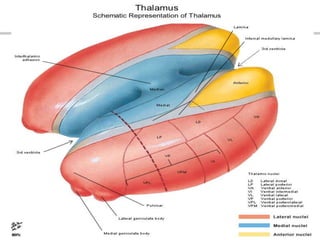
Relations of Thalamus
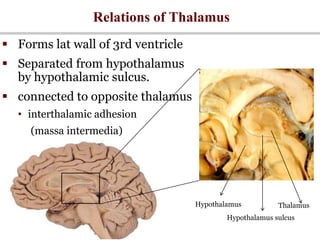
 Forms lat wall of 3rd ventricle
 Separated from hypothalamus
by hypothalamic sulcus.
 connected to opposite thalamus
• interthalamic adhesion
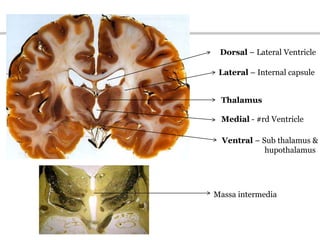
(massa intermedia)
ThalamusHypothalamus
Hypothalamus sulcus
Massa intermedia
Medial - #rd Ventricle
Dorsal – Lateral Ventricle
Lateral – Internal capsule
Thalamus
Ventral – Sub thalamus &
hupothalamus
Classification of Thalamic Nuclei
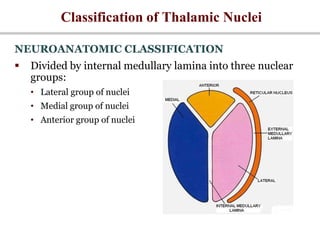
NEUROANATOMIC CLASSIFICATION
 Divided by internal medullary lamina into three nuclear
groups:
• Lateral group of nuclei
• Medial group of nuclei
• Anterior group of nuclei
Classification of Thalamic Nuclei
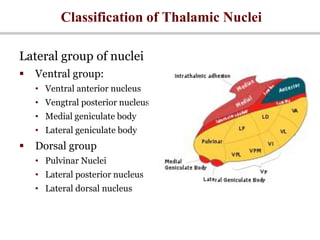
Lateral group of nuclei
 Ventral group:
• Ventral anterior nucleus
• Vengtral posterior nucleus
• Medial geniculate body
• Lateral geniculate body
 Dorsal group
• Pulvinar Nuclei
• Lateral posterior nucleus
• Lateral dorsal nucleus
Classification of Thalamic Nuclei
Medial group of nuclei
• Centromedian nucleus
• Dorsomedial nucleus
• Midline nucleus
Anterior Group of nuclei
• Lying between the bifurcation of internal medullary
lamina
Classification of Thalamic Nuclei
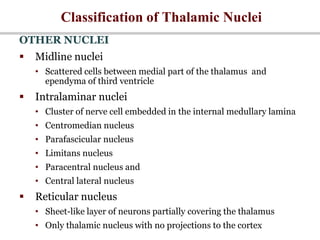
OTHER NUCLEI
 Midline nuclei
• Scattered cells between medial part of the thalamus and
ependyma of third ventricle
 Intralaminar nuclei
• Cluster of nerve cell embedded in the internal medullary lamina
• Centromedian nucleus
• Parafascicular nucleus
• Limitans nucleus
• Paracentral nucleus and
• Central lateral nucleus
 Reticular nucleus
• Sheet-like layer of neurons partially covering the thalamus
• Only thalamic nucleus with no projections to the cortex
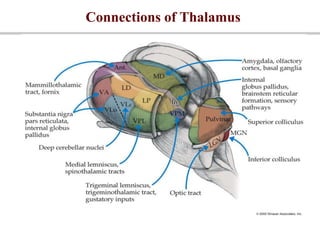
Connections of Thalamus
 Every thalamic nucleus (except the reticular
nucleus) sends axons to specific parts of the
cerebral cortex and every part of the cerebral
cortex sends reciprocal fibers back to the thalamic
nuclei.
 Information received by the thalamus is always
shared with the cerebral cortex and that the cortex
and thalamus can modify each other's activities.
Connections of Thalamus
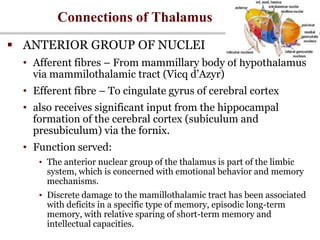
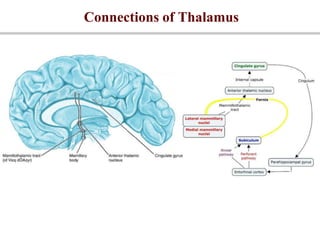
 ANTERIOR GROUP OF NUCLEI
• Afferent fibres – From mammillary body of hypothalamus
via mammilothalamic tract (Vicq d’Azyr)
• Efferent fibre – To cingulate gyrus of cerebral cortex
• also receives significant input from the hippocampal
formation of the cerebral cortex (subiculum and
presubiculum) via the fornix.
• Function served:
• The anterior nuclear group of the thalamus is part of the limbic
system, which is concerned with emotional behavior and memory
mechanisms.
• Discrete damage to the mamillothalamic tract has been associated
with deficits in a specific type of memory, episodic long-term
memory, with relative sparing of short-term memory and
intellectual capacities.
Connections of Thalamus
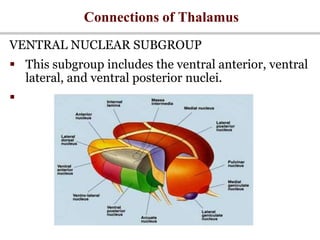
VENTRAL NUCLEAR SUBGROUP
 This subgroup includes the ventral anterior, ventral
lateral, and ventral posterior nuclei.

Connections of Thalamus
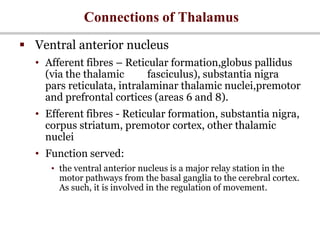
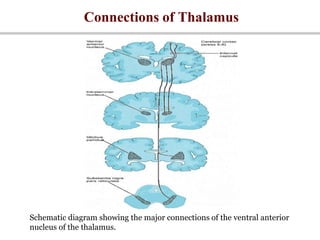
 Ventral anterior nucleus
• Afferent fibres – Reticular formation,globus pallidus
(via the thalamic fasciculus), substantia nigra
pars reticulata, intralaminar thalamic nuclei,premotor
and prefrontal cortices (areas 6 and 8).
• Efferent fibres - Reticular formation, substantia nigra,
corpus striatum, premotor cortex, other thalamic
nuclei
• Function served:
• the ventral anterior nucleus is a major relay station in the
motor pathways from the basal ganglia to the cerebral cortex.
As such, it is involved in the regulation of movement.
Connections of Thalamus
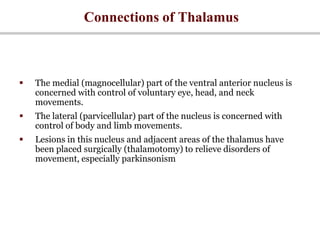
 The medial (magnocellular) part of the ventral anterior nucleus is
concerned with control of voluntary eye, head, and neck
movements.
 The lateral (parvicellular) part of the nucleus is concerned with
control of body and limb movements.
 Lesions in this nucleus and adjacent areas of the thalamus have
been placed surgically (thalamotomy) to relieve disorders of
movement, especially parkinsonism
Connections of Thalamus
Schematic diagram showing the major connections of the ventral anterior
nucleus of the thalamus.
Connections of Thalamus
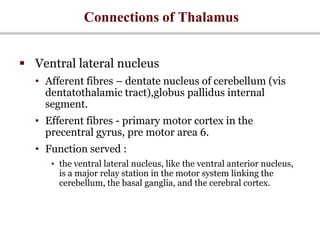
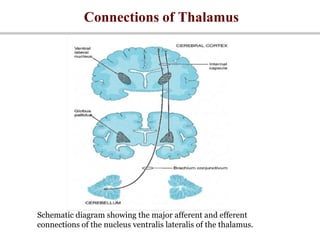
 Ventral lateral nucleus
• Afferent fibres – dentate nucleus of cerebellum (vis
dentatothalamic tract),globus pallidus internal
segment.
• Efferent fibres - primary motor cortex in the
precentral gyrus, pre motor area 6.
• Function served :
• the ventral lateral nucleus, like the ventral anterior nucleus,
is a major relay station in the motor system linking the
cerebellum, the basal ganglia, and the cerebral cortex.
Connections of Thalamus
Schematic diagram showing the major afferent and efferent
connections of the nucleus ventralis lateralis of the thalamus.
Connections of Thalamus
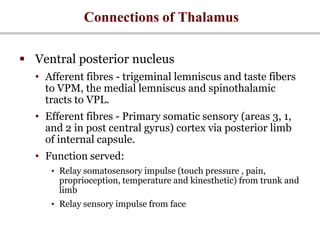
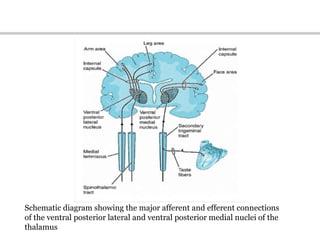
 Ventral posterior nucleus
• Afferent fibres - trigeminal lemniscus and taste fibers
to VPM, the medial lemniscus and spinothalamic
tracts to VPL.
• Efferent fibres - Primary somatic sensory (areas 3, 1,
and 2 in post central gyrus) cortex via posterior limb
of internal capsule.
• Function served:
• Relay somatosensory impulse (touch pressure , pain,
proprioception, temperature and kinesthetic) from trunk and
limb
• Relay sensory impulse from face
Schematic diagram showing the major afferent and efferent connections
of the ventral posterior lateral and ventral posterior medial nuclei of the
thalamus
Connections of Thalamus
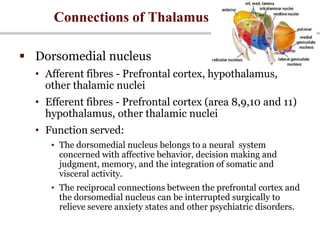
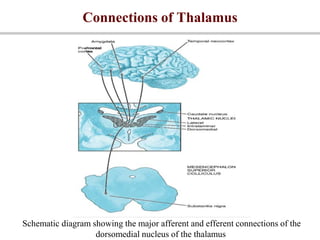
 Dorsomedial nucleus
• Afferent fibres - Prefrontal cortex, hypothalamus,
other thalamic nuclei
• Efferent fibres - Prefrontal cortex (area 8,9,10 and 11)
hypothalamus, other thalamic nuclei
• Function served:
• The dorsomedial nucleus belongs to a neural system
concerned with affective behavior, decision making and
judgment, memory, and the integration of somatic and
visceral activity.
• The reciprocal connections between the prefrontal cortex and
the dorsomedial nucleus can be interrupted surgically to
relieve severe anxiety states and other psychiatric disorders.
Connections of Thalamus
Schematic diagram showing the major afferent and efferent connections of the
dorsomedial nucleus of the thalamus
Connections of Thalamus
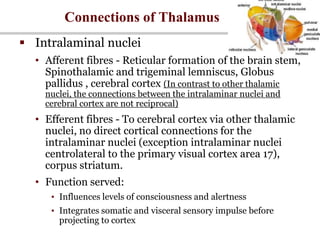
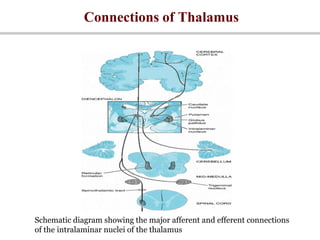
 Intralaminal nuclei
• Afferent fibres - Reticular formation of the brain stem,
Spinothalamic and trigeminal lemniscus, Globus
pallidus , cerebral cortex (In contrast to other thalamic
nuclei, the connections between the intralaminar nuclei and
cerebral cortex are not reciprocal)
• Efferent fibres - To cerebral cortex via other thalamic
nuclei, no direct cortical connections for the
intralaminar nuclei (exception intralaminar nuclei
centrolateral to the primary visual cortex area 17),
corpus striatum.
• Function served:
• Influences levels of consciousness and alertness
• Integrates somatic and visceral sensory impulse before
projecting to cortex
Connections of Thalamus
Schematic diagram showing the major afferent and efferent connections
of the intralaminar nuclei of the thalamus
Connections of Thalamus
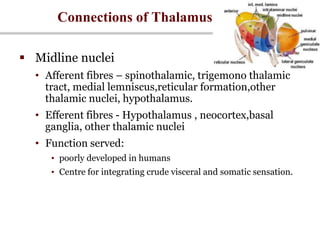
 Midline nuclei
• Afferent fibres – spinothalamic, trigemono thalamic
tract, medial lemniscus,reticular formation,other
thalamic nuclei, hypothalamus.
• Efferent fibres - Hypothalamus , neocortex,basal
ganglia, other thalamic nuclei
• Function served:
• poorly developed in humans
• Centre for integrating crude visceral and somatic sensation.
Connections of Thalamus
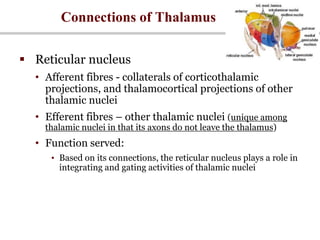
 Reticular nucleus
• Afferent fibres - collaterals of corticothalamic
projections, and thalamocortical projections of other
thalamic nuclei
• Efferent fibres – other thalamic nuclei (unique among
thalamic nuclei in that its axons do not leave the thalamus)
• Function served:
• Based on its connections, the reticular nucleus plays a role in
integrating and gating activities of thalamic nuclei
Connections of Thalamus
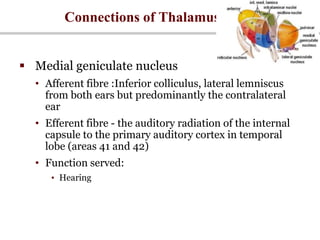
 Medial geniculate nucleus
• Afferent fibre :Inferior colliculus, lateral lemniscus
from both ears but predominantly the contralateral
ear
• Efferent fibre - the auditory radiation of the internal
capsule to the primary auditory cortex in temporal
lobe (areas 41 and 42)
• Function served:
• Hearing
Connections of Thalamus
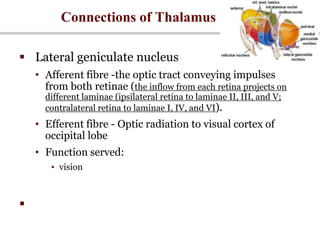
 Lateral geniculate nucleus
• Afferent fibre -the optic tract conveying impulses
from both retinae (the inflow from each retina projects on
different laminae (ipsilateral retina to laminae II, III, and V;
contralateral retina to laminae I, IV, and VI).
• Efferent fibre - Optic radiation to visual cortex of
occipital lobe
• Function served:
• vision

Connections of Thalamus
Neurotransmitters and Neuropeptides in Thalamus
 The following neurotransmitters have been identified in
the thalamus:
• GABA is the inhibitory neurotransmitter in terminals from the
globus pallidus, in local circuit neurons, and in projection
neurons of the reticular nucleus and lateral geniculate nucleus;
and
• glutamate and aspartate are the excitatory neurotransmitters in
corticothalamic and cerebellar terminals and in thalamocortical
projection neurons.
• Several neuropeptides have been identified like substance P,
somatostatin, neuropeptide Y, enkephalin, and cholecystokinin
Functions of Thalamus
 Serves as a great sensory relay station and
integrating centre for most inputs to cerebral
cortex.
 Responsible for maintaining conscios and
alerting response of RAS.
 Responsible for subcortical perception of
sensation to some extent
 Concerned with control of muscular ,movement
via its various connections with basal ganglia,
cerebellum and motor cortex
 Integrating centre for sleep- Electrical
activation of thalamic nuclei induces sleep.
Thalamus applied aspects
Thalamic syndrome
 Also known as "Dejerine-Roussy disease", after Joseph
jules dejerine & Gustave Roussy
 Caused due to infarct in geniculothalamic
(thalamogeniculate, posterolateral) artery, a branch of
the posterior cerebral artery.
 Thalamic structures involved by the infarct are the
posteroventral and the posterolateral nuclei.
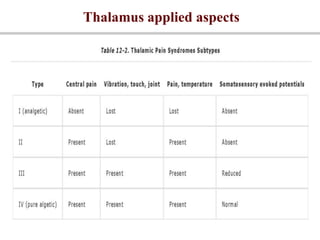
 The clinical hallmark is a pansensory loss contralateral
to the lesion, paresthesia, and thalamic pain.
 Transient hemiparesis, homonymous hemianopsia,
hemiataxia, tremor, choreiform movements, and spatial
neglect, all contralateral to the lesion in the thalamus
Thalamus applied aspects
 The contrlateral hand is flexed and pronated at the
wrist and metacarpo-phalangeal joints and extended at
the interphalangeal joints. The fingers may be abducted.
The thumb is either abducted or pushed against the
palm.(Thalamic hand)
 Cutaneous stimuli trigger paroxysmal exacerbations of
the pain that outlast the stimulus. Because the
perception of “epicritic” pain (from a pinprick) is
reduced on the painful areas, this symptom is known as
anesthesia dolorosa, or painful anesthesia
Thalamus applied aspects
 The Alien Hand Syndrome
• The alien hand syndrome is defined as unwilled,
uncontrollable movements of an upper limb together
with failure to recognize ownership of a limb in the
absence of visual cues.
• The syndrome was first described by Goldstein in
1908
• Most cases are associated with lesions in the corpus
callosum and frontal area but are also seen in infarcts
involving the posterolateral and anterolateral
thalamic territories
 Surgical Relief of Pain by Thalamic
Cauterization
• The intralaminar nuclei of the thalamus are known to
take part in the relay of pain to the cerebral cortex.
• Cauterization of these nuclei has been shown to
relieve severe and intractable pain associated with
terminal cancer.
That’s all ……..
Thank you!!!!

Thalamus

  • 1.
    Physiology Seminar 24/06/2013 ©Dr. AnwarSiddiqui THALAMUS “Gateway to cerebral cortex”
  • 2.
    Introduction  The termthalamus derives from a Greek word that means “inner chamber” or “meeting place”.  Paired, oval, nuclear mass of ~ 30 × 20 × 20 mm  The largest component (80%) of the diencephalon  The term diencephalon includes the following structures: • epithalamus, • thalamus (including the metathalamus), • hypothalamus, and • subthalamus.
  • 3.
    Relations of Thalamus Forms lat wall of 3rd ventricle  Separated from hypothalamus by hypothalamic sulcus.  connected to opposite thalamus • interthalamic adhesion (massa intermedia) ThalamusHypothalamus Hypothalamus sulcus
  • 4.
    Massa intermedia Medial -#rd Ventricle Dorsal – Lateral Ventricle Lateral – Internal capsule Thalamus Ventral – Sub thalamus & hupothalamus
  • 5.
    Classification of ThalamicNuclei NEUROANATOMIC CLASSIFICATION  Divided by internal medullary lamina into three nuclear groups: • Lateral group of nuclei • Medial group of nuclei • Anterior group of nuclei
  • 6.
    Classification of ThalamicNuclei Lateral group of nuclei  Ventral group: • Ventral anterior nucleus • Vengtral posterior nucleus • Medial geniculate body • Lateral geniculate body  Dorsal group • Pulvinar Nuclei • Lateral posterior nucleus • Lateral dorsal nucleus
  • 7.
    Classification of ThalamicNuclei Medial group of nuclei • Centromedian nucleus • Dorsomedial nucleus • Midline nucleus Anterior Group of nuclei • Lying between the bifurcation of internal medullary lamina
  • 9.
    Classification of ThalamicNuclei OTHER NUCLEI  Midline nuclei • Scattered cells between medial part of the thalamus and ependyma of third ventricle  Intralaminar nuclei • Cluster of nerve cell embedded in the internal medullary lamina • Centromedian nucleus • Parafascicular nucleus • Limitans nucleus • Paracentral nucleus and • Central lateral nucleus  Reticular nucleus • Sheet-like layer of neurons partially covering the thalamus • Only thalamic nucleus with no projections to the cortex
  • 10.
    Connections of Thalamus Every thalamic nucleus (except the reticular nucleus) sends axons to specific parts of the cerebral cortex and every part of the cerebral cortex sends reciprocal fibers back to the thalamic nuclei.  Information received by the thalamus is always shared with the cerebral cortex and that the cortex and thalamus can modify each other's activities.
  • 11.
    Connections of Thalamus ANTERIOR GROUP OF NUCLEI • Afferent fibres – From mammillary body of hypothalamus via mammilothalamic tract (Vicq d’Azyr) • Efferent fibre – To cingulate gyrus of cerebral cortex • also receives significant input from the hippocampal formation of the cerebral cortex (subiculum and presubiculum) via the fornix. • Function served: • The anterior nuclear group of the thalamus is part of the limbic system, which is concerned with emotional behavior and memory mechanisms. • Discrete damage to the mamillothalamic tract has been associated with deficits in a specific type of memory, episodic long-term memory, with relative sparing of short-term memory and intellectual capacities.
  • 12.
  • 13.
    Connections of Thalamus VENTRALNUCLEAR SUBGROUP  This subgroup includes the ventral anterior, ventral lateral, and ventral posterior nuclei. 
  • 14.
    Connections of Thalamus Ventral anterior nucleus • Afferent fibres – Reticular formation,globus pallidus (via the thalamic fasciculus), substantia nigra pars reticulata, intralaminar thalamic nuclei,premotor and prefrontal cortices (areas 6 and 8). • Efferent fibres - Reticular formation, substantia nigra, corpus striatum, premotor cortex, other thalamic nuclei • Function served: • the ventral anterior nucleus is a major relay station in the motor pathways from the basal ganglia to the cerebral cortex. As such, it is involved in the regulation of movement.
  • 15.
    Connections of Thalamus The medial (magnocellular) part of the ventral anterior nucleus is concerned with control of voluntary eye, head, and neck movements.  The lateral (parvicellular) part of the nucleus is concerned with control of body and limb movements.  Lesions in this nucleus and adjacent areas of the thalamus have been placed surgically (thalamotomy) to relieve disorders of movement, especially parkinsonism
  • 16.
    Connections of Thalamus Schematicdiagram showing the major connections of the ventral anterior nucleus of the thalamus.
  • 17.
    Connections of Thalamus Ventral lateral nucleus • Afferent fibres – dentate nucleus of cerebellum (vis dentatothalamic tract),globus pallidus internal segment. • Efferent fibres - primary motor cortex in the precentral gyrus, pre motor area 6. • Function served : • the ventral lateral nucleus, like the ventral anterior nucleus, is a major relay station in the motor system linking the cerebellum, the basal ganglia, and the cerebral cortex.
  • 18.
    Connections of Thalamus Schematicdiagram showing the major afferent and efferent connections of the nucleus ventralis lateralis of the thalamus.
  • 19.
    Connections of Thalamus Ventral posterior nucleus • Afferent fibres - trigeminal lemniscus and taste fibers to VPM, the medial lemniscus and spinothalamic tracts to VPL. • Efferent fibres - Primary somatic sensory (areas 3, 1, and 2 in post central gyrus) cortex via posterior limb of internal capsule. • Function served: • Relay somatosensory impulse (touch pressure , pain, proprioception, temperature and kinesthetic) from trunk and limb • Relay sensory impulse from face
  • 20.
    Schematic diagram showingthe major afferent and efferent connections of the ventral posterior lateral and ventral posterior medial nuclei of the thalamus
  • 21.
    Connections of Thalamus Dorsomedial nucleus • Afferent fibres - Prefrontal cortex, hypothalamus, other thalamic nuclei • Efferent fibres - Prefrontal cortex (area 8,9,10 and 11) hypothalamus, other thalamic nuclei • Function served: • The dorsomedial nucleus belongs to a neural system concerned with affective behavior, decision making and judgment, memory, and the integration of somatic and visceral activity. • The reciprocal connections between the prefrontal cortex and the dorsomedial nucleus can be interrupted surgically to relieve severe anxiety states and other psychiatric disorders.
  • 22.
    Connections of Thalamus Schematicdiagram showing the major afferent and efferent connections of the dorsomedial nucleus of the thalamus
  • 23.
    Connections of Thalamus Intralaminal nuclei • Afferent fibres - Reticular formation of the brain stem, Spinothalamic and trigeminal lemniscus, Globus pallidus , cerebral cortex (In contrast to other thalamic nuclei, the connections between the intralaminar nuclei and cerebral cortex are not reciprocal) • Efferent fibres - To cerebral cortex via other thalamic nuclei, no direct cortical connections for the intralaminar nuclei (exception intralaminar nuclei centrolateral to the primary visual cortex area 17), corpus striatum. • Function served: • Influences levels of consciousness and alertness • Integrates somatic and visceral sensory impulse before projecting to cortex
  • 24.
    Connections of Thalamus Schematicdiagram showing the major afferent and efferent connections of the intralaminar nuclei of the thalamus
  • 25.
    Connections of Thalamus Midline nuclei • Afferent fibres – spinothalamic, trigemono thalamic tract, medial lemniscus,reticular formation,other thalamic nuclei, hypothalamus. • Efferent fibres - Hypothalamus , neocortex,basal ganglia, other thalamic nuclei • Function served: • poorly developed in humans • Centre for integrating crude visceral and somatic sensation.
  • 26.
    Connections of Thalamus Reticular nucleus • Afferent fibres - collaterals of corticothalamic projections, and thalamocortical projections of other thalamic nuclei • Efferent fibres – other thalamic nuclei (unique among thalamic nuclei in that its axons do not leave the thalamus) • Function served: • Based on its connections, the reticular nucleus plays a role in integrating and gating activities of thalamic nuclei
  • 27.
    Connections of Thalamus Medial geniculate nucleus • Afferent fibre :Inferior colliculus, lateral lemniscus from both ears but predominantly the contralateral ear • Efferent fibre - the auditory radiation of the internal capsule to the primary auditory cortex in temporal lobe (areas 41 and 42) • Function served: • Hearing
  • 28.
    Connections of Thalamus Lateral geniculate nucleus • Afferent fibre -the optic tract conveying impulses from both retinae (the inflow from each retina projects on different laminae (ipsilateral retina to laminae II, III, and V; contralateral retina to laminae I, IV, and VI). • Efferent fibre - Optic radiation to visual cortex of occipital lobe • Function served: • vision 
  • 29.
  • 30.
    Neurotransmitters and Neuropeptidesin Thalamus  The following neurotransmitters have been identified in the thalamus: • GABA is the inhibitory neurotransmitter in terminals from the globus pallidus, in local circuit neurons, and in projection neurons of the reticular nucleus and lateral geniculate nucleus; and • glutamate and aspartate are the excitatory neurotransmitters in corticothalamic and cerebellar terminals and in thalamocortical projection neurons. • Several neuropeptides have been identified like substance P, somatostatin, neuropeptide Y, enkephalin, and cholecystokinin
  • 31.
    Functions of Thalamus Serves as a great sensory relay station and integrating centre for most inputs to cerebral cortex.  Responsible for maintaining conscios and alerting response of RAS.  Responsible for subcortical perception of sensation to some extent  Concerned with control of muscular ,movement via its various connections with basal ganglia, cerebellum and motor cortex  Integrating centre for sleep- Electrical activation of thalamic nuclei induces sleep.
  • 32.
    Thalamus applied aspects Thalamicsyndrome  Also known as "Dejerine-Roussy disease", after Joseph jules dejerine & Gustave Roussy  Caused due to infarct in geniculothalamic (thalamogeniculate, posterolateral) artery, a branch of the posterior cerebral artery.  Thalamic structures involved by the infarct are the posteroventral and the posterolateral nuclei.  The clinical hallmark is a pansensory loss contralateral to the lesion, paresthesia, and thalamic pain.  Transient hemiparesis, homonymous hemianopsia, hemiataxia, tremor, choreiform movements, and spatial neglect, all contralateral to the lesion in the thalamus
  • 33.
    Thalamus applied aspects The contrlateral hand is flexed and pronated at the wrist and metacarpo-phalangeal joints and extended at the interphalangeal joints. The fingers may be abducted. The thumb is either abducted or pushed against the palm.(Thalamic hand)  Cutaneous stimuli trigger paroxysmal exacerbations of the pain that outlast the stimulus. Because the perception of “epicritic” pain (from a pinprick) is reduced on the painful areas, this symptom is known as anesthesia dolorosa, or painful anesthesia
  • 34.
  • 35.
    Thalamus applied aspects The Alien Hand Syndrome • The alien hand syndrome is defined as unwilled, uncontrollable movements of an upper limb together with failure to recognize ownership of a limb in the absence of visual cues. • The syndrome was first described by Goldstein in 1908 • Most cases are associated with lesions in the corpus callosum and frontal area but are also seen in infarcts involving the posterolateral and anterolateral thalamic territories
  • 36.
     Surgical Reliefof Pain by Thalamic Cauterization • The intralaminar nuclei of the thalamus are known to take part in the relay of pain to the cerebral cortex. • Cauterization of these nuclei has been shown to relieve severe and intractable pain associated with terminal cancer.
  • 37.