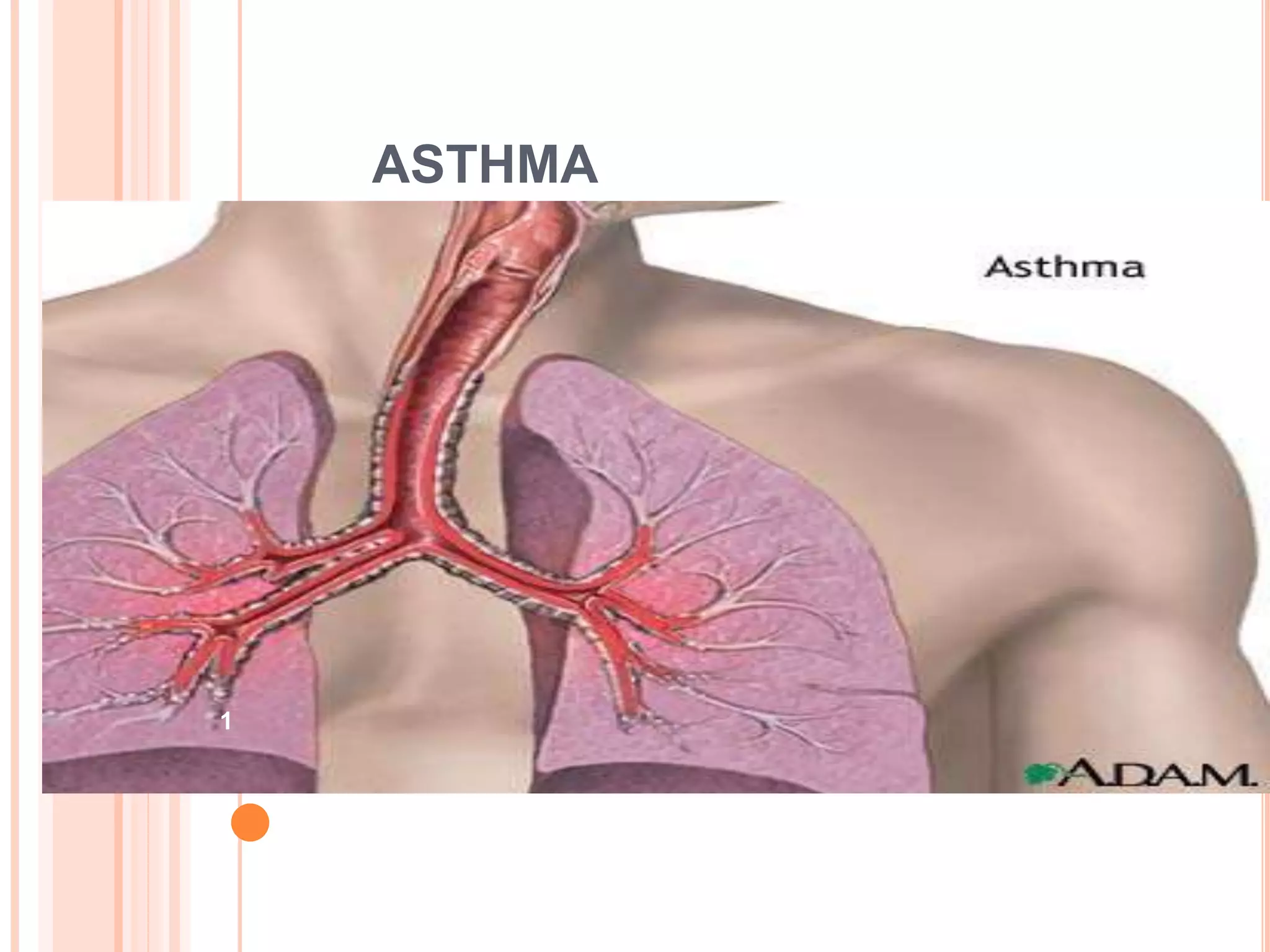
ASTHMA
1
INTRODUCTION
 Asthma is a chronic inflammatory disease of
the airways that causes airway hyper-
responsiveness, mucosal edema, and mucus
production
Asthma is characterized by chronic airway
inflammation and increased airway hyper-
responsiveness leading to symptoms of wheeze,
cough, chest tightness and dyspnoea.
4
 Asthma is a disorder of the bronchial airways
characterized by period of reversible bronchospam.
5
INTRODUCTION CONTD…..
Asthma differs from the other obstructive lung
diseases in that it is largely reversible, either
spontaneously or with treatment.
Patients with asthma may experience
symptom-free periods alternating with acute
exacerbations, which last from minutes to
hours or days.
6
INTRODUCTION CONTD…
The most frequent form has its onset
in childhood between the ages of 3
and 5 years and may either worsen or
improve during adolescence.
7
8
EPIDEMIOLOGY
In many countries the prevalence of
asthma is increasing.
This increase, with its accompanying
allergy, is particularly in children and
young adults where this disease may
affect up to 15% of the population.
Asthma being commoner in more
developed countries. 9
EPIDEMIOLOGY CONTD….
World-wide ,approximately 300 million
people have asthma and this is ,expected to
rise to 400 million by 2025.
In childhood, asthma is more common in
boys, but following puberty females are
more frequently affected.
10
ETIOLOGY AND RISK FACTOR
 Asthma occurs in families which suggest that it
is an inherited disorder.
Allergy is the strongest predisposing factor for
asthma.
Chronic exposure to airway irritants or
allergens also increases the risk for developing
asthma.
Common allergens can be seasonal (eg, grass,
tree, and weed pollens, mold, dust, or animal
dander).
11
CONTD…
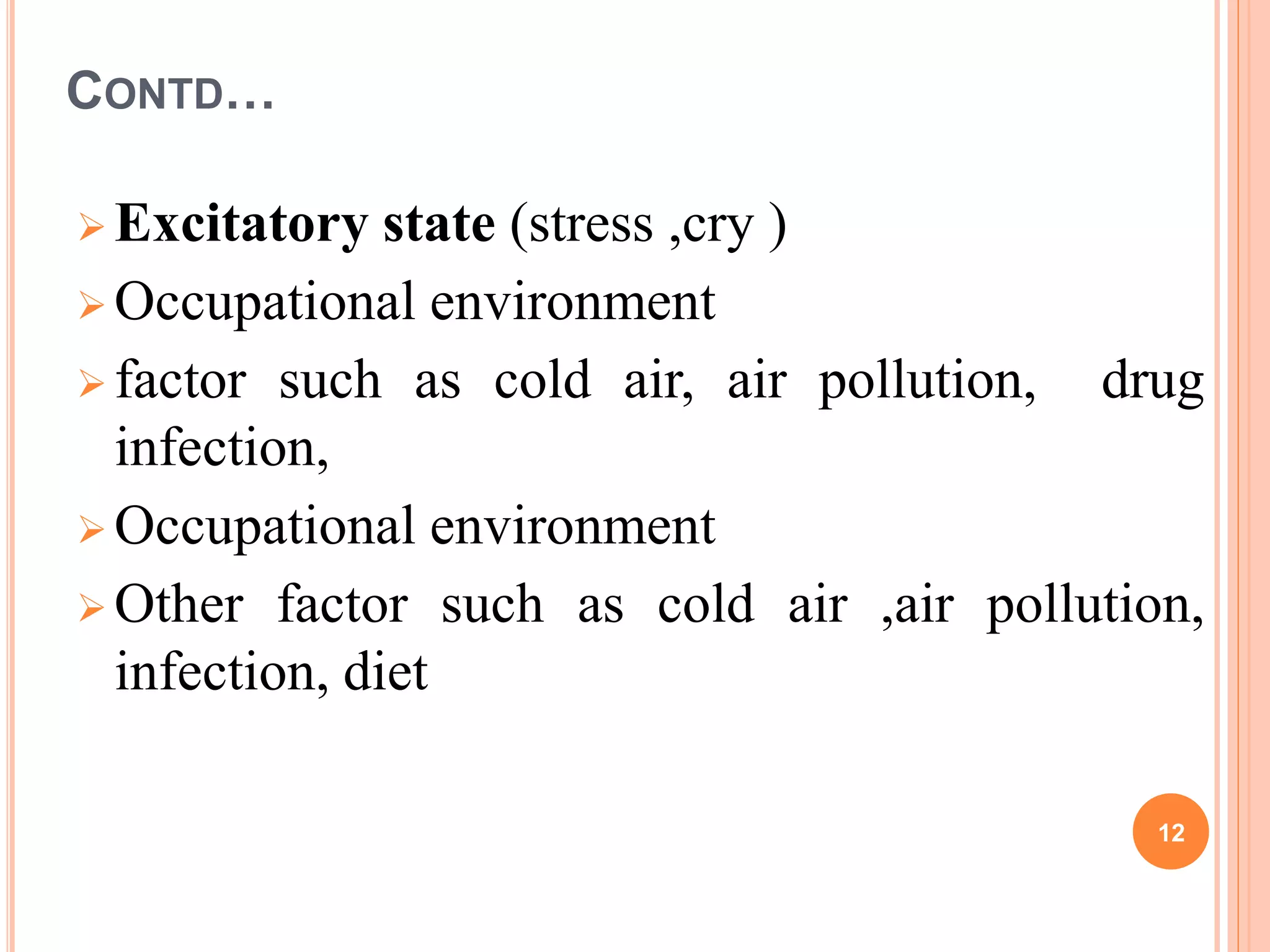
 Excitatory state (stress ,cry )
 Occupational environment
 factor such as cold air, air pollution, drug
infection,
 Occupational environment
 Other factor such as cold air ,air pollution,
infection, diet
12
CONTD…
Triggers
 Allergens
 Upper respiratory tract viral infections
Exercise
 Cold air
 Sulfur dioxide Drugs ( BETA blockers,
aspirin)
 Stress
 Irritants (household sprays, paint fumes)13
CLASSIFICATION
Asthma is a complex disorder of the
conducting airways that most simply can be
classified as:
 extrinsic – implying a definite external cause
 intrinsic – when no causative agent can be
identified.
14
Physiology/Pathophysiology
15
16
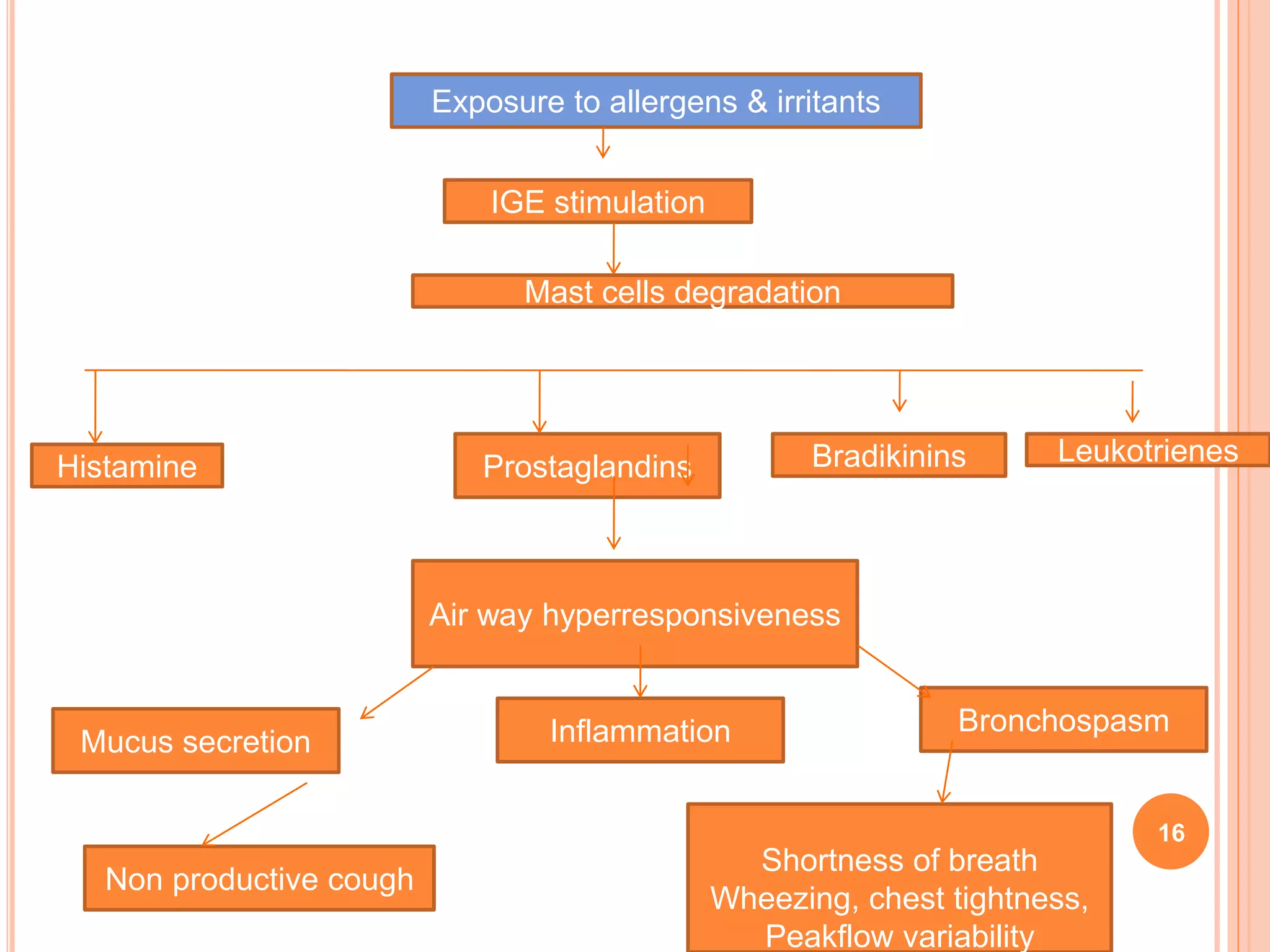
Exposure to allergens & irritants
IGE stimulation
Mast cells degradation
Histamine Prostaglandins Bradikinins Leukotrienes
Air way hyperresponsiveness
Mucus secretion
BronchospasmInflammation
Non productive cough
Shortness of breath
Wheezing, chest tightness,
Peakflow variability
CLINICAL MANIFESTATIONS
 The principal symptoms of asthma are wheezing
attacks and episodic shortness of breath.
 Typical symptoms include recurrent episodes of
wheezing, chest tightness, breathlessness and
cough.
 In some instances, cough may be the only
symptom
 cough, with or without mucus production
 Expiration requires effort and becomes
prolonged.
17
Contd….
As the exacerbation progresses,
diaphoresis, Tachycardia and a widened
pulse pressure may occur along with
hypoxemia and central cyanosis .
18
DIAGNOSIS
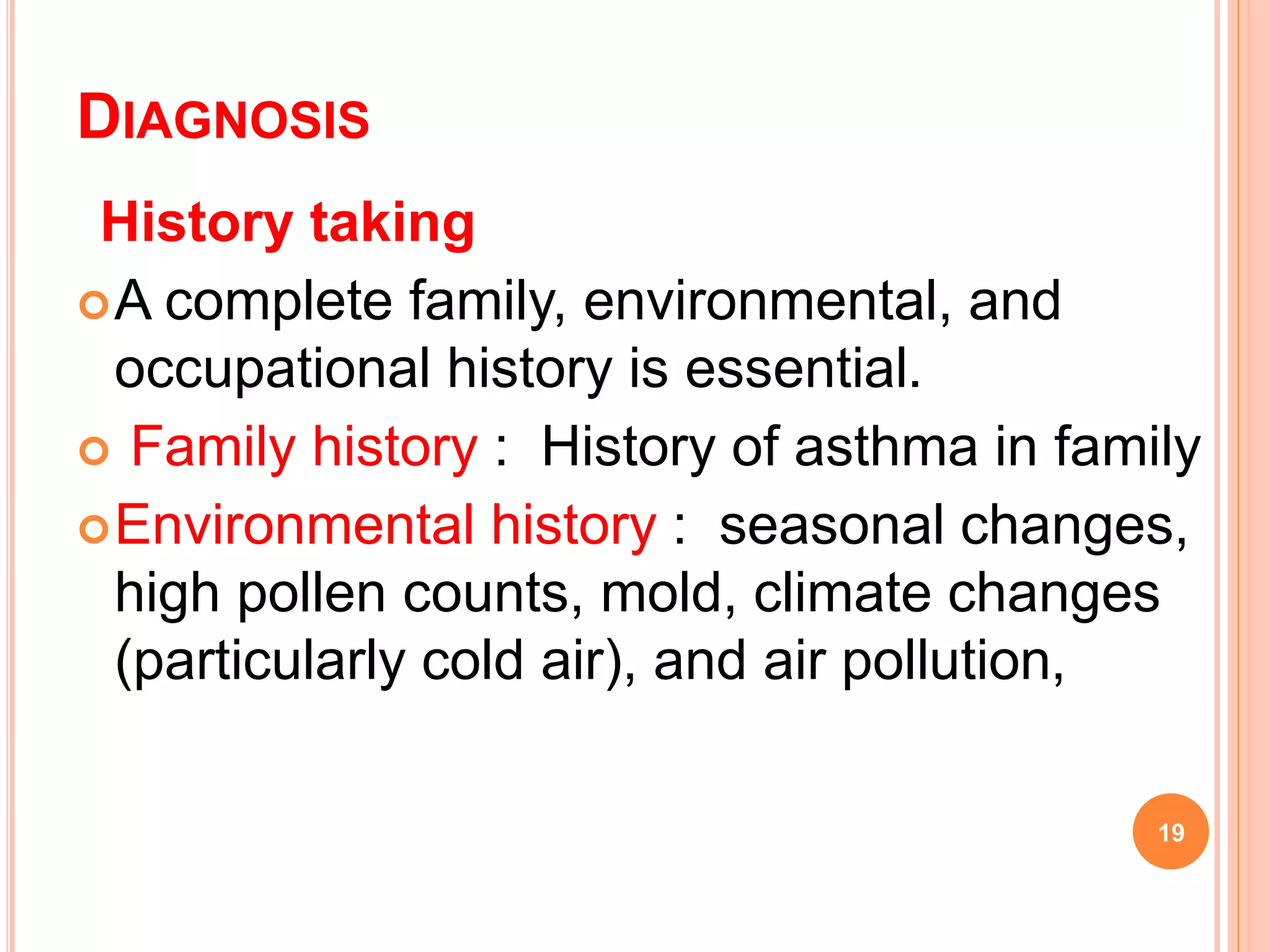
History taking
A complete family, environmental, and
occupational history is essential.
 Family history : History of asthma in family
Environmental history : seasonal changes,
high pollen counts, mold, climate changes
(particularly cold air), and air pollution,
19
CONTD…
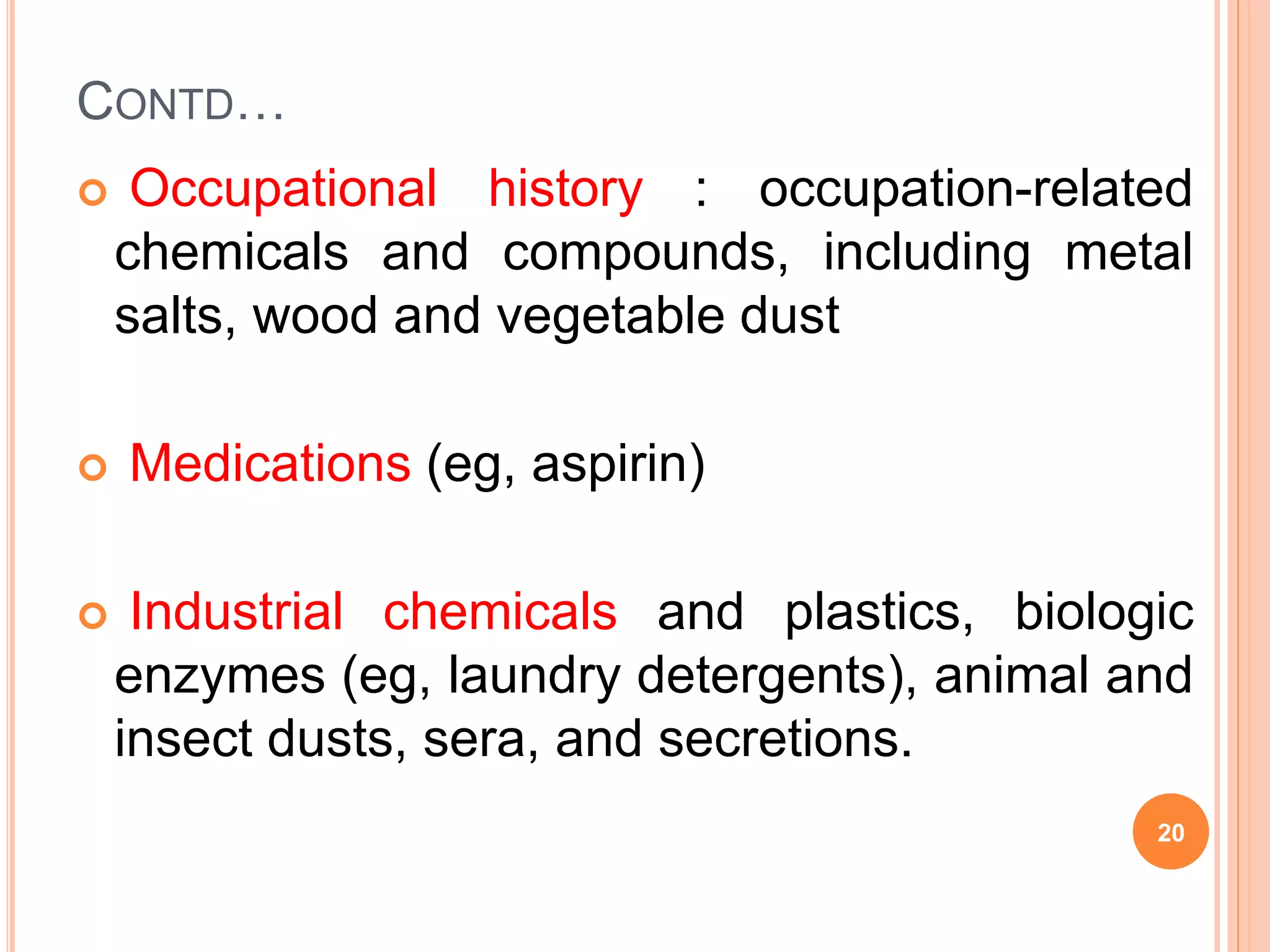
 Occupational history : occupation-related
chemicals and compounds, including metal
salts, wood and vegetable dust
 Medications (eg, aspirin)
 Industrial chemicals and plastics, biologic
enzymes (eg, laundry detergents), animal and
insect dusts, sera, and secretions.
20
CONTD..
Physical examination
 wheezing all over the lung
breathlessness and cough.
Cyanosis
21
INVESTIGATIONS
Lung function tests/ pulmonary function
test : Shows variable airflow limitation
Blood tests :shows increase in the number
of eosinophils in peripheral blood (> 0.4 ×
109/L).
 Sputum tests The presence of large
numbers of eosinophils in the sputum is a
more useful diagnostic tool. 22
CONTD…
Chest X-ray : There are no diagnostic
features of asthma on the chest X-ray
A chest X-ray may be helpful in excluding
a pneumothorax, which can occur as a
complication of asthma
Skin tests Skin-prick tests (SPT) should
be performed in all cases of asthma to
help identify allergic causes.
23
24
ESSENTIALS OF DIAGNOSIS
 Episodic or chronic symptoms of airflow
obstruction: breathlessness, cough, wheezing, and
chest tightness.
 Symptoms frequently worse at night or in the early
morning.
 Prolonged expiration and diffuse wheezes on
physical examination.
 Limitation of airflow on pulmonary function testing.
 Complete or partial reversibility of airflow
obstruction, either spontaneously or following
bronchodilator therapy.
25
MEDICAL MANAGEMENT
THE GOALS OF ASTHMA MANAGEMENT
 Achieve and maintain control of symptoms
Prevent asthma exacerbations
Maintain pulmonary function as close to normal
as possible
Avoid adverse effects from asthma medications
Prevent development of irreversible airflow
limitation
Prevent asthma mortality
27
MEDICAL MANAGEMENT
 Reassure the patient , as anxiety worsen respiratory
distress
 Keep the patient in upright position
 Start oxygen 50-60 % initially, continue till the patient
is better and not dyspnoeic
 Nebulized with salbutamol or Terbutalin for
immediate relief.
Salbutamol 5 mg (1 ml with 1 ml normal saline) stat.
Repeat dose at 15 mins if required during the first
hour.
Hourly for next few hours till bronchospasm is
controlled.
28
MEDICAL MANAGEMENT CONTD….
Secure I/V line
Inj. Hydrocotisone 200mg I/V stat routinely
given to all severe cases than 6 hourly
Antibiotic if there is evidence of infection
Adequate hydration and mucolytics.
29
NURSING MANAGEMENT
NURSING PROCESS:
Assessment
Assessment involves obtaining information
about current symptoms as well as previous
disease manifestations
A complete family, environmental, and
occupational history is essential.
 family history : History of asthma in family
31
Contd…
Environmental history : seasonal changes,
high pollen counts, mold, climate changes
(particularly cold air), and air pollution
occupational history : occupation-related
chemicals and compounds, including metal
salts, wood and vegetable dust,
Medications taken (eg, aspirin)
32
CONTD…
Industrial chemicals and plastics, biologic
enzymes (eg, laundry detergents), animal
and insect dusts, sera, and secretions
Physical examination
 wheezing all over the lung
breathlessness and cough.
Cyanosis
33
NURSING DIAGNOSIS
Ineffective airway clearance related to
increased production of secretions and
bronchospasm.
Ineffective breathing pattern related to
shortness of breath, mucus,
bronchoconstriction, and airway
irritants
34
Contd…
Activity intolerance due to fatigue, ineffective
breathing patterns, and hypoxemia
 Deficient knowledge of self-care strategies to
be performed at home.
Ineffective coping related to reduced
socialization, anxiety, depression, lower
activity level, and the inability to work
35
PLANNING AND GOALS
The major goals for the patient may include
smoking cessation,
Improved gas exchange, & Airway
clearance,
improved breathing pattern,
 Improved activity tolerance ,
Maximal self-management,
Improved coping ability,
Adherence to the therapeutic program ,Home
care & Absence of complications.
36
DIAGNOSIS: INEFFECTIVE BREATHING
PATTERN
Nursing diagnosis: Ineffective breathing
pattern related to shortness of breath, mucus,
bronchoconstriction, and airway irritants
Outcomes
A decreasing respiratory rate to within normal
limits.
Decreased dyspnoea, less nasal flaring, and
reduced use of accessory muscles.
Decreased manifestations of anxiety.
Oxygen saturation greater than 95%.
37
INTERVENTIONS
Assess the client frequently, observing
respiratory rate and depth.
Assess the breathing pattern for shortness
of breath, pursed-lip breathing, nasal
flaring,
Assess of Sternal and intercostals
retractions, or a prolonged expiratory,
phase.
38
INTERVENTIONS CONTD…
Place the client in the fowler position
Give oxygen by face mask as ordered.
 Give Nebulization using asthalin and impravent
solution.
Monitor ABGs and oxygen saturation level to
determine the effectiveness of treatments.
Reassure the patient .
39
DIAGNOSIS: INEFFECTIVE AIRWAY
CLEARANCE:
The nursing diagnosis: Ineffective
Airway Clearance related to increased
production of secretions and
bronchospasm.
Outcomes
Decreased inspiratory and expiratory
wheezing.
Decreased rhonchi.
Decreasing dry, nonproductive cough. 40
INTERVENTIONS
Monitor the color and consistency of the
sputum.
Assist the client to cough effectively.
Encourage oral fluids to thin the secretions
and replace fluids lost through rapid
respiration.
 perform Postural drainage, lung percussion
and vibration.
 Give Expectorants as prescribe
 Do frequent position changes.
41
DIAGNOSIS: IMPAIRED GAS EXCHANGE.
Nursing diagnosis: Impaired Gas
Exchange related to air trapping.
Outcomes
Decreased inspiratory and expiratory
wheezing.
Oxygen saturation >90%.
pH of 7.35 to 7.45.
Usual skin color (no cyanosis).
Decreasing dry, nonproductive cough. 42
INTERVENTIONS
Asses lung sounds every hour during acute
episodes to determine the adequacy of gas
exchange.
Asses skin and mucous membrane color of
cyanosis.(Cyanosis is a late manifestation of
hypoxia and an indication of serious gas-
exchange problems.)
Monitor pulse oximetry for oxygen saturation
levels.
Administer oxygen as ordered to maintain
optimal oxygen saturation.
43
INTERVENTIONS CONTD…
Assist the client to cough effectively.
Encourage oral fluids to thin the secretions
and replace fluids lost through rapid
respiration.
 perform Postural drainage, lung
percussion and vibration.
 Give Expectorants as prescribe
 Do frequent position changes.
44
KNOWLEDGE DEFICIT.
 Nursing Diagnosis: Knowledge Deficit
related to use of inhaler and /nebulizer
mechine.
Outcomes
The client will have increased knowledge
about how to use nebulizer /inhaler
evidenced by explaining or demonstrating
the correct technique
45
INTERVENTIONS
Show the each part of device and explain
the function of inhaler device.
Demonstrate/ explain the patient about
correct use of device and how to care of
the device .
Certain the client knows prober use of
device (post test)
 Observe the client’s use of the inhaled to
ascertain whether the medication is
entering the airway. 46
47
RISK FOR DECISIONAL CONFLICT
Outcomes
The client will express an understanding of
the conflict involved with maintain the
present life style and its effect asthma.
48
INTERVENTIONS
Encourage clients to stop smoking.
Elimination of irritants as much as possible .
 Encourage for use of mask to protect from
dust .
Advice patient not to directly expose in cold .
Advice to keep the emergency medicine at
any time with him/her
Take special precaution while caring the pets.
49
ACTIVITY INTOLERANCE
 Nursing Diagnosis: Activity intolerance
due to fatigue, ineffective breathing patterns,
and hypoxemia
Out comes
Maintained respiratory depth and rate while
activity
 Decreased dyspnoea
Decreased manifestations of anxiety
Increased participation in activity of daily
living 50
INTERVENTION
 Assess level of activity tolerance and degree of
fatigue, lethargy, and malaise when performing
routine ADLs.
 Assist with activities and hygiene when fatigued.
 Encourage for rest when fatigued
 finish the procedure with in a short period of
time to avoid extra exertion
 Give rest between the procedure
 monitor the oxygen saturation frequently &
Provide oxygen when necessary during the
activity .
51
PREVENTIVE MEASURES FOR ASTHMA
Asthma is not a totally preventable disease
however the person should take
precaution from allergen related to
occupational exposure and household
exposure .
 Use of face mask
 Avoid upper respiratory tract infection as
much as possible.
 Avoid smoking and smoky environment
 Avoid passive smoking
52
PREVENTION CONTD…
You can reduce asthma symptoms by avoiding
known triggers and substances that irritate the
airways.
Cover bedding with "allergy-proof" casings to
reduce exposure to dust mites.
Remove carpets from bedrooms and vacuum
regularly.
Use only odorless detergents and cleaning
materials in the home.
Keep humidity levels low and fix leaks to
reduce the growth of organisms such as mold.
53
PREVENTION CONTD…
Keep humidity levels low and fix leaks to
reduce the growth of organisms such as
mold.
Keep the house clean and keep food in
containers and out of bedrooms -- this helps
reduce the possibility of cockroaches, which
can trigger asthma attacks in some people.
If a person is allergic to an animal that
cannot be removed from the home, the
animal should be kept out of the bedroom..
54
PREVENTION CONTD…
 Eliminate tobacco smoke from the home. This is
the single most important thing a family can do to
help a child with asthma. Family members and
visitors who smoke outside carry smoke residue
inside on their clothes and hair -- this can trigger
asthma symptoms.
 Persons with asthma should also avoid air
pollution, industrial dusts, and other irritating fumes
as much as possible.
55
REFERENCES
Joyce M. BLACK., Jane Hokanson
Hawk.(2009).Medical-Surgical Nursing ,
Clinical Management for Positive
Outcomes(8th ed.).Elsevier, a division of
Reed Elsevier India private Limited.(page
1570-1577)
vidyasagar Suda., & Acharya V.
Raviraj.(2000). Manipal Medical Manual (4th
ed.) CBS Publisher and Distributors, Delhi
(Page 53-54)
Bruner& Siddhartha’s (2004). Medical
Surgical Nursing .(12th Ed.) 56
REFERENCES CONTD..
Davidson’s Principle and Practice of
Medicine (20th Ed)
 kumar & Clark’s., Clinical Medicine(7th
Ed)
Harison’s .,Principles of Internal
medicine(17th )
http://www.ncbi.nlm.nih.gov/pubmedhealt
h/PMH0001196/#adam_000141.disease.
prevention retrieve on 2068/10/17
57
THANK YOU
58

Asthma

  • 1.
  • 2.
    INTRODUCTION  Asthma isa chronic inflammatory disease of the airways that causes airway hyper- responsiveness, mucosal edema, and mucus production Asthma is characterized by chronic airway inflammation and increased airway hyper- responsiveness leading to symptoms of wheeze, cough, chest tightness and dyspnoea. 4
  • 3.
     Asthma isa disorder of the bronchial airways characterized by period of reversible bronchospam. 5
  • 4.
    INTRODUCTION CONTD….. Asthma differsfrom the other obstructive lung diseases in that it is largely reversible, either spontaneously or with treatment. Patients with asthma may experience symptom-free periods alternating with acute exacerbations, which last from minutes to hours or days. 6
  • 5.
    INTRODUCTION CONTD… The mostfrequent form has its onset in childhood between the ages of 3 and 5 years and may either worsen or improve during adolescence. 7
  • 6.
  • 7.
    EPIDEMIOLOGY In many countriesthe prevalence of asthma is increasing. This increase, with its accompanying allergy, is particularly in children and young adults where this disease may affect up to 15% of the population. Asthma being commoner in more developed countries. 9
  • 8.
    EPIDEMIOLOGY CONTD…. World-wide ,approximately300 million people have asthma and this is ,expected to rise to 400 million by 2025. In childhood, asthma is more common in boys, but following puberty females are more frequently affected. 10
  • 9.
    ETIOLOGY AND RISKFACTOR  Asthma occurs in families which suggest that it is an inherited disorder. Allergy is the strongest predisposing factor for asthma. Chronic exposure to airway irritants or allergens also increases the risk for developing asthma. Common allergens can be seasonal (eg, grass, tree, and weed pollens, mold, dust, or animal dander). 11
  • 10.
    CONTD…  Excitatory state(stress ,cry )  Occupational environment  factor such as cold air, air pollution, drug infection,  Occupational environment  Other factor such as cold air ,air pollution, infection, diet 12
  • 11.
    CONTD… Triggers  Allergens  Upperrespiratory tract viral infections Exercise  Cold air  Sulfur dioxide Drugs ( BETA blockers, aspirin)  Stress  Irritants (household sprays, paint fumes)13
  • 12.
    CLASSIFICATION Asthma is acomplex disorder of the conducting airways that most simply can be classified as:  extrinsic – implying a definite external cause  intrinsic – when no causative agent can be identified. 14
  • 13.
  • 14.
    16 Exposure to allergens& irritants IGE stimulation Mast cells degradation Histamine Prostaglandins Bradikinins Leukotrienes Air way hyperresponsiveness Mucus secretion BronchospasmInflammation Non productive cough Shortness of breath Wheezing, chest tightness, Peakflow variability
  • 15.
    CLINICAL MANIFESTATIONS  Theprincipal symptoms of asthma are wheezing attacks and episodic shortness of breath.  Typical symptoms include recurrent episodes of wheezing, chest tightness, breathlessness and cough.  In some instances, cough may be the only symptom  cough, with or without mucus production  Expiration requires effort and becomes prolonged. 17
  • 16.
    Contd…. As the exacerbationprogresses, diaphoresis, Tachycardia and a widened pulse pressure may occur along with hypoxemia and central cyanosis . 18
  • 17.
    DIAGNOSIS History taking A completefamily, environmental, and occupational history is essential.  Family history : History of asthma in family Environmental history : seasonal changes, high pollen counts, mold, climate changes (particularly cold air), and air pollution, 19
  • 18.
    CONTD…  Occupational history: occupation-related chemicals and compounds, including metal salts, wood and vegetable dust  Medications (eg, aspirin)  Industrial chemicals and plastics, biologic enzymes (eg, laundry detergents), animal and insect dusts, sera, and secretions. 20
  • 19.
    CONTD.. Physical examination  wheezingall over the lung breathlessness and cough. Cyanosis 21
  • 20.
    INVESTIGATIONS Lung function tests/pulmonary function test : Shows variable airflow limitation Blood tests :shows increase in the number of eosinophils in peripheral blood (> 0.4 × 10⁹/L).  Sputum tests The presence of large numbers of eosinophils in the sputum is a more useful diagnostic tool. 22
  • 21.
    CONTD… Chest X-ray :There are no diagnostic features of asthma on the chest X-ray A chest X-ray may be helpful in excluding a pneumothorax, which can occur as a complication of asthma Skin tests Skin-prick tests (SPT) should be performed in all cases of asthma to help identify allergic causes. 23
  • 22.
  • 23.
    ESSENTIALS OF DIAGNOSIS Episodic or chronic symptoms of airflow obstruction: breathlessness, cough, wheezing, and chest tightness.  Symptoms frequently worse at night or in the early morning.  Prolonged expiration and diffuse wheezes on physical examination.  Limitation of airflow on pulmonary function testing.  Complete or partial reversibility of airflow obstruction, either spontaneously or following bronchodilator therapy. 25
  • 24.
    MEDICAL MANAGEMENT THE GOALSOF ASTHMA MANAGEMENT  Achieve and maintain control of symptoms Prevent asthma exacerbations Maintain pulmonary function as close to normal as possible Avoid adverse effects from asthma medications Prevent development of irreversible airflow limitation Prevent asthma mortality 27
  • 25.
    MEDICAL MANAGEMENT  Reassurethe patient , as anxiety worsen respiratory distress  Keep the patient in upright position  Start oxygen 50-60 % initially, continue till the patient is better and not dyspnoeic  Nebulized with salbutamol or Terbutalin for immediate relief. Salbutamol 5 mg (1 ml with 1 ml normal saline) stat. Repeat dose at 15 mins if required during the first hour. Hourly for next few hours till bronchospasm is controlled. 28
  • 26.
    MEDICAL MANAGEMENT CONTD…. SecureI/V line Inj. Hydrocotisone 200mg I/V stat routinely given to all severe cases than 6 hourly Antibiotic if there is evidence of infection Adequate hydration and mucolytics. 29
  • 27.
    NURSING MANAGEMENT NURSING PROCESS: Assessment Assessmentinvolves obtaining information about current symptoms as well as previous disease manifestations A complete family, environmental, and occupational history is essential.  family history : History of asthma in family 31
  • 28.
    Contd… Environmental history :seasonal changes, high pollen counts, mold, climate changes (particularly cold air), and air pollution occupational history : occupation-related chemicals and compounds, including metal salts, wood and vegetable dust, Medications taken (eg, aspirin) 32
  • 29.
    CONTD… Industrial chemicals andplastics, biologic enzymes (eg, laundry detergents), animal and insect dusts, sera, and secretions Physical examination  wheezing all over the lung breathlessness and cough. Cyanosis 33
  • 30.
    NURSING DIAGNOSIS Ineffective airwayclearance related to increased production of secretions and bronchospasm. Ineffective breathing pattern related to shortness of breath, mucus, bronchoconstriction, and airway irritants 34
  • 31.
    Contd… Activity intolerance dueto fatigue, ineffective breathing patterns, and hypoxemia  Deficient knowledge of self-care strategies to be performed at home. Ineffective coping related to reduced socialization, anxiety, depression, lower activity level, and the inability to work 35
  • 32.
    PLANNING AND GOALS Themajor goals for the patient may include smoking cessation, Improved gas exchange, & Airway clearance, improved breathing pattern,  Improved activity tolerance , Maximal self-management, Improved coping ability, Adherence to the therapeutic program ,Home care & Absence of complications. 36
  • 33.
    DIAGNOSIS: INEFFECTIVE BREATHING PATTERN Nursingdiagnosis: Ineffective breathing pattern related to shortness of breath, mucus, bronchoconstriction, and airway irritants Outcomes A decreasing respiratory rate to within normal limits. Decreased dyspnoea, less nasal flaring, and reduced use of accessory muscles. Decreased manifestations of anxiety. Oxygen saturation greater than 95%. 37
  • 34.
    INTERVENTIONS Assess the clientfrequently, observing respiratory rate and depth. Assess the breathing pattern for shortness of breath, pursed-lip breathing, nasal flaring, Assess of Sternal and intercostals retractions, or a prolonged expiratory, phase. 38
  • 35.
    INTERVENTIONS CONTD… Place theclient in the fowler position Give oxygen by face mask as ordered.  Give Nebulization using asthalin and impravent solution. Monitor ABGs and oxygen saturation level to determine the effectiveness of treatments. Reassure the patient . 39
  • 36.
    DIAGNOSIS: INEFFECTIVE AIRWAY CLEARANCE: Thenursing diagnosis: Ineffective Airway Clearance related to increased production of secretions and bronchospasm. Outcomes Decreased inspiratory and expiratory wheezing. Decreased rhonchi. Decreasing dry, nonproductive cough. 40
  • 37.
    INTERVENTIONS Monitor the colorand consistency of the sputum. Assist the client to cough effectively. Encourage oral fluids to thin the secretions and replace fluids lost through rapid respiration.  perform Postural drainage, lung percussion and vibration.  Give Expectorants as prescribe  Do frequent position changes. 41
  • 38.
    DIAGNOSIS: IMPAIRED GASEXCHANGE. Nursing diagnosis: Impaired Gas Exchange related to air trapping. Outcomes Decreased inspiratory and expiratory wheezing. Oxygen saturation >90%. pH of 7.35 to 7.45. Usual skin color (no cyanosis). Decreasing dry, nonproductive cough. 42
  • 39.
    INTERVENTIONS Asses lung soundsevery hour during acute episodes to determine the adequacy of gas exchange. Asses skin and mucous membrane color of cyanosis.(Cyanosis is a late manifestation of hypoxia and an indication of serious gas- exchange problems.) Monitor pulse oximetry for oxygen saturation levels. Administer oxygen as ordered to maintain optimal oxygen saturation. 43
  • 40.
    INTERVENTIONS CONTD… Assist theclient to cough effectively. Encourage oral fluids to thin the secretions and replace fluids lost through rapid respiration.  perform Postural drainage, lung percussion and vibration.  Give Expectorants as prescribe  Do frequent position changes. 44
  • 41.
    KNOWLEDGE DEFICIT.  NursingDiagnosis: Knowledge Deficit related to use of inhaler and /nebulizer mechine. Outcomes The client will have increased knowledge about how to use nebulizer /inhaler evidenced by explaining or demonstrating the correct technique 45
  • 42.
    INTERVENTIONS Show the eachpart of device and explain the function of inhaler device. Demonstrate/ explain the patient about correct use of device and how to care of the device . Certain the client knows prober use of device (post test)  Observe the client’s use of the inhaled to ascertain whether the medication is entering the airway. 46
  • 43.
  • 44.
    RISK FOR DECISIONALCONFLICT Outcomes The client will express an understanding of the conflict involved with maintain the present life style and its effect asthma. 48
  • 45.
    INTERVENTIONS Encourage clients tostop smoking. Elimination of irritants as much as possible .  Encourage for use of mask to protect from dust . Advice patient not to directly expose in cold . Advice to keep the emergency medicine at any time with him/her Take special precaution while caring the pets. 49
  • 46.
    ACTIVITY INTOLERANCE  NursingDiagnosis: Activity intolerance due to fatigue, ineffective breathing patterns, and hypoxemia Out comes Maintained respiratory depth and rate while activity  Decreased dyspnoea Decreased manifestations of anxiety Increased participation in activity of daily living 50
  • 47.
    INTERVENTION  Assess levelof activity tolerance and degree of fatigue, lethargy, and malaise when performing routine ADLs.  Assist with activities and hygiene when fatigued.  Encourage for rest when fatigued  finish the procedure with in a short period of time to avoid extra exertion  Give rest between the procedure  monitor the oxygen saturation frequently & Provide oxygen when necessary during the activity . 51
  • 48.
    PREVENTIVE MEASURES FORASTHMA Asthma is not a totally preventable disease however the person should take precaution from allergen related to occupational exposure and household exposure .  Use of face mask  Avoid upper respiratory tract infection as much as possible.  Avoid smoking and smoky environment  Avoid passive smoking 52
  • 49.
    PREVENTION CONTD… You canreduce asthma symptoms by avoiding known triggers and substances that irritate the airways. Cover bedding with "allergy-proof" casings to reduce exposure to dust mites. Remove carpets from bedrooms and vacuum regularly. Use only odorless detergents and cleaning materials in the home. Keep humidity levels low and fix leaks to reduce the growth of organisms such as mold. 53
  • 50.
    PREVENTION CONTD… Keep humiditylevels low and fix leaks to reduce the growth of organisms such as mold. Keep the house clean and keep food in containers and out of bedrooms -- this helps reduce the possibility of cockroaches, which can trigger asthma attacks in some people. If a person is allergic to an animal that cannot be removed from the home, the animal should be kept out of the bedroom.. 54
  • 51.
    PREVENTION CONTD…  Eliminatetobacco smoke from the home. This is the single most important thing a family can do to help a child with asthma. Family members and visitors who smoke outside carry smoke residue inside on their clothes and hair -- this can trigger asthma symptoms.  Persons with asthma should also avoid air pollution, industrial dusts, and other irritating fumes as much as possible. 55
  • 52.
    REFERENCES Joyce M. BLACK.,Jane Hokanson Hawk.(2009).Medical-Surgical Nursing , Clinical Management for Positive Outcomes(8th ed.).Elsevier, a division of Reed Elsevier India private Limited.(page 1570-1577) vidyasagar Suda., & Acharya V. Raviraj.(2000). Manipal Medical Manual (4th ed.) CBS Publisher and Distributors, Delhi (Page 53-54) Bruner& Siddhartha’s (2004). Medical Surgical Nursing .(12th Ed.) 56
  • 53.
    REFERENCES CONTD.. Davidson’s Principleand Practice of Medicine (20th Ed)  kumar & Clark’s., Clinical Medicine(7th Ed) Harison’s .,Principles of Internal medicine(17th ) http://www.ncbi.nlm.nih.gov/pubmedhealt h/PMH0001196/#adam_000141.disease. prevention retrieve on 2068/10/17 57
  • 54.