Challenges in Hepatitis B Vaccination
(a personal view)
Graham P Taylor
Section of Virology
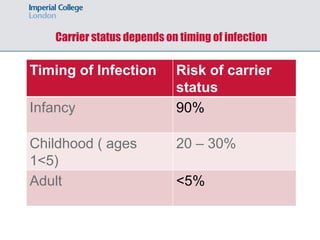
Carrier status depends on timing of infection
Timing of Infection Risk of carrier
status
Infancy 90%
Childhood ( ages
1<5)
20 – 30%
Adult <5%
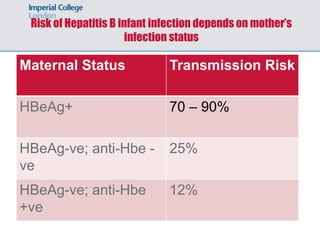
Risk of Hepatitis B infant infection depends on mother’s
infection status
Maternal Status Transmission Risk
HBeAg+ 70 – 90%
HBeAg-ve; anti-Hbe -
ve
25%
HBeAg-ve; anti-Hbe
+ve
12%
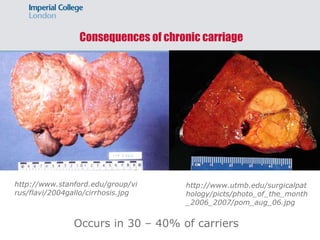
Consequences of chronic carriage
http://www.stanford.edu/group/vi
rus/flavi/2004gallo/cirrhosis.jpg
http://www.utmb.edu/surgicalpat
hology/picts/photo_of_the_month
_2006_2007/pom_aug_06.jpg
Occurs in 30 – 40% of carriers
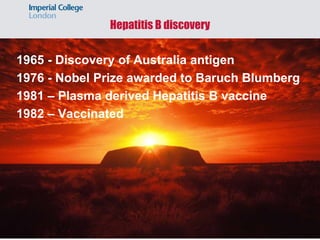
Hepatitis B discovery
1965 - Discovery of Australia antigen
1976 - Nobel Prize awarded to Baruch Blumberg
1981 – Plasma derived Hepatitis B vaccine
1982 – Vaccinated
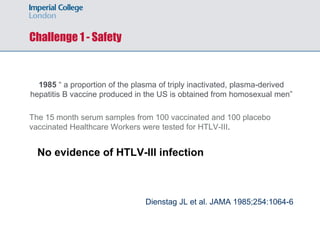
Challenge 1 - Safety
1985 “ a proportion of the plasma of triply inactivated, plasma-derived
hepatitis B vaccine produced in the US is obtained from homosexual men”
The 15 month serum samples from 100 vaccinated and 100 placebo
vaccinated Healthcare Workers were tested for HTLV-III.
No evidence of HTLV-III infection
Dienstag JL et al. JAMA 1985;254:1064-6
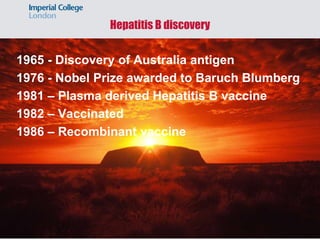
Hepatitis B discovery
1965 - Discovery of Australia antigen
1976 - Nobel Prize awarded to Baruch Blumberg
1981 – Plasma derived Hepatitis B vaccine
1982 – Vaccinated
1986 – Recombinant vaccine
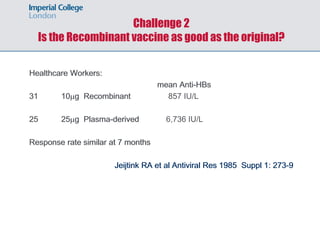
Challenge 2
Is the Recombinant vaccine as good as the original?
Healthcare Workers:
mean Anti-HBs
31 10mg Recombinant
25 25mg Plasma-derived
Response rate similar at 7 months
Jeijtink RA et al Antiviral Res 1985 Suppl 1: 273-9
Healthcare Workers:
mean Anti-HBs
31 10mg Recombinant 857 IU/L
25 25mg Plasma-derived 6,736 IU/L
Response rate similar at 7 months
Jeijtink RA et al Antiviral Res 1985 Suppl 1: 273-9
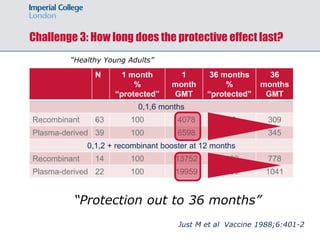
Challenge 3: How long does the protective effect last?
N 1 month
%
“protected”
1
month
GMT
36 months
%
“protected”
36
months
GMT
0,1,6 months
Recombinant 63 100 4078 98 309
Plasma-derived 39 100 6598 97 345
0,1,2 + recombinant booster at 12 months
Recombinant 14 100 13752 100 778
Plasma-derived 22 100 19959 100 1041
“Protection out to 36 months”
Just M et al Vaccine 1988;6:401-2
“Healthy Young Adults”
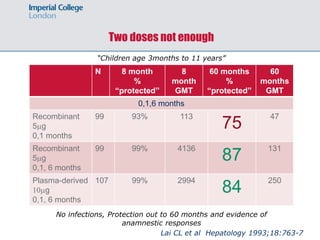
Two doses not enough
N 8 month
%
“protected”
8
month
GMT
60 months
%
“protected”
60
months
GMT
0,1,6 months
Recombinant
5mg
0,1 months
99 93% 113
75
47
Recombinant
5mg
0,1, 6 months
99 99% 4136
87
131
Plasma-derived
10mg
0,1, 6 months
107 99% 2994
84
250
No infections, Protection out to 60 months and evidence of
anamnestic responses
Lai CL et al Hepatology 1993;18:763-7
“Children age 3months to 11 years”
Challenge 4: Cost – can this be reduced?
Stockholm, Sweden health care workers
Recombinant vaccine (Engerix B)
protective anti-HBs levels
286 20mg IM 94%
382 2mg ID 89%
Predictive factors for higher response rates and higher anti-HBs were:
Female gender
IM injection
Younger age
Non-Smoker
If an 85% response rate is acceptable
ID injection can be used in females and non-smoking males <age 30
Struve J et al: Scand J Infect Dis 1992;24: 423-9
Challenge 4: Cost – can this be reduced? YES
Challenge 5: Non or Sub-optimal responders
20mg Plasma-derived vaccine, 0, 1 & 6 months
MSM
Low/No antibody titre in 7/16 HIV+ v 6/68 HIV-ve
Median anti-HBs titre 15.5 v 205 (sample ratio units)
Ann Int Med 1988;109:101-5
Challenge 5: Non-Responders
Japan
31 non-responders to sc vaccination
Px
5mg Plasma-derived vaccine intradermally every two weeks until delayed
type hypersensitivity (DTH) skin reaction to HBsAg became positive
97% developed DTH after 2.3 +/- 1.2 revaccinations
94% developed >10 IU/L of anti-HBs in plasma
74% remain “protected” at 1 year
Nagafuchi et al, JAMA 1991; 265:2679-83
can be managed
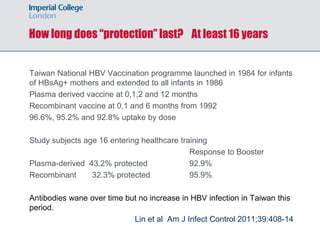
How long does “protection” last? At least 16 years
Taiwan National HBV Vaccination programme launched in 1984 for infants
of HBsAg+ mothers and extended to all infants in 1986
Plasma derived vaccine at 0,1,2 and 12 months
Recombinant vaccine at 0,1 and 6 months from 1992
96.6%, 95.2% and 92.8% uptake by dose
Study subjects age 16 entering healthcare training
Response to Booster
Plasma-derived 43.2% protected 92.9%
Recombinant 32.3% protected 95.9%
Antibodies wane over time but no increase in HBV infection in Taiwan this
period.
Lin et al Am J Infect Control 2011;39:408-14
How long does “protection” last?
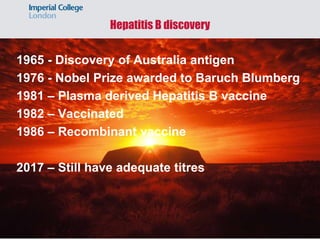
Hepatitis B discovery
1965 - Discovery of Australia antigen
1976 - Nobel Prize awarded to Baruch Blumberg
1981 – Plasma derived Hepatitis B vaccine
1982 – Vaccinated
1986 – Recombinant vaccine
2017 – Still have adequate titres
Protection after 30 years?
Alaska
Indigenous 1578 adults and children
3 doses Plasma derived vaccine in 1981
(10mg if <20years; 20mg if > 20 years)
435 were followed up at 30 years
22 years after vaccination 60% remained “protected”
40% were given booster
At 30 years 125/243 (56%) anti-HBs >10 IU/L (un boosted)
85 <10 IU/L given booster – 75(88%) response at 30 days
From: Antibody Levels and Protection After Hepatitis B Vaccine: Results of a 30-Year Follow-up Study and
Response to a Booster Dose
J Infect Dis. 2016;214(1):16-22. doi:10.1093/infdis/jiv748
J Infect Dis | Published by Oxford University Press for the Infectious Diseases Society of America 2016. This work is written by
(a) US Government employee(s) and is in the public domain in the US.
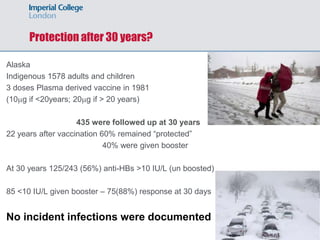
Protection after 30 years?
Alaska
Indigenous 1578 adults and children
3 doses Plasma derived vaccine in 1981
(10mg if <20years; 20mg if > 20 years)
435 were followed up at 30 years
22 years after vaccination 60% remained “protected”
40% were given booster
At 30 years 125/243 (56%) anti-HBs >10 IU/L (un boosted)
85 <10 IU/L given booster – 75(88%) response at 30 days
No incident infections were documented
Challenge 6: cold chain
Previous study demonstrated cold chain breached 23% of time by being
too high and 47% of the time by being too low
To determine immunity to HBV in adolescents vaccinated in infancy 1989 -
1990 in a remote aboriginal community
n= 37
4 (11%) HBV infected
7 (19%) past HBV infection
15 (41%) no seroprotection (<10 IU/L)
11 (29%) Seroprotected
Dent et al, Commun Dis Intell 2010;34:435-9
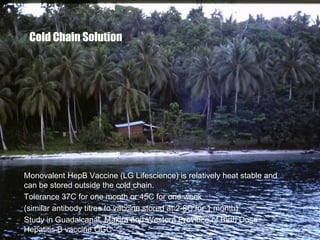
Cold Chain Solution
Monovalent HepB Vaccine (LG Lifescience) is relatively heat stable and
can be stored outside the cold chain.
Tolerance 37C for one month or 45C for one week
(similar antibody titres to vaccine stored at 2-8C for 1 month)
Study in Guadalcanal, Makira and Western Province of Birth Dose
Hepatitis B vaccine OCC
Cold Chain Solution
Timely HepB Birth Dose increased from 38/125 (30%) births to
104/152 (68%) p 0.0005
Late BD (first dose before 42 days) increased from 80 – 85%
For home deliveries HepB Birth Dose increased from 2/46 (4%)
to 9/38 (24%)
Late BD increased from 4/46 (9%) to 20/38 (53%)
Breakwell et al Vaccine 2017;35: 2770-4
Cold Chain Solution – use a vaccine that is heat stable
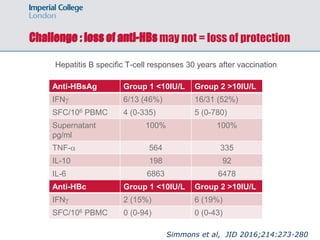
Challenge : loss of anti-HBs
Hepatitis B specific T-cell responses 30 years after vaccination
Anti-HBV Group 1 <10IU/L Group 2 >10IU/L
IFNg 6/13 (46%) 16/31 (52%)
SFC/106 PBMC 4 (0-335) 5 (0-780)
Anti-HBsAg Group 1 <10IU/L Group 2 >10IU/L
IFNg 6/13 (46%) 16/31 (52%)
SFC/106 PBMC 4 (0-335) 5 (0-780)
Supernatant
pg/ml
100% 100%
TNF-a 564 335
IL-10 198 92
IL-6 6863 6478
Anti-HBc Group 1 <10IU/L Group 2 >10IU/L
IFNg 2 (15%) 6 (19%)
SFC/106 PBMC 0 (0-94) 0 (0-43)
Simmons et al, JID 2016;214:273-280
Challenge : loss of anti-HBs may not = loss of protection
Challenge 7: Global prevalence of HBsAg+ persons
60
115
39
21
15
7
257 million
WHO Global Report 2017
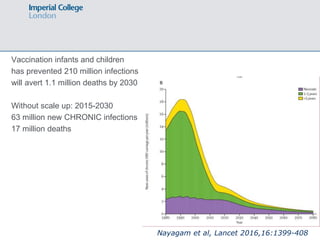
Vaccination infants and children
has prevented 210 million infections
will avert 1.1 million deaths by 2030
Without scale up: 2015-2030
63 million new CHRONIC infections
17 million deaths
Nayagam et al, Lancet 2016,16:1399-408
Challenge 8: Elimination of HBV by 2090
Scale up to:
90% infant coverage
80% birth dose
80% HBeAg+ mothers
peripartum antivirals
80% population Test and
Treat
?HBV Cure
Annual cost will peak at $7.5
Billion worldwide then
decrease rapidly
Nayagam et al, Lancet 2016,16:1399-408
The Final Challenge

SS 2017: Challenges in Hepatitis B Vaccination

  • 1.
    Challenges in HepatitisB Vaccination (a personal view) Graham P Taylor Section of Virology
  • 2.
    Carrier status dependson timing of infection Timing of Infection Risk of carrier status Infancy 90% Childhood ( ages 1<5) 20 – 30% Adult <5%
  • 3.
    Risk of HepatitisB infant infection depends on mother’s infection status Maternal Status Transmission Risk HBeAg+ 70 – 90% HBeAg-ve; anti-Hbe - ve 25% HBeAg-ve; anti-Hbe +ve 12%
  • 4.
    Consequences of chroniccarriage http://www.stanford.edu/group/vi rus/flavi/2004gallo/cirrhosis.jpg http://www.utmb.edu/surgicalpat hology/picts/photo_of_the_month _2006_2007/pom_aug_06.jpg Occurs in 30 – 40% of carriers
  • 5.
    Hepatitis B discovery 1965- Discovery of Australia antigen 1976 - Nobel Prize awarded to Baruch Blumberg 1981 – Plasma derived Hepatitis B vaccine 1982 – Vaccinated
  • 6.
    Challenge 1 -Safety 1985 “ a proportion of the plasma of triply inactivated, plasma-derived hepatitis B vaccine produced in the US is obtained from homosexual men” The 15 month serum samples from 100 vaccinated and 100 placebo vaccinated Healthcare Workers were tested for HTLV-III. No evidence of HTLV-III infection Dienstag JL et al. JAMA 1985;254:1064-6
  • 7.
    Hepatitis B discovery 1965- Discovery of Australia antigen 1976 - Nobel Prize awarded to Baruch Blumberg 1981 – Plasma derived Hepatitis B vaccine 1982 – Vaccinated 1986 – Recombinant vaccine
  • 8.
    Challenge 2 Is theRecombinant vaccine as good as the original? Healthcare Workers: mean Anti-HBs 31 10mg Recombinant 25 25mg Plasma-derived Response rate similar at 7 months Jeijtink RA et al Antiviral Res 1985 Suppl 1: 273-9 Healthcare Workers: mean Anti-HBs 31 10mg Recombinant 857 IU/L 25 25mg Plasma-derived 6,736 IU/L Response rate similar at 7 months Jeijtink RA et al Antiviral Res 1985 Suppl 1: 273-9
  • 9.
    Challenge 3: Howlong does the protective effect last? N 1 month % “protected” 1 month GMT 36 months % “protected” 36 months GMT 0,1,6 months Recombinant 63 100 4078 98 309 Plasma-derived 39 100 6598 97 345 0,1,2 + recombinant booster at 12 months Recombinant 14 100 13752 100 778 Plasma-derived 22 100 19959 100 1041 “Protection out to 36 months” Just M et al Vaccine 1988;6:401-2 “Healthy Young Adults”
  • 10.
    Two doses notenough N 8 month % “protected” 8 month GMT 60 months % “protected” 60 months GMT 0,1,6 months Recombinant 5mg 0,1 months 99 93% 113 75 47 Recombinant 5mg 0,1, 6 months 99 99% 4136 87 131 Plasma-derived 10mg 0,1, 6 months 107 99% 2994 84 250 No infections, Protection out to 60 months and evidence of anamnestic responses Lai CL et al Hepatology 1993;18:763-7 “Children age 3months to 11 years”
  • 11.
    Challenge 4: Cost– can this be reduced? Stockholm, Sweden health care workers Recombinant vaccine (Engerix B) protective anti-HBs levels 286 20mg IM 94% 382 2mg ID 89% Predictive factors for higher response rates and higher anti-HBs were: Female gender IM injection Younger age Non-Smoker If an 85% response rate is acceptable ID injection can be used in females and non-smoking males <age 30 Struve J et al: Scand J Infect Dis 1992;24: 423-9 Challenge 4: Cost – can this be reduced? YES
  • 12.
    Challenge 5: Nonor Sub-optimal responders 20mg Plasma-derived vaccine, 0, 1 & 6 months MSM Low/No antibody titre in 7/16 HIV+ v 6/68 HIV-ve Median anti-HBs titre 15.5 v 205 (sample ratio units) Ann Int Med 1988;109:101-5
  • 13.
    Challenge 5: Non-Responders Japan 31non-responders to sc vaccination Px 5mg Plasma-derived vaccine intradermally every two weeks until delayed type hypersensitivity (DTH) skin reaction to HBsAg became positive 97% developed DTH after 2.3 +/- 1.2 revaccinations 94% developed >10 IU/L of anti-HBs in plasma 74% remain “protected” at 1 year Nagafuchi et al, JAMA 1991; 265:2679-83 can be managed
  • 14.
    How long does“protection” last? At least 16 years Taiwan National HBV Vaccination programme launched in 1984 for infants of HBsAg+ mothers and extended to all infants in 1986 Plasma derived vaccine at 0,1,2 and 12 months Recombinant vaccine at 0,1 and 6 months from 1992 96.6%, 95.2% and 92.8% uptake by dose Study subjects age 16 entering healthcare training Response to Booster Plasma-derived 43.2% protected 92.9% Recombinant 32.3% protected 95.9% Antibodies wane over time but no increase in HBV infection in Taiwan this period. Lin et al Am J Infect Control 2011;39:408-14 How long does “protection” last?
  • 15.
    Hepatitis B discovery 1965- Discovery of Australia antigen 1976 - Nobel Prize awarded to Baruch Blumberg 1981 – Plasma derived Hepatitis B vaccine 1982 – Vaccinated 1986 – Recombinant vaccine 2017 – Still have adequate titres
  • 16.
    Protection after 30years? Alaska Indigenous 1578 adults and children 3 doses Plasma derived vaccine in 1981 (10mg if <20years; 20mg if > 20 years) 435 were followed up at 30 years 22 years after vaccination 60% remained “protected” 40% were given booster At 30 years 125/243 (56%) anti-HBs >10 IU/L (un boosted) 85 <10 IU/L given booster – 75(88%) response at 30 days
  • 17.
    From: Antibody Levelsand Protection After Hepatitis B Vaccine: Results of a 30-Year Follow-up Study and Response to a Booster Dose J Infect Dis. 2016;214(1):16-22. doi:10.1093/infdis/jiv748 J Infect Dis | Published by Oxford University Press for the Infectious Diseases Society of America 2016. This work is written by (a) US Government employee(s) and is in the public domain in the US.
  • 18.
    Protection after 30years? Alaska Indigenous 1578 adults and children 3 doses Plasma derived vaccine in 1981 (10mg if <20years; 20mg if > 20 years) 435 were followed up at 30 years 22 years after vaccination 60% remained “protected” 40% were given booster At 30 years 125/243 (56%) anti-HBs >10 IU/L (un boosted) 85 <10 IU/L given booster – 75(88%) response at 30 days No incident infections were documented
  • 19.
    Challenge 6: coldchain Previous study demonstrated cold chain breached 23% of time by being too high and 47% of the time by being too low To determine immunity to HBV in adolescents vaccinated in infancy 1989 - 1990 in a remote aboriginal community n= 37 4 (11%) HBV infected 7 (19%) past HBV infection 15 (41%) no seroprotection (<10 IU/L) 11 (29%) Seroprotected Dent et al, Commun Dis Intell 2010;34:435-9
  • 20.
    Cold Chain Solution MonovalentHepB Vaccine (LG Lifescience) is relatively heat stable and can be stored outside the cold chain. Tolerance 37C for one month or 45C for one week (similar antibody titres to vaccine stored at 2-8C for 1 month) Study in Guadalcanal, Makira and Western Province of Birth Dose Hepatitis B vaccine OCC
  • 21.
    Cold Chain Solution TimelyHepB Birth Dose increased from 38/125 (30%) births to 104/152 (68%) p 0.0005 Late BD (first dose before 42 days) increased from 80 – 85% For home deliveries HepB Birth Dose increased from 2/46 (4%) to 9/38 (24%) Late BD increased from 4/46 (9%) to 20/38 (53%) Breakwell et al Vaccine 2017;35: 2770-4 Cold Chain Solution – use a vaccine that is heat stable
  • 22.
    Challenge : lossof anti-HBs Hepatitis B specific T-cell responses 30 years after vaccination Anti-HBV Group 1 <10IU/L Group 2 >10IU/L IFNg 6/13 (46%) 16/31 (52%) SFC/106 PBMC 4 (0-335) 5 (0-780) Anti-HBsAg Group 1 <10IU/L Group 2 >10IU/L IFNg 6/13 (46%) 16/31 (52%) SFC/106 PBMC 4 (0-335) 5 (0-780) Supernatant pg/ml 100% 100% TNF-a 564 335 IL-10 198 92 IL-6 6863 6478 Anti-HBc Group 1 <10IU/L Group 2 >10IU/L IFNg 2 (15%) 6 (19%) SFC/106 PBMC 0 (0-94) 0 (0-43) Simmons et al, JID 2016;214:273-280 Challenge : loss of anti-HBs may not = loss of protection
  • 23.
    Challenge 7: Globalprevalence of HBsAg+ persons 60 115 39 21 15 7 257 million WHO Global Report 2017
  • 24.
    Vaccination infants andchildren has prevented 210 million infections will avert 1.1 million deaths by 2030 Without scale up: 2015-2030 63 million new CHRONIC infections 17 million deaths Nayagam et al, Lancet 2016,16:1399-408
  • 25.
    Challenge 8: Eliminationof HBV by 2090 Scale up to: 90% infant coverage 80% birth dose 80% HBeAg+ mothers peripartum antivirals 80% population Test and Treat ?HBV Cure Annual cost will peak at $7.5 Billion worldwide then decrease rapidly Nayagam et al, Lancet 2016,16:1399-408
  • 26.