Updates in Asthma Management
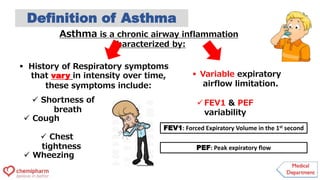
Asthma is a chronic airway inflammation
characterized by:
 History of Respiratory symptoms
that vary in intensity over time,
these symptoms include:
 Wheezing
 Shortness of
breath
 Chest
tightness
 Cough
Definition of Asthma
 Variable expiratory
airflow limitation.
 FEV1 & PEF
variability
FEV1: Forced Expiratory Volume in the 1st second
PEF: Peak expiratory flow
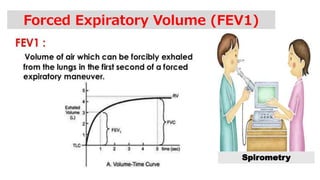
Forced Expiratory Volume (FEV1)
Spirometry
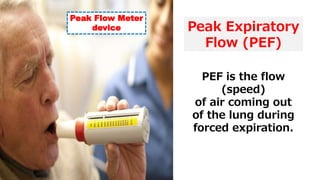
Peak Expiratory
Flow (PEF)
PEF is the flow
(speed)
of air coming out
of the lung during
forced expiration.
Peak Flow Meter
device
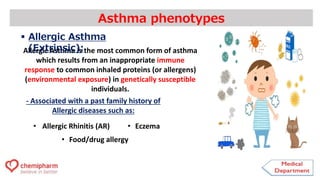
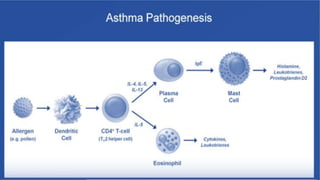
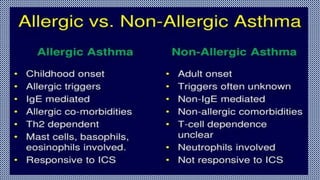
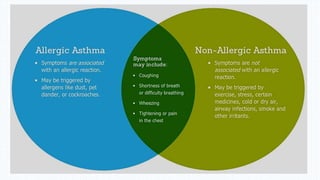
Allergic Asthma is the most common form of asthma
which results from an inappropriate immune
response to common inhaled proteins (or allergens)
(environmental exposure) in genetically susceptible
individuals.
Asthma phenotypes
 Allergic Asthma
(Extrinsic):
- Associated with a past family history of
Allergic diseases such as:
• Allergic Rhinitis (AR) • Eczema
• Food/drug allergy
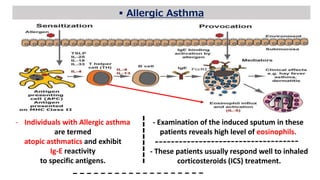
- Individuals with Allergic asthma
are termed
atopic asthmatics and exhibit
Ig-E reactivity
to specific antigens.
 Allergic Asthma
- Examination of the induced sputum in these
patients reveals high level of eosinophils.
- These patients usually respond well to inhaled
corticosteroids (ICS) treatment.
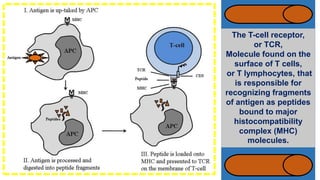
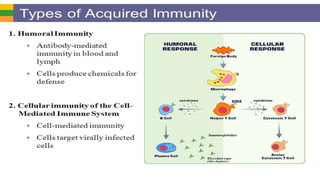
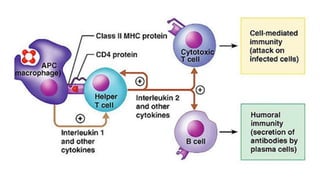
The T-cell receptor,
or TCR,
Molecule found on the
surface of T cells,
or T lymphocytes, that
is responsible for
recognizing fragments
of antigen as peptides
bound to major
histocompatibility
complex (MHC)
molecules.
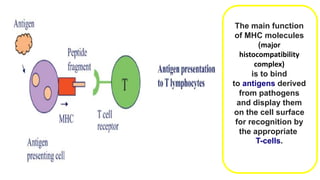
The main function
of MHC molecules
(major
histocompatibility
complex)
is to bind
to antigens derived
from pathogens
and display them
on the cell surface
for recognition by
the appropriate
T-cells.
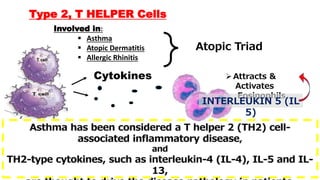
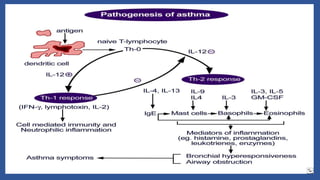
Asthma has been considered a T helper 2 (TH2) cell-
associated inflammatory disease,
and
TH2-type cytokines, such as interleukin-4 (IL-4), IL-5 and IL-
13,
Cytokines Attracts &
Activates
Eosinophils
Type 2, T HELPER Cells
Involved in:
 Asthma
 Atopic Dermatitis
 Allergic Rhinitis
Atopic Triad
INTERLEUKIN 5 (IL
5)
Asthma phenotypes
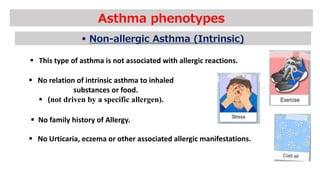
 Non-allergic Asthma (Intrinsic)
 This type of asthma is not associated with allergic reactions.
 No relation of intrinsic asthma to inhaled
substances or food.
 (not driven by a specific allergen).
 No family history of Allergy.
 No Urticaria, eczema or other associated allergic manifestations.
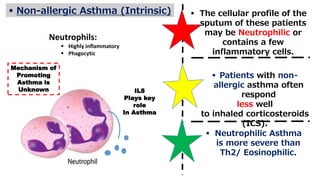
 Neutrophilic Asthma
is more severe than
Th2/ Eosinophilic.
 The cellular profile of the
sputum of these patients
may be Neutrophilic or
contains a few
inflammatory cells.
 Patients with non-
allergic asthma often
respond
less well
to inhaled corticosteroids
(ICS).
 Non-allergic Asthma (Intrinsic)
IL8
Plays key
role
In Asthma
Mechanism of
Promoting
Asthma is
Unknown
Neutrophils:
 Highly inflammatory
 Phagocytic
Medical
Department
Diagnostic features & Asthma criteria
Diagnostic feature Asthma Criteria
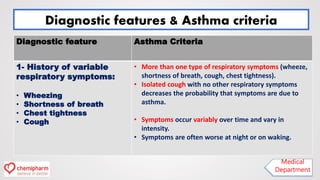
1- History of variable
respiratory symptoms:
• Wheezing
• Shortness of breath
• Chest tightness
• Cough
• More than one type of respiratory symptoms (wheeze,
shortness of breath, cough, chest tightness).
• Isolated cough with no other respiratory symptoms
decreases the probability that symptoms are due to
asthma.
• Symptoms occur variably over time and vary in
intensity.
• Symptoms are often worse at night or on waking.
Diagnostic features Asthma Criteria
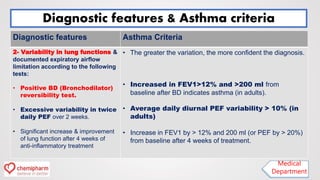
2- Variability in lung functions &
documented expiratory airflow
limitation according to the following
tests:
• Positive BD (Bronchodilator)
reversibility test.
• Excessive variability in twice
daily PEF over 2 weeks.
• Significant increase & improvement
of lung function after 4 weeks of
anti-inflammatory treatment
• The greater the variation, the more confident the diagnosis.
• Increased in FEV1>12% and >200 ml from
baseline after BD indicates asthma (in adults).
• Average daily diurnal PEF variability > 10% (in
adults)
• Increase in FEV1 by > 12% and 200 ml (or PEF by > 20%)
from baseline after 4 weeks of treatment.
Diagnostic features & Asthma criteria
Medical
Department
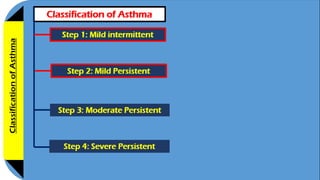
Step 2: Mild Persistent
Step 1: Mild intermittent
Classification of Asthma
Symptoms
:
Less than or equal 2 times a week &
asymptomatic between
exacerbations.
Night-time
symptoms:
Not more than 2 times per month
Lung functions:  FEV1 Or PEF higher than or equal 80%
predicted
 PEF Variability less than 20%
Symptoms
:
Night-time
symptoms:
Lung functions:
More than 2 times a week
But Less than daily
symptoms
More than 2 times per
month
 FEV1 or PEF higher than or equal 80%
predicted.
 PEF Variability from 20% to 30%.
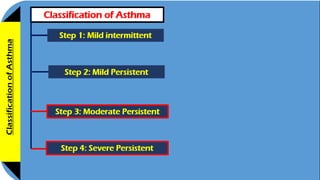
Classification of Asthma
Step 3: Moderate
Persistent
Step 4: Severe Persistent
Symptoms
:
Symptoms
:
Night-time
symptoms:
Night-time
symptoms:
Lung functions:
Lung functions:
Symptoms are daily
Daily use of Short-acting Beta2-agonists
(SABA)
More than once per week
 FEV1 Or PEF higher than 60%
and less than 80% predicted.
 PEF Variability higher than 30%
- Continual daily
symptoms
- Frequent ExacerbationsFrequent Nocturnal
symptoms
 FEV1 Or PEF Less than 60%
Predicted
 PEF Variability higher than 30%
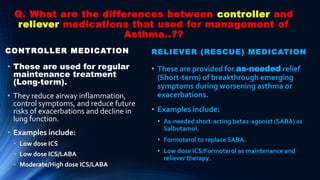
Q. What are the differences between controller and
reliever medications that used for management of
Asthma..??
CONTROLLER MEDICATION
• These are used for regular
maintenance treatment
(Long-term).
• They reduce airway inflammation,
control symptoms, and reduce future
risks of exacerbations and decline in
lung function.
• Examples include:
• Low dose ICS
• Low dose ICS/LABA
• Moderate/High dose ICS/LABA
RELIEVER (RESCUE) MEDICATION
• These are provided for as-needed relief
(Short-term) of breakthrough emerging
symptoms during worsening asthma or
exacerbations.
• Examples include:
• As-needed short-acting beta2-agonist (SABA) as
Salbutamol.
• Formoterol to replace SABA.
• Low dose ICS/Formoterol as maintenance and
reliever therapy.
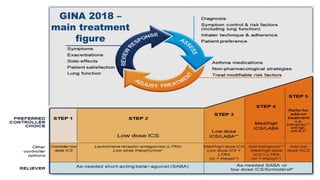
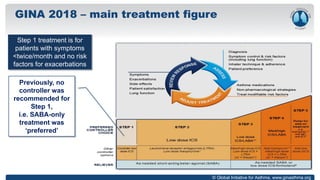
GINA 2018 –
main treatment
figure
© Global Initiative for Asthma, www.ginasthma.org
GINA 2018 – main treatment figure
Step 1 treatment is for
patients with symptoms
<twice/month and no risk
factors for exacerbations
Previously, no
controller was
recommended for
Step 1,
i.e. SABA-only
treatment was
‘preferred’
© Global Initiative for Asthma, www.ginasthma.org
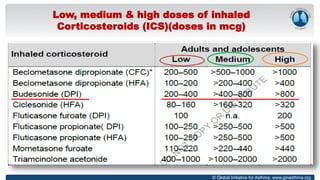
Low, medium & high doses of inhaled
Corticosteroids (ICS)(doses in mcg)
© Global Initiative for Asthma, www.ginasthma.org
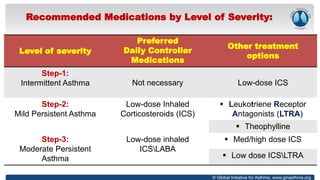
Recommended Medications by Level of Severity:
Level of severity
Preferred
Daily Controller
Medications
Other treatment
options
Step-1:
Intermittent Asthma Not necessary Low-dose ICS
Step-2:
Mild Persistent Asthma
Low-dose Inhaled
Corticosteroids (ICS)
 Leukotriene Receptor
Antagonists (LTRA)
 Theophylline
Step-3:
Moderate Persistent
Asthma
Low-dose inhaled
ICSLABA
 Med/high dose ICS
 Low dose ICSLTRA
© Global Initiative for Asthma, www.ginasthma.org
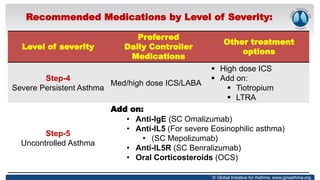
Recommended Medications by Level of Severity:
Level of severity
Preferred
Daily Controller
Medications
Other treatment
options
Step-4
Severe Persistent Asthma
Med/high dose ICS/LABA
 High dose ICS
 Add on:
 Tiotropium
 LTRA
Step-5
Uncontrolled Asthma
Add on:
• Anti-IgE (SC Omalizumab)
• Anti-IL5 (For severe Eosinophilic asthma)
• (SC Mepolizumab)
• Anti-IL5R (SC Benralizumab)
• Oral Corticosteroids (OCS)
© Global Initiative for Asthma
GINA Global Strategy for Asthma
Management and Prevention
Global Initiative for Asthma (GINA)
What’s new in GINA 2019?
This slide set is restricted for academic and educational purposes only. No additions
or changes may be made to slides. Use of the slide set or of individual slides for
commercial or promotional purposes requires approval from GINA.
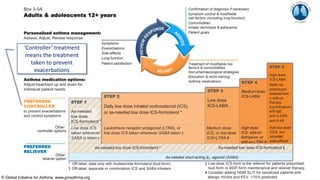
* Off-label; data only with budesonide-formoterol (bud-form)
† Off-label; separate or combination ICS and SABA inhalers
PREFERRED
CONTROLLER
to prevent exacerbations
and control symptoms
Other
controller options
Other
reliever option
PREFERRED
RELIEVER
STEP 2
Daily low dose inhaled corticosteroid (ICS),
or as-needed low dose ICS-formoterol *
STEP 3
Low dose
ICS-LABA
STEP 4
Medium dose
ICS-LABA
Leukotriene receptor antagonist (LTRA), or
low dose ICS taken whenever SABA taken †
As-needed low dose ICS-formoterol *
As-needed short-acting β2 -agonist (SABA)
Medium dose
ICS, or low dose
ICS+LTRA #
High dose
ICS, add-on
tiotropium, or
add-on LTRA #
Add low dose
OCS, but
consider
side-effects
As-needed low dose ICS-formoterol ‡
Box 3-5A
Adults & adolescents 12+ years
Personalized asthma management:
Assess, Adjust, Review response
Asthma medication options:
Adjust treatment up and down for
individual patient needs
STEP 5
High dose
ICS-LABA
Refer for
phenotypic
assessment
± add-on
therapy,
e.g.tiotropium,
anti-IgE,
anti-IL5/5R,
anti-IL4R
Symptoms
Exacerbations
Side-effects
Lung function
Patient satisfaction
Confirmation of diagnosis if necessary
Symptom control & modifiable
risk factors (including lung function)
Comorbidities
Inhaler technique & adherence
Patient goals
Treatment of modifiable risk
factors & comorbidities
Non-pharmacological strategies
Education & skills training
Asthma medications
1© Global Initiative for Asthma, www.ginasthma.org
STEP 1
As-needed
low dose
ICS-formoterol *
Low dose ICS
taken whenever
SABA is taken†
‡ Low-dose ICS-form is the reliever for patients prescribed
bud-form or BDP-form maintenance and reliever therapy
# Consider adding HDM SLIT for sensitized patients with
allergic rhinitis and FEV >70% predicted
‘Controller’ treatment
means the treatment
taken to prevent
exacerbations
© Global Initiative for Asthma, www.ginasthma.org
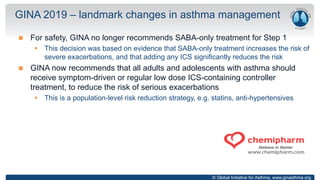
 For safety, GINA no longer recommends SABA-only treatment for Step 1
 This decision was based on evidence that SABA-only treatment increases the risk of
severe exacerbations, and that adding any ICS significantly reduces the risk
 GINA now recommends that all adults and adolescents with asthma should
receive symptom-driven or regular low dose ICS-containing controller
treatment, to reduce the risk of serious exacerbations
 This is a population-level risk reduction strategy, e.g. statins, anti-hypertensives
GINA 2019 – landmark changes in asthma management
* Off-label; data only with budesonide-formoterol (bud-form)
† Off-label; separate or combination ICS and SABA inhalers
STEP 2
Daily low dose inhaled corticosteroid (ICS),
or as-needed low dose ICS-formoterol *
STEP 3
Low dose
ICS-LABA
STEP 4
Medium dose
ICS-LABA
Leukotriene receptor antagonist (LTRA), or
low dose ICS taken whenever SABA taken †
As-needed low dose ICS-formoterol *
As-needed short-acting β2 -agonist (SABA)
Medium dose
ICS, or low dose
ICS+LTRA #
High dose
ICS, add-on
tiotropium, or
add-on LTRA #
Add low dose
OCS, but
consider
side-effects
As-needed low dose ICS-formoterol ‡
STEP 5
High dose
ICS-LABA
Refer for
phenotypic
assessment
± add-on
therapy,
e.g.tiotropium,
anti-IgE,
anti-IL5/5R,
anti-IL4R
Symptoms
Exacerbations
Side-effects
Lung function
Patient satisfaction
Confirmation of diagnosis if necessary
Symptom control & modifiable
risk factors (including lung function)
Comorbidities
Inhaler technique & adherence
Patient goals
Treatment of modifiable risk
factors & comorbidities
Non-pharmacological strategies
Education & skills training
Asthma medications
1© Global Initiative for Asthma, www.ginasthma.org
STEP 1
As-needed
low dose
ICS-formoterol *
Low dose ICS
taken whenever
SABA is taken†
‡ Low-dose ICS-form is the reliever for patients prescribed
bud-form or BDP-form maintenance and reliever therapy
# Consider adding HDM SLIT for sensitized patients with
allergic rhinitis and FEV >70% predicted
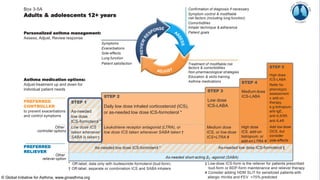
PREFERRED
CONTROLLER
to prevent exacerbations
and control symptoms
Other
controller options
Other
reliever option
PREFERRED
RELIEVER
Box 3-5A
Adults & adolescents 12+ years
Personalized asthma management:
Assess, Adjust, Review response
Asthma medication options:
Adjust treatment up and down for
individual patient needs
* Off-label; data only with budesonide-formoterol (bud-form)
† Off-label; separate or combination ICS and SABA inhalers
STEP 2
Daily low dose inhaled corticosteroid (ICS),
or as-needed low dose ICS-formoterol *
STEP 3
Low dose
ICS-LABA
STEP 4
Medium dose
ICS-LABA
Leukotriene receptor antagonist (LTRA), or
low dose ICS taken whenever SABA taken †
As-needed low dose ICS-formoterol *
As-needed short-acting β2 -agonist (SABA)
Medium dose
ICS, or low dose
ICS+LTRA #
High dose
ICS, add-on
tiotropium, or
add-on LTRA #
Add low dose
OCS, but
consider
side-effects
As-needed low dose ICS-formoterol ‡
STEP 5
High dose
ICS-LABA
Refer for
phenotypic
assessment
± add-on
therapy,
e.g.tiotropium,
anti-IgE,
anti-IL5/5R,
anti-IL4R
Symptoms
Exacerbations
Side-effects
Lung function
Patient satisfaction
Confirmation of diagnosis if necessary
Symptom control & modifiable
risk factors (including lung function)
Comorbidities
Inhaler technique & adherence
Patient goals
Treatment of modifiable risk
factors & comorbidities
Non-pharmacological strategies
Education & skills training
Asthma medications
1© Global Initiative for Asthma, www.ginasthma.org
STEP 1
As-needed
low dose
ICS-formoterol *
Low dose ICS
taken whenever
SABA is taken†
‡ Low-dose ICS-form is the reliever for patients prescribed
bud-form or BDP-form maintenance and reliever therapy
# Consider adding HDM SLIT for sensitized patients with
allergic rhinitis and FEV >70% predicted
PREFERRED
CONTROLLER
to prevent exacerbations
and control symptoms
Other
controller options
Other
reliever option
PREFERRED
RELIEVER
Box 3-5A
Adults & adolescents 12+ years
Personalized asthma management:
Assess, Adjust, Review response
Asthma medication options:
Adjust treatment up and down for
individual patient needs
* Off-label; data only with budesonide-formoterol (bud-form)
† Off-label; separate or combination ICS and SABA inhalers
STEP 2
Daily low dose inhaled corticosteroid (ICS),
or as-needed low dose ICS-formoterol *
STEP 3
Low dose
ICS-LABA
STEP 4
Medium dose
ICS-LABA
Leukotriene receptor antagonist (LTRA), or
low dose ICS taken whenever SABA taken †
As-needed low dose ICS-formoterol *
As-needed short-acting β2 -agonist (SABA)
Medium dose
ICS, or low dose
ICS+LTRA #
High dose
ICS, add-on
tiotropium, or
add-on LTRA #
Add low dose
OCS, but
consider
side-effects
As-needed low dose ICS-formoterol ‡
STEP 5
High dose
ICS-LABA
Refer for
phenotypic
assessment
± add-on
therapy,
e.g.tiotropium,
anti-IgE,
anti-IL5/5R,
anti-IL4R
Symptoms
Exacerbations
Side-effects
Lung function
Patient satisfaction
Confirmation of diagnosis if necessary
Symptom control & modifiable
risk factors (including lung function)
Comorbidities
Inhaler technique & adherence
Patient goals
Treatment of modifiable risk
factors & comorbidities
Non-pharmacological strategies
Education & skills training
Asthma medications
1© Global Initiative for Asthma, www.ginasthma.org
STEP 1
As-needed
low dose
ICS-formoterol *
Low dose ICS
taken whenever
SABA is taken†
‡ Low-dose ICS-form is the reliever for patients prescribed
bud-form or BDP-form maintenance and reliever therapy
# Consider adding HDM SLIT for sensitized patients with
allergic rhinitis and FEV >70% predicted
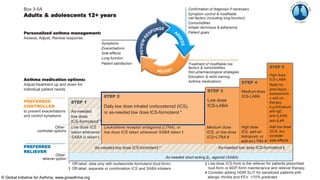
PREFERRED
CONTROLLER
to prevent exacerbations
and control symptoms
Other
controller options
Other
reliever option
PREFERRED
RELIEVER
Box 3-5A
Adults & adolescents 12+ years
Personalized asthma management:
Assess, Adjust, Review response
Asthma medication options:
Adjust treatment up and down for
individual patient needs
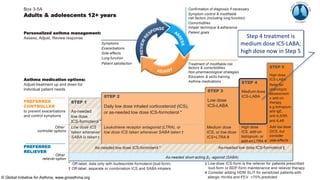
Step 4 treatment is
medium dose ICS-LABA;
high dose now in Step 5
Medical
Department
Bronchial Asthma: Definition,Pathophysiology and Management

Bronchial Asthma: Definition,Pathophysiology and Management

  • 1.
  • 2.
    Asthma is achronic airway inflammation characterized by:  History of Respiratory symptoms that vary in intensity over time, these symptoms include:  Wheezing  Shortness of breath  Chest tightness  Cough Definition of Asthma  Variable expiratory airflow limitation.  FEV1 & PEF variability FEV1: Forced Expiratory Volume in the 1st second PEF: Peak expiratory flow
  • 3.
    Forced Expiratory Volume(FEV1) Spirometry
  • 4.
    Peak Expiratory Flow (PEF) PEFis the flow (speed) of air coming out of the lung during forced expiration. Peak Flow Meter device
  • 5.
    Allergic Asthma isthe most common form of asthma which results from an inappropriate immune response to common inhaled proteins (or allergens) (environmental exposure) in genetically susceptible individuals. Asthma phenotypes  Allergic Asthma (Extrinsic): - Associated with a past family history of Allergic diseases such as: • Allergic Rhinitis (AR) • Eczema • Food/drug allergy
  • 9.
    - Individuals withAllergic asthma are termed atopic asthmatics and exhibit Ig-E reactivity to specific antigens.  Allergic Asthma - Examination of the induced sputum in these patients reveals high level of eosinophils. - These patients usually respond well to inhaled corticosteroids (ICS) treatment.
  • 10.
    The T-cell receptor, orTCR, Molecule found on the surface of T cells, or T lymphocytes, that is responsible for recognizing fragments of antigen as peptides bound to major histocompatibility complex (MHC) molecules.
  • 11.
    The main function ofMHC molecules (major histocompatibility complex) is to bind to antigens derived from pathogens and display them on the cell surface for recognition by the appropriate T-cells.
  • 15.
    Asthma has beenconsidered a T helper 2 (TH2) cell- associated inflammatory disease, and TH2-type cytokines, such as interleukin-4 (IL-4), IL-5 and IL- 13, Cytokines Attracts & Activates Eosinophils Type 2, T HELPER Cells Involved in:  Asthma  Atopic Dermatitis  Allergic Rhinitis Atopic Triad INTERLEUKIN 5 (IL 5)
  • 19.
    Asthma phenotypes  Non-allergicAsthma (Intrinsic)  This type of asthma is not associated with allergic reactions.  No relation of intrinsic asthma to inhaled substances or food.  (not driven by a specific allergen).  No family history of Allergy.  No Urticaria, eczema or other associated allergic manifestations.
  • 20.
     Neutrophilic Asthma ismore severe than Th2/ Eosinophilic.  The cellular profile of the sputum of these patients may be Neutrophilic or contains a few inflammatory cells.  Patients with non- allergic asthma often respond less well to inhaled corticosteroids (ICS).  Non-allergic Asthma (Intrinsic) IL8 Plays key role In Asthma Mechanism of Promoting Asthma is Unknown Neutrophils:  Highly inflammatory  Phagocytic
  • 23.
    Medical Department Diagnostic features &Asthma criteria Diagnostic feature Asthma Criteria 1- History of variable respiratory symptoms: • Wheezing • Shortness of breath • Chest tightness • Cough • More than one type of respiratory symptoms (wheeze, shortness of breath, cough, chest tightness). • Isolated cough with no other respiratory symptoms decreases the probability that symptoms are due to asthma. • Symptoms occur variably over time and vary in intensity. • Symptoms are often worse at night or on waking.
  • 24.
    Diagnostic features AsthmaCriteria 2- Variability in lung functions & documented expiratory airflow limitation according to the following tests: • Positive BD (Bronchodilator) reversibility test. • Excessive variability in twice daily PEF over 2 weeks. • Significant increase & improvement of lung function after 4 weeks of anti-inflammatory treatment • The greater the variation, the more confident the diagnosis. • Increased in FEV1>12% and >200 ml from baseline after BD indicates asthma (in adults). • Average daily diurnal PEF variability > 10% (in adults) • Increase in FEV1 by > 12% and 200 ml (or PEF by > 20%) from baseline after 4 weeks of treatment. Diagnostic features & Asthma criteria Medical Department
  • 25.
    Step 2: MildPersistent Step 1: Mild intermittent Classification of Asthma Symptoms : Less than or equal 2 times a week & asymptomatic between exacerbations. Night-time symptoms: Not more than 2 times per month Lung functions:  FEV1 Or PEF higher than or equal 80% predicted  PEF Variability less than 20% Symptoms : Night-time symptoms: Lung functions: More than 2 times a week But Less than daily symptoms More than 2 times per month  FEV1 or PEF higher than or equal 80% predicted.  PEF Variability from 20% to 30%.
  • 26.
    Classification of Asthma Step3: Moderate Persistent Step 4: Severe Persistent Symptoms : Symptoms : Night-time symptoms: Night-time symptoms: Lung functions: Lung functions: Symptoms are daily Daily use of Short-acting Beta2-agonists (SABA) More than once per week  FEV1 Or PEF higher than 60% and less than 80% predicted.  PEF Variability higher than 30% - Continual daily symptoms - Frequent ExacerbationsFrequent Nocturnal symptoms  FEV1 Or PEF Less than 60% Predicted  PEF Variability higher than 30%
  • 27.
    Q. What arethe differences between controller and reliever medications that used for management of Asthma..?? CONTROLLER MEDICATION • These are used for regular maintenance treatment (Long-term). • They reduce airway inflammation, control symptoms, and reduce future risks of exacerbations and decline in lung function. • Examples include: • Low dose ICS • Low dose ICS/LABA • Moderate/High dose ICS/LABA RELIEVER (RESCUE) MEDICATION • These are provided for as-needed relief (Short-term) of breakthrough emerging symptoms during worsening asthma or exacerbations. • Examples include: • As-needed short-acting beta2-agonist (SABA) as Salbutamol. • Formoterol to replace SABA. • Low dose ICS/Formoterol as maintenance and reliever therapy.
  • 28.
    GINA 2018 – maintreatment figure
  • 29.
    © Global Initiativefor Asthma, www.ginasthma.org GINA 2018 – main treatment figure Step 1 treatment is for patients with symptoms <twice/month and no risk factors for exacerbations Previously, no controller was recommended for Step 1, i.e. SABA-only treatment was ‘preferred’
  • 30.
    © Global Initiativefor Asthma, www.ginasthma.org Low, medium & high doses of inhaled Corticosteroids (ICS)(doses in mcg)
  • 31.
    © Global Initiativefor Asthma, www.ginasthma.org Recommended Medications by Level of Severity: Level of severity Preferred Daily Controller Medications Other treatment options Step-1: Intermittent Asthma Not necessary Low-dose ICS Step-2: Mild Persistent Asthma Low-dose Inhaled Corticosteroids (ICS)  Leukotriene Receptor Antagonists (LTRA)  Theophylline Step-3: Moderate Persistent Asthma Low-dose inhaled ICSLABA  Med/high dose ICS  Low dose ICSLTRA
  • 32.
    © Global Initiativefor Asthma, www.ginasthma.org Recommended Medications by Level of Severity: Level of severity Preferred Daily Controller Medications Other treatment options Step-4 Severe Persistent Asthma Med/high dose ICS/LABA  High dose ICS  Add on:  Tiotropium  LTRA Step-5 Uncontrolled Asthma Add on: • Anti-IgE (SC Omalizumab) • Anti-IL5 (For severe Eosinophilic asthma) • (SC Mepolizumab) • Anti-IL5R (SC Benralizumab) • Oral Corticosteroids (OCS)
  • 33.
    © Global Initiativefor Asthma GINA Global Strategy for Asthma Management and Prevention Global Initiative for Asthma (GINA) What’s new in GINA 2019? This slide set is restricted for academic and educational purposes only. No additions or changes may be made to slides. Use of the slide set or of individual slides for commercial or promotional purposes requires approval from GINA.
  • 34.
    * Off-label; dataonly with budesonide-formoterol (bud-form) † Off-label; separate or combination ICS and SABA inhalers PREFERRED CONTROLLER to prevent exacerbations and control symptoms Other controller options Other reliever option PREFERRED RELIEVER STEP 2 Daily low dose inhaled corticosteroid (ICS), or as-needed low dose ICS-formoterol * STEP 3 Low dose ICS-LABA STEP 4 Medium dose ICS-LABA Leukotriene receptor antagonist (LTRA), or low dose ICS taken whenever SABA taken † As-needed low dose ICS-formoterol * As-needed short-acting β2 -agonist (SABA) Medium dose ICS, or low dose ICS+LTRA # High dose ICS, add-on tiotropium, or add-on LTRA # Add low dose OCS, but consider side-effects As-needed low dose ICS-formoterol ‡ Box 3-5A Adults & adolescents 12+ years Personalized asthma management: Assess, Adjust, Review response Asthma medication options: Adjust treatment up and down for individual patient needs STEP 5 High dose ICS-LABA Refer for phenotypic assessment ± add-on therapy, e.g.tiotropium, anti-IgE, anti-IL5/5R, anti-IL4R Symptoms Exacerbations Side-effects Lung function Patient satisfaction Confirmation of diagnosis if necessary Symptom control & modifiable risk factors (including lung function) Comorbidities Inhaler technique & adherence Patient goals Treatment of modifiable risk factors & comorbidities Non-pharmacological strategies Education & skills training Asthma medications 1© Global Initiative for Asthma, www.ginasthma.org STEP 1 As-needed low dose ICS-formoterol * Low dose ICS taken whenever SABA is taken† ‡ Low-dose ICS-form is the reliever for patients prescribed bud-form or BDP-form maintenance and reliever therapy # Consider adding HDM SLIT for sensitized patients with allergic rhinitis and FEV >70% predicted ‘Controller’ treatment means the treatment taken to prevent exacerbations
  • 35.
    © Global Initiativefor Asthma, www.ginasthma.org  For safety, GINA no longer recommends SABA-only treatment for Step 1  This decision was based on evidence that SABA-only treatment increases the risk of severe exacerbations, and that adding any ICS significantly reduces the risk  GINA now recommends that all adults and adolescents with asthma should receive symptom-driven or regular low dose ICS-containing controller treatment, to reduce the risk of serious exacerbations  This is a population-level risk reduction strategy, e.g. statins, anti-hypertensives GINA 2019 – landmark changes in asthma management
  • 36.
    * Off-label; dataonly with budesonide-formoterol (bud-form) † Off-label; separate or combination ICS and SABA inhalers STEP 2 Daily low dose inhaled corticosteroid (ICS), or as-needed low dose ICS-formoterol * STEP 3 Low dose ICS-LABA STEP 4 Medium dose ICS-LABA Leukotriene receptor antagonist (LTRA), or low dose ICS taken whenever SABA taken † As-needed low dose ICS-formoterol * As-needed short-acting β2 -agonist (SABA) Medium dose ICS, or low dose ICS+LTRA # High dose ICS, add-on tiotropium, or add-on LTRA # Add low dose OCS, but consider side-effects As-needed low dose ICS-formoterol ‡ STEP 5 High dose ICS-LABA Refer for phenotypic assessment ± add-on therapy, e.g.tiotropium, anti-IgE, anti-IL5/5R, anti-IL4R Symptoms Exacerbations Side-effects Lung function Patient satisfaction Confirmation of diagnosis if necessary Symptom control & modifiable risk factors (including lung function) Comorbidities Inhaler technique & adherence Patient goals Treatment of modifiable risk factors & comorbidities Non-pharmacological strategies Education & skills training Asthma medications 1© Global Initiative for Asthma, www.ginasthma.org STEP 1 As-needed low dose ICS-formoterol * Low dose ICS taken whenever SABA is taken† ‡ Low-dose ICS-form is the reliever for patients prescribed bud-form or BDP-form maintenance and reliever therapy # Consider adding HDM SLIT for sensitized patients with allergic rhinitis and FEV >70% predicted PREFERRED CONTROLLER to prevent exacerbations and control symptoms Other controller options Other reliever option PREFERRED RELIEVER Box 3-5A Adults & adolescents 12+ years Personalized asthma management: Assess, Adjust, Review response Asthma medication options: Adjust treatment up and down for individual patient needs
  • 37.
    * Off-label; dataonly with budesonide-formoterol (bud-form) † Off-label; separate or combination ICS and SABA inhalers STEP 2 Daily low dose inhaled corticosteroid (ICS), or as-needed low dose ICS-formoterol * STEP 3 Low dose ICS-LABA STEP 4 Medium dose ICS-LABA Leukotriene receptor antagonist (LTRA), or low dose ICS taken whenever SABA taken † As-needed low dose ICS-formoterol * As-needed short-acting β2 -agonist (SABA) Medium dose ICS, or low dose ICS+LTRA # High dose ICS, add-on tiotropium, or add-on LTRA # Add low dose OCS, but consider side-effects As-needed low dose ICS-formoterol ‡ STEP 5 High dose ICS-LABA Refer for phenotypic assessment ± add-on therapy, e.g.tiotropium, anti-IgE, anti-IL5/5R, anti-IL4R Symptoms Exacerbations Side-effects Lung function Patient satisfaction Confirmation of diagnosis if necessary Symptom control & modifiable risk factors (including lung function) Comorbidities Inhaler technique & adherence Patient goals Treatment of modifiable risk factors & comorbidities Non-pharmacological strategies Education & skills training Asthma medications 1© Global Initiative for Asthma, www.ginasthma.org STEP 1 As-needed low dose ICS-formoterol * Low dose ICS taken whenever SABA is taken† ‡ Low-dose ICS-form is the reliever for patients prescribed bud-form or BDP-form maintenance and reliever therapy # Consider adding HDM SLIT for sensitized patients with allergic rhinitis and FEV >70% predicted PREFERRED CONTROLLER to prevent exacerbations and control symptoms Other controller options Other reliever option PREFERRED RELIEVER Box 3-5A Adults & adolescents 12+ years Personalized asthma management: Assess, Adjust, Review response Asthma medication options: Adjust treatment up and down for individual patient needs
  • 38.
    * Off-label; dataonly with budesonide-formoterol (bud-form) † Off-label; separate or combination ICS and SABA inhalers STEP 2 Daily low dose inhaled corticosteroid (ICS), or as-needed low dose ICS-formoterol * STEP 3 Low dose ICS-LABA STEP 4 Medium dose ICS-LABA Leukotriene receptor antagonist (LTRA), or low dose ICS taken whenever SABA taken † As-needed low dose ICS-formoterol * As-needed short-acting β2 -agonist (SABA) Medium dose ICS, or low dose ICS+LTRA # High dose ICS, add-on tiotropium, or add-on LTRA # Add low dose OCS, but consider side-effects As-needed low dose ICS-formoterol ‡ STEP 5 High dose ICS-LABA Refer for phenotypic assessment ± add-on therapy, e.g.tiotropium, anti-IgE, anti-IL5/5R, anti-IL4R Symptoms Exacerbations Side-effects Lung function Patient satisfaction Confirmation of diagnosis if necessary Symptom control & modifiable risk factors (including lung function) Comorbidities Inhaler technique & adherence Patient goals Treatment of modifiable risk factors & comorbidities Non-pharmacological strategies Education & skills training Asthma medications 1© Global Initiative for Asthma, www.ginasthma.org STEP 1 As-needed low dose ICS-formoterol * Low dose ICS taken whenever SABA is taken† ‡ Low-dose ICS-form is the reliever for patients prescribed bud-form or BDP-form maintenance and reliever therapy # Consider adding HDM SLIT for sensitized patients with allergic rhinitis and FEV >70% predicted PREFERRED CONTROLLER to prevent exacerbations and control symptoms Other controller options Other reliever option PREFERRED RELIEVER Box 3-5A Adults & adolescents 12+ years Personalized asthma management: Assess, Adjust, Review response Asthma medication options: Adjust treatment up and down for individual patient needs Step 4 treatment is medium dose ICS-LABA; high dose now in Step 5
  • 39.

Editor's Notes

  • #36 With population-level risk reduction strategies, short-term clinical benefit may not necessarily be seen in individual patients. The aim is to reduce the probability of serious adverse outcomes at a population level.
  • #37 The dotted line around Step 1 indicates that the evidence is indirect